
Systematic literature review software 2026: A guide to evidence-based tools
Find the best systematic literature review software 2026. Our guide compares tools to help you automate screening, extract data, and connect evidence to your...
Write with structure in Clarami AI
Editor-first AI drafting, citations, and two Workflows for student writing.
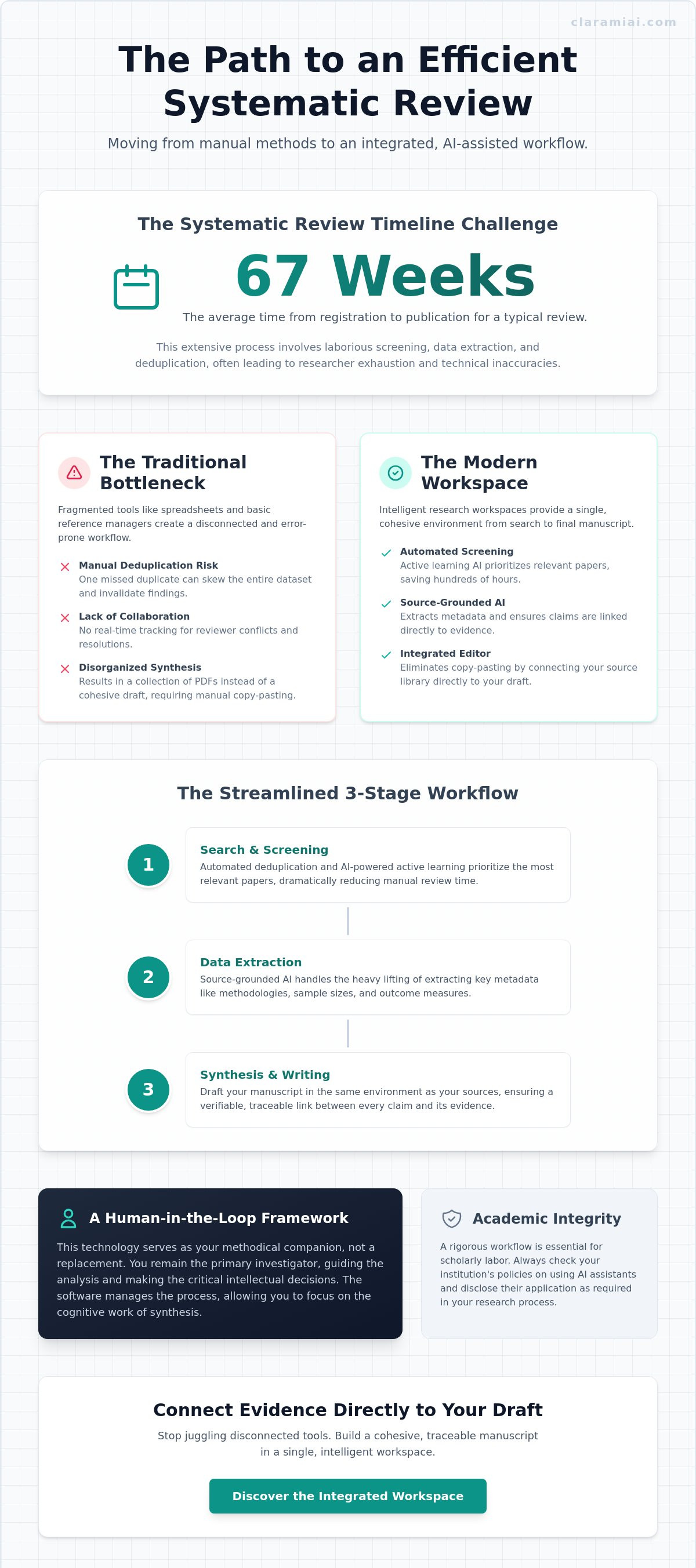
A typical systematic review takes 67 weeks from registration to publication. Extensive screening. Laborious data extraction. Manual deduplication. These phases often lead to exhaustion and technical inaccuracies. You likely feel the pressure of maintaining a traceable link between your sources and your final manuscript. Selecting the right systematic literature review software 2026 is the first step toward a disciplined, organized workflow that respects your time and your intellectual agency.
This guide evaluates the most effective evidence-based tools for screening and synthesizing research while protecting the structural integrity of your work. You'll discover how to move from data extraction to a cohesive draft without the anxiety of citation errors or the disconnect of manual formatting. We focus on a human-in-the-loop framework where you remain the primary investigator and the software serves as your methodical companion. By the end of this article, you'll have a clear path to a streamlined workflow that connects evidence directly to your draft.
Academic integrity is a core requirement of scholarly labor. Always check your institutional policies regarding the use of AI assistants and ensure you disclose their application in your research process where required.
Key Takeaways
- Understand how specialized infrastructure replaces manual spreadsheets to automate screening workflows while maintaining high levels of precision.
- Compare the leading systematic literature review software 2026 options based on screening efficiency, collaborative features, and disciplinary focus.
- Identify strategies to overcome the synthesis bottleneck by connecting your extracted data directly to your manuscript draft in a single workspace.
- Establish a rigorous human-in-the-loop framework that ensures every claim in your review is verified and anchored in primary sources.
- Explore how an integrated document editor maintains organizational cohesion by eliminating the need to copy-paste between disconnected research tools.
Table of Contents
- The landscape of systematic literature review software in 2026
- Top screening and data extraction platforms compared
- Solving the synthesis bottleneck in systematic reviews
- Maintaining academic integrity in AI-driven reviews
- Clarami: A workspace designed for evidence-based research
The landscape of systematic literature review software in 2026
Systematic literature review software 2026 represents a departure from basic digital storage toward specialized infrastructure. It's a purpose-built environment for methodical synthesis. You can't rely on fragmented tools when modern research standards demand absolute traceability. Every claim needs a verifiable audit trail. The process follows three rigid stages: search and screening, data extraction, and finally, the synthesis and writing phase. Each stage requires specific technical requirements to ensure the final output stands up to peer review.
Understanding What is a systematic review? is essential before choosing your toolset. In 2026, the shift from manual spreadsheets to automated screening is definitive. Researchers no longer spend hundreds of hours on manual deduplication or sorting through endless rows of data. Instead, they use software that provides a clear, linear narrative from raw search results to a verified output. This transition reduces human error and ensures that your methodology is transparent and reproducible.
To better understand this concept, watch this helpful video:
### Why traditional reference managers are no longer enoughReference managers like Zotero or EndNote serve as excellent digital libraries. They don't, however, support the rigorous screening tasks required for a high-quality review. Manual deduplication in 2026 poses a significant risk to your research integrity. One missed duplicate can skew your entire data set and invalidate your findings. These tools also lack the collaborative features necessary for multi-reviewer protocols. You need a system that tracks reviewer conflicts and resolutions in real-time. Without these specialized features, you're left with a disorganized collection of PDFs rather than a systematic synthesis.
The shift toward intelligent research workspaces
The most effective tools now function as intelligent research workspaces. These platforms integrate your source library directly with an in-app editor. This isn't a general-purpose chatbot that hallucinates data. It's source-grounded AI. It focuses on the structural connection between a statement and its supporting data. Automated metadata extraction now handles the heavy lifting of identifying methodologies, sample sizes, and outcome measures. This allows you to focus on the cognitive work of synthesis. You're no longer copying and pasting between windows. Your evidence and your draft exist in a single, cohesive environment.
Top screening and data extraction platforms compared
Evaluating systematic literature review software 2026 requires a framework focused on screening efficiency, collaborative transparency, and cost-effectiveness. You need to distinguish between tools optimized for medical meta-analysis and those designed for the broader social sciences. High-quality platforms now utilize active learning, a form of machine learning that prioritizes relevant papers based on your initial decisions. This technology significantly reduces the time spent on irrelevant abstracts. Mobile accessibility has also become a standard requirement. You should be able to screen titles and abstracts during brief windows of downtime without losing your progress or compromising the audit trail.
Choosing the right tool depends on your specific workflow needs and budget constraints. A comprehensive feature-by-feature comparison of SR tools reveals that while many platforms share core functions, their specialized utilities vary greatly. You must ensure your choice supports the rigorous deduplication and blinded screening protocols necessary for academic integrity.
Specialized tools for screening and deduplication
Rayyan is a reliable choice for researchers who prioritize efficiency in blinded screening. It offers individual plans starting at $8.33 per month, and its free tier remains a viable option for single, smaller reviews. Covidence provides a more comprehensive, institutional-grade experience but comes with higher costs. Individual researcher plans typically range from $240 to $450 per year, though many universities provide institutional access to cover these fees for their faculty and students. For those seeking an open-source alternative, ASReview uses active learning to accelerate the screening phase by continuously re-ranking your library based on your inclusion and exclusion patterns. This helps you reach the "point of saturation" faster, where the likelihood of finding more relevant papers becomes statistically low.
Software for quantitative meta-analysis and qualitative synthesis
If your review involves heavy quantitative synthesis, RevMan is the standard for Cochrane-style meta-analysis. It's purpose-built for managing complex statistical data and generating forest plots. Researchers working with mixed-methods or qualitative data often prefer JBI SUMARI, which provides structured modules for various review types beyond simple clinical trials. Despite these advancements, data extraction remains the most manual and error-prone part of the process. You still have to meticulously transfer findings from PDF tables into your extraction forms. Once your data is extracted, the challenge shifts to synthesizing those findings into a cohesive narrative. To begin organizing your extracted evidence into a structured draft, you can create a free research workspace to keep your sources and synthesis connected in one interface.
Solving the synthesis bottleneck in systematic reviews
Many researchers hit a wall after the extraction phase. You have a spreadsheet full of data points, but the transition to a cohesive manuscript feels insurmountable. This "writing gap" is where momentum stalls. A typical systematic review takes 67 weeks from registration to publication, and the synthesis stage is often where the most significant delays occur. The cognitive load of switching between a PDF reader, a complex spreadsheet, and a blank document is exhausting. It fragments your focus. Systematic literature review software 2026 must do more than just sort data; it should facilitate the intellectual transition to composition. Learning how to organize research references effectively is the first step in preparing for this synthesis.
The risk of disconnected data and drafting
Manual copy-pasting from spreadsheets into your draft is a primary source of error. It's easy to misattribute a specific finding to the wrong study when you're managing dozens of sources. This leads to "citation drift," where the original context of a claim is lost over multiple revision cycles. You need a persistent, visible connection between your claim and the source PDF. Verification becomes a chore rather than a built-in feature of your workflow. Specialized tools like ClaimShield are designed to address this by anchoring arguments in primary sources. This ensures every statement you make remains backed by verified evidence throughout the drafting process, protecting the structural integrity of your review.
Why integrated editors are replacing copy-paste workflows
Modern workspace features solve this by keeping your arguments and evidence in a single view. You can view your source PDF side-by-side with your draft within an In-App Editor. This eliminates the need to jump between windows. Selection-level editing allows you to refine specific paragraphs using AutoDraft while maintaining a human-in-the-loop approach. Clara can assist by providing initial drafts based on your extracted data, but you remain responsible for the final synthesis. You aren't just writing; you're anchoring your arguments in primary data. This structural cohesion is what distinguishes professional systematic literature review software 2026 from generic writing tools that treat data management and output as separate, disconnected tasks.
Maintaining academic integrity in AI-driven reviews
AI integration in systematic literature review software 2026 must be governed by a rigorous human-in-the-loop framework. You cannot outsource the intellectual responsibility of synthesis to an algorithm. Generating entire manuscripts using AI is inappropriate for scholarly work because it bypasses the critical evaluation required for evidence-based research. Instead, use technology to organize, extract, and draft while you maintain final editorial authority. This approach preserves the structural integrity of your review and ensures that your conclusions are grounded in verified data.
Academic Integrity Disclaimer: Always check your school or journal policies regarding AI use. You are responsible for disclosing the use of AI assistants in your research and ensuring all submissions meet institutional standards.
Verifying claims against primary sources
Fabricated DOIs and hallucinated citations are significant risks when using ungrounded AI tools. You must learn how to verify ai citations to ensure every reference exists in the real world. Source-grounded AI is a system that only generates responses based on the specific documents you provide, preventing the injection of external, unverified data. Use a methodical checklist to maintain technical accuracy:
- Cross-reference every AI-generated summary against the original PDF page number.
- Verify that statistical values in your draft match the primary data tables exactly.
- Ensure the software hasn't conflated findings from two different studies during the extraction phase.
- Confirm that the methodology described in your synthesis matches the primary source's actual protocol.
The human-in-the-loop approach to systematic writing
A disciplined workflow involves approving AI suggestions sentence by sentence rather than accepting large blocks of text. You can use Clara to locate specific methodologies within a library of hundreds of PDFs, which speeds up the extraction phase without removing your oversight. This allows you to find relevant data points quickly while you remain the primary investigator. The final synthesis must reflect your unique intellectual contribution and understanding of the field. Professional systematic literature review software 2026 acts as a companion that surfaces evidence, but you provide the analytical depth. You aren't just a reader; you're the architect of the argument. To implement this verified workflow in your own research, you can get started with a verified research workspace today.
Clarami: A workspace designed for evidence-based research
Clarami functions as an integrated environment where your research library and your manuscript coexist. This architecture eliminates the friction of moving between disconnected applications. You can transition directly from a synthesis matrix to a verified draft without losing the connection to your primary evidence. As a specialized systematic literature review software 2026, it prioritizes the structural connection between each claim and its source. This ensures that your review maintains the high standards of accuracy required for academic publication. You manage the entire lifecycle of your review within a single interface, which reduces the cognitive load of complex synthesis.
Academic Integrity Disclaimer: Users must check their specific school policies regarding AI-assisted writing. It's your responsibility to disclose AI use where required and ensure the final submission is your own work and meets all institutional standards.
AutoDraft and source-grounded assistance
The AutoDraft feature assists you by generating initial summaries derived strictly from your uploaded PDFs. This source-grounded approach ensures the content remains relevant to your specific research questions. You can use the Clara AI assistant to locate specific methodologies, sample sizes, or outcome measures across your entire library in seconds. This eliminates the manual labor of scanning hundreds of pages for a single data point. The integrated In-App Editor provides a "no copy-paste" advantage. You draft within the same window where your sources are displayed, preserving your cognitive momentum. It maintains a human-in-the-loop workflow where you edit and refine every suggestion sentence by sentence.
Verification with ClaimShield and citation management
ClaimShield acts as a verification layer that checks your statements against the supporting evidence in your workspace. It highlights claims that lack a clear anchor in your primary sources. This prevents the accidental inclusion of unverified information or fabricated citations. The automated citation helper surfaces real, verifiable sources and formats them in styles such as APA, MLA, or Chicago. This ensures your bibliography is accurate and formatted correctly from the start. Once your synthesis is complete, you can export your work to DOCX or LaTeX for final submission. This workflow ensures that your systematic literature review software 2026 experience is both efficient and academically rigorous, providing a clear path from raw data to a polished, verified output.
Establishing a verifiable research workflow
Selecting the right systematic literature review software 2026 is a decision that impacts the structural integrity of your entire project. You've seen how the landscape has shifted from manual spreadsheets toward specialized infrastructure that prioritizes traceability and organizational cohesion. By bridging the gap between data extraction and the final manuscript, you can eliminate the synthesis bottleneck that often stalls professional research. Maintaining a human-in-the-loop approach ensures that your work remains ethically grounded and academically rigorous.
Clarami provides the tools necessary to maintain this discipline. With source-grounded AI assistance, integrated PDF management, and an In-App Editor, your evidence stays connected to your claims. Automated APA and Chicago citation building further reduces the manual labor of formatting, allowing you to focus on the cognitive labor of analysis. Academic Integrity Disclaimer: Check your school policies regarding AI use and disclose its application where required.
You can begin building your evidence-based draft in a workspace designed for specialists. Start your systematic review in the Clarami workspace today and move forward with confidence in your findings.
Frequently Asked Questions
What is the best software for a systematic literature review in 2026?
The best software depends on your specific research phase and institutional budget. Covidence is a top choice for medical meta-analysis due to its rigorous screening protocols. Rayyan remains highly effective for independent researchers who need a cost-effective tool for blinded screening. Clarami provides a specialized workspace for the synthesis and drafting phase, keeping your evidence and arguments connected in a single interface.
Can I use AI to write a systematic literature review?
You can use AI as a methodical assistant for drafting and summarization, but you shouldn't use it to generate a final paper. AutoDraft provides initial summaries based on your uploaded evidence. You must then edit, refine, and verify these drafts sentence by sentence. Always check your institutional policies and disclose AI use to maintain your intellectual agency and ensure academic integrity.
How does SLR software handle deduplication of research papers?
Systematic literature review software 2026 automates deduplication by comparing metadata like DOIs, titles, and author lists across multiple database exports. This process prevents identical studies from appearing multiple times in your screening queue. Accurate deduplication is essential for maintaining the structural integrity of your data set and ensuring your final synthesis is based on unique, non-redundant evidence.
Is there free software available for systematic reviews?
Several platforms offer free tiers for students and independent researchers. Rayyan and ASReview provide cost-effective options for the screening phase without requiring an initial subscription fee. Clarami offers a free entry point for researchers who need a workspace to organize sources and begin the synthesis process. These tools allow you to maintain professional standards even without significant institutional funding.
How do I ensure academic integrity when using research tools?
Maintain academic integrity by verifying every AI-assisted claim against its primary source in your library. Use ClaimShield to anchor your arguments in verified data and avoid fabricated citations or hallucinations. You're responsible for the final submission. It's critical to disclose your workflow and ensure your review follows the specific transparency and disclosure requirements of your academic institution.
What is the difference between a reference manager and SLR software?
Reference managers are primarily digital libraries for storing and formatting citations for general writing tasks. In contrast, systematic literature review software 2026 is specialized infrastructure designed for the rigorous protocols of methodical synthesis. It includes features for blinded screening, conflict resolution between multiple reviewers, and structured data extraction forms that general-purpose reference managers typically lack.
Related on Clarami
- Best AI writing tool for students (full guide) →
- AI academic integrity checklist →
- Clarami pricing: Free vs PRO vs Platinum →
- Editor vs ChatGPT for writing →
- Export DOCX, PDF, and hand-in checklist →
- How to outline a paper →
- Prompt to structured essay draft →
- Revise with AI on a selection →
- Sign up free →
- Clarami home →
- More guides on the Clarami blog →