

How to synthesize sources in a research paper using a synthesis matrix
Learn how to synthesize sources in a research paper with our guide. Use a synthesis matrix to organize themes, build a cohesive argument, and improve your wr...
Write with structure in Clarami AI
Editor-first AI drafting, citations, and two Workflows for student writing.
A literature review is not a chronological list of book reports; it is a structural map of an intellectual conversation. If you feel like your writing is just a repetitive cycle of "Author A said this" followed by "Author B said that," you are likely struggling with how to synthesize sources in a research paper. It's common to lose track of specific claims or feel overwhelmed by the volume of data across multiple documents. You want your draft to show critical thinking, but the transition from reading to writing often feels like a disorganized hurdle.
This guide provides a methodical process to organize your research using a synthesis matrix. You'll learn how to use this structural tool to identify gaps in existing research, and build a cohesive argument that prioritizes your intellectual agency. By moving from source-centric notes to a theme-based matrix, you can create a clear organizational structure and speed up your manuscript preparation. Please remember to review your institution's specific policies regarding AI tools and disclose their use in your research process as required.
Key Takeaways
- Thematic organization. Utilize a synthesis matrix to transition from source-centric summaries to a theme-focused argument.
- Methodical workflow. Implement a step-by-step process for how to synthesize sources in a research paper to ensure your manuscript remains cohesive and logical.
- Critical analysis. Use the sandwich method to anchor source evidence within your own original claims and scholarly voice.
- Organizational cohesion. Adopt an integrated workspace to eliminate the disconnect between your PDF library and your document editor.
- Academic compliance. Always verify institutional policies and disclose the use of AI tools in your research and synthesis labor.
Table of Contents
- Understanding the role of synthesis in academic writing
- Using a synthesis matrix template to organize literature
- A step-by-step workflow for synthesizing sources
- Transitioning from the matrix to the first draft
- Streamlining synthesis with Clarami’s integrated research workspace
Understanding the role of synthesis in academic writing
Synthesis is more than a mechanical gathering of citations. It is the cognitive process of integrating multiple perspectives to support a new, original argument. In the context of research synthesis, you aren't just reporting what others have written. You're analyzing how different studies interact. Think of your research paper as a professional dialogue. Scholars have been discussing your topic for years. You are the moderator of this discussion. Your job is to listen to their conversation, identify the main points of agreement or tension, and then contribute your own informed perspective. When you master how to synthesize sources in a research paper, you move beyond mere reporting and begin to build a unique academic voice.
To better understand this concept, watch this helpful video:
Learning how to synthesize sources in a research paper is the primary requirement for a successful literature review or dissertation. Without it, your writing remains a series of isolated summaries rather than a cohesive intellectual contribution. It is the difference between a list of raw ingredients and a finished, nutritious meal. Synthesis provides the structural integrity your manuscript needs to withstand academic scrutiny. Using a specialized writing tool can help you maintain this thematic focus throughout your draft.The difference between summary and synthesis
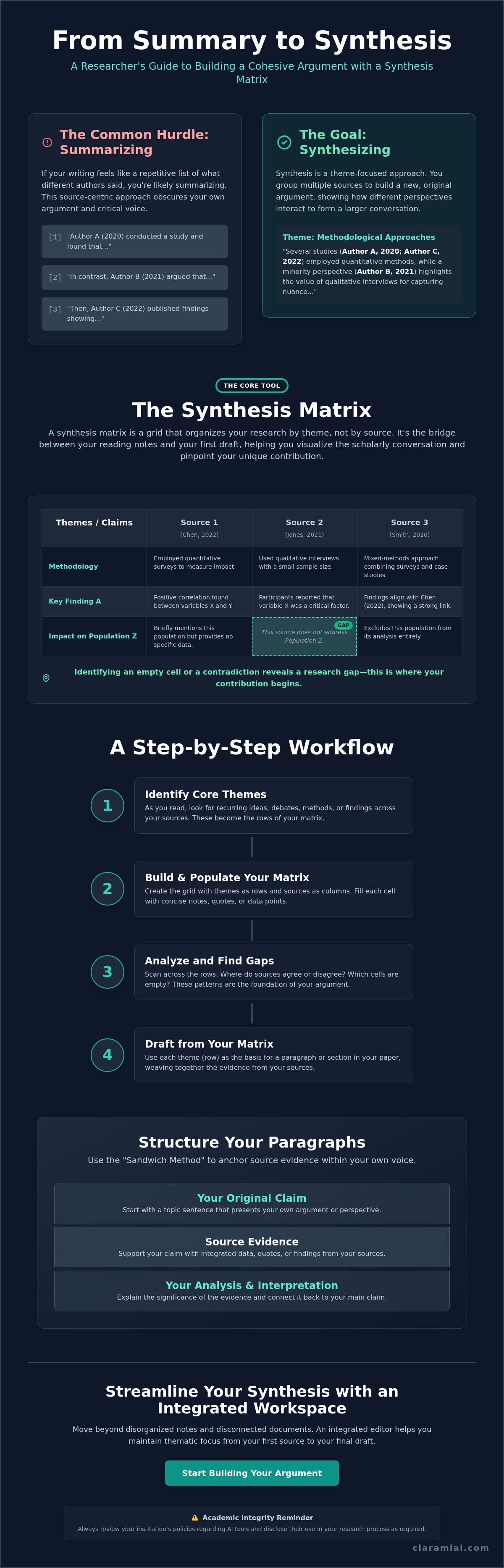
Summary and synthesis serve different purposes in academic writing. A summary focuses on the author. It restates the main points of a single source in a condensed form. If your paper reads like a list of paragraphs that each start with a different author's name, you're likely summarizing. Synthesis focuses on the topic or theme. It connects multiple sources to highlight a broader trend or a specific conflict in the data. A synthesized paper feels like an argument because it identifies the "so what" factor. You compare sources to show where they overlap and where they diverge. This thematic approach allows you to group information logically, making your manuscript easier to follow for a professional audience.
Why synthesis is essential for scholarly contribution
Synthesis demonstrates your mastery of the field. By grouping sources together, you show that you understand the scholarly consensus and the nuances of the debate. It's not enough to know what Author A said; you must understand how Author A's findings influence or contradict Author B's methodology. This process also helps you highlight contradictions or gaps in existing research. When you align sources in a structured workspace, you can see where the conversation stops or where certain populations have been ignored. Establishing this gap is how you justify your own research. It moves you from a passive observer to an active participant with intellectual agency. Please check your school policies regarding the use of AI tools for synthesis and disclose their use where required by your institution.
Using a synthesis matrix template to organize literature
A synthesis matrix is a structural grid designed to categorize the core components of your research. It serves as a visual bridge. It's the connection between your raw reading notes and the final manuscript. While many students struggle with how to synthesize sources in a research paper, the matrix provides a concrete solution. By organizing data into a table, you shift your focus from individual authors to overarching themes. This method reveals repetitions in the literature and highlights contradictions that require further investigation. It's a tool for precision and order.
The primary benefit of this approach is the identification of missing data points. When a row in your matrix remains empty for several sources, you've found a gap. This is where your original contribution begins. For a detailed breakdown of this tool, you can consult the UAGC Writing Center's synthesis matrix guide. Using a structured framework ensures that your argument is anchored in verified claims rather than vague recollections. Please check your institutional policies regarding AI use and ensure you disclose any automated assistance in your synthesis process.
Core components of a synthesis matrix
A functional matrix requires three distinct elements for maximum utility. First, include source metadata. This includes the author, publication year, and specific methodology. Knowing if a study was qualitative or quantitative helps you weigh its evidence. Second, use thematic labels. These are the sub-topics or research questions you're investigating across all papers. Finally, populate evidence cells. These should contain brief paraphrases or direct quotes that represent the source's stance. This layout allows you to compare multiple perspectives at a single glance. If you find the organization process overwhelming, starting with a template in a dedicated workspace can provide the necessary structure.
How to build your synthesis matrix
Building your matrix is a chronological process that mirrors your research workflow. Follow these steps to ensure structural integrity:
- Step 1: List your research questions or main arguments as row headers. These categories will eventually become the subheadings of your paper.
- Step 2: List your primary sources as column headers. Use a consistent naming convention to keep your bibliography organized.
- Step 3: Populate the grid with verified claims. Extract data directly from your PDF library to maintain traceability.
This systematic approach transforms a pile of papers into a manageable dataset. It ensures that when you begin writing, you aren't searching for quotes. You're simply translating your matrix into prose. This methodical preparation is the secret to understanding how to synthesize sources in a research paper effectively.
A step-by-step workflow for synthesizing sources
Before beginning your synthesis, verify your institution's specific policies regarding the use of AI assistants and synthesis tools. Academic integrity is your responsibility. You must disclose the use of any automated tools in your research and ensure that the final manuscript reflects your own intellectual agency. This workflow focuses on a human-in-the-loop approach where you remain the primary architect of the argument, using technology as a support rather than a replacement for critical thought.
Phase 1 involves reading for themes rather than reading for completion. When you approach a new PDF, don't just aim to reach the final page. Look for recurring variables, methodologies, or theoretical frameworks. This is the foundation of how to synthesize sources in a research paper effectively. In Phase 2, you extract these findings directly into your matrix. Focus on specific data points and methodology descriptions. This step eliminates the need to re-read entire papers later in the process. Phase 3 requires you to compare sources both vertically and horizontally to identify patterns of consensus or conflict. Finally, Phase 4 is the verification stage. Every claim in your matrix must be double-checked against the original source to prevent misattribution or inaccuracies.
Identifying consensus and contradiction
Analysis happens in two directions. Horizontal analysis involves looking across a single row in your matrix to see how Author A and Author B agree on a specific theme. This is where you find the scholarly consensus. Vertical analysis focuses on a single column to identify the unique contribution of one specific source across all themes. Don't ignore the outliers. A source that disagrees with the consensus is often the most valuable. It highlights a tension in the literature that your research can help resolve.
Managing your digital research library
Organization is the precursor to successful synthesis. A disorganized PDF library leads to lost context and inaccurate citations. It's helpful to link your matrix cells directly to the specific page numbers in your source files for immediate verification. Using a centralized system like an integrated workspace ensures that your evidence remains physically connected to your draft. For more detailed strategies on this, you can read our guide on how to organize research references. This systematic approach reduces the cognitive load of switching between tabs and allows you to focus on the high-level cognitive task of building an original argument.
Transitioning from the matrix to the first draft
Transitioning from your matrix to a manuscript is a structural translation. You're turning a grid of data into a linear narrative. This phase is where many writers feel the most friction. However, with a populated matrix, you've already done the heavy lifting. You're no longer staring at a blank page. You're simply expanding on the relationships you've already identified while learning how to synthesize sources in a research paper effectively. You are the architect; the matrix is your blueprint.
Drafting by theme ensures you don't fall back into summarizing individual authors. Each paragraph should address a specific row in your matrix. This is the core of how to synthesize sources in a research paper. Instead of asking "What did Smith say?", you ask "What does the literature say about Theme X?". This shift in perspective transforms your writing from a report into an argument. To maintain this focus, use the "sandwich" method for every paragraph:
- Your claim: A topic sentence that identifies the overarching theme or sub-topic.
- Source evidence: Specific findings, data, or paraphrases extracted from your matrix cells.
- Your analysis: A critical explanation of how these sources interact to support your thesis.
Writing thematic paragraphs
A thematic paragraph is a unit of argument. It shouldn't focus on a specific author in the topic sentence. Instead, the opening sentence should establish the concept being discussed. Group similar findings together to show a unified front of evidence. This demonstrates scholarly consensus. When sources disagree, use transition words like "conversely" or "in contrast" to signal the relationship. This helps the reader follow the logic of the scholarly conversation without getting lost in the details. You can begin starting your draft in a structured editor to keep your matrix and your manuscript in a single view, which reduces the risk of organizational drift.
Maintaining academic integrity and voice
Your own interpretation must remain the driving force of the narrative. Avoid "patchwriting," which is the practice of simply stringing quotes together with minimal transition. Your analysis is what connects the sources. It provides the "so what" factor. Always verify that every cited claim is accurately represented in its original context. Misattribution is a common error in complex synthesis. Use verify ai citations techniques to ensure your draft meets the highest standards of accuracy. Please remember to check your school policies regarding AI use and disclose any assistance in your writing process as required by your institution.
Streamlining synthesis with Clarami’s integrated research workspace
The physical disconnect between your PDF library and your document editor is a primary source of organizational friction. When you manually move between tabs, you risk losing the structural connection between a claim and its supporting data. Clarami’s In-App Editor addresses this by integrating your research materials directly into the writing environment. This allows you to maintain the methodical expert persona required for scholarly labor. You can view your synthesis matrix and your manuscript side by side, ensuring that every thematic paragraph remains anchored in primary sources. This proximity reduces the stress of disorganization and allows you to focus on the logical flow of your argument.
Learning how to synthesize sources in a research paper is a rigorous cognitive process. Technology should support this labor without replacing your intellectual agency. By using the PDF Manager within the workspace, you keep your evidence and arguments physically connected. This setup enables a workflow of steady, instructional progress. You can use AutoDraft to generate source-grounded drafts based on the rows of your matrix. Because these drafts are generated within the editor, you maintain total control over the editing and verification process.
From research notes to first draft without copy-pasting
General-purpose chat interfaces often create a "black box" problem where you lose the direct link to your original source. This makes verification difficult and increases the risk of technical inaccuracies. Clarami utilizes selection-level edits, allowing you to refine your synthesis paragraph by paragraph rather than generating whole essays at once. This human-in-the-loop approach ensures you remain responsible for the final output. The Clara AI assistant helps surface relevant evidence from your library based on the themes you've identified in your matrix. It suggests drafts grounded in your uploaded documents, which you then edit and verify to ensure they meet your specific academic standards.
Verifying claims with ClaimShield
Accuracy is uncompromising in professional academic writing. ClaimShield provides a layer of verification by checking that every sentence in your synthesis is backed by a real, traceable citation. This prevents the inaccuracies common in broad-market tools that treat data management as a secondary feature. The system also includes a Citation Generator to build automated citations in APA, Chicago, or MLA styles directly within your workflow. To see these features in action, you can explore the Clarami workspace and test the integrated editor. Please check your institutional policy regarding AI use and synthesis tools. Academic integrity requires transparency. You should disclose the use of AI assistants in your research process and ensure your final submission adheres to your school’s ethical guidelines.
Mastering the synthesis workflow
Effective academic writing requires a shift from simple summary to thematic integration. By utilizing a synthesis matrix, you move from a disorganized collection of PDFs to a structured map of scholarly conversation. This methodical approach is the foundation of how to synthesize sources in a research paper, allowing you to identify gaps and establish your own intellectual agency. You've learned how to read for themes, populate a matrix, and use the sandwich method to anchor your analysis in verified evidence.
The transition from notes to a manuscript shouldn't be a source of anxiety. Clarami’s integrated workspace streamlines this process by keeping your source-grounded AI assistant, PDF manager, and editor in a single environment. With automated citation building and selection-level edits, you maintain full control over the structural integrity of your draft. Academic integrity is a priority; always verify institutional policies and disclose the use of AI tools as required.
Start your next research project in the Clarami workspace to experience a more disciplined approach to composition. Your original contribution to the field begins with systematic organization.
Frequently asked questions
What is the difference between a synthesis and a literature review?
Synthesis is the cognitive process you use to construct a literature review. While a summary condenses the findings of a single source, synthesis identifies the relationships between multiple studies to show the broader state of knowledge. It transforms a collection of individual research reports into a cohesive narrative about a specific theme or research question.
How many sources should I include in a single synthesis paragraph?
You should aim to include at least two or three sources in every synthesis paragraph. Including only one source usually results in a summary rather than a true synthesis. Using multiple sources allows you to demonstrate scholarly consensus or highlight a significant tension in the research. This thematic grouping is essential for showing you understand the wider conversation in your field.
Can I use AI to help me synthesize sources for my research paper?
You can use an AI assistant like Clara to identify themes and organize your research library. These tools are effective for surfacing relevant evidence and drafting initial thematic paragraphs. However, you must maintain a human-in-the-loop approach by editing every draft and verifying all citations. Always check your institutional policies regarding how to synthesize sources in a research paper and disclose AI use as required.
What should I do if my sources completely contradict each other?
Contradictions are valuable data points that you should highlight in your manuscript. If two sources disagree, use your synthesis matrix to compare their methodologies, participant groups, or theoretical frameworks. Explaining these discrepancies shows critical thinking and helps you identify a gap in the current literature. This tension often provides the justification for your own research questions or experimental design.
How do I avoid plagiarism when synthesizing multiple viewpoints?
Avoid plagiarism by focusing on the underlying concepts rather than the original authors' specific phrasing. Paraphrase the findings in your own words and provide a clear citation for every claim you make. Your own analysis should serve as the connective tissue between the sources. This ensures that the narrative voice remains yours while the evidence remains anchored in the verified work of others.
Related on Clarami
- Best AI writing tool for students (full guide) →
- AI academic integrity checklist →
- Clarami pricing: Free vs PRO vs Platinum →
- Editor vs ChatGPT for writing →
- Export DOCX, PDF, and hand-in checklist →
- How to outline a paper →
- Prompt to structured essay draft →
- Revise with AI on a selection →
- Sign up free →
- Clarami home →
- More guides on the Clarami blog →