How to verify ai citations for academic and professional research
AI making up sources? Learn how to verify AI citations with our methodical checklist and tools to protect your academic integrity and avoid fabricated refere...
Write with structure in Clarami AI
Editor-first AI drafting, citations, and two Workflows for student writing.
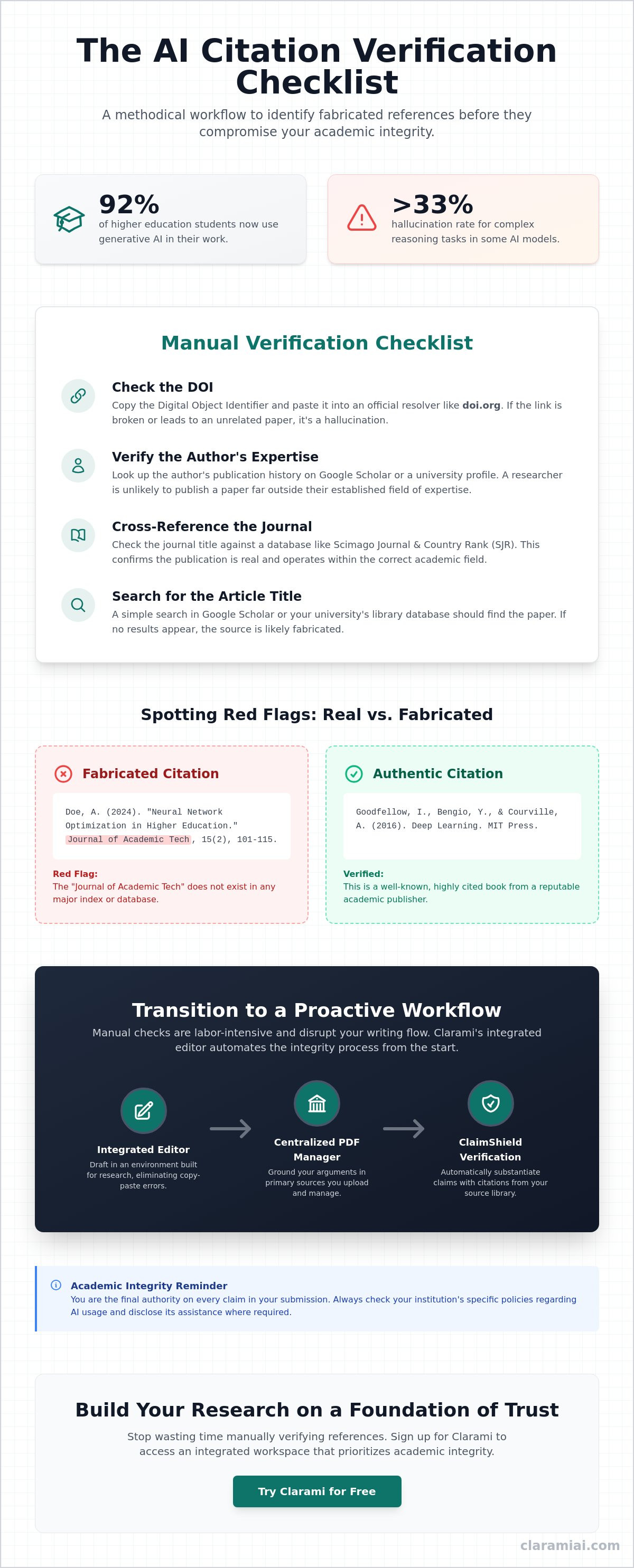
92% of higher education students now use generative AI, yet hallucination rates for complex reasoning tasks can still exceed 33%. You likely know the anxiety of staring at a perfectly formatted DOI and wondering if the paper actually exists. The need to verify ai citations has become a structural necessity rather than a final check. Manually investigating every journal name and volume number is a grueling process that disrupts your creative flow. You need a way to ensure your work stands on a foundation of authentic data.
This guide provides a methodical workflow to identify fabricated references before they compromise your academic integrity. You'll learn how to use an ai writing tool for students that integrates verification into the drafting process. We will cover a reliable checklist for spotting fake sources and introduce tools like Clarami’s PDF Manager and Citation Generator. These features allow you to sign up and ground your arguments in primary sources without leaving your editor. Note: Always check your institution's specific policies regarding AI use and disclose its assistance in your work as required.
Key Takeaways
- Identify the structural causes of AI-generated hallucinations to better predict which references require the most scrutiny.
- Apply a methodical checklist to verify ai citations using official DOI resolvers and journal ranking databases.
- Transition from a chat-based interface to an integrated editor to eliminate the risks associated with manual copy-pasting.
- Utilize ClaimShield and a centralized PDF Manager to automatically substantiate your arguments with verifiable primary sources.
- Maintain academic integrity by using selection-level edits and structured templates that respect your role as the final editor.
Table of Contents
- The challenge of ai hallucinations in scholarly research
- Manual methods to verify scholarly citations
- Automated tools for citation verification and source discovery
- A proactive workflow for evidence-based drafting
- How Clarami and ClaimShield automate the integrity process
The challenge of ai hallucinations in scholarly research
Generative AI doesn't search a database like a human librarian. It predicts the most likely next word based on vast training data. This creates the challenge of AI hallucinations, where the system provides a citation that looks authentic but doesn't actually exist. You might see a real author's name attached to a title that sounds plausible, yet the DOI leads to a dead link or a completely different paper. Because these models are built for fluency rather than factual retrieval, they prioritize the structure of a citation over the accuracy of its contents.
Academic Integrity Disclaimer: You are the final authority on every claim in your submission. Always check your institution's specific policies regarding AI usage and disclose its assistance where required.
To better understand this concept, watch this helpful video:
### Why general ai models fabricate referencesLarge Language Models (LLMs) prioritize linguistic patterns over database accuracy. They recognize that a citation usually follows a specific format: Author, Year, Journal Title, and Volume. The model fills these slots with words that fit the context of your prompt. If you use a general chat interface, you're interacting with a probability engine rather than a dedicated research tool. Learning to verify ai citations is a core skill because these fake titles often mirror scholarly jargon perfectly. ESL writers face a unique risk here. The AI's ability to polish phrasing can make a fabricated source seem even more credible, leading you to trust a reference that hasn't been vetted.
The consequences of submitting unverified citations
Academic integrity is non-negotiable. Submitting a paper with fake references is often categorized as data fabrication or falsification by university boards. Even if you didn't intend to deceive, the responsibility to verify ai citations rests solely with you. Penalties can range from a failing grade on a single assignment to permanent expulsion. Beyond the immediate academic cost, unverified sources damage your professional reputation. If peers or reviewers discover a "phantom" citation in your work, they'll likely question the validity of your entire methodology. Maintaining a human-in-the-loop approach ensures that you remain the final authority on your research.
Manual methods to verify scholarly citations
Manual verification is a labor-intensive but critical line of defense. You must treat every AI-generated reference as a hypothesis that requires testing. The most direct method involves the Digital Object Identifier (DOI). Copy the alphanumeric string and paste it into the official DOI Foundation resolver. If the link breaks or resolves to a completely unrelated study, you've identified a hallucination. This happens because models predict strings of numbers that look like valid DOIs without checking them against a registry.
Check the author's publication history. A prolific researcher in molecular biology is unlikely to have suddenly published a seminal paper on medieval history. When AI-powered Bing Chat loses its mind, it often creates these types of categorical errors. Professional research requires you to cross-reference the journal title with the Scimago Journal & Country Rank (SJR). This ensures the publication actually exists and operates within the stated academic field. If you can't find the article title in Google Scholar or your university library database, the source is likely fabricated.
Red flags of a fabricated reference
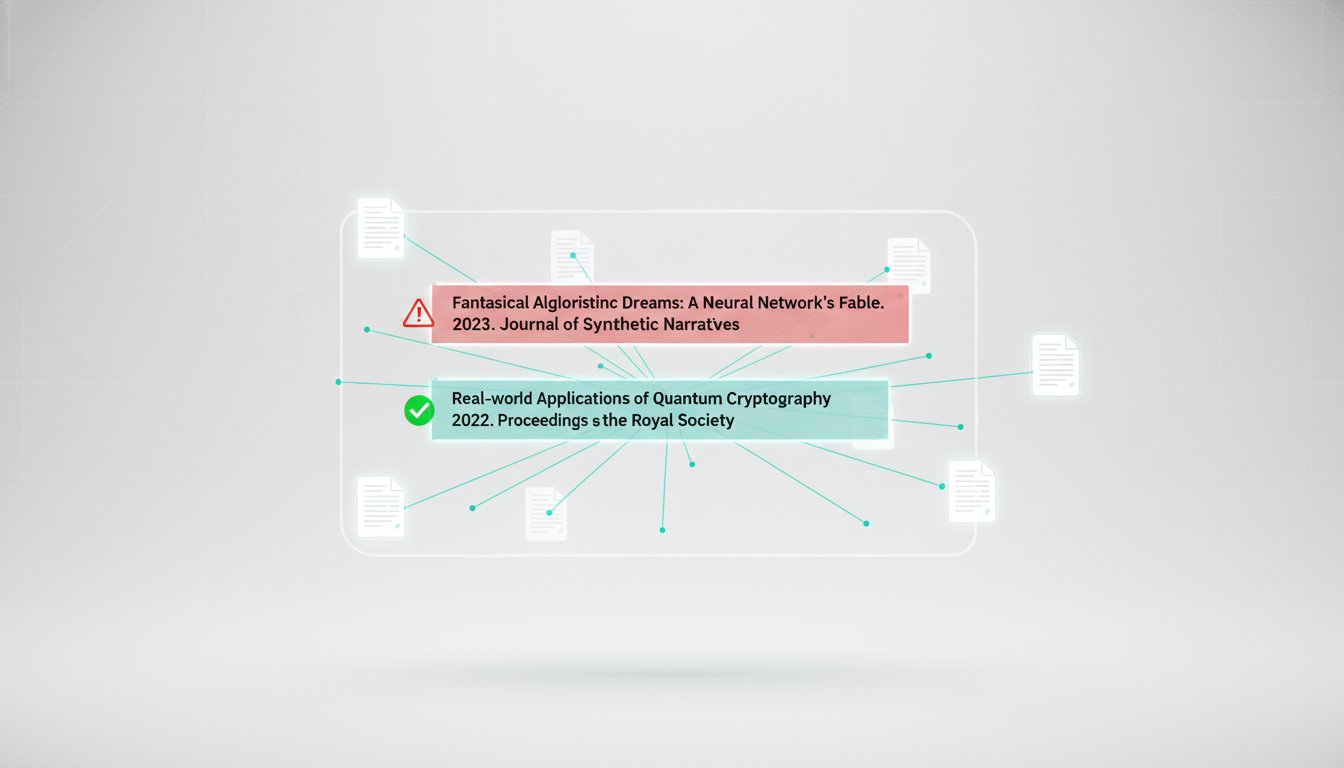
A hallucinated citation often looks perfect on the surface. Compare these two examples. A fake citation might read: Doe, A. (2024). "Neural Network Optimization in Higher Education." Journal of Academic Tech, 15(2), 101-115. You'll notice the "Journal of Academic Tech" doesn't exist in any major index. A real citation provides specific, traceable metadata: Doe, A. (2023). "Deep Learning for Student Retention." Computers & Education, 194, 104687. To verify ai citations effectively, look for DOIs that lead to 404 errors or metadata mismatches, such as a 2024 date for a journal volume that was actually published in 2010. Titles that perfectly match your prompt's wording are also highly suspicious.
Essential databases for manual verification
Use specialized repositories to substantiate claims. CrossRef and PubMed are the gold standards for medical and scientific validation. For pre-prints and social science papers, check arXiv or SSRN. These databases provide the structural integrity that general AI models lack. Using these resources takes significant time, which is why choosing the best ai citation generator is vital for modern researchers. It moves the verification step from a post-draft chore to an integrated part of your writing process. If you find manual verification too disruptive to your composition, you can start building your verified library within a workspace designed for accuracy.
Automated tools for citation verification and source discovery
Manual checks are the gold standard for accuracy, but the sheer volume of modern scholarly work makes automation a practical necessity. Automated tools provide a structural bridge between your draft and its evidence. To effectively verify ai citations, you must choose between a standalone detector and an integrated research environment. Standalone tools often require you to copy-paste blocks of text into a separate interface. This process is prone to error and creates unnecessary friction in your workflow. It forces you to act as a courier between your draft and your verification tool.
The Ohio State University emphasizes the necessity of Verifying AI Results by checking every claim against primary sources. Professional verification software achieves this by integrating directly with academic databases such as Semantic Scholar. This allows the system to surface real, peer-reviewed papers that match your specific topic. Investing in a monthly subscription for a research-focused workspace is a structural decision. For a predictable monthly fee, you gain access to a purpose-built ecosystem that prioritize accuracy over the generic output of broad-market chat tools.
Academic Integrity Disclaimer: You are the final authority on every claim in your submission. Always check your institution's specific policies regarding AI usage and disclose its assistance where required.
Standalone detection vs. integrated verification
Switching between browser tabs disrupts your focus. When you move text from an editor to an external detector, you risk losing the nuanced context of your argument. An integrated workspace maintains this context by keeping your sources and your draft in a single, cohesive environment. This workflow ensures that every selection-level edit remains grounded in the data you've already verified. Clara, our AI assistant, operates within this framework to help you anchor claims in your own source library. This eliminates the need to copy-paste from a separate chat box, which is where many hallucinations are introduced.
Key features of professional verification software
A robust tool must do more than flag errors; it should assist in the cognitive process of composition. Professional software provides real-time fact-checking against verified academic databases. It handles the structural requirements of your field, including automated bibliography generation in APA, Chicago, or MLA styles. Look for tools that support exporting to DOCX and LaTeX. This ensures that your final submission maintains its structural integrity. By using an in-app editor, you can verify ai citations while you write, turning verification into a continuous process rather than a stressful final hurdle.
A proactive workflow for evidence-based drafting
Verification is most effective when it's treated as a structural component of the writing process rather than a final hurdle. Instead of drafting in a vacuum and checking for errors later, you should build your document on a foundation of verified data. This proactive approach minimizes the need to verify ai citations after the fact because every claim is anchored to a primary source from the start. By organizing your research first, you maintain total intellectual agency over the output.
Academic Integrity Disclaimer: You are the final authority on every claim in your submission. Always check your institution's specific policies regarding AI usage and disclose its assistance where required.
Start by uploading your research papers to a centralized PDF Manager. This creates a closed ecosystem where your AI assistant can only pull information from the documents you've provided. When you ground the AI in your own library, hallucination rates drop significantly compared to open-domain queries. Follow this sequence for a disciplined workflow:
- Organize: Centralize your primary sources in a dedicated research workspace.
- Draft: Use selection-level edits to refine specific paragraphs rather than generating long-form text.
- Anchor: Explicitly link every AI-suggested claim to a specific page in your uploaded PDFs.
- Verify: Run a final integrity check to ensure the context of the source matches your argument.
Grounding your ai assistant in real data
General AI models often fail because they lack access to your specific research context. You can solve this by using Clara to query your own uploaded PDFs directly. This "human-in-the-loop" method allows you to transform research notes into a polished draft without losing the connection to the original evidence. By focusing on selection-level edits, you avoid the risks of whole-essay generation. You're not asking the AI to write for you; you're using it to help synthesize the data you've already collected and vetted. This keeps your work's structural integrity intact.
Final review and ethical disclosure
Approval must happen at the sentence level. Read every AI-suggested phrase and confirm that it accurately represents the source material. If the tone feels inconsistent with your personal voice, use the Draft Tone Checker to align the language with academic standards. Transparency is equally important. When you submit your work, include a clear disclosure of AI use. State that AI assisted with synthesis and formatting while you performed the final verification of all data points. This honesty protects your reputation and demonstrates a commitment to academic ethics. Create your verified research environment today to ensure your final submission is evidence-based and audit-ready.
How Clarami and ClaimShield automate the integrity process
The final stage of a professional workflow is the transition from a drafted argument to a verified, formatted submission. While manual checks are essential for final approval, ClaimShield provides a structural layer of protection during the composition phase. This specialized tool allows you to verify ai citations by checking every claim against your uploaded source library. Instead of relying on a general model's internal weights, ClaimShield anchors your text to the specific data points you've already vetted in your PDF Manager.
Academic Integrity Disclaimer: You are the final authority on every claim in your submission. Always check your institution's specific policies regarding AI usage and disclose its assistance where required.
One of the primary risks in academic writing is the loss of traceability. When you use a separate chat interface, you're forced to copy-paste text, which often strips away the connection to the original source. Clarami eliminates this friction by housing your PDFs, notes, and draft in a single workspace. This consolidated environment is part of why Clarami is built for serious researchers who prioritize accuracy over speed. You maintain a direct line from every sentence back to the primary evidence.
Real-time claim verification with ClaimShield
ClaimShield operates within the In-App Editor to provide immediate feedback on the substantiation of your arguments. As you write or use Clara to refine paragraphs, the system highlights claims that require evidence. It then surfaces relevant snippets from your source library, allowing you to link the statement directly to a specific citation. This process prevents accidental fabrication and ensures that your bibliography is built automatically from real sources. You don't have to search for a DOI at the end of the night because the tool has already verified the source's structural integrity during the drafting process.
Streamlining the research to writing transition
Moving from raw research to a structured draft requires a methodical approach. AutoDraft assists this transition by using your specific library rather than general training data to suggest initial outlines. These suggestions are mapped to academic rubrics through our library of structured templates, ensuring your work meets the formal requirements of your field. By maintaining a human-in-the-loop workflow, you use these tools to handle the organizational labor while you focus on the synthesis and analysis. To see how these integrated features can support your next project, you can check pricing and start a trial today.
Mastering the integrity-first research workflow
The responsibility to verify ai citations is now a permanent part of the modern scholar's toolkit. Effective research requires a transition from reactive detection to proactive verification. By utilizing a centralized PDF Manager and an integrated editor, you eliminate the structural gaps where hallucinations often occur. You've learned how to cross-reference DOIs and use specialized databases like CrossRef to substantiate your claims. This methodical discipline ensures that your final submission is both accurate and audit-ready.
Clarami provides the tools to maintain this standard without sacrificing your momentum. ClaimShield offers real-time verification that anchors your draft to your own primary source library, ensuring every citation is authentic. This approach respects your intellectual agency and protects your professional reputation from the risks of fabricated data. You are the final authority on your work; these tools ensure your foundation is secure. Academic Integrity Disclaimer: Always check your institution's specific policies regarding AI use and disclose its assistance where required.
Start your verified research journey with Clarami today. Build your next submission with the calm assurance that every claim is grounded in authentic, verifiable evidence.
Frequently Asked Questions
How can I tell if a DOI provided by AI is real?
You can verify a DOI by pasting the alphanumeric string into the official DOI Foundation resolver or the CrossRef search engine. A legitimate DOI will resolve to a persistent landing page containing the article's metadata and full-text options. If the resolver returns an error or directs you to a paper with a different title, the AI has likely predicted a plausible-looking but non-existent string.
What should I do if my AI tool generates a fake citation?
Remove the fabricated reference immediately to protect your academic integrity. You should never attempt to modify a fake citation to make it look real; instead, use a specialized tool to verify ai citations against an authentic database. Search for a primary source that substantiates your claim through a trusted repository like PubMed or Semantic Scholar to ensure your argument remains evidence-based.
Can AI detectors accurately find hallucinated citations?
Most general AI detectors focus on linguistic probability and syntax rather than factual accuracy. They often miss fabricated sources because the citations follow correct formatting patterns. To ensure your work is accurate, you need a system like ClaimShield that compares your draft against a specific library of uploaded PDFs. This structural check identifies claims that lack supporting evidence in your primary sources.
Is it ethical to use AI to find sources for my research?
Using AI as a discovery assistant is ethical provided you maintain a human-in-the-loop workflow. You must read every suggested source and confirm it accurately supports your specific claims. Always consult your institution's guidelines regarding AI assistance and disclose its use in your methodology or acknowledgments. You remain the final authority on every piece of data submitted under your name.
How does source-grounded AI differ from ChatGPT?
Source-grounded AI, such as Clara, restricts its search to a closed ecosystem of documents you provide in your PDF Manager. General models like ChatGPT generate responses based on broad training data, which increases the likelihood of "hallucinations" or fabricated facts. By anchoring the AI to your specific research library, you ensure the assistant only synthesizes information from the verifiable data you have already collected.
What are the best databases to use for verifying academic claims?
CrossRef and PubMed are the gold standards for verifying scientific, technical, and medical claims. For social sciences and pre-prints, researchers should utilize arXiv, SSRN, or their university's library discovery service. These repositories allow you to verify ai citations by checking the paper's volume, issue, and page numbers against a permanent, peer-reviewed record.
Guide maintained by Clarami AI. If you found this useful, consider sharing it with a classmate or research group.
Clarami AI is a All-in-one AI academic writing workspace for students and researchers. Draft, cite, and revise from outline to submission — in one editor, with traceable citations. Try free. Get started free
Related on Clarami
- Best AI writing tool for students (full guide) →
- AI academic integrity checklist →
- Clarami pricing: Free vs PRO vs Platinum →
- Editor vs ChatGPT for writing →
- Export DOCX, PDF, and hand-in checklist →
- How to outline a paper →
- Prompt to structured essay draft →
- Revise with AI on a selection →
- Sign up free →
- Clarami home →
- More guides on the Clarami blog →