Does Clarami replace grammar checking?
Clarami supports revision and clarity improvement while also helping with structure and drafting.
Comparison
Clarami supports essay development from thesis to conclusion, not just sentence-level proofreading.
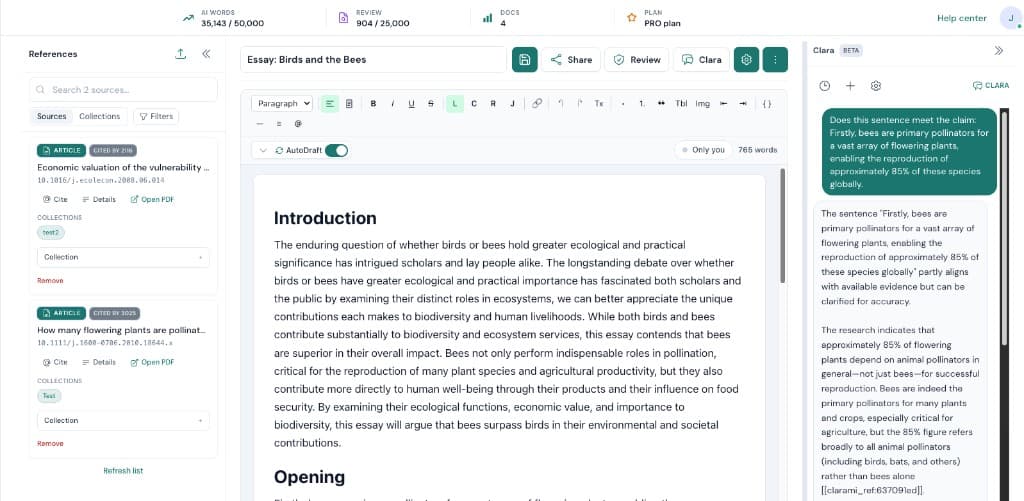
Grammarly built one of the best sentence-level proofreaders ever shipped. It catches subject-verb agreement errors, fragmented sentences, misplaced modifiers, and the small inconsistencies that make a paper look unfinished. For polishing the work of a writer who already knows what they are trying to say, it is genuinely useful, and pretending otherwise would not be honest.
What sentence-level proofreading cannot do is the harder half of essay writing. Grammar is a downstream concern. The questions that matter for an essay grade — is this thesis defensible, does this paragraph actually support the claim it opens with, are these three pieces of evidence sufficient — sit upstream of any sentence-level check. A grammatically perfect essay can still be wrong about the prompt. That is the boundary where a tool optimised for the comma and the clause stops being enough.
Essay writing is structural work before it is stylistic work. The early decisions — what the thesis is, what counter-arguments to address, which evidence to put in body paragraph two versus body paragraph three — set the ceiling for what the essay can become. No amount of grammar polishing can rescue a paper whose body paragraphs do not support its thesis.
That structural work is exactly what Grammarly, by design, does not touch. It assumes the structure is correct and tightens the prose around it. For a writer who has already written the essay in their head and just needs help getting it on the page cleanly, that is a perfectly good assumption. For a writer who is still figuring out the argument while they write — which is most students writing most essays — it is the wrong starting point.
A drafting tool is in the conversation while the essay is still taking shape. It helps you generate an outline, sketch a thesis you can defend, push through the framing paragraph that always takes longer than you expect, and notice when your evidence does not yet support your claim. Its job is to keep the writing moving while the argument is being built.
A proofreader joins the conversation after the argument is in place. Its job is to make sure the prose carrying the argument is clean. The two roles look similar from the outside — both are “AI helping with my writing” — but they intervene at different points and have different definitions of success.
The mistake most essay writers make is buying a proofreader first and trying to use it as a drafting tool. The thesis stays vague, the structure stays loose, and the grammar gets steadily better while the actual argument stays mediocre. The grade reflects the argument, not the grammar.
There is no argument here that says you should stop using grammar tools. After your draft is structurally sound and the argument is doing the work it is supposed to do, a proofreader catches the kind of errors that distract a reader from the substance of the paper. That is genuinely useful, and writers who care about their work usually run both passes.
A reasonable order: build the essay in a drafting tool that helps with structure, evidence, and citations. Run a proofreader over the final draft to catch the residue. The two passes are doing different jobs and they do not compete for the same minute of your attention.
If you currently use Grammarly for essays, the workflow that probably saves you the most time is not switching tools — it is adding a drafting tool upstream of it.
That ordering matters. The argument and structure carry most of the grade. Grammar carries the rest. Tools that intervene at the wrong stage cannot rescue a paper whose problem is upstream.
Comparison
Primary use
Essay planning, drafting, and revision.
Grammar and style corrections.
Argument support
Tools for thesis, outline, and section flow.
Limited support for argument construction.
Research workflow
Source-aware writing and citation support.
Citation management is usually external.
Support
Clarami supports revision and clarity improvement while also helping with structure and drafting.
Yes. It is designed for longer writing workflows with multiple sections and references.
Yes. Clarami supports both essay and source-grounded research writing.
Use Clarami AI to generate, refine, and export in one workflow.