Is Clarami still AI-powered?
Yes. Clarami uses AI features in a writing workspace designed specifically for document workflows.
Comparison
Chat interfaces are flexible, but Clarami is purpose-built for structured essay workflows with drafting and citation continuity.
ChatGPT became the default AI tool for essay writing for an obvious reason: it is free to start, available everywhere, and asks nothing of you except a prompt. For brainstorming a topic, drafting an outline, generating example arguments, or breaking a writing block at midnight, a general-purpose chat interface is a genuinely useful first move. It deserves credit for that, and any honest comparison should start there.
What chat-based workflows are not built for is the rest of the essay — the part where the draft has to live somewhere, the citations have to be correct, the structure has to survive multiple revisions, and the work has to be defensible to whoever is grading it. The friction in those later steps does not show up the first time you use ChatGPT for an essay. It shows up the fifth time, when the copy-paste tax adds up across a week of writing.
A chat thread is a transcript, not a document. Each prompt-response cycle produces a block of text you then have to lift out of the chat, paste into Word or Google Docs, reformat the headings of, integrate with the paragraphs you already wrote, and check against the sources you are supposed to be citing. The work the chat tool did not do is the work that determines whether the final document is any good.
Three problems compound across a typical essay. The first is structural drift. Each prompt produces text without memory of the surrounding argument. A body paragraph generated in turn three of the chat does not know what claim turn one made, what evidence turn two cited, or how the conclusion needs to land. You end up with paragraphs that are individually fluent and collectively inconsistent.
The second is citation hallucination. Generic chat models will produce plausible-looking DOIs, author/year tuples, and journal titles that do not exist. Even when they cite real sources, the page reference is often guessed. For graded academic work, this is the worst failure mode — the writing looks correct enough that the error is invisible until a reviewer checks.
The third is verification cost. Even when the chat output is broadly accurate, you cannot tell which sentences are supported by your actual reading and which are model invention. The only way to know is to re-read every source and check, which is the work the AI was supposed to save you.
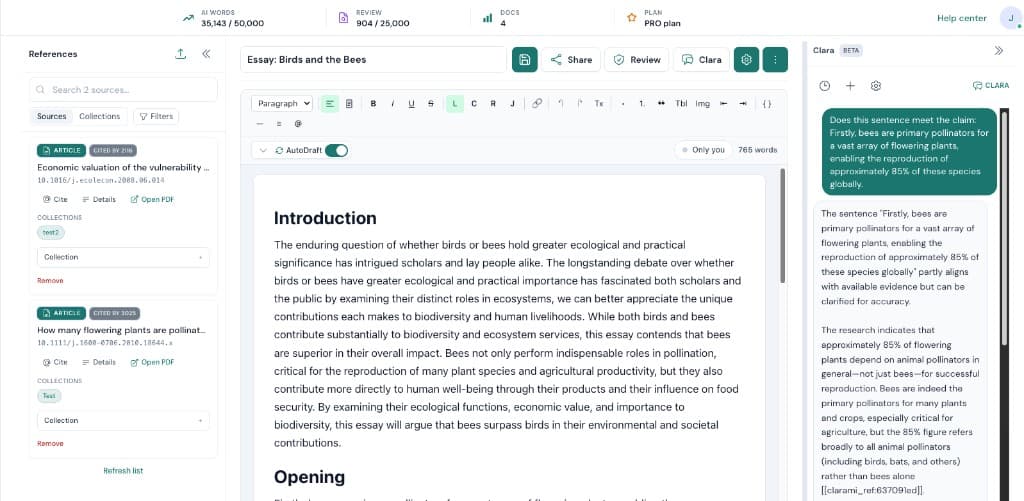
The alternative is not a different chatbot. It is moving the AI into the document where the essay actually lives. Clarami’s draft, source library, and citation tools sit in one workspace. When you ask for help drafting a paragraph, the suggestion is generated against the paragraph you already wrote, the sources you uploaded, and the citation style you are writing in. There is no copy-paste step because there is no separate chat tab.
In practice, that means the AI knows what the rest of the essay says. It knows which sources are in scope. It knows what citation format you need. The result is fewer suggestions, but the suggestions are integrated rather than orphaned.
The largest cost of a chat-based workflow is not visible per session. It is the accumulated tax across every prompt cycle. Open Word. Open ChatGPT. Read the prompt. Copy the output. Paste into Word. Reformat the heading. Check the source. Realise the citation is wrong. Open Zotero. Find the correct reference. Reformat. Move on.
That sequence takes ninety seconds per paragraph if everything goes smoothly. Across a forty-paragraph essay that is an hour of pure overhead before any actual writing happens. Across a semester of essay writing, it is dozens of hours, and the hours come out of the time you would otherwise spend reading sources or revising arguments.
A single-workspace workflow removes the overhead by making the prompt cycle happen inside the document. The sentence appears, you accept or reject it, the citation comes with it, and you keep writing.
Nothing in this comparison says you should stop using ChatGPT. For pure brainstorming, for exploring a topic you know nothing about, for getting unstuck when you are blocked, a flexible chat interface is still the right tool. The argument is narrower: it is that the chat interface is the right tool for getting started on an essay and the wrong tool for finishing one.
A reasonable order: use ChatGPT to explore topics, sketch initial framings, and break through blocks. Move into Clarami once you have something to build on, so the rest of the writing happens with structure, sources, and citations in one place.
Comparison
Essay structure
Dedicated tools for thesis and outline generation.
Structure depends on prompt quality and iteration.
Editing context
Edits happen in your active draft workspace.
Output often generated outside final document.
Citation continuity
Source-aware drafting and revision steps.
Citation mapping usually manual.
Support
Yes. Clarami uses AI features in a writing workspace designed specifically for document workflows.
Yes. Clarami can be your main drafting environment even if you use outside research tools.
Writers handling structured essays, reports, and research-based assignments.
Related resources
Use Clarami AI to generate, refine, and export in one workflow.