Can Clarami help with literature reviews?
Yes. It includes literature review and summarization workflows for source-heavy projects.
Research tools
For research writing, the best tool is not just text generation. It must support structure, source handling, and revision in one consistent workflow.
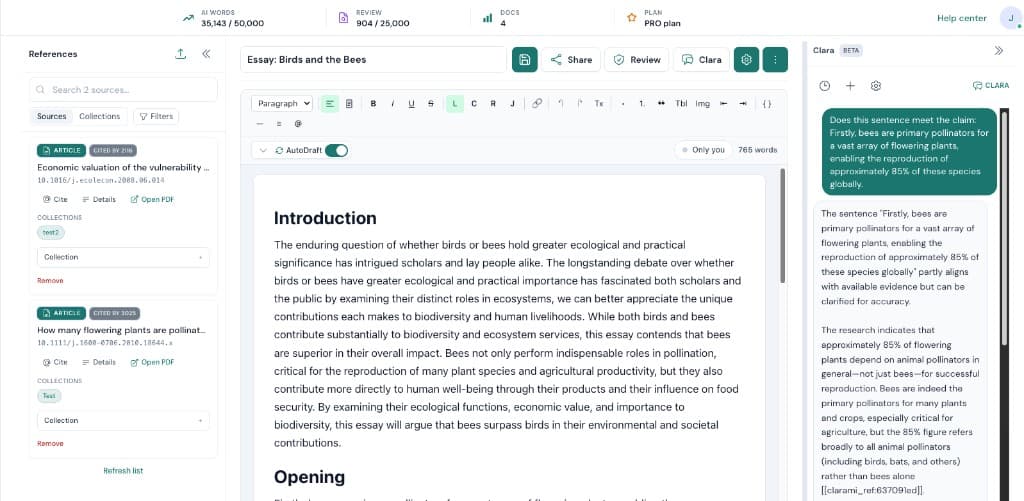
Search for “best AI writing tool for research papers” and you will find dozens of ranked lists. Most are affiliate posts that score tools on price, free tier, and feature checkboxes. None of them score on the question that actually matters for research writing: does the tool help you produce a manuscript that holds up under peer review.
The reason is mechanical. Affiliate rankings need to fit into a comparison table. The properties that determine research-writing quality — source alignment, citation traceability, qualifier preservation, co-author handoff — do not compress into a tick-or-cross column. So they get dropped, and the rankings end up scoring tools on the wrong axis.
This page does not try to rank tools. It tries to give you a decision framework. The right tool for your research paper depends on what kind of paper you are writing, what your discipline expects, and what the cost of getting the source wrong actually is.
For a graded essay, “best” often means fastest to a finished draft. For a research paper, the definition changes. A research paper is judged on whether the argument holds up against the cited evidence, whether the methods are reproducible, and whether the prior literature has been characterised fairly. Speed is a constraint, not a goal.
A research-paper-grade tool therefore needs to optimise for three properties that essay-writing tools can usually skip.
The first is source-grounded drafting. The AI’s suggestions need to be generated against the documents you are actually citing, not against generic training data. Otherwise every drafted claim is a guess about whether your sources support it.
The second is citation-aware revision. When you rewrite a paragraph, the citation chip should follow the rewrite. Tools that lose the citation link force you to reconnect every reference manually after a revision pass.
The third is review-time traceability. Months after the original draft, you, a co-author, or a reviewer should be able to walk from any sentence back to the source passage in one click. Without this, the manuscript is technically cited but practically unverifiable.
If you are evaluating a research writing tool — Clarami, Paperpal, Jenni, SciSpace, or any of the others — five concrete capabilities separate research-grade tools from general-purpose writing assistants.
Any tool that has all five is, broadly, in the research-writing tier. Most tools have one or two.
When a general-purpose chat tool is used for research writing, three failure modes recur. Each is small per occurrence and severe in aggregate.
The first is hallucinated citations. Generic models produce plausible DOIs, author/year tuples, and journal titles that do not exist. Even when the citation is real, the page number is often guessed. For peer review, this is the worst failure mode — the writing looks correct enough that the error is invisible until a reviewer checks.
The second is drifted paraphrases. A general tool rewrites sentences without seeing the source. The rewrite is fluent and looks correct, but qualifiers have dropped and emphasis has shifted in ways that change the underlying claim. Reviewers who have read the cited paper notice immediately.
The third is disconnected revisions. A general tool rewrites a paragraph but cannot update the citation, the reference list, or the cross-references to other sections. Every revision pass leaves a small amount of housekeeping for you to discover later.
These are not bugs in general AI tools. They are the expected behaviour of a tool that was not built for the source-grounded writing research papers require.
If you are deciding which tool to use for a real research paper, the fastest test is to write one paragraph end-to-end inside the tool and look at what happens.
A tool that passes all six steps is in the research-writing tier. A tool that fails on citation attachment or survival is in the essay-writing tier. There is no comparison-table feature checklist that gives you this signal as reliably as one real paragraph does.
Clarami is built to pass all six. That is the test we recommend writers run on any tool — including ours — before committing to it for a manuscript.
Comparison
Research synthesis
Supports multi-source summarizing and review workflows.
Often optimized for standalone prompts.
Draft orchestration
Structure and drafting tools are connected.
Users manually stitch outputs together.
Citation readiness
Built for source-grounded writing flow.
Citation steps are commonly external.
Support
Yes. It includes literature review and summarization workflows for source-heavy projects.
Yes. It is designed for both academic coursework and advanced research drafting.
Yes. All generated drafts are editable and meant to be refined with your judgment.
Related resources
Use Clarami AI to generate, refine, and export in one workflow.