Can Clarami reduce accidental meaning drift?
Yes. In-context rewriting makes it easier to keep claims consistent with surrounding text.
Paraphrasing
In research papers, paraphrasing quality depends on context, evidence, and revision control. Clarami is built for that full workflow.
Most “best paraphrasing tool” rankings score on a single axis: how fluently does the tool rewrite a sentence? For casual writing that ranking is roughly correct — the most fluent rewrite usually wins. For research writing it is the wrong scoring rubric. Fluency without source alignment is exactly the failure mode that fails peer review.
A paraphrasing tool that scores well on isolated sentence rewrites can still produce paragraphs that drift away from the cited source, lose the specificity the original paper relied on, or quietly soften a finding the original author was careful to qualify. None of those problems show up in a side-by-side fluency test. All of them show up in a manuscript that gets sent back for revision.
The better question is not “which paraphrasing tool is most fluent” but “which paraphrasing tool keeps my rewrites aligned with the source I am citing.”
For research writing — literature reviews, methods sections, discussion paragraphs, grant proposals — four properties matter more than raw fluency.
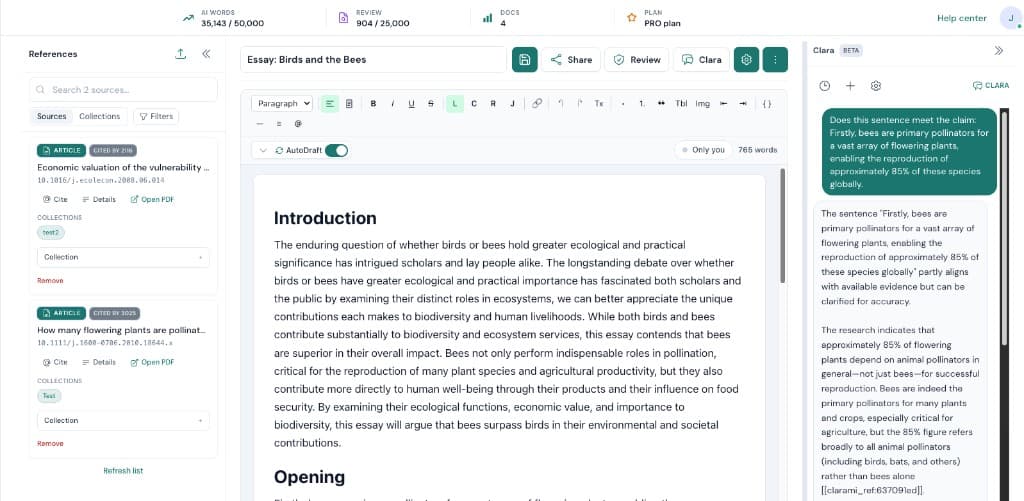
The first is source visibility during the rewrite. The tool should know which source the sentence is paraphrasing and which passage in that source the claim is built on. Without it, every rewrite is a guess about whether the new version still supports the citation.
The second is meaning preservation under specificity. Research sentences are dense with qualifiers — “in a subset of participants,” “under controlled conditions,” “reported but not significant.” A good paraphrase keeps those qualifiers. A bad one drops them in favour of a cleaner sentence and quietly overclaims.
The third is integration with citation tooling. The rewrite should land in the same document where the bibliography is being assembled, with the citation chip still attached to the rewritten sentence. Anything that breaks the link forces manual reconnection after the fact.
The fourth is review-time verifiability. Months after the original draft, a co-author or reviewer should be able to walk from any sentence back to the source passage in one click. If the tool cannot do that, the rewrites are technically present but practically opaque.
Meaning drift in paraphrasing is rarely dramatic. It is small softenings, dropped qualifiers, and shifted emphasis that compound across forty paragraphs of a literature review.
A sentence from the source: “In a retrospective cohort of 142 patients, treatment X was associated with a 7% absolute reduction in event rate (95% CI 2–12%, p = 0.04).” A casually paraphrased version: “Treatment X reduced event rates by 7%.”
Both sentences look clean. The second is unrecognisable as a faithful paraphrase of the first. The retrospective design, sample size, confidence interval, and p-value have all disappeared. A reviewer who has read the original paper notices immediately. So does anyone who has to defend the manuscript at a conference.
Drift like this is not a failure of the paraphrasing tool’s language model. It is a failure of the workflow that lets the rewrite happen without the source passage visible. Tools that keep the source in view while rewriting catch drift before it leaves the paragraph.
The simplest decision rule for evaluating any paraphrasing tool for research: does the rewrite know which source the sentence is citing, or does it not?
A citation-aware rewrite is generated with the source passage in scope. The model is asked to produce an alternative sentence that supports the same cited claim, drawn from the same evidence. The citation chip stays attached. Verification is one click.
A citation-blind rewrite is generated from the sentence alone. The model has no way to check whether the rewrite still supports the citation. Verification is a manual re-read of the source.
The first is what Clarami’s paraphrasing produces by default. The second is what most general-purpose tools produce because they have no source library to draw from.
If you are choosing a paraphrasing tool for research writing, the test takes five minutes and works on any tool.
A tool that passes all five is the one that holds up under research-paper standards. Most tools pass one or two. Clarami is built to pass all five.
Comparison
Context depth
Paraphrasing happens inside full draft workflow.
Often runs as disconnected input/output.
Academic fit
Designed for structured, source-grounded writing.
Usually optimized for generic rewriting.
Control
Suggestion-by-suggestion acceptance and revision.
Users often re-edit large pasted outputs.
Support
Yes. In-context rewriting makes it easier to keep claims consistent with surrounding text.
Yes. Clarami supports source-aware academic workflows.
Yes. You can rewrite sentence-level or paragraph-level selections.
Related resources
Use Clarami AI to generate, refine, and export in one workflow.