Is Clarami only for paraphrasing?
No. It supports outlining, paragraph drafting, summarizing, and citation-aware writing workflows.
Comparison
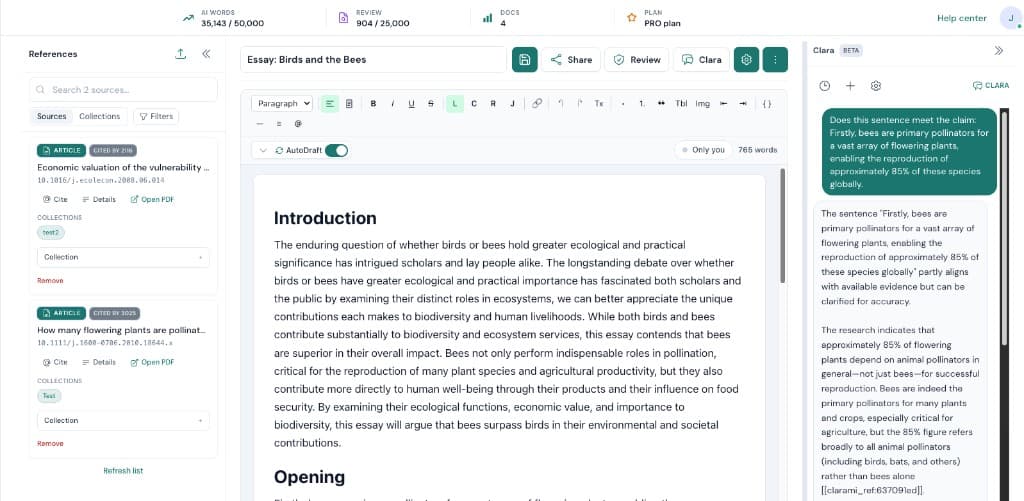
Clarami goes beyond sentence rewrites by combining drafting, source organization, and citation-aware editing in one workspace.
QuillBot built a reputation by doing one thing exceptionally: rewriting a sentence into a cleaner, clearer, or differently-toned alternative. For tightening an awkward email or smoothing a paragraph that reads like a first draft, it is a useful, fast, and well-engineered tool. There is no honest comparison to be made that pretends otherwise.
What sentence-level paraphrasing cannot do is much narrower than it looks from the outside. A rewrite is good when the sentence in front of you is the right sentence to begin with. When the upstream choice is wrong — wrong evidence, wrong emphasis, wrong relationship to the source you are citing — a more fluent rewrite makes the problem harder to spot, not easier. In a 1,200-word essay you can usually tell. In a 5,000-word research paper with twenty cited sources, you sometimes cannot. That is the boundary where a tool optimised for one paragraph at a time stops being enough.
Paraphrasing in isolation has no opinion about what came before the sentence or what comes after it. It does not know which source you are paraphrasing, what the source actually says, or whether your version still supports the claim you are about to attach to it. Everything that should anchor the rewrite — the source, the surrounding argument, the citation format you eventually need — lives in another tab or another tool.
The friction this produces is small per rewrite and large per paper. You paraphrase a sentence, paste it back into your draft, re-check the source to make sure the meaning held, re-format the citation if it shifted, and then do the same for the next paragraph. Multiply by forty paragraphs and an afternoon disappears. Multiply by a research paper deadline and you ship the work with the obvious sentences cleaned up and the structural problems untouched.
Clarami’s paraphrasing lives in the same document as your sources, your citations, and your existing draft. When you select a sentence and ask for an alternative, the rewrite is generated against the surrounding paragraph and the source the sentence is attached to. The citation chip stays connected. The source pane is one click away if you want to verify the rewrite still supports the cited claim.
That is not a magical trick. It is a change in where the work happens. A sentence rewritten inside a draft with sources visible takes the same number of seconds it always did — what disappears is the verification overhead you used to absorb silently across the rest of the paper.
For students, that means a literature review where every paraphrase you accept has already been checked against the original passage. For researchers, it means a methods section where the language has been tightened without anyone needing to re-read three articles to confirm nothing drifted. For writers in regulated fields, it means an audit trail you did not have to assemble after the fact.
There is no rule that says you need one writing tool. Plenty of writers use Clarami for sourced academic work and reach for a fast sentence-rewriter for everything else — emails, application essays, blog drafts, internal communications that have no citation requirements at all. The two tools are not in direct competition. They are aimed at different problems.
A reasonable rule of thumb: if the document you are writing has zero citations, a sentence-level paraphraser is probably the right tool. If it has more than five, the tool that keeps your sources in view while you rewrite is the one that will save you the most time downstream.
Writers who outgrow a pure paraphrasing tool usually hit the same handful of walls.
If any of those sound like your work, the upgrade is not “better paraphrasing.” It is paraphrasing that happens inside the workspace where your sources, draft, and citations already live. That is what Clarami is built for, and what the rest of this site walks through in more detail.
Comparison
Scope
Paraphrasing, drafting, and citations in one app.
Strong paraphrasing but limited full-draft workflow.
Research context
Source context can stay attached while rewriting.
Rewriting often happens outside source context.
Draft continuity
Edits stay in your active manuscript.
Frequent switching across tabs and tools.
Support
No. It supports outlining, paragraph drafting, summarizing, and citation-aware writing workflows.
Yes. Every suggestion is optional and fully editable before it lands in your draft.
Students, researchers, and professionals writing source-grounded documents.
Use Clarami AI to generate, refine, and export in one workflow.