How to organize research references for systematic writing
Struggling to organize research references? This guide offers a workflow to structure your library, link evidence to your draft, and write with confidence.
Write with structure in Clarami AI
Editor-first AI drafting, citations, and two Workflows for student writing.
What if the hours you spend managing your bibliography are the primary cause of your writer's block? Most researchers treat their library as a digital warehouse, yet they still struggle to organize research references in a way that supports the actual composition process. You likely know the frustration of finding a compelling data point only to lose the link to its primary source minutes later. It's a common pain that turns a scholarly pursuit into a tedious administrative task.
This guide provides a methodical framework to structure your digital library and maintain the vital connection between evidence and your draft. You'll learn to move from raw notes to a polished manuscript with confidence in your citation accuracy. By using an AI writing tool for students that includes a PDF Manager and ClaimShield, you can ensure every argument is anchored in verified data. We'll walk through a workflow that prioritizes structural integrity and eliminates the need for constant copy-pasting. You can start your project with a system designed for precision.
Academic integrity is central to this process. Always check your institution's specific policies regarding AI assistance and disclose the use of tools like the Clara AI Assistant or AutoDraft where required. The user remains responsible for the final verification, editing, and submission of all work.
Key Takeaways
- Learn to organize research references by treating bibliographic metadata as the structural backbone of your digital library.
- Identify the "fragmentation trap" where your evidence, notes, and drafts remain in disconnected silos.
- Implement status-based tags to categorize sources by their current utility, such as "methodology focus" or "cited."
- Use integrated PDF annotations to maintain a direct, traceable link between source highlights and your written claims.
- Transition from collection to composition using a workflow that eliminates the need for constant copy-pasting between separate windows.
Table of Contents
- The foundations of systematic reference organization
- Developing a categorization framework that supports writing
- Managing metadata and PDF annotations for traceability
- Bridging the gap between your library and your draft
- Streamlining your workflow with the Clarami research workspace
The foundations of systematic reference organization
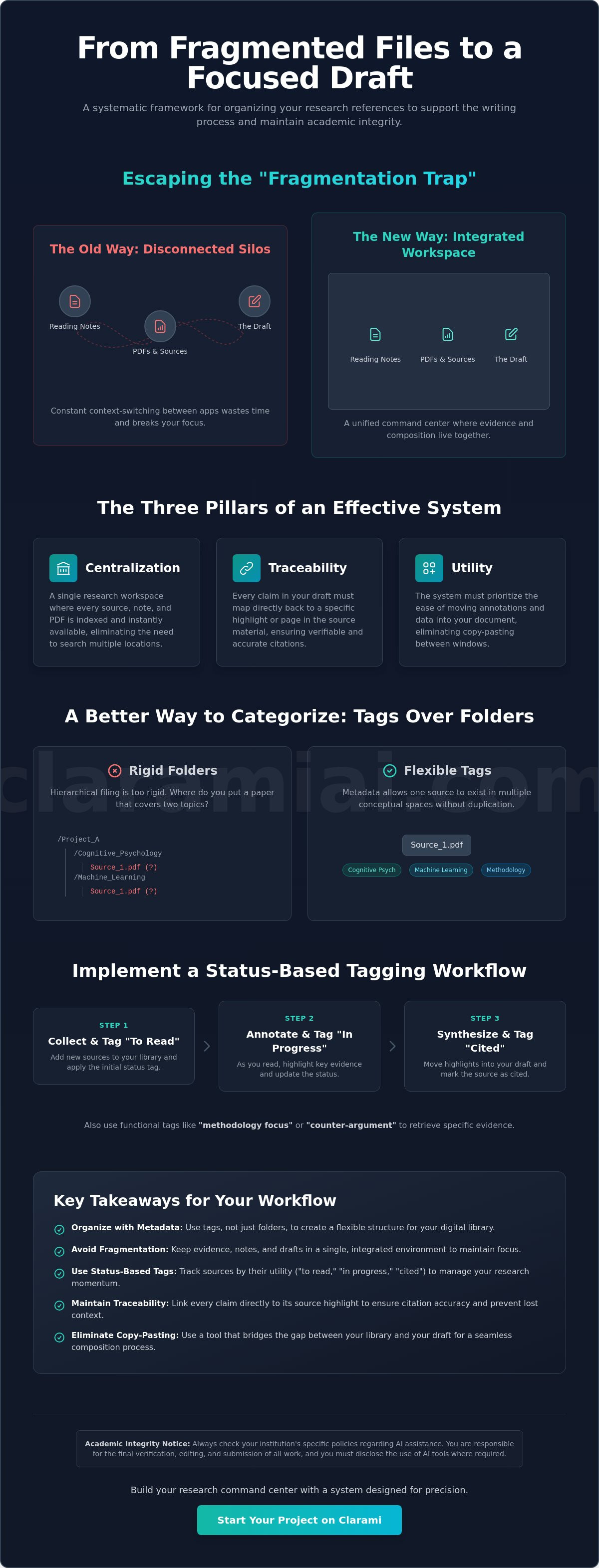
Systematic research reference organization is the disciplined management of evidence to substantiate scholarly claims. It transforms a chaotic pile of PDFs into a structured knowledge base. Many scholars fall into the fragmentation trap. This happens when your reading notes live in one app, your annotated PDFs in another, and your draft in a third. These disconnected silos force you to context-switch constantly. Your goal is to build a research command center that prioritizes retrieval over simple storage. Effective systems don't just hold data; they make it accessible at the moment of composition.
Before you refine your workflow, check your specific school policies regarding AI assistance. You are responsible for disclosing the use of tools like the Clara AI Assistant and verifying all final outputs for accuracy and academic integrity.
To better understand the challenges of managing scholarly knowledge, watch this helpful video:
### Why traditional folder structures often failHierarchical filing is often too rigid for interdisciplinary work. If a paper covers both cognitive psychology and machine learning, you face a dilemma. Deciding where a file belongs creates a mental tax that drains your energy. This friction often leads to abandoned organizational habits. Modern reference management software solves this by using flat structures. You rely on rich metadata rather than deep folders. This allows a single source to exist in multiple conceptual spaces. It's a more flexible way to organize research references across complex projects.
The three pillars of an effective system
A professional system rests on three specific requirements that ensure your library serves your writing:
- Centralization: You need a single research workspace where every source is indexed and available.
- Traceability: Every claim in your draft must map back to a specific page or highlight in the source material. This prevents the loss of context.
- Utility: The system must prioritize the ease of moving data into your document editor. High-utility systems eliminate the need to copy-paste between windows.
By focusing on these pillars, you create a foundation for systematic writing. You move away from simple storage. You move toward a verified, logical library that supports your intellectual agency.
Developing a categorization framework that supports writing
Effective categorization moves beyond simple storage. It prepares your data for the synthesis stage of writing. While folders are useful for broad administrative divisions, tags allow for the thematic flexibility required in scholarly work. To effectively organize research references, you must distinguish between where a file lives and what it contributes to your argument. Folders are best used for high-level project names or semesters. Tags should be used to track the evolution of your research. This multidimensional approach ensures that a single source can support multiple sections of your manuscript without creating duplicate files.
Status-based tags are the most practical way to manage your workflow. Use labels like "to read," "in progress," and "cited" to track your momentum. You can also apply specific functional tags such as "methodology focus" or "counter-argument" to quickly retrieve evidence when you reach those sections of your draft. Scholars often find success by adopting Strategies for Reading and Writing that involve active engagement with the text before the drafting phase begins. This preparation prevents the anxiety of staring at a blank page with a library full of unorganized PDFs.
Tagging strategies for thematic research
Consistency is the foundation of a searchable library. Establish a strict naming convention for your tags, such as using lowercase letters or prefixing tags with categories like "THEME: ethics" or "TYPE: case study." This prevents the creation of near-duplicate tags that fracture your system. Limit your total number of active tags to a manageable amount. Too many tags create the same mental tax as disorganized folders. Focus on functional tags that describe exactly how you will use the paper in your current project. If you are overwhelmed by the volume of your material, you can centralize your library to regain control.
Implementing a synthesis matrix
A synthesis matrix is a structural tool used to compare themes across multiple sources. It forces you to look at your research horizontally rather than reading each paper in isolation. You can build a basic matrix using a table with the following columns:
- Source: Author, Year, and Title.
- Main Argument: The primary claim of the work.
- Methodology: The specific research design used.
- Key Findings: The data points or conclusions relevant to your topic.
By filling out this matrix, you can identify gaps in current literature and see where different authors agree or conflict. This process makes the transition to writing much smoother because your outline is already supported by a grid of evidence. For help with the technical aspects of this process, consider choosing an AI research assistant tool to assist in extracting these data points from your PDF collection. This allows you to spend more time on analysis and less on manual data entry.
Managing metadata and PDF annotations for traceability
Bibliographic metadata is the structural backbone of your digital library. Without accurate data points like the DOI, author names, and publication year, your ability to organize research references effectively collapses. High-quality metadata ensures that your citation generator functions correctly and your library remains searchable. It's a common mistake to assume that automated imports are always correct. Even the most sophisticated systems can misread a PDF header or omit a critical subtitle. You must verify these details immediately to maintain the integrity of your work.
Adopting the "Integrated Annotation" method is a superior alternative to keeping notes in separate apps. By keeping your highlights and commentary within the PDF file itself, you maintain a permanent, physical link between your insights and the primary source. This approach mirrors the advice found in a guide to writing a research paper, which emphasizes the need for documenting information as you collect it. This practice prevents the loss of context that occurs when notes are detached from their evidentiary roots. When you're ready to write, you can extract these specific quotes directly into your editor.
The metadata verification checklist
Accuracy begins the moment you import a file. Don't wait until the final draft to fix your bibliography. A disciplined verification process includes three specific steps:
- Verify the DOI: This Digital Object Identifier is the unique fingerprint of a scholarly work. It's the most reliable way to ensure your citations are accurate.
- Check for "ghost" authors: Automated tools often struggle with multi-author papers or complex institutional names. Ensure every contributor is listed correctly.
- Confirm the publication date: Missing years are a frequent cause of citation errors. Always verify the year against the journal's official record.
For those utilizing generative tools during the drafting process, you should also review the guide on how to verify AI citations to ensure your evidence is grounded in real, verifiable publications.
Effective highlighting and note-taking
Over-highlighting is a form of passive reading that delays actual synthesis. If everything is important, nothing is. This disciplined approach to how you organize research references ensures that when you move to the drafting phase, you aren't sifting through pages of meaningless color. Use color-coding to categorize different types of evidence. For instance, use yellow for direct results and blue for theoretical frameworks. Write a summary note at the top of the first page describing the paper's core contribution in your own words. Focus on highlighting only the sentences that directly substantiate your argument or provide a necessary counterpoint. This makes your future retrieval process both faster and more precise.
Bridging the gap between your library and your draft
The "copy-paste" problem is a significant hurdle in scholarly composition. It's the friction created when you must toggle between a PDF manager and a document editor. This process breaks your concentration. It also increases the risk of transcription errors. When you organize research references, you aren't just filing papers; you're preparing to synthesize arguments. A seamless transition from your digital library to your draft is essential for maintaining momentum. Cognitive flow. Structural integrity. Traceable evidence. These are the markers of a professional system.
This workflow requires a human-in-the-loop approach. While technology can surface your notes, you're responsible for the final interpretation. You must ensure every claim is accurately represented and correctly attributed. Citation styles like APA or Chicago are the final step in this process. They provide the formal structure that signals professional credibility. Using an AI writing tool for students that integrates these styles directly into the editor can prevent last-minute formatting stress.
Step-by-step: From source to sentence
Moving from a collection of sources to a coherent paragraph is a cognitive process. Follow these steps to ensure accuracy:
- Selection: Choose the most relevant source from your categorized library.
- Review: Re-examine your annotations and the synthesis matrix created in previous stages.
- Drafting: Write the paragraph in your own words. Use a clear placeholder for the citation to maintain your flow.
- Verification: Re-read the primary source to confirm the data point hasn't been taken out of context.
- Finalization: Replace the placeholder with a formal citation in your required style.
Maintaining structural integrity during revisions
Manual citation entry is a common source of formatting errors. It's easy to misplace a comma or forget a page number during a late-night revision. To avoid these pitfalls, use an integrated editor that keeps your library visible while you write. This ensures you never lose the link between your claim and your evidence. It's a more disciplined way to organize research references across multiple drafts.
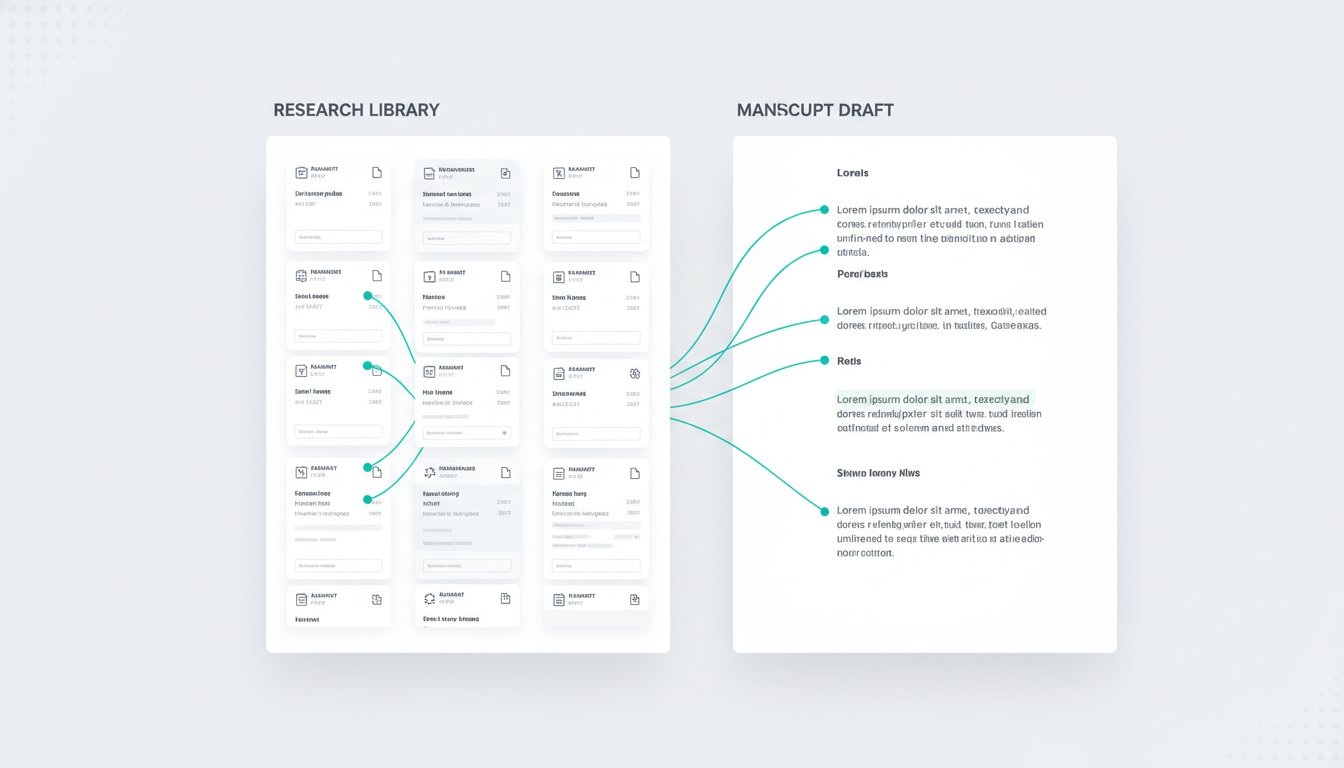
The Clarami workspace is designed specifically for this purpose. It eliminates the need for disconnected silos by placing your sources and your draft in a single environment. This structural cohesion allows you to focus on the nuance of your argument rather than the mechanics of file management. If you're ready to improve your writing efficiency, you can create your integrated research workspace today and experience a more logical path to submission.
Streamlining your workflow with the Clarami research workspace
Clarami provides a purpose-built environment designed to alleviate the stress of disorganized source material. By integrating a document editor with a robust PDF Manager, it eliminates the need for external filing systems that often lead to the fragmentation trap. You no longer have to switch between tabs to verify a data point or find a specific highlight. This structural cohesion allows you to organize research references within a single, logical workspace. It ensures that your evidence remains anchored to your arguments throughout the entire composition process. When you use AutoDraft to generate evidence-based sections, the tool maintains your unique voice while grounding every sentence in your uploaded sources.
Before using AI tools to assist your workflow, verify your institution's specific policies. You must disclose the use of assistants like Clara where required. All final editing, fact-checking, and submission remain your responsibility as the author. The human-in-the-loop approach ensures that technology serves your intellectual agency rather than replacing it.
Source-grounded assistance with Clara
Clara acts as a reliable intellectual companion by providing source-grounded assistance. Unlike general-purpose bots, Clara answers your questions using only the documents you have uploaded to your project. This grounding ensures that every suggestion is based on your specific research rather than abstract training data. You can see the exact source location next to every response, which facilitates immediate verification. This "no copy-paste" workflow means you can move from a query to a draft without leaving the editor. It respects your researcher's intuition while accelerating the extraction of methodology and key data points from your library.
Verification and integrity with ClaimShield
Maintaining accuracy is an uncompromising requirement for scholarly labor. ClaimShield serves this need by checking your draft against your library to prevent hallucinations or misattributions. It analyzes your sentences to ensure the data points align with the primary sources stored in your PDF Manager. If you need to refine a specific paragraph, you can use "suggest-mode" to collaborate with the AI on selection-level edits. This ensures you maintain full control over the final wording and argumentative structure. By using these features, you can explore Clarami features to build a verified, professional manuscript. The transition from collection to synthesis becomes a linear, manageable path that prioritizes structural integrity.
Building your research command center
Systematic writing requires a shift from passive collection to active evidence management. You now have the framework to use status-based tags and synthesis matrices to maintain a clear path from source to sentence. When you organize research references with a focus on structural integrity, you eliminate the mental tax of disconnected files. This precision allows you to focus on the cognitive work of analysis rather than the administrative burden of file retrieval.
The Clarami workspace supports this methodical approach with a source-grounded AI assistant and an integrated PDF manager. By automating APA and Chicago citations directly within the editor, you ensure your final manuscript meets the highest professional standards. It's a system designed to respect your intellectual agency while providing reliable support. Always check your school policies regarding AI assistance and disclose its use where required. You're responsible for the final verification and submission of your work.
Start organizing your research with the Clarami workspace to maintain a traceable link between your evidence and your draft. Your path to a polished, scholarly work is now structured and clear.
Frequently asked questions
How do I start organizing a large collection of unorganized PDFs?
Begin your cleanup by importing your files into a central PDF Manager that fetches metadata automatically. Use a "gentle reset" approach to handle the volume. Sort your files by current relevance, archive completed projects, and delete truly irrelevant documents. You should focus on verifying the DOI for each paper to ensure your library remains searchable and logically structured for future retrieval.
Should I use folders or tags to organize my research?
Adopt a hybrid organizational structure to manage your library effectively. Folders are best suited for broad project categories, such as a specific dissertation or grant proposal. Tags are superior for thematic or functional labels like "methodology" or "key evidence." This approach is more flexible because a single paper can carry multiple tags while residing in only one folder location.
How can I ensure my citations are accurate when using AI?
Prioritize source-grounded AI assistants to maintain accuracy as you organize research references for your final draft. Avoid general-purpose chat bots that often fabricate bibliographic details. Tools like ClaimShield can verify that every claim in your manuscript is substantiated by a real paper in your library. This human-in-the-loop approach ensures your work remains anchored in verified, primary evidence.
What is a synthesis matrix and how does it help?
A synthesis matrix is a diagnostic table used to compare the core arguments of multiple sources. By listing sources on one axis and specific themes or findings on the other, you can identify where authors agree or conflict. This structural tool helps you move beyond summarizing individual papers. It allows you to write a cohesive literature review that identifies existing gaps in the field.
How do I handle references for a collaborative research project?
Use a shared workspace that allows all team members to follow the same tagging and naming conventions. Consistency is the foundation of collaborative success. An integrated editor with "suggest-mode" allows for transparent co-authoring without losing vital citation links. This environment ensures that every contribution is properly attributed and that the structural integrity of the bibliography remains intact during the revision process.
Why is metadata important for reference management?
Metadata acts as the searchable fingerprint for every source in your collection. It allows your software to generate accurate citations and find papers by author, year, or journal title. Without verified metadata, you risk introducing technical errors into your final bibliography. Precise data entry at the import stage prevents the stress of manual correction during the final hours of your project.
Related on Clarami
- Best AI writing tool for students (full guide) →
- AI academic integrity checklist →
- Clarami pricing: Free vs PRO vs Platinum →
- Editor vs ChatGPT for writing →
- Export DOCX, PDF, and hand-in checklist →
- How to outline a paper →
- Prompt to structured essay draft →
- Revise with AI on a selection →
- Sign up free →
- Clarami home →
- More guides on the Clarami blog →