
Strategies for overcoming academic writer's block in 2026
Feeling stuck on your paper? Learn methodical strategies for overcoming academic writer's block with structured workflows and clear steps to resume your prog...
Write with structure in Clarami AI
Editor-first AI drafting, citations, and two Workflows for student writing.
The inability to start your first draft is rarely a failure of intellect; it's a failure of the bridge between your source management and your writing environment. You likely know your topic well, yet the anxiety of a high-stakes deadline makes the transition from research notes to a polished draft feel insurmountable. This methodical guide focuses on overcoming academic writer's block by identifying the structural friction in your workflow and providing a clear path to resuming your scholarly progress.
We'll examine how to integrate sources without feeling overwhelmed, utilize an ai writing tool for students to maintain momentum, and bridge the gap between data and prose with help from Clara and our structured templates. Before you begin, please review your institution's specific AI governance policies. Maintaining academic integrity requires you to disclose the use of AI tools and ensure all final submissions are your own verified work.
Key Takeaways
- Distinguish between psychological anxiety and structural disorganization to identify the specific root cause of your writing paralysis.
- Apply the Two Sentence Method to clarify your core argument and use the Pomodoro technique to lower the entry barrier for new sections.
- Organize research into a synthesis matrix to transform disconnected notes into a coherent scholarly conversation before you begin drafting.
- Implement structural workflows for overcoming academic writer's block by using selection-level drafting to expand on complex data within your integrated editor.
- Maintain consistent momentum by prioritizing a disciplined writing schedule and verifying your school's specific AI disclosure policies before submission.
Table of Contents
- Understanding the mechanics of academic writer's block
- Immediate manual strategies to resume writing
- Building the bridge from research notes to prose
- Using intelligent assistance to facilitate the first draft
- Maintaining momentum and academic integrity
Understanding the mechanics of academic writer's block
Academic writer's block is rarely a lack of ideas. It is the inability to translate research into a structured narrative. You have the evidence. You've conducted the analysis. Yet, the document remains empty. This paralysis often occurs because the bridge between your notes and your prose is too narrow. Identifying the specific nature of your paralysis is the first step in overcoming academic writer's block. You must determine if your trigger is a lack of evidence or a fear of the first sentence.
For a broader perspective on the history and causes of this phenomenon, Understanding Writer's Block provides useful foundational context. To begin making progress, you need to distinguish between psychological blocks, such as anxiety over high-stakes deadlines, and structural blocks, like disorganized source material. By organizing your workspace, you can reduce the friction that prevents you from starting.
To better understand the underlying causes of this paralysis, watch this helpful video:
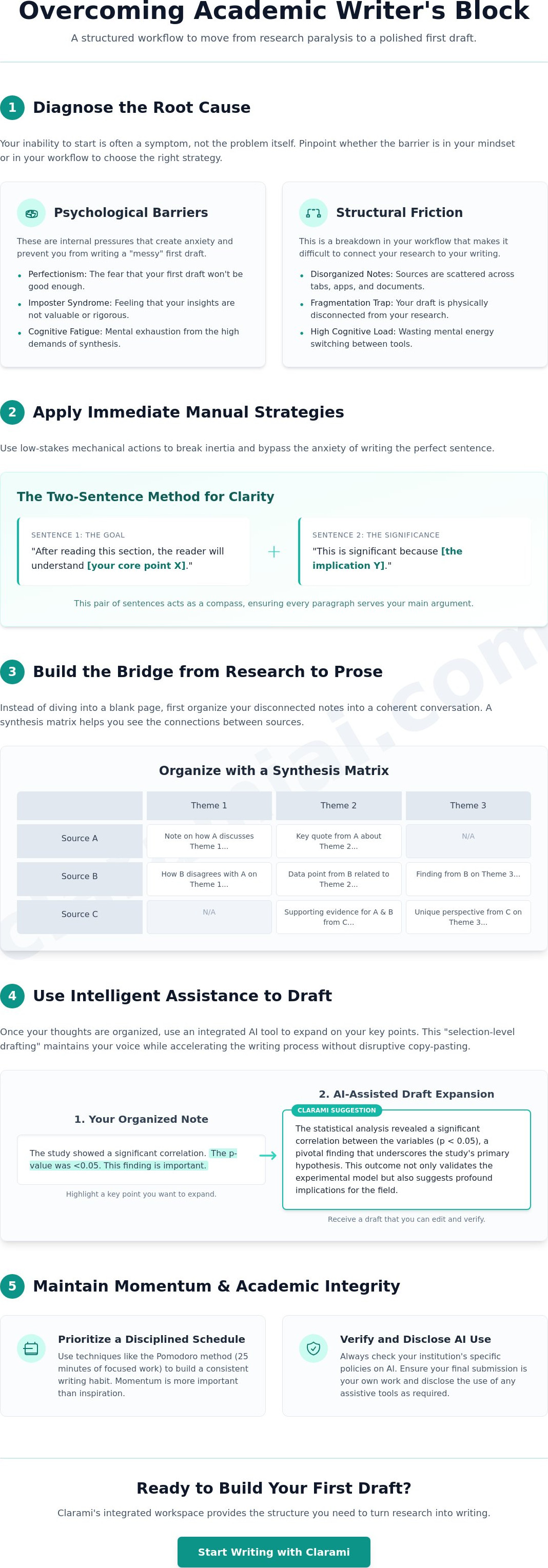
### The psychological barriers to scholarly outputScholarly labor carries immense weight. You aren't just writing; you're contributing to a global field of knowledge. This pressure often triggers imposter syndrome. You might feel your insights aren't rigorous enough to withstand peer review. Perfectionism then takes hold. It prevents you from writing a discovery draft. This is the low-stakes version where you explore your thoughts without judgment. Without this messy first step, your final argument never forms. Cognitive fatigue also contributes to the block. The mental energy required for argumentative synthesis is finite. When your brain is tired, the connection between your research and your writing fades. You can't force synthesis when your cognitive reserves are empty.
Structural friction in the modern research workflow
Disorganization is a silent productivity killer. You likely spend hours switching between browser tabs, citation managers like Zotero 9.0.4, and your word processor. This high cognitive load drains your focus before you even type a sentence. The fragmentation trap occurs when your research notes are digitally disconnected from your draft. You lose momentum every time you stop to find a citation or a specific quote. A structural block is a breakdown in organizational cohesion that prevents the seamless flow of data into a manuscript. Overcoming this requires a unified environment where your sources and your editor coexist. When your evidence is visible next to your draft, the friction of starting disappears.
Please note that while Clarami provides structural support, academic integrity remains your responsibility. Always check your school's specific policies on AI use. Disclose the use of assistive tools according to your institution's guidelines.
Immediate manual strategies to resume writing
When you face a blank document, the primary objective is to break inertia through mechanical action rather than intellectual force. Overcoming academic writer's block often requires lowering the stakes of the initial interaction with the page. You might start by identifying the smallest possible task, such as formatting a single reference list or organizing your bibliography. This low-resistance activity signals to your brain that the writing process has begun without the pressure of synthesizing complex arguments. You can also use the Pomodoro technique to commit to just twenty-five minutes of focused work. This short duration makes the task feel manageable and reduces the urge to procrastinate. By focusing on the physical act of typing or organizing, you bypass the cognitive paralysis that accompanies high-stakes deadlines.
The two sentence method for clarity
Precision starts with a narrow focus. Before drafting a full section, try the two sentence method to anchor your thoughts. Draft sentence one: "After reading this section, the reader will understand [X]." Draft sentence two: "This is significant because [Y]." These sentences act as a structural compass. They prevent you from drifting into tangents and ensure every subsequent paragraph serves your core thesis.
Reducing the stakes with discovery drafting
Discovery drafting prioritizes volume over quality. This is the stage for the "shitty first draft," a necessary step in any scholarly project. Set a timer for fifteen minutes and commit to continuous typing without self-editing. As noted in the URI Graduate School's writer's block strategies, prewriting exercises are essential for bypassing the inner critic and maintaining a steady logical flow.
If your cognitive patterns feel stagnant, a physical reset can help. Switch your environment by moving to a different room or changing your digital medium. Sometimes, writing on a tablet or switching to a minimalist text editor can disrupt the mental loop of paralysis. These manual shifts are often the most effective way of overcoming academic writer's block when intellectual strategies fail. Once you've generated raw text through these manual strategies, you can refine your draft within a structured workspace. This human-in-the-loop approach allows you to take raw thoughts and shape them into a verified, scholarly output. Please remember to check your school's specific policies on AI use. Academic integrity requires you to disclose the use of assistive tools and ensure that all final submissions represent your own verified work.
Building the bridge from research notes to prose
Academic writing paralysis often results from the high cognitive load of managing dozens of open PDFs and browser tabs. When your research material is digitally separated from your drafting environment, the mental energy required to bridge that gap is immense. To begin overcoming academic writer's block, you must first organize your source material into a thematic synthesis matrix. This allows you to see how different authors converse on a single point. It transforms a list of individual papers into a coherent intellectual dialogue. Structural cohesion is the foundation of scholarly progress.
You can follow a from research notes to first draft guide to map evidence directly to your arguments. Instead of starting with a blank page, draft the skeleton of your argument using evidence-based bullet points. This approach treats writing as an assembly of verified claims rather than a creative act from scratch. It's about building a logical sequence before you worry about the flow of the prose.
Connecting evidence to your narrative structure
Effective synthesis requires you to group highlights by theme rather than by individual paper. When you view your notes through a thematic lens, the structure of your section emerges naturally. You should place your primary sources directly alongside your editor to minimize context switching. This proximity allows you to draft transition sentences that explain the relationship between two cited claims without losing your train of thought. By grounding your prose in specific data points, you ensure that every paragraph maintains structural integrity.
The role of an integrated workspace in maintaining focus
A fragmented workflow is a primary cause of writing paralysis. Utilizing an integrated workspace reduces the friction of citation management by keeping your reference manager and editor in a single view. This transparency ensures that your supporting data is always available. It allows you to anchor your arguments in primary sources without leaving the document. When you can see your source material while you compose, the fear of producing low-quality work diminishes because every statement is substantiated by grounded data.
As you implement these structural workflows, remember that academic integrity is your responsibility. Always review your school's specific policies on AI usage and disclose your use of assistive tools where required. The final output must be your own verified work.
Using intelligent assistance to facilitate the first draft
Overcoming academic writer's block is often a matter of reducing the friction between a complex thought and a written sentence. While manual strategies provide a physical reset, intelligent assistance can facilitate the transition from a skeleton outline to a full draft. You should adopt a human-in-the-loop approach. This ensures you maintain control over every granular edit. Instead of asking for a completed essay, use assistance to expand on specific bullet points or clarify complex data. This method preserves your intellectual agency while maintaining steady scholarly progress. You are the architect of the argument; the technology simply provides the structural support to begin building.
Granular drafting vs. whole-paper generation
General-purpose AI tools often suggest generating entire manuscripts from a single prompt. This approach is prone to hallucinations and frequently violates academic integrity standards. In contrast, granular drafting involves using an In-App Editor to rewrite specific paragraphs or sentences. This ensures every claim is substantiated by your own research. You can use selection-level drafting to refine your phrasing without losing your unique scholarly voice. By using suggest-mode, you evaluate AI-provided text before accepting it into your document. This level of ai writing control ensures your work remains precise, original, and logically sound.
Source-grounded assistance for technical accuracy
Technical accuracy depends on the direct relationship between a statement and its supporting data. Tools like Clara allow you to summarize specific sources within your library to help you get started. This process is not about scraping the open web for generic information. It is about analyzing the actual PDFs you have uploaded to your PDF Manager. You must verify all assisted claims against your primary sources in real time. The goal of this assistance is to clarify your thoughts, not replace them. When your assistant is grounded in your specific research material, the risk of technical inaccuracy decreases significantly. You can focus on the higher-level synthesis while the tool helps surface the relevant data points you need to anchor your arguments.
This methodical workflow transforms the drafting phase from a daunting hurdle into a series of manageable, verified steps. You control the narrative. The technology supports the structure. To begin applying these workflows to your research and resume your progress, you can Start your first draft today within an integrated workspace. This environment keeps your citations and your prose in one place, eliminating the need for inefficient copy-pasting.
Academic integrity is a core requirement for all scholarly work. You must check your school's specific policies regarding the use of AI tools and disclose their use where required. Ensure all final submissions are your own verified work and that all citations are accurate.
Maintaining momentum and academic integrity
Consistency beats intensity. Establishing a sustainable writing schedule ensures that your progress remains steady even when your motivation fluctuates. Overcoming academic writer's block is a continuous process that extends beyond the first draft into the final revision. You should prioritize short, daily sessions over infrequent marathons. This approach reduces the cognitive fatigue associated with high-stakes deadlines and allows for more frequent periods of synthesis. By treating writing as a disciplined habit, you transform it from a daunting obstacle into a standard part of your scholarly workflow. You can manage this process effectively by using a structured integrated workspace that keeps your goals visible and your sources organized.
Developing a habit of leaving a breadcrumb for your next session is a practical way of overcoming academic writer's block. End every writing period by drafting the first sentence of the next paragraph or leaving a brief note about the next piece of evidence you need to integrate. This simple act eliminates the fear of the blank page when you return to your document. It provides an immediate point of entry, allowing you to resume your work without having to reconstruct your previous logical path from scratch.
The importance of the academic integrity disclaimer
Academic integrity is the foundation of scholarly labor. As university policies in 2026 continue to evolve, you must remain diligent about your institutional guidelines. Most universities have shifted toward policies that require clear disclosure of AI use rather than outright bans. You should always check your specific school policy before using an ai writing tool for students. If required, disclose the use of AI assistance in your methodology or acknowledgments. Verification is your responsibility. You must ensure that all final submissions represent your own verified work. Implement a final review stage to confirm that every claim is grounded in primary sources and that you avoid common research writing mistakes such as inaccurate citations or misattributed data.
Long-term habits for a block-free workflow
Maintain a parking lot for ideas that don't fit your current section. This prevents you from getting distracted by tangential thoughts while ensuring that valuable insights aren't lost. Place these notes in a separate document or a dedicated area within your editor for later review. External accountability is also vital. Schedule regular check-ins with your advisor or a writing group to discuss your progress. These interactions provide a structured timeline and help you refine your arguments through academic dialogue. When you combine these habits with a methodical draft-and-verify process, you create a resilient workflow that withstands the pressures of professional research. To begin building your next project with this level of structural cohesion, you can view our workspace options and choose the plan that best supports your scholarly goals.
Resuming your scholarly progress
Transitioning from research notes to a polished manuscript requires more than willpower; it requires a disciplined system. By distinguishing between psychological anxiety and structural disorganization, you can apply targeted workflows to resume your writing. You've seen how thematic synthesis and granular drafting can bridge the gap between source material and your first draft. Establishing these methodical habits is the most effective path toward overcoming academic writer's block and maintaining long-term momentum.
You can maintain your intellectual agency while utilizing specialized tools for verification and structural order. Our integrated environment features a PDF Manager to keep sources grounded, AutoDraft for source-grounded drafting, and a built-in Citation Generator for APA and Chicago standards. This human-in-the-loop approach ensures your work remains accurate and logically sound. Please remember to review your institution's specific AI governance policies and disclose your use of assistive tools where required. Your scholarly labor deserves a workspace that respects your agency.
Try Clarami's integrated workspace to connect your research to your draft and start your next section with confidence.
Frequently Asked Questions
What is the fastest way to overcome academic writer's block?
The fastest way to break writing paralysis is to lower the stakes by completing a mechanical task. Start by formatting your bibliography or organizing your PDF library within your workspace. This physical engagement with your document signals to your brain that the session has begun without the pressure of producing high-level synthesis. Once the document is open, you can use the Two Sentence Method to define your core argument and resume your progress.
Is using an AI writing assistant considered cheating in university?
Whether using an assistant is considered misconduct depends entirely on your institution's specific 2026 guidelines. Most universities allow AI for brainstorming or structural help provided you disclose its use and remain responsible for the final output. You must check your school's AI governance policy and ensure your workflow involves selection-level edits rather than generating entire essays. Maintaining academic integrity requires you to verify every claim against primary sources.
How do I start a literature review when I feel overwhelmed by sources?
Start by organizing your research highlights into a thematic synthesis matrix rather than reading paper by paper. Group your notes by specific arguments or methodologies to see the intellectual dialogue between authors. Using an integrated PDF Manager allows you to view your grounded data alongside your editor, which reduces the cognitive load of switching between tabs. This structural order is essential for overcoming academic writer's block during the literature review stage.
Can I use AI to help me structure my dissertation without losing my voice?
You can maintain your unique scholarly voice by using AI for selection-level drafting rather than whole-chapter generation. Use structured templates matched to your rubric to build a logical skeleton, then expand on individual bullet points one by one. This human-in-the-loop approach ensures that you control the narrative while the technology assists with structural cohesion. Tools like Clara help clarify complex thoughts without replacing your intellectual agency.
What should I do if I have a deadline tomorrow and I'm still stuck?
If you face an immediate deadline, commit to a series of fifteen-minute Pomodoro sessions focused on producing a discovery draft. Don't self-edit or check citations during this phase; focus entirely on volume and logical flow. You can use AutoDraft to generate a source-grounded starting point for a specific paragraph, which you then edit and verify against your research notes. This process breaks the "blank page syndrome" and allows you to submit a polished, verified draft on time.
How do I explain my use of AI tools to my supervisor?
Explain your use of AI as a structural and organizational aid that facilitates your synthesis of primary sources. Describe your workflow as a methodical process where you use an integrated workspace for citation management and selection-level drafting. Emphasize that you maintain full control over the final prose and that you verify all claims against your research library. Transparency regarding your human-in-the-loop methodology demonstrates your commitment to academic ethics and rigorous scholarly standards.
Related on Clarami
- Best AI writing tool for students (full guide) →
- AI academic integrity checklist →
- Clarami pricing: Free vs PRO vs Platinum →
- Editor vs ChatGPT for writing →
- Export DOCX, PDF, and hand-in checklist →
- How to outline a paper →
- Prompt to structured essay draft →
- Revise with AI on a selection →
- Sign up free →
- Clarami home →
- More guides on the Clarami blog →