Avoiding common research writing mistakes: A guide to scholarly integrity
Master scholarly integrity and boost your credibility by avoiding common research writing mistakes. Get a clear checklist for precise citations and polished ...
Write with structure in Clarami AI
Editor-first AI drafting, citations, and two Workflows for student writing.
The most rigorous research fails if the structural integrity of the final document is compromised. You've likely spent weeks gathering data and synthesizing complex theories, yet the transition from notes to a cohesive draft feels like a minefield of potential errors. It's natural to feel anxiety when faced with the 18th edition of the Chicago Manual of Style or the fear of accidental plagiarism. You aren't alone in struggling to maintain a consistent academic tone while avoiding common research writing mistakes that can undermine your credibility. Using an ai writing tool for students helps bridge the gap between research notes and a polished manuscript.
This guide provides a methodical approach to scholarly integrity. You'll learn how to identify the most frequent errors in academic composition and correct them before they reach a reviewer's desk. We'll outline a structured workflow for drafting and verification using tools like AutoDraft to keep your claims anchored in primary sources. By the end, you'll have a clear checklist to ensure your work is precise and properly cited. Note: You should always check your institutional policies regarding AI use and disclose the use of assistants like Clarami where required.
Key Takeaways
- Adopt a human-in-the-loop workflow where you provide the intellectual direction for every draft the AI produces.
- Treat citations as essential anchors for your arguments during the drafting phase instead of a final formatting task.
- Avoid the "thesaurus mistake" by choosing clear, functional verbs that prioritize sophisticated clarity over obscure synonyms.
- Establish a verification process for your evidence, as a perfect grammar score doesn't protect you from avoiding common research writing mistakes in your claims.
- Eliminate workflow fragmentation by using an integrated workspace that prevents citation loss and reduces the need for copy-pasting.
Table of Contents
- Beyond the myth of automated generation: avoiding structural drafting errors
- Why the "citations come last" approach is a critical research writing mistake
- Debunking the belief that complex language equals scholarly depth
- The misconception that grammar checks replace claim verification
- Avoiding workflow fragmentation with an integrated research workspace
Beyond the myth of automated generation: avoiding structural drafting errors
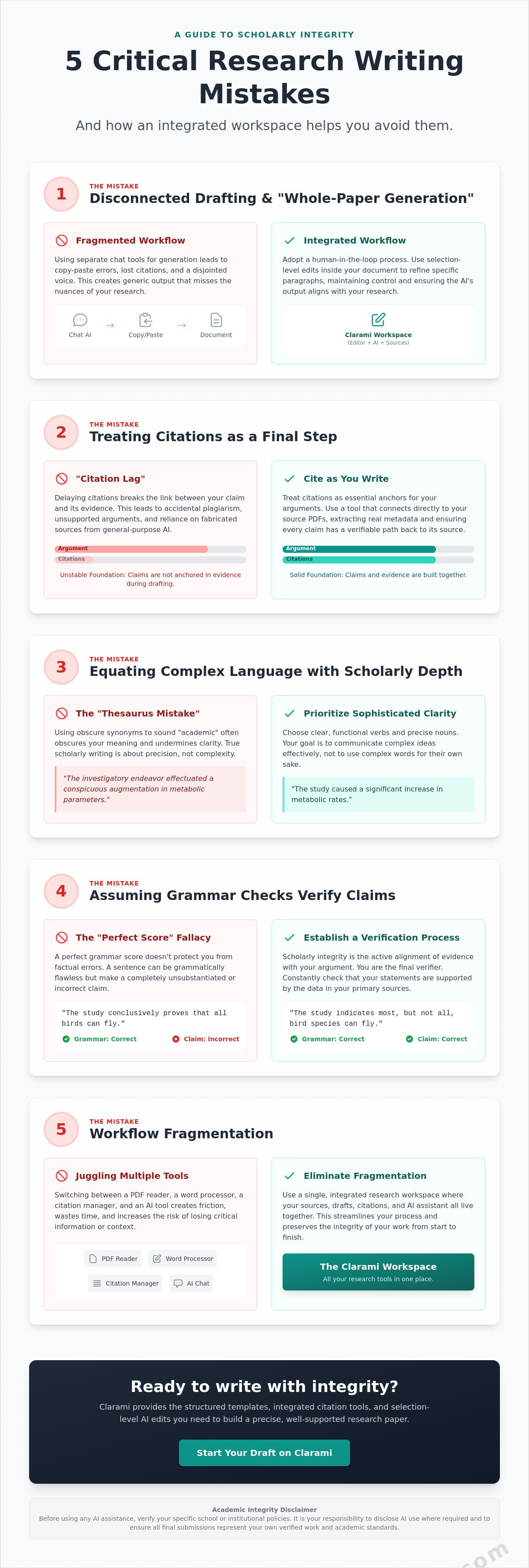
Scholarly integrity is often misunderstood as a passive state of being "correct." In reality, it's the active and continuous alignment of your evidence with your argument. You're the lead investigator. Every sentence must reflect your specific insights and the data you've gathered. One of the most significant pitfalls in modern academia is the move toward "whole-paper generation." This approach creates a generic output that fails to address the unique nuances of your research. Avoiding common research writing mistakes requires a shift toward a human-in-the-loop methodology. In this workflow, the AI acts as a sophisticated drafting partner, but you maintain the intellectual direction and final verification.
Academic Integrity Disclaimer: Before using any AI assistance, verify your specific school or institutional policies. It's your responsibility to disclose AI use where required and to ensure that all final submissions represent your own verified work and academic standards.
To better understand the foundational errors that can impact your work, watch this helpful video:
### The danger of disconnected draftingAvoiding common research writing mistakes often involves fixing your workflow. A fragmented workflow is a primary source of technical inaccuracies. When you move text between a separate chat interface and your document, you introduce the risk of "copy-paste errors." These errors aren't just about formatting. They involve the loss of citation metadata and the disruption of your logical progression. Relying on bulk text generation often results in a document that feels disjointed or lacks a cohesive voice. Instead, prioritize selection-level edits. By focusing on rewriting specific paragraphs rather than whole sections, you ensure the content remains precise. Using features like "suggest-mode" allows you to review and refine AI-generated drafts, maintaining total control over your scholarly tone.
Establishing purpose and tension early
A frequent error in academic composition is the "elusive purpose" mistake. This occurs when a writer fails to define their research question or central tension within the first paragraph. Without this anchor, the reader struggles to understand the relevance of your data. You can avoid this by using structured templates matched to specific academic rubrics. These templates guide the organization of your claims, ensuring every paragraph serves the core argument. When you connect Clara directly to your primary source material, the assistant helps you extract relevant methodology and data. This keeps your draft grounded in evidence rather than abstract filler, ensuring your claims are always substantiable.
Why the "citations come last" approach is a critical research writing mistake
Treating citations as a final formatting step is one of the most persistent myths in academic writing. You might think the bibliography is an administrative cleanup task to be handled once the "real" writing is done. This approach is a critical error. Citations are the anchor points for every claim you make. When you delay referencing, you risk "citation lag." This is the moment where the logical link between a paraphrase and its specific source becomes blurred or lost entirely. Avoiding common research writing mistakes means verifying the connection between your argument and the evidence in real-time.
General-purpose AI tools often contribute to this problem by generating fabricated DOIs or non-existent URLs. This happens because those tools aren't grounded in real PDF metadata. They predict what a citation should look like rather than extracting facts from a source. To maintain scholarly integrity, your workflow must prioritize traceability. Every sentence should be a verifiable path back to a primary source. Using a dedicated research workspace helps you maintain this connection by keeping your source material and your draft in the same environment.
Common citation and referencing errors
Disorganized PDF management is a primary cause of misattribution. When your research material is scattered across folders and browser tabs, you're likely to attribute a finding to the wrong author. This is a central hurdle in avoiding common research writing mistakes. Another frequent error is the mismatch between in-text citations and the final reference list. If you're using the APA 7th edition or the Chicago Manual of Style 18th edition, the requirements for digital sources and AI-generated content are specific and rigorous. Using outdated or non-peer-reviewed sources for foundational claims can also invalidate your entire methodology. Integrity requires that every citation matches the current standards of your discipline.
Integrating sources into the drafting process
Your drafting process should be inseparable from your sourcing. Instead of writing in a vacuum, use a citation helper to surface real sources as you compose. This allows you to build automated citations in APA, MLA, or Chicago styles while the draft is still active. By anchoring your arguments as you go, you ensure that your work remains grounded in evidence. This methodical approach reduces cognitive load and eliminates the stress of "finding the source" days after the text was written. It turns a disorganized collection of notes into a polished, verified output. To begin building a more traceable and accurate draft today, you can set up your research workspace.
Debunking the belief that complex language equals scholarly depth
Sophistication isn't found in a thesaurus. You might feel pressured to replace functional verbs with multi-syllabic synonyms to appear more academic, but this often backfires. This behavior leads to the "thesaurus mistake," a primary hurdle in avoiding common research writing mistakes. True scholarly depth is characterized by clarity and precision. When you use obscure language to mask a simple point, you lose the reader's trust. Clarity is the highest form of sophistication in professional research because it demonstrates a total command of the subject matter.
Nominalization is another structural issue that compromises your draft. This occurs when you transform active verbs into heavy, stagnant nouns. For example, changing "the researchers analyzed" to "an analysis was conducted by the researchers" adds unnecessary weight. It slows down the reader and obscures the action of your study. A Draft Tone Checker helps you identify these patterns, allowing you to maintain a precise and authoritative voice. By prioritizing active structures, you ensure that your intellectual agency remains at the forefront of the document.
Achieving precision without jargon
Precision requires you to distinguish between essential technical terminology and unnecessary complexity. Every field has specific terms that act as shortcuts for complex ideas, but using them outside that context creates a barrier. You should also identify and remove "filler" phrases. Expressions like "it is interesting to note that" or "due to the fact that" increase your word count while subtracting meaning. Writing for an international audience makes accessible sentence structures even more vital. If your work is being read by ESL scholars or global collaborators, clear syntax ensures your findings are understood exactly as intended.
Maintaining a consistent academic persona
Your scholarly voice must remain steady across every section of your paper. It's a common error for the introduction to feel conversational while the methodology becomes dense and impenetrable. This shift in persona can signal a lack of confidence or a disorganized drafting process. Using a Draft Tone Checker allows you to see where your language might slip into overly casual or promotional styles. You should also be mindful of your claims. The mistake of "hedging" too much with words like "possibly" or "maybe" can make your argument seem weak. Conversely, making overconfident, unsupported claims without grounding them in evidence is equally damaging to your integrity. A balanced, steady voice projects the persona of a methodical expert.
For readers who want to learn how a seasoned professional maintains an authoritative voice in complex fields, they can find out more about the work of Dr. Daniel Glauber.
The misconception that grammar checks replace claim verification
A "green light" on a grammar checker is not a signal for submission. You might have a document free of spelling errors and syntax issues, yet it could still fail the test of scholarly integrity. A grammatically perfect sentence can be factually incorrect or entirely ungrounded in evidence. This distinction is vital for avoiding common research writing mistakes that lead to peer-review rejection. Scholarly writing requires a layer of verification that general-purpose editing tools simply cannot provide.
Literature reviews are particularly vulnerable to "AI hallucinations." Broad-market automated tools often predict text patterns rather than extracting data from your specific source material. This leads to the invention of findings or the misrepresentation of a theorist's core argument. Using ClaimShield allows you to verify your arguments against your primary sources. It ensures that every statement you make is a direct reflection of the data in your PDF Manager.
Academic Integrity Disclaimer: Always verify your school's specific policies regarding AI tools. You are responsible for the factual accuracy of your work and must disclose AI assistance according to institutional guidelines.
A three-step verification workflow
Integrity is the result of a systematic process. You should approach your final review through three distinct lenses. First, perform a linguistic check. This covers grammar, syntax, and the consistent use of the Oxford comma. Second, conduct a structural check. Look for logical transitions that guide the reader between paragraphs. This ensures your argument flows naturally from one point to the next. Finally, complete a factual check. This step is the most critical. You must ensure every claim is substantiated by the research you've uploaded. Verification is not a one-time event but a repetitive cycle of refinement.
Avoiding the "unsupported statement" trap
Sweeping generalizations are a common pitfall in academic drafts. You might find yourself making broad claims about "all researchers" or "universal trends" without empirical evidence to back them up. Identifying these unsupported statements is essential for maintaining a professional tone. Check your data against your discussion section to ensure your conclusions don't overreach your findings. Avoiding common research writing mistakes requires you to anchor every assertion in a specific data point. Using an in-app editor allows you to rewrite weak claims while staying connected to your original source material. You can verify your claims and strengthen your arguments by creating your Clarami account.
Avoiding workflow fragmentation with an integrated research workspace
Workflow fragmentation is a silent drain on scholarly productivity. When you move text between a chat interface and a separate word processor, you risk the "copy-paste error." This isn't just about losing italics or bold text. It involves the critical loss of citation metadata and the disruption of your logical flow. Avoiding common research writing mistakes requires a unified environment where your sources and your draft exist in a single view. An intelligent research workspace reduces the cognitive load of tracking multiple browser tabs and document versions. It keeps your intellectual agency at the center of the process.
Academic Integrity Disclaimer: Ensure you verify your school's specific policies on AI tools. You must disclose AI use where required and remain responsible for the final accuracy of your submission.
Streamlining the path from notes to draft
Keeping research notes separate from your drafting environment is a strategic error. It forces you to mentally bridge the gap between evidence and argument every time you change windows. This mental context-switching is where technical inaccuracies often occur. Using AutoDraft allows you to synthesize your uploaded research notes into a structured outline without leaving the editor. This ensures your arguments and evidence remain connected in one view. It prevents "logic gaps" where a claim is made but the supporting data remains trapped in a separate file. When the path from notes to draft is linear, your scholarly voice remains consistent. Once your draft is verified, you can export directly to DOCX or LaTeX, ensuring your structural integrity remains intact during the transition to a final file format.
Building confidence through systematic order
The "anxiety of the blank page" is often just a symptom of disorganization. When your PDFs are managed in one place and your editor is pre-loaded with academic templates, the path forward is clear. A methodical approach transforms a collection of disorganized PDFs into a polished, professional output through a steady, instructional workflow. Integrated reference management prevents bibliographical errors at the 11th hour. It ensures that your in-text citations and reference list are perfectly synchronized. This systematic order builds confidence. You aren't just writing; you are substantiating a thesis.
Before you submit, use this final checklist to ensure your work meets the highest standards:
- Integrity: Does the draft reflect your active intellectual direction?
- Verification: Has every claim been anchored in a primary source?
- Formatting: Are the citations consistent with APA 7th, MLA 9th, or Chicago 18th edition requirements?
By following this structured progression, you move from initial research to a verified output with calm assurance.
Advancing your scholarly workflow
Academic excellence is not a byproduct of speed. It's the result of a disciplined, methodical approach to evidence and argument. By shifting your focus from bulk generation to selection-level edits, you maintain the intellectual agency required for high-impact research. Avoiding common research writing mistakes involves more than just a final proofread. It requires a structural commitment to traceability. Integrating your source material directly into your workspace ensures every paragraph is anchored in verified data.
This systematic order reduces the cognitive load of disorganized notes and fragmented workflows. You can move from initial collection to a polished, professional output with calm assurance. Using source-grounded AI assistance, integrated PDF management, and automated APA or Chicago citations helps you maintain rigorous standards without the stress of manual formatting. Note: Always check your institutional policies and disclose AI use where required.
Start drafting your research with Clara today to establish a more precise and ethical workflow. You have the ability to produce work that is both linguistically polished and factually unassailable.
Frequently Asked Questions
What is the most common mistake in academic writing for ESL students?
The most frequent error for ESL writers is the "thesaurus mistake," which involves replacing functional verbs with obscure synonyms to sound more academic. This often leads to a loss of clarity and an inconsistent scholarly voice. You should prioritize active sentence structures and precise technical terminology over complex vocabulary. Using a Draft Tone Checker helps you identify where your language becomes overly dense or unnatural, ensuring your findings remain accessible to a global audience.
How can I avoid AI hallucinations when using a research assistant?
You can avoid AI hallucinations by using a workspace that grounds its assistant in your uploaded PDF metadata rather than general web data. Hallucinations occur when models predict text patterns without referencing primary sources. To prevent this, use ClaimShield to verify every argument against your research material. Maintaining a human-in-the-loop workflow is essential for avoiding common research writing mistakes related to factual accuracy and the invention of non-existent citations.
Is it a mistake to use AI to draft my literature review?
Using AI to draft a literature review is not a mistake if you use it as a structural partner rather than a ghostwriter. The error lies in "whole-paper generation," which lacks the critical analysis required for scholarly work. You should use structured templates to organize your themes and AutoDraft to synthesize your own research notes. Always check your institutional policies regarding AI use and disclose the assistance of tools like Clarami where required.
How do I fix a descriptive literature review and make it more critical?
To fix a descriptive literature review, you must transition from summarizing individual papers to synthesizing overarching themes. A descriptive review simply lists what authors said; a critical review evaluates how those findings interact or conflict. Identify tensions between sources or gaps in the current methodology. Using a workspace that keeps your evidence and arguments in one view helps you see these connections, allowing you to build a more sophisticated and critical analysis.
Why do journals reject papers even if the research is solid?
Journals often reject papers due to structural drafting errors or poor citation hygiene even when the underlying data is rigorous. If your bibliography contains formatting mismatches or your arguments lack logical transitions, reviewers may question your overall attention to detail. Ensuring your document meets current standards, such as the APA 7th edition or Chicago 18th edition, is vital. A methodical verification process ensures your final output reflects the professional quality of your research.
Guide maintained by Clarami AI. If you found this useful, consider sharing it with a classmate or research group.
Clarami AI is a All-in-one AI academic writing workspace for students and researchers. Draft, cite, and revise from outline to submission — in one editor, with traceable citations. Try free. Get started free
Related on Clarami
- Best AI writing tool for students (full guide) →
- AI academic integrity checklist →
- Clarami pricing: Free vs PRO vs Platinum →
- Editor vs ChatGPT for writing →
- Export DOCX, PDF, and hand-in checklist →
- How to outline a paper →
- Prompt to structured essay draft →
- Revise with AI on a selection →
- Sign up free →
- Clarami home →
- More guides on the Clarami blog →