Ai writing control: A guide to granular drafting and academic integrity
Tired of generic AI essays? Our guide to ai writing control teaches you granular drafting to maintain your voice and ensure academic integrity in your work.
Write with structure in Clarami AI
Editor-first AI drafting, citations, and two Workflows for student writing.
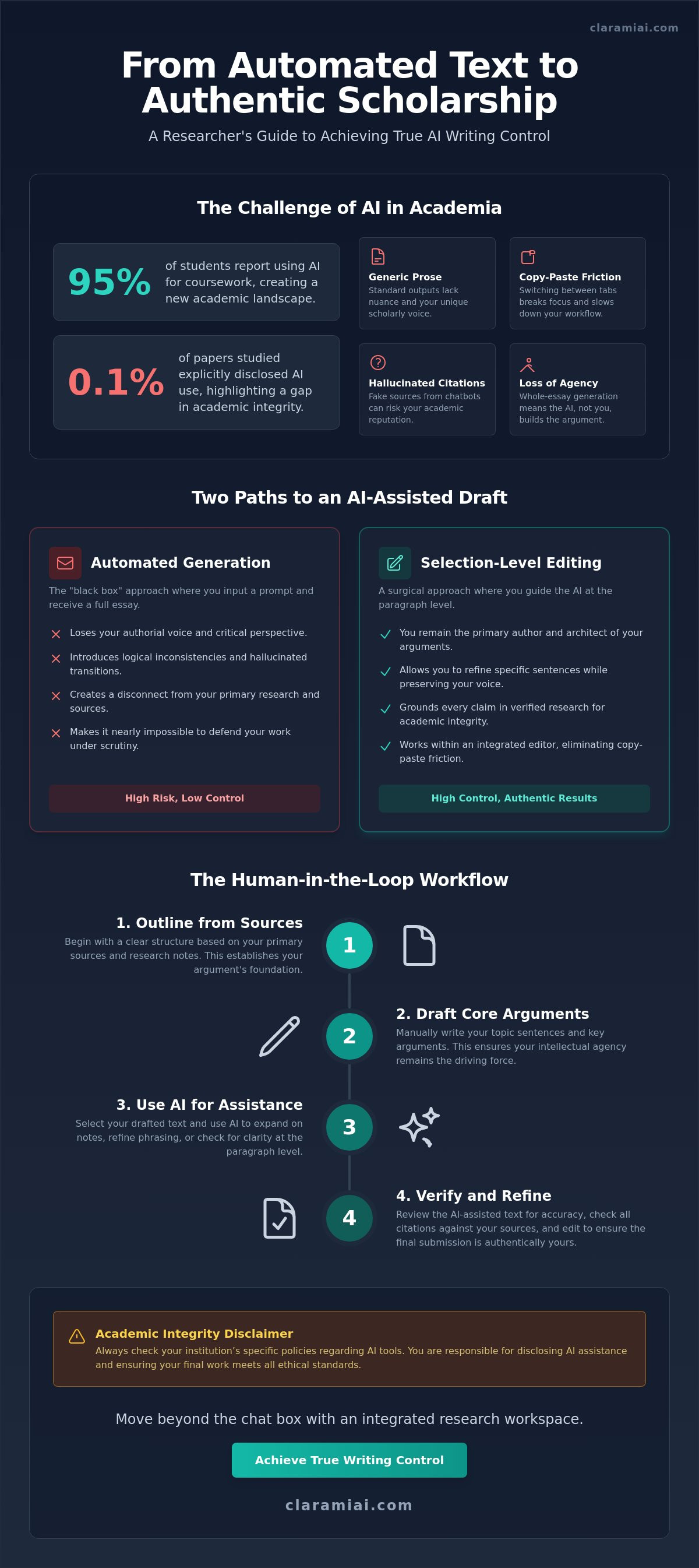
By 2026, 95% of students report using AI to assist with their coursework, yet a study of 75,000 papers found that only 0.1% explicitly disclosed that use. You likely feel the tension between the efficiency of these tools and the rigid standards of academic integrity. The generic, repetitive prose produced by standard chatbots often feels disconnected from your actual voice. You are likely tired of the friction caused by copy-pasting between separate browser tabs and your document, fearing that a single hallucinated citation could derail your scholarly reputation. Achieving true ai writing control requires moving past the broad approach of essay generators toward a more disciplined, methodical workflow.
You can maintain your intellectual agency while utilizing technology to enhance your productivity. This guide shows you how to shift from automated generation to granular, paragraph-level drafting. We will explore a workflow where you remain the primary editor, using tools designed to anchor every claim in your primary sources. You will learn how to integrate research seamlessly into your draft to ensure your final submission is verified and authentically yours.
Academic Integrity Disclaimer: Always check your institution’s specific policies regarding AI tools. You are responsible for disclosing AI assistance and ensuring your final work meets all ethical standards.
Key Takeaways
- Transition from automated essay generation to precise ai writing control by focusing on paragraph-level edits within an integrated document editor.
- Understand why selection-level editing is superior to "black box" generation, giving you the ability to refine specific sentences while maintaining your unique scholarly voice.
- Implement a human-in-the-loop workflow that prioritizes structured outlines and manual drafting of core arguments to ensure you remain the primary author.
- Protect your academic integrity by grounding your drafts in verified research sources, ensuring every claim is substantiated by real data and traceable citations.
- Eliminate the logistical friction of copy-pasting by utilizing an integrated workspace where your research materials and draft exist in a single, unified view.
Table of Contents
- Why AI writing control is the next step for serious researchers
- Generative vs. selection-level editing: Understanding the difference
- Developing a human-in-the-loop workflow for scholarly drafts
- Moving beyond the chat box with an integrated research workspace
- Refining your scholarly workflow
Why AI writing control is the next step for serious researchers
Serious research requires a high degree of precision. When you delegate the entire drafting process to a general-purpose chatbot, you create an agency gap. The machine decides the hierarchy of information. It chooses which evidence to prioritize. This often results in a narrative arc that lacks the nuance of your original research notes. Maintaining academic integrity in the age of AI starts with retaining ownership of the logic behind every paragraph. You must remain the architect of your own arguments.
Generic prompts inevitably lead to generic arguments. Large language models are trained to predict the most probable next word, which often results in surface-level analysis and repetitive phrasing. To produce work that meets scholarly standards, you need ai writing control. This means moving away from the "author" model and toward a "sophisticated research assistant" model. By controlling the output at a granular level, you eliminate the common stylistic tells that make automated prose recognizable to instructors and peer reviewers. This methodical approach ensures your voice remains the dominant force in the text.
To see how specific prompting and granular adjustments change the quality of your output, watch this brief demonstration:
### The limitations of whole-document generationGenerating an entire essay in one click is a high-risk strategy for any researcher. It often introduces logical inconsistencies where the conclusion contradicts the initial methodology. Transitions are frequently hallucinated, creating links between ideas that do not exist in your actual data. This automated process bypasses the essential cognitive work of synthesis. When the AI builds the house, you lose the ability to explain why every brick was placed in a specific location. This lack of transparency makes it nearly impossible to defend your work during an oral defense or a rigorous peer review. Large-scale generation is a shortcut that sacrifices depth for speed.
Defining the human-in-the-loop approach
A human-in-the-loop approach establishes you as the primary architect of the work. You set the structural boundaries. You define the methodology. Before engaging any tools within an integrated research workspace, you must have a clear outline based on your primary sources. The AI should only assist with the heavy lifting of initial phrasing or expanding on your specific notes. This workflow keeps you in the driver’s seat. The final responsibility for accuracy and ethical disclosure rests with you. This disciplined mindset ensures that your intellectual agency remains intact from the first draft to the final submission.
Generative vs. selection-level editing: Understanding the difference
Most AI tools operate as a "black box." You input a prompt. A complete essay emerges. The problem is simple: you cannot fix what you did not build. When a machine generates an entire narrative arc, you lose the ability to verify the logical progression of individual arguments. True ai writing control requires a shift from this wholesale generation toward selection-level editing. This method allows for a surgical application of technology, where you refine specific sentences or paragraphs rather than the entire document.
Templates also play a vital role in maintaining structural integrity. By using templates matched to specific academic rubrics, you establish clear boundaries for the draft. The assistant operates within your predefined framework, which prevents the logical "drift" often seen in long-form generation. This methodical approach ensures that the resulting text adheres to the required scholarly standards without sacrificing your unique perspective.
The risk of the external chat box
Moving text between a browser and a document creates mechanical friction. You lose context. You lose version history. Every time you copy-paste from an external chat box, you risk introducing formatting errors or losing track of your original source material. An integrated research workspace solves this by keeping your draft and your research in one view. Features like "suggest-mode" allow you to review AI-generated changes as tracked edits, ensuring you maintain full oversight of every modification. If you want to experience this streamlined workflow, you can create a free account to test the integrated interface.
Selection-level control in practice
This granular approach is particularly useful for technical drafting. You might have a paragraph that is factually correct but stylistically dense. Instead of regenerating the entire section, you can use AI to refine the tone of that single paragraph. This preserves your data while improving readability. Consider these common research scenarios:
- Expanding a specific claim: Highlight a sentence and prompt the assistant to add supporting details from your uploaded PDFs.
- Meeting word counts: Shorten a methodology section by 20% while ensuring technical terms remain unchanged.
- Tone adjustment: Shift a section from descriptive to analytical without altering the underlying argument.
By focusing on these selection-level edits, you remain the primary editor. You are not just accepting a machine's output; you are actively shaping the text to meet your specific scholarly needs. This ensures the final submission is a true reflection of your research and critical thinking.
Developing a human-in-the-loop workflow for scholarly drafts
Scholarly drafting is a sequence of deliberate choices. You cannot outsource the narrative logic of a dissertation or a peer-reviewed article to a generative algorithm without losing the essence of your research. A human-in-the-loop workflow ensures that the technology serves your expertise rather than replacing it. By following a structured, three-step process, you maintain absolute authority over the final output. This disciplined approach prevents the machine from steering your argument into generic territory.
Step 1: Establishing the structural foundation
Never ask an AI to "write a paper" from scratch. This broad request forces the model to fill in logical gaps with generic assumptions. Instead, use your primary research notes to build a detailed outline. Map your evidence to specific sections of your draft to ensure every claim is anchored in data. This transition from research notes to first draft is where your unique scholarly voice is established. You are the architect. The outline is your blueprint. By defining the boundaries first, you ensure the AI operates only within your established logic.
Step 2: Targeted drafting with AutoDraft
Once your structure is firm, you can use AutoDraft to generate initial phrasing for specific subsections. This is a primary feature of ai writing control. Rather than generating a whole essay, you might ask for a draft of a descriptive summary or a transition between two complex theories. Within the integrated workspace, your source PDFs remain visible alongside your draft. This visibility allows you to identify immediately if the AI requires more source-grounded information to maintain accuracy. You provide the raw material; the assistant provides the initial structure.
Step 3: The iterative review process
The final step is a rigorous review. Read the AI-suggested sentences aloud. This helps you identify rhythmic patterns that feel robotic or repetitive. Manually adjust the syntax to match your established authorial persona. You must ensure every claim made in the text is supported by your uploaded documents. Check for technical accuracy in your methodology and verify that the tone remains professional. This iterative process transforms a rough draft into a verified, scholarly work. You are the editor. You are the final authority. Accuracy remains your responsibility.
Academic Integrity Disclaimer: Always check your school policies regarding the use of AI tools. You are responsible for disclosing AI use and ensuring the final work is your own.
Academic Integrity Disclaimer: Always check your institutional policies and disclose AI use as required. The human author retains full responsibility for the accuracy, integrity, and originality of the work, regardless of AI involvement. AI tools cannot be listed as co-authors.
General-purpose AI often prioritizes linguistic fluency over factual accuracy. This creates a significant risk for researchers who require absolute precision. To mitigate this, your workflow must transition to a source-grounded model where every generated sentence is anchored in your own library of primary documents. This level of ai writing control ensures that the assistant does not invent data or fabricate supporting evidence. By utilizing ClaimShield, you can verify that AI-suggested text matches the specific methodology and findings within your uploaded PDFs. This proactive approach is far more effective than relying on reactive plagiarism detectors that only identify errors after the draft is complete.
Verifying claims in real time
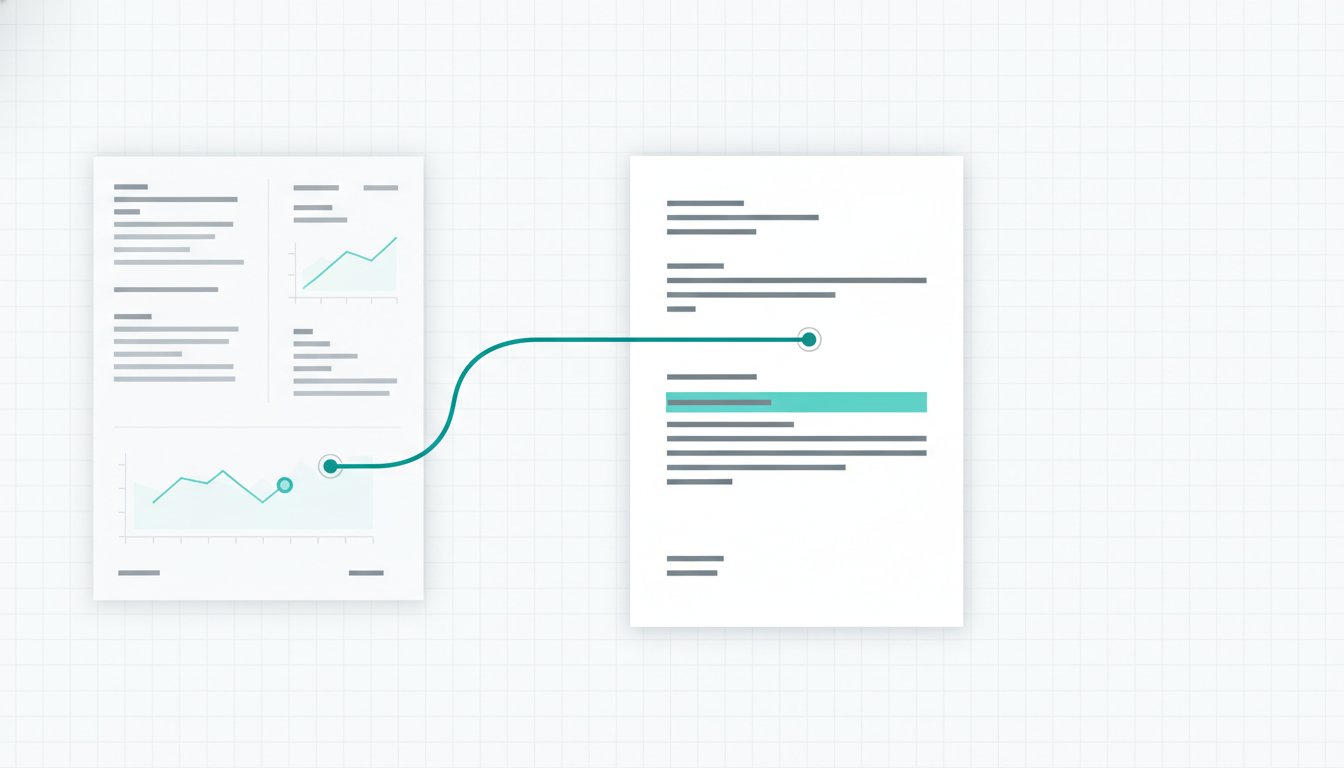
False technical statements often sound plausible. A large language model might confidently describe a chemical reaction or a historical event that never occurred because the sequence of words seems statistically probable. You must use tools that facilitate the structural connection between a statement and its supporting data. Verification is a continuous process. It involves avoiding common research writing mistakes by checking every technical claim against your source material in real time. ClaimShield acts as a digital auditor. It highlights claims in your draft and links them directly to the corresponding page in your research library, ensuring that your arguments remain grounded in reality.
Managing citations with precision
Manual citation building remains a critical skill for any serious scholar. You must be able to distinguish between a real Digital Object Identifier (DOI) and a hallucinated reference created by a machine. Hallucinated references often look perfect; they include realistic titles and author names but lead to non-existent URLs or papers. A reliable citation helper should surface real sources from your research library rather than generating them from scratch. This ensures organizational cohesion and traceability across your entire document. Whether you are formatting for APA, Chicago, or LaTeX, the structural integrity of your bibliography depends on your personal oversight. Establishing rigorous ai writing control means you never accept a citation without a verifiable source. You can start verifying your research claims today by integrating your library with a source-grounded editor.
The immediate availability of supporting data within your workspace acts as a powerful safeguard. It allows you to cross-reference AI suggestions immediately, which is essential for maintaining scholarly rigor. When you control the input sources, you control the integrity of the output. This systematic order is the foundation of professional academic labor.
Moving beyond the chat box with an integrated research workspace
The traditional workflow of switching between a browser-based chat and a word processor is fundamentally inefficient. It fragments your focus. It creates mechanical friction. When your research materials are docked directly next to your active draft, the structural connection between evidence and argument becomes undeniable. This unified environment is the final requirement for total ai writing control. Within this workspace, Clara AI acts as a methodical research companion rather than a ghostwriter. It helps you organize complex data sets without ever taking over the narrative arc of your work.
Collaboration also requires transparency. Using suggest-mode allows you to work with advisors or co-authors in a way that preserves version history. You can accept or reject individual suggestions with a single click, ensuring that no change is made without your explicit approval. This level of oversight is essential for maintaining the scholarly rigor of your project. Once the draft is finalized, export flexibility ensures you can move your work into DOCX or LaTeX for final formatting. You remain in control of the file from the initial note-taking phase to the final submission.
The technical advantage of an integrated editor
Precision is mandatory. An integrated editor reduces cognitive load by eliminating the need for constant window-switching. You don't have to remember which tab contains your methodology or which PDF holds a specific statistic. Selection-level edits allow you to refine the text within the context of the entire document. This prevents the logical "drift" that occurs when you generate text in an isolated chat window. You maintain a clean, organized draft that accurately reflects your intellectual progress. Every paragraph remains anchored to the primary sources visible in your sidebar.
Final steps: From draft to submission
The final polish of a scholarly paper requires a critical eye. Use a Draft Tone Checker to ensure your voice remains authoritative and objective. This tool identifies informal phrasing or repetitive structures that might undermine your argument. You must also conduct a final verification of all cross-references and bibliography entries. Ensure that every DOI is active and every citation matches the corresponding claim in the text. This systematic verification is the hallmark of professional research. You can check the pricing options to find a plan that fits the specific scale of your dissertation or article project.
Academic Integrity Disclaimer: Always check your institutional policies regarding the use of AI tools. You are responsible for disclosing AI use and ensuring that the final work meets all ethical and scholarly standards.
Refining your scholarly workflow
Transitioning from broad AI generation to precise ai writing control is the foundation of modern scholarly rigor. You can maintain your intellectual agency by focusing on granular, selection-level edits within a single, unified workspace. This methodical approach eliminates the logistical friction of copy-pasting between disconnected chat boxes and your document. It keeps your focus on the structural connection between your evidence and your arguments.
By utilizing ClaimShield, you ensure that every technical claim is substantiated by your own research library. Integrated citation management further reinforces the structural integrity of your draft, protecting you from the risks of hallucinated references. You are the primary architect of your work. The tools you use should reflect that responsibility and prioritize your authorial voice. Start your next research project in the Clarami workspace to establish a workflow that values accuracy and scholarly transparency. Your commitment to academic integrity defines your professional identity.
Academic Integrity Disclaimer: Always check your institutional policies and disclose AI use as required. You are responsible for the accuracy and originality of your final submission.
Frequently Asked Questions
How do I maintain my unique voice when using AI writing control?
Establish your unique voice by manually drafting your core arguments and using the assistant only for specific hurdles like transitions or descriptive summaries. Selection-level edits allow you to refine small portions of text without overwriting your established authorial tone. By keeping the AI in a "suggest-mode," you can review and adjust stylistic changes to ensure the final output reflects your personal scholarly perspective.
What is selection-level editing and why is it better than prompting?
Selection-level editing is the process of highlighting specific sentences or paragraphs for the AI to rewrite, expand, or shorten within your document. Unlike broad prompting, which generates entire sections from scratch, this method provides granular ai writing control. It prevents the "black box" problem where you lose oversight of the narrative logic and ensures the assistant only modifies the specific text you choose.
Does using AI for drafting count as academic plagiarism?
Plagiarism policies vary by institution, but most academic bodies define it as representing another’s work as your own. While using AI to assist with phrasing is increasingly common, presenting unedited AI text as original research can lead to integrity violations. You must always disclose your use of these tools and check your school's specific "traffic light" policies for each assignment.
How can I verify if an AI-generated claim is actually supported by my sources?
You can use ClaimShield to cross-reference AI-generated statements with your uploaded research library. This tool highlights technical claims and links them directly to the corresponding page in your primary source PDFs. This systematic verification ensures that no "plausible-sounding" but false technical statements remain in your final draft.
Why is copy-pasting from a chat box risky for research integrity?
Copy-pasting fragments from an external chat box often leads to a loss of context and version control. It increases the mechanical friction of drafting and makes it easier to accidentally introduce hallucinated citations or formatting errors. An integrated editor keeps your research and draft in one view, which is essential for maintaining ai writing control and ensuring every claim remains traceable.
What is source-grounded AI and how does it work in a workspace?
Source-grounded AI is a system that restricts the assistant's output to the data found within your provided documents. In a workspace, the AI analyzes your uploaded PDFs and notes to generate drafts based only on those specific materials. This prevents the assistant from pulling generic or inaccurate information from its training data, keeping your work anchored in verified evidence.
Academic Integrity Disclaimer: Always check your institution’s specific policies regarding AI tools. You are responsible for disclosing AI assistance and ensuring your final work meets all ethical standards.
Related on Clarami
- Best AI writing tool for students (full guide) →
- AI academic integrity checklist →
- Clarami pricing: Free vs PRO vs Platinum →
- Editor vs ChatGPT for writing →
- Export DOCX, PDF, and hand-in checklist →
- How to outline a paper →
- Prompt to structured essay draft →
- Revise with AI on a selection →
- Sign up free →
- Clarami home →
- More guides on the Clarami blog →