From research notes to first draft: A methodical guide to academic synthesis
Bridge the gap from research notes to first draft with our methodical guide. Learn to synthesize sources and structure your academic paper without losing mom...
Write with structure in Clarami AI
Editor-first AI drafting, citations, and two Workflows for student writing.
74% of university students report using generative AI to overcome writer's block. This statistic highlights the common, stressful gap between completing your reading and beginning your manuscript. You've likely spent hours annotating PDFs and collecting data, only to find the transition from research notes to first draft feels like an insurmountable hurdle. It's frustrating to watch your momentum stall because you're worried about losing the connection between a specific claim and its original source.
You deserve a workflow that respects the rigor of your research. This guide provides a systematic, repeatable method for academic synthesis that eliminates the tedious cycle of copy-pasting between disparate apps. You'll learn how to use a specialized AI writing tool for students to transform disorganized fragments into a structured, source-grounded draft. We'll walk through the process of organizing evidence, using integrated templates, and refining your prose within a unified editor. Note: Always check your institution's specific policies regarding AI assistance and ensure you disclose its use according to their guidelines to maintain academic integrity.
Key Takeaways
- Identify and bridge the "synthesis gap" by moving from chronological reading highlights to thematic evidence clusters.
- Establish a systematic workflow to manage the transition from research notes to first draft without losing the connection to your primary sources.
- Apply the "notes on notes" method to organize your evidence, ensuring every argument is substantiated before you begin writing.
- Utilize a unified research environment to eliminate the friction of switching between note-taking apps and word processors.
- Maintain your individual scholarly voice through human-led editing and verification of all draft components.
Table of Contents
- Understanding the friction between research notes and the first draft
- Organizing your evidence for structural synthesis
- Drafting with integrity: Transforming fragments into arguments
- Refining the voice and verifying claims
- Optimizing your workflow in a unified research workspace
Understanding the friction between research notes and the first draft
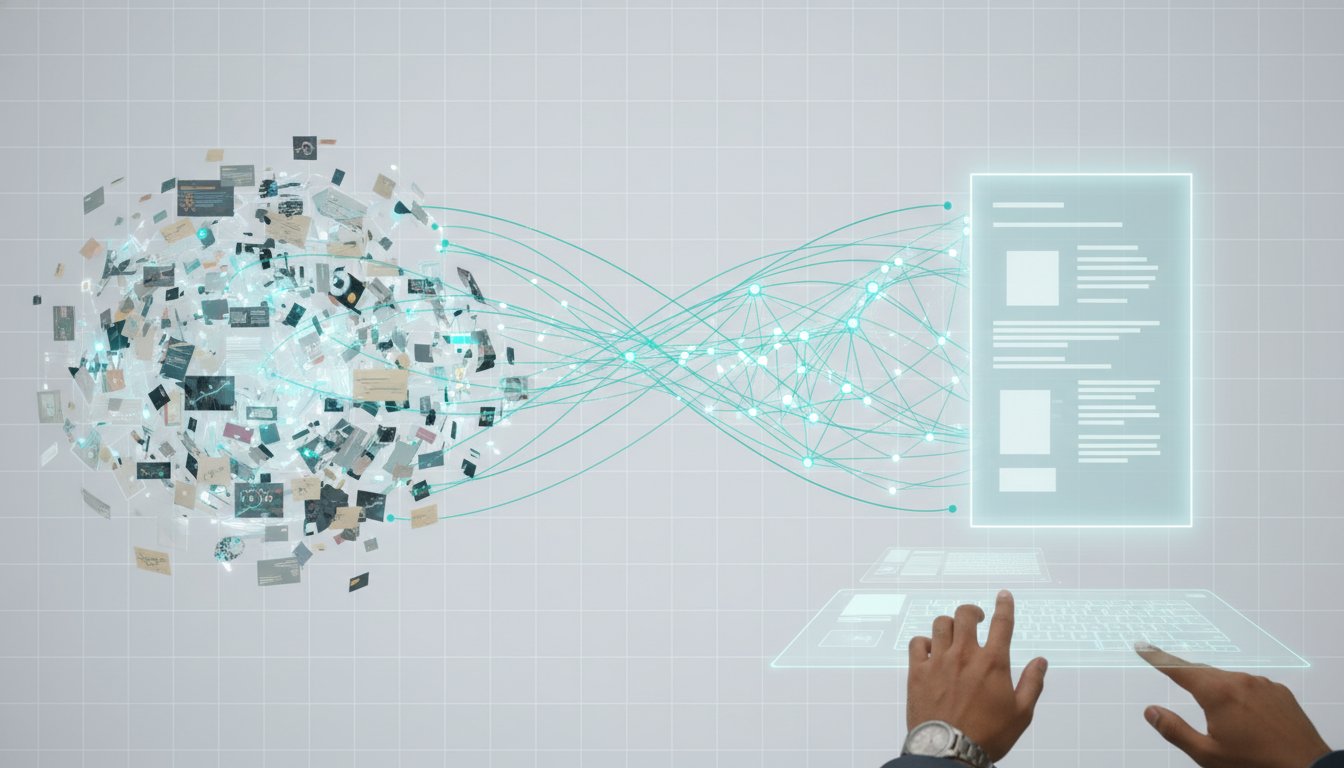
The transition from research notes to first draft represents the most significant hurdle in the scholarly workflow. This "synthesis gap" occurs when a researcher possesses a wealth of data but lacks a clear structural path to transform those fragments into a cohesive narrative. It's a state of cognitive paralysis. You have the evidence; you simply cannot find the logic to arrange it. This friction often leads to weeks of stagnation despite a completed research phase.
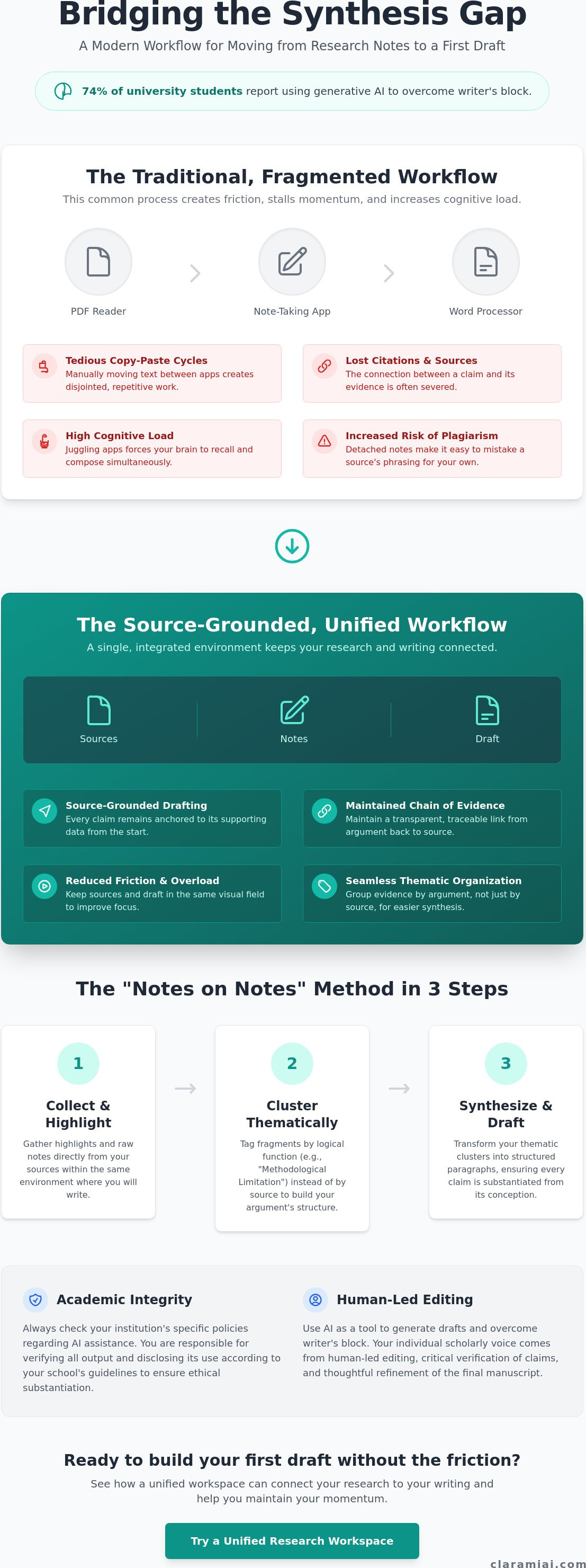
Traditional workflows often exacerbate this issue. Moving text between a PDF reader, a separate note-taking app, and a word processor creates a fragmented environment. This copy-paste method frequently results in lost citations and diluted arguments. By the time a sentence reaches the final document, its connection to the primary source is often obscured or entirely severed. In 2026, the modern standard has shifted toward source-grounded drafting. This approach ensures that every claim is anchored to its supporting data from the moment of its inception, maintaining a transparent chain of evidence.
To better understand the practical reality of starting your initial manuscript, watch this helpful video:
Academic integrity is a personal and professional responsibility. Always check your specific school policies regarding AI assistance and ensure you disclose its use where required. You're responsible for verifying all output against your original sources to ensure accuracy and ethical substantiation.The cognitive load of the blank page
Starting from a blank page is inefficient. It forces the brain to perform two heavy tasks simultaneously: recall and composition. When your research is stored in a separate application, the mental energy required to retrieve information competes with the energy needed to write. This disconnect increases the risk of accidental plagiarism. When notes are detached from their origins, it's easy to mistake a source's phrasing for your own. Utilizing an integrated workspace reduces this friction by keeping your sources and your draft in the same visual field. Structural integrity remains intact.
Moving from collection to synthesis
There's a fundamental difference between collection and synthesis. Collection is the act of gathering highlights. Synthesis is the act of connecting those highlights to form a new argument. Your first draft is not a finished product; it's a rough map of your intellectual territory. It's a structural foundation. Maintaining traceability is essential during this stage. Every claim you make must remain anchored to its source to ensure long-term accuracy and ease of revision.
Organizing your evidence for structural synthesis
Organizing research is a structural challenge rather than a clerical one. The "notes on notes" method requires you to treat your initial highlights as raw material for a secondary layer of analysis. Instead of simply reviewing what you found, you actively categorize fragments based on their logical function within your argument. This transition from chronological notes to thematic clusters is the most effective way to move from research notes to first draft without losing your intellectual momentum. By grouping information by topic rather than by the source it came from, you begin to see the architecture of your paper before you write a single paragraph.
Academic integrity remains your primary responsibility during this organizational phase. You must disclose the use of AI assistants in your workflow if required by your institution and verify that your thematic clusters accurately reflect the original intent of the primary sources. To begin organizing your thematic clusters in a unified workspace, you can create a project environment to keep your evidence and draft physically connected.
Thematic grouping of research fragments
Effective synthesis begins with tagging your notes by argument. Instead of labeling a note as "Smith (2023)," label it "Methodological Limitation" or "Economic Impact." This allows you to identify "claim gaps" where your current research is insufficient to support a planned section. A synthesis matrix is a useful tool here. It allows you to see how different authors converse on the same topic, highlighting areas of consensus or disagreement. This matrix serves as the factual foundation for your narrative, ensuring your draft is grounded in a multi-perspective analysis rather than a summary of a single source.
Building a reverse outline from your notes
A reverse outline starts with the evidence you already possess. You draft your headings based on the strongest clusters of data rather than an abstract idea of what the paper should be. This method ensures that every section of your manuscript is substantiated. A rigorous standard is to ensure each H2 header is supported by at least three distinct data points or citations. If a section lacks this density, it requires further research. You can use Clara to query your existing PDF collection for specific methodology details or missing statistics that can fill these gaps. This targeted retrieval keeps you focused on composition rather than manual searching. Using structured templates during this stage provides a skeleton that aligns with specific academic rubrics, helping you maintain a logical flow throughout the synthesis process.
Drafting with integrity: Transforming fragments into arguments
Drafting is the stage where structural planning meets linguistic execution. Transitioning from research notes to first draft requires a disciplined approach to ensure that your argument remains tethered to your evidence. Academic integrity is paramount during this phase. You must always check your institution's specific policies regarding AI assistance and ensure you disclose its use where required. The responsibility for verifying the accuracy of every claim and citation remains entirely yours.
To maintain a high standard of scholarly rigor, follow this systematic five-step workflow within a unified workspace:
- Step 1: Upload all relevant PDFs and notes into a single project environment to centralize your source material.
- Step 2: Use an in-app editor to keep your source library physically adjacent to your drafting space, eliminating the need to switch between windows.
- Step 3: Draft paragraph by paragraph, intentionally anchoring every claim to a specific source fragment before moving to the next point.
- Step 4: Utilize "suggest-mode" for AI assistance. This ensures you remain the primary editor while the software provides structural suggestions or transitions.
- Step 5: Build citations in real-time using a built-in generator for APA, MLA, or Chicago styles to prevent formatting errors later.
The "no copy-paste" workflow
Selection-level drafting is superior to whole-document generation. It allows you to maintain total control over the narrative arc of your paper. By using AutoDraft to expand on a specific research note, you can generate a rough sentence structure that maintains the context of your original highlight. This "human-in-the-loop" approach requires you to edit AI-suggested transitions and refine the prose to match your individual voice. It's a collaborative process where the software handles the mechanical expansion while you provide the intellectual direction.
Maintaining the citation trail
Waiting until the end of a project to format your bibliography is a common research writing mistake that often leads to missing data or incorrect DOIs. Real-time source anchoring ensures that every statement in your manuscript is traceable to its origin from the start. Utilizing integrated tools to format bibliography entries as you write reduces the time spent on mechanical formatting. This disciplined habit protects the structural integrity of your project and simplifies long-term management, especially when dealing with complex, multi-source arguments.
Refining the voice and verifying claims
A completed draft is rarely a finished argument. At this stage, your manuscript likely resembles a dense collection of evidence rather than a flowing narrative. The transition from research notes to first draft often results in a rough output that requires significant refinement to meet scholarly standards. You must now shift your focus from assembly to verification. This involves checking for tone consistency and ensuring that every claim remains tethered to its original source. Before finalizing your work, always check your institution's specific guidelines on AI usage and ensure all assistance is disclosed as required.
ClaimShield and factual verification
Verification is the final gatekeeping step for academic integrity. It's essential to verify AI citations to ensure that no hallucinations occurred during the drafting process. Hollow claims, which are statements that sound authoritative but lack specific data backing, must be identified and corrected. You can cross-reference your draft against your original PDF library automatically to confirm that every statistic and methodology detail is accurate. This process ensures that your synthesis is grounded in reality rather than algorithmic probability. You can start verifying your research claims by uploading your source library to a secure project workspace.
Polishing for academic rigor
Precision and clarity are the hallmarks of professional scholarship. An objective tone is necessary for credibility. Using an academic writing tone checker helps you identify informal language or subjective qualifiers that weaken your argument. This isn't just about grammar; it's about structural integrity. While AI tools can suggest transitions, the human voice must lead the argument. You are responsible for the intellectual direction and the final synthesis of ideas. Humanizing the draft means ensuring the logic follows your specific research question and adheres to the required academic rubrics. Review the following elements during your final pass:
- Identify and remove subjective adjectives that lack empirical support.
- Ensure that every paragraph transitions logically to the next point in your reverse outline.
- Verify that the evidence provided directly substantiates the claim made in the topic sentence.
- Check that all in-text citations match the entries in your bibliography.
Finalizing a draft requires a disciplined eye. By prioritizing verification over creative flair, you ensure that your work stands up to the rigors of peer review or faculty assessment. Accuracy is the foundation of scholarly trust.
Optimizing your workflow in a unified research workspace
Managing the transition from research notes to first draft within a fragmented multi-app stack often leads to intellectual exhaustion. When your data lives in one application and your manuscript in another, the constant context switching degrades your cognitive focus. A single, unified environment is superior because it maintains the physical proximity of your evidence to your arguments. This structural cohesion ensures that your research remains a living part of your composition process rather than a static archive. Traceable evidence. Structured output. Professional integrity.
Academic integrity is a core requirement for all scholarly work. You must check your institution's specific policies regarding the use of AI tools and ensure you disclose their application where required. You're the final authority on the accuracy and ethical standing of your submission. Verification is not an optional step; it's a fundamental responsibility of the researcher.
The Clarami advantage for researchers
The synergy between AutoDraft and Clara allows you to bridge the synthesis gap with precision. AutoDraft provides the structural framework for expanding fragments, while Clara acts as a specialized assistant for retrieving specific methodology details from your library. This integration eliminates the friction of switching between reading and writing. Your data remains immediate. Security is also a primary concern for professional labor. A dedicated integrated workspace keeps your research data safe in a professional environment, protecting your intellectual property throughout the drafting cycle.
Next steps for your manuscript
Moving forward requires a methodical approach to organization. Your PDF Manager acts as a long-term asset, preserving annotations and metadata for future projects. This prevents you from repeating the same preliminary research in later semesters. Utilizing a specialized AI writing tool for students streamlines these final stages. To begin your next manuscript from research notes to first draft, follow these procedures:
- Select a template matched to your specific academic rubric to provide an immediate structural skeleton.
- Use the In-App Editor to maintain your citation trail while drafting.
- Invite collaborators to "suggest-mode" for feedback. This ensures you remain the primary editor while benefiting from peer review.
- Perform a final pass using the Draft Tone Checker to ensure scholarly precision.
Once your draft is verified, you can export the document directly to DOCX or LaTeX for final submission. This preserves your formatting and bibliography entries. A systematic workflow reduces the mechanical burden of formatting, allowing you to focus on the quality of your argument. Professional synthesis is a disciplined process. It requires a reliable intellectual companion to manage the complexity of modern scholarship.
Establishing a systematic synthesis workflow
Moving from research notes to first draft doesn't have to be a source of anxiety. By replacing the traditional copy-paste cycle with a thematic organization strategy, you maintain the structural integrity of your argument. You've learned how to bridge the synthesis gap by grouping evidence into logical clusters and using a reverse outline to ground your claims. This methodical approach ensures that your final manuscript is both authoritative and fully substantiated from the very first sentence.
A unified workspace provides the technical framework for this transition. Utilizing an integrated PDF manager keeps your sources adjacent to your writing, while AutoDraft facilitates source-grounded drafting without the risk of losing context. Before submission, tools like ClaimShield offer a final layer of citation verification to protect your scholarly reputation. It's essential to check your school's specific policies and disclose any AI assistance to maintain academic integrity. You're the primary author; the tools simply provide the structure.
You have the evidence and the expertise. Now, you have a repeatable system to bring them together. Start your first draft with Clarami for free and transform your disorganized research into a polished, verified academic narrative.
Frequently asked questions
How do I move from research notes to first draft without feeling overwhelmed?
Moving from research notes to first draft is a structural process rather than a creative leap. You can reduce cognitive load by mapping pre-sorted evidence to a reverse outline before you begin writing. This separates the organization phase from the composition phase, allowing you to assemble substantiated claims rather than inventing text from scratch. This methodical approach ensures your draft remains grounded in your original research data.
Is it ethical to use AI to help turn my notes into a first draft?
AI assistance is ethical when it serves as a structural aid rather than a replacement for your intellectual agency. You must maintain a human-in-the-loop approach, where you're responsible for the final synthesis, editing, and verification of all claims. It's essential to check your institution's specific AI policies and disclose its use where required. Professional workspaces are designed to alleviate mechanical friction, not to bypass the rigors of scholarly labor.
How do I avoid AI hallucinations when drafting from my research notes?
You avoid inaccuracies by using a source-grounded environment that anchors every claim to your uploaded PDF library. Tools like ClaimShield allow you to verify citations against the original source text in real-time. Never accept an automated draft without performing a manual check of the primary data. Verification is the final gatekeeping step for maintaining academic integrity and ensuring that your synthesis is based on verified facts.
Can I use Clarami to manage my citations in APA or Chicago style?
You can use the integrated Citation Generator to format your bibliography in real-time. It supports the APA 7th Edition and the Chicago Manual of Style 18th Edition to ensure your formatting meets current academic standards. By building your citations as you move from research notes to first draft, you prevent the common error of losing citation metadata or formatting DOIs incorrectly during the final revision phase.
How can I ensure my AI-assisted draft still sounds like my own writing?
Utilizing selection-level editing instead of generating whole documents ensures your individual voice remains dominant. By drafting paragraph by paragraph, you can manually refine transitions and adjust the prose to match your scholarly perspective. You can also use a Draft Tone Checker to identify informal language or subjective qualifiers that don't align with your narrative, keeping the intellectual direction of the manuscript under your total control.
Related on Clarami
- Best AI writing tool for students (full guide) →
- AI academic integrity checklist →
- Clarami pricing: Free vs PRO vs Platinum →
- Editor vs ChatGPT for writing →
- Export DOCX, PDF, and hand-in checklist →
- How to outline a paper →
- Prompt to structured essay draft →
- Revise with AI on a selection →
- Sign up free →
- Clarami home →
- More guides on the Clarami blog →