Academic writing tone checker online: Refining your scholarly voice with precision
Use our academic writing tone checker online to refine your scholarly voice. Fix biased phrasing and weak hedging to meet peer-review standards with precision.
Write with structure in Clarami AI
Editor-first AI drafting, citations, and two Workflows for student writing.
Recent data indicates that 86% of higher education students now use AI to assist with their academic work. While these tools aid productivity, the primary challenge remains maintaining a rigorous, scholarly voice that satisfies peer-review standards. You've likely felt the frustration of a supervisor flagging your research for sounding too conversational or subjective. It's a common struggle to balance complex ideas with the precise, neutral language required for formal publication.
Using an academic writing tone checker online allows you to identify biased phrasing and weak hedging language before you submit. You'll learn how to refine your prose to meet strict institutional standards while keeping your intellectual agency at the center of the process. We will examine how a seamless, integrated workflow helps you maintain consistency across your entire manuscript without the need for tedious copy-pasting between different applications.
Academic Integrity Disclaimer: Always verify your university’s AI policies and disclose the use of any writing assistants according to your specific program requirements.
Key Takeaways
- Define the core characteristics of a scholarly voice, focusing on objectivity and evidence-based claims rather than subjective or conversational language.
- Use an academic writing tone checker online to identify specific linguistic markers, such as weak hedging or biased phrasing, that may lower the formality of your manuscript.
- Recognize why general-purpose business tools are often insufficient for research, as they prioritize politeness over the rigorous precision required for peer review.
- Optimize your revision workflow by utilizing an integrated editor that allows for selection-level edits without the need to copy-paste text between multiple applications.
- Maintain your intellectual agency by treating AI-generated suggestions as drafts that require your personal review and alignment with institutional integrity policies.
Table of Contents
- The role of scholarly tone in academic discourse
- How an academic writing tone checker online analyzes prose
- Comparing general tone detectors with scholarly checkers
- Practical steps to adjust your writing style
- Integrating tone refinement into your research workflow
The role of scholarly tone in academic discourse
Scholarly tone is the foundation of research credibility. It isn't a stylistic ornament. It's a structural necessity that signals your adherence to the scientific method. A scholarly tone in academic discourse relies on objectivity and evidence-based claims to build trust with peer reviewers. When you use an academic writing tone checker online, you're not just fixing typos. You're ensuring your voice reflects the rigor of your methodology. This process helps you avoid the trap of using overly complex jargon to mask a lack of data. Instead, you'll produce prose that is both accessible to your peers and uncompromising in its precision.
Academic Integrity Disclaimer: Always check your institution’s specific policies regarding AI tools and disclose their use as required by your department. While the Clara AI Assistant helps you draft, you're responsible for the final manuscript's voice and accuracy. Your intellectual agency must remain at the center of every stylistic choice you make during the revision process.
The balance between confidence and academic humility
Expert writing requires a careful navigation of "hedging" language. You must learn how to express uncertainty without appearing weak or unprepared. Phrases like "the evidence suggests" or "it's probable that" demonstrate that you understand the limits of your data. This is a marker of intellectual honesty. An academic writing tone checker online helps you identify absolute statements that you can't actually substantiate. By refining these sentences, you transition from a student voice that merely reports to an expert voice that interprets findings with appropriate academic humility.
Recognizing common tone mistakes in research
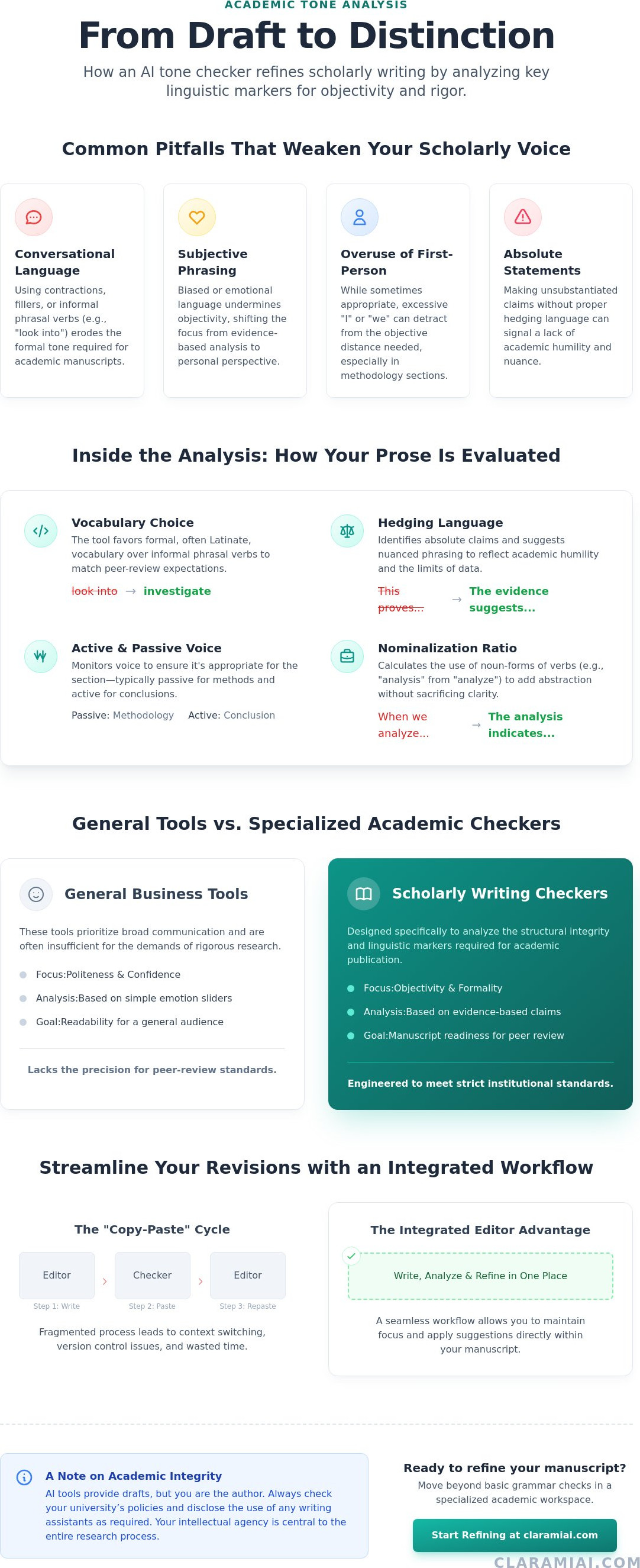
Informal habits can easily compromise research neutrality. Eliminating conversational fillers and informal contractions is a basic requirement for any formal paper. You should also reduce the use of first-person pronouns where objective distance is required to keep the focus on the methodology. Correcting biased or emotional language prevents your personal perspectives from overshadowing your results. These methodical corrections ensure your arguments remain focused on the evidence rather than your feelings. By recognizing these common errors, you build a manuscript that stands up to the scrutiny of the most rigorous peer-review panels.
How an academic writing tone checker online analyzes prose
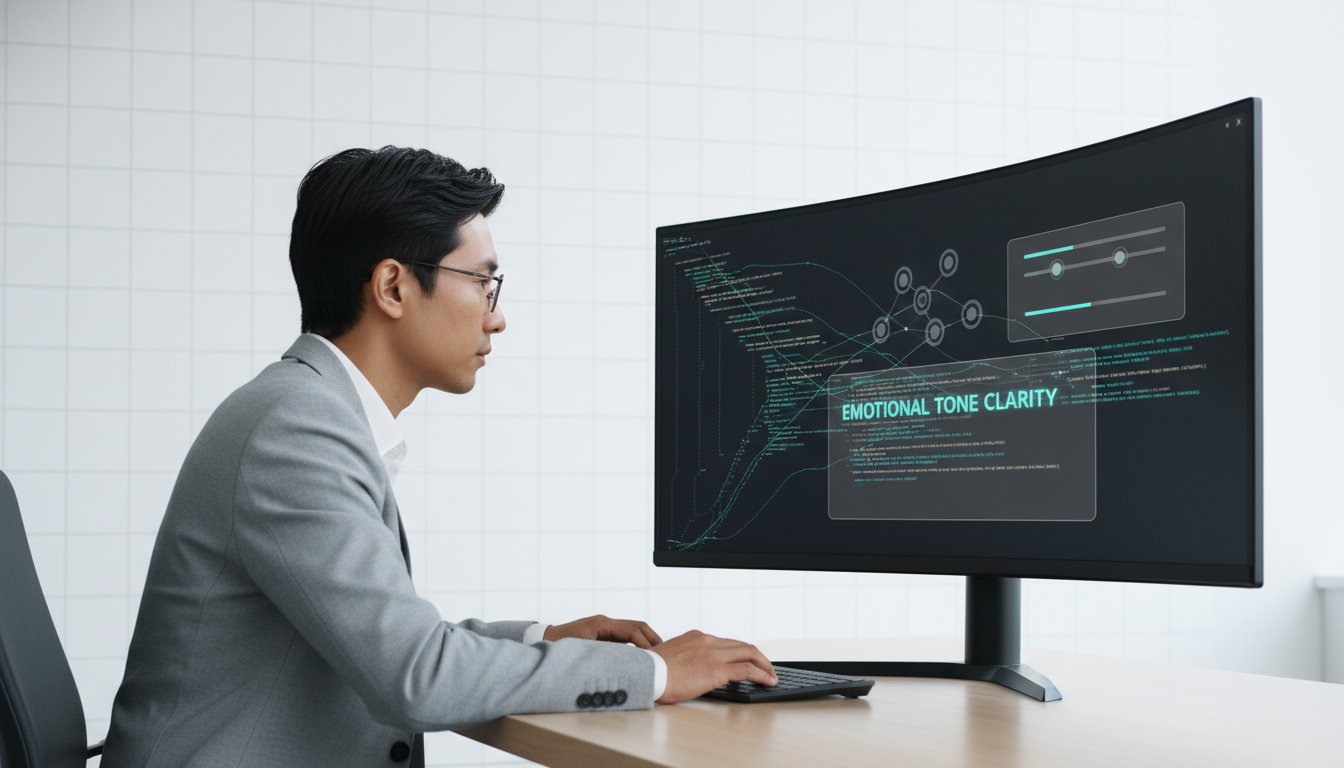
Scholarly tone is quantifiable. An academic writing tone checker online functions by deconstructing your prose into measurable linguistic units. It uses natural language processing (NLP) to evaluate the distance between your draft and established scholarly standards. Unlike generic tools that rely on simplistic emotion sliders for "joy" or "confidence," these algorithms focus on the structural integrity of your arguments. They track objectivity and formality by examining the relationship between your claims and your supporting data.
The analysis begins with vocabulary choice. Algorithms evaluate word frequency and origin to determine the density of your prose. Formal academic writing often favors Latinate roots, such as "investigate," over Germanic phrasal verbs like "look into." This level of refinement into your research workflow ensures your vocabulary matches the expectations of peer reviewers in your specific field. The tool also identifies subjective modifiers and emotional cues that can undermine your neutrality. If you're ready to move beyond basic grammar checks, you can start refining your manuscript within a specialized workspace designed for academic rigor.
Linguistic markers of formal writing
Specific markers determine the authority of your scholarly voice. The algorithm calculates your use of nominalization, which involves turning verbs or adjectives into nouns. While excessive nominalization can cause wordiness, a healthy ratio adds a necessary layer of abstraction to theoretical discussions. The checker also monitors your active and passive voice. Methodology sections often require passive voice to emphasize the process, but your conclusion needs active constructions to anchor your findings. Using an academic writing tone checker online identifies these shifts, helping you maintain a balanced rhetorical profile.
The technology behind tone detection
Modern systems utilize large language models trained on massive scholarly corpora. These models recognize patterns unique to academic disciplines, distinguishing between the rhetorical styles of a legal brief and a clinical trial report. Context-aware analysis prevents the tool from suggesting "polite" business phrasing where a critical, objective stance is required. Real-time feedback is essential here. Addressing tone issues during the composition process is more effective than post-drafting analysis. It allows you to maintain a consistent voice from the first paragraph to the final citation.
Academic Integrity Disclaimer: Always verify your university’s specific policies regarding AI tools. Ensure you disclose the use of any writing assistants as required by your department or publisher.
Comparing general tone detectors with scholarly checkers
General-market tools prioritize social harmony over intellectual rigor. They often measure "joy," "gratitude," or "confidence," which are metrics designed for marketing emails or corporate Slack messages. In a literature review or a methodology section, these emotional benchmarks are irrelevant. An academic writing tone checker online focuses instead on rhetorical metrics such as critical distance, tentative hedging, and objective substantiation. Precision is the goal. While a business tool might flag a sentence for being "unfriendly," a scholarly checker ensures that same sentence maintains the necessary neutrality required for peer review.
The problem with "politeness" filters is that they often strip away the assertive, critical stance needed in research. If you're critiquing a previous study's flaws, a general AI might suggest "softening" your language to avoid sounding harsh. This is a mistake. Scholarly discourse requires you to be direct and evidence-based. Using a tool that understands these nuances prevents your prose from becoming vague or overly conversational. It keeps your writing anchored in the standards of your specific field rather than the standards of customer service.
The limitations of general-purpose AI tools
Generic AI tools often prioritize brevity at the expense of necessary nuance. In research, "wordiness" is sometimes essential for precision. For example, technical terminology like "longitudinal stratified sampling" might be flagged as "complex" by a general tool, which may suggest a simpler but inaccurate alternative. This leads to "hallucinated" style improvements that change your intended meaning. These tools also struggle with nominalization. While business writing avoids it, academic writing often requires it to discuss abstract concepts effectively. A general tool won't distinguish between a clunky sentence and a necessary theoretical framework.
The advantages of a research-specific workspace
A specialized research environment keeps your arguments connected to your evidence while you refine your style. Instead of the disconnected copy-paste workflow of standalone detectors, an integrated editor allows you to perform selection-level edits. You can rewrite a single paragraph for tone without risking the structural integrity of your entire manuscript. This methodical approach ensures that every stylistic change is backed by real data. It's also vital to learn how to verify ai citations to ensure that your polished tone is supported by legitimate, verifiable sources.
Academic Integrity Disclaimer: Always verify your university’s specific policies regarding AI tools. Ensure you disclose the use of any writing assistants as required by your department or publisher.
Practical steps to adjust your writing style
Refining a manuscript requires more than a simple grammar check. You shouldn't treat AI feedback as a set of final corrections. Instead, view every prompt as a draft that requires your personal verification. When using an academic writing tone checker online, examine how each suggested change affects the nuance of your argument. If a tool suggests a more formal synonym, ensure it still aligns with your specific methodology. Maintaining your intellectual agency is vital for a successful submission. Your role is to act as the final editor, ensuring that the AI’s stylistic suggestions don't distort your underlying logic.
Structured templates keep your work aligned with specific academic rubrics. This prevents you from drifting into narrative styles that don't belong in a research paper. Refining transitions between paragraphs is another mechanical step that improves the logical flow of evidence. Instead of repeating basic connectors, use phrases that demonstrate the relationship between data points. Eliminating repetitive sentence starters also keeps the reader engaged with your ideas rather than your syntax. This methodical approach ensures your voice remains consistent across the entire document.
Refining your methodology and results
Your methodology section must remain purely descriptive and objective. This is not the place for narrative flair or personal reflection. Use precise verbs to describe data trends and statistical significance. Instead of stating a result was "notable," specify that it was "statistically significant at the p < 0.05 level." Avoid hyperbole when discussing the implications of your findings. A grounded, cautious tone reflects the reality of your data and builds credibility with peer reviewers. Precision in these sections anchors your arguments in verifiable facts.
Mastering the literature review
Evaluating the work of other scholars requires a critical but respectful tone. Use synthesis to connect different voices in your field rather than listing them in isolation. This demonstrates your ability to navigate complex scholarly conversations. Ensure your own voice remains distinct from the sources you cite. You are the curator of the research, and your tone should reflect that authority. By maintaining a neutral stance, you show that your conclusions are based on a balanced analysis of existing literature.
Academic Integrity Disclaimer: Always check your institution’s specific policies regarding AI tools. You must disclose the use of any writing assistants as required by your department or publisher. While tools provide drafts, the final manuscript remains your responsibility.
To start refining your scholarly voice with precision and structural integrity, create your Clarami account today.
Integrating tone refinement into your research workflow
Effective research requires a unified environment. You shouldn't have to break your focus by moving text between a word processor and a standalone AI interface. This disconnected model often leads to formatting errors or a loss of structural context. By using an academic writing tone checker online that is built directly into your editor, you maintain a steady cognitive flow. This integration ensures that every stylistic adjustment remains anchored to your original research goals and data. A seamless transition from drafting to refining is what distinguishes a professional scholarly process from a disorganized one.
Maintaining a "human-in-the-loop" approach is essential for academic integrity. AI tools should provide drafts and suggestions, but you remain the primary architect of your work. You are responsible for the final manuscript and the accuracy of its claims. An integrated system supports this by keeping your supporting evidence within sight while you edit. This ensures that as you polish your prose, you don't accidentally drift away from the methodology or data that substantiates your arguments.
The Clarami workspace advantage
Accessing the Clara AI Assistant within your document allows you to refine prose in real-time. You can highlight a single paragraph that sounds too conversational and request a more formal rewrite without affecting the rest of your manuscript. This selection-level precision is essential for maintaining your unique scholarly voice. While you edit, integrated research tools keep your PDFs and primary sources visible in the same window. This proximity allows you to verify that every tone adjustment accurately reflects the evidence in your notes. It eliminates the friction of the copy-paste model, keeping your research and writing connected.
Finalizing your draft for submission
The final stage of your workflow centers on verification and formatting. Once your tone is polished and your claims are verified, you can export your work to DOCX or LaTeX for submission. This process includes a final review of your citations to ensure compliance with your specific style guide. Automated citation checks help catch minor formatting errors that could undermine your credibility. Taking the next step by signing up for a research-first workspace helps you move away from fragmented tools toward a methodical, disciplined writing process. You'll gain a reliable intellectual companion that respects your agency while providing the precision needed for high-stakes academic labor.
Academic Integrity Disclaimer: Always check your university’s specific policies regarding AI tools. You must disclose the use of any writing assistants as required by your department or publisher. Final responsibility for the content and integrity of the submission rests with the author.
Mastering the standards of scholarly publication
Achieving a precise, objective voice is a fundamental requirement for peer-reviewed success. You now understand the distinction between generic business politeness and the critical distance required for research. By moving away from fragmented tools, you ensure your arguments remain anchored in verifiable data. A methodical approach to revision protects the structural integrity of your manuscript while identifying weak hedging or biased language that could undermine your credibility.
Integrating an academic writing tone checker online into your daily workflow eliminates the friction of copy-pasting and keeps your research notes visible. This human-in-the-loop model ensures you remain the primary architect of your work, using AI to provide drafts that you then verify and refine. You can refine your academic voice with Clarami today to access an integrated research editor, source-grounded AI assistance, and automated citation management. These tools work together to keep your writing focused on evidence rather than stylistic flair.
Academic Integrity Disclaimer: Always verify your university’s specific policies regarding AI tools. You must disclose the use of any writing assistants as required by your department or publisher. Final responsibility for the content and integrity of the submission rests with the author. Your research deserves a voice as rigorous as your methodology.
Frequently asked questions
How does an online tone checker distinguish between formal and informal writing?
An online tone checker distinguishes between styles by analyzing vocabulary origins and sentence complexity. It tracks the ratio of Latinate words to Germanic phrasal verbs. For example, it might flag "find out" as informal and suggest "discover" or "determine" for a scholarly profile. It also monitors for subjective modifiers that belong in personal narratives rather than research papers.
Can using a tone checker help me avoid sounding like AI?
Using a tone checker helps you identify the predictable, generic phrasing often associated with unedited AI outputs. By highlighting repetitive sentence structures or vague qualifiers, an academic writing tone checker online prompts you to inject specific, data-driven analysis. This human-in-the-loop process ensures your final manuscript reflects your original intellectual agency rather than a generic machine-generated style.
Is it ethical to use an AI tone checker for my dissertation or thesis?
Using these tools for a dissertation is typically ethical when treated as an editing assistant rather than a ghostwriting service. You must verify your university’s specific policies and disclose AI assistance according to your department's guidelines. The final responsibility for the accuracy of claims and the integrity of the research remains with you as the author.
What is the difference between a tone checker and a grammar checker?
A grammar checker focuses on syntax and spelling rules, while a tone checker evaluates rhetorical style. While a grammar tool ensures your sentences are technically correct, an academic writing tone checker online evaluates if those sentences meet the formality standards of your field. It looks for objectivity and critical distance rather than just subject-verb agreement or punctuation.
How can I ensure my academic writing remains objective?
Objectivity is maintained by replacing emotional qualifiers with measurable data and precise verbs. Instead of describing a result as "impressive," you should provide the specific statistical significance. Avoiding first-person pronouns and absolute statements that lack evidence also helps maintain the neutral, evidence-based stance required for peer-reviewed publication and scholarly credibility.
Do tone checkers work for researchers who speak English as a second language?
Tone checkers are particularly useful for ESL writers because they identify casual idioms that may seem formal in other contexts. They help bridge the gap between conversational fluency and the specific requirements of academic English. By highlighting informal contractions or "false friend" vocabulary, these tools allow non-native researchers to refine their scholarly voice with the same precision as native speakers.
Guide maintained by Clarami AI. If you found this useful, consider sharing it with a classmate or research group.
Clarami AI is a All-in-one AI academic writing workspace for students and researchers. Draft, cite, and revise from outline to submission — in one editor, with traceable citations. Try free. Get started free
Related on Clarami
- Best AI writing tool for students (full guide) →
- AI academic integrity checklist →
- Clarami pricing: Free vs PRO vs Platinum →
- Editor vs ChatGPT for writing →
- Export DOCX, PDF, and hand-in checklist →
- How to outline a paper →
- Prompt to structured essay draft →
- Revise with AI on a selection →
- Sign up free →
- Clarami home →
- More guides on the Clarami blog →