

How to Write a Strong Background of a Study
Struggling with the background of a study? This guide offers a structural template and a better workflow to contextualize your research and prove its necessity.
Write with structure in Clarami AI
Editor-first AI drafting, citations, and two Workflows for student writing.
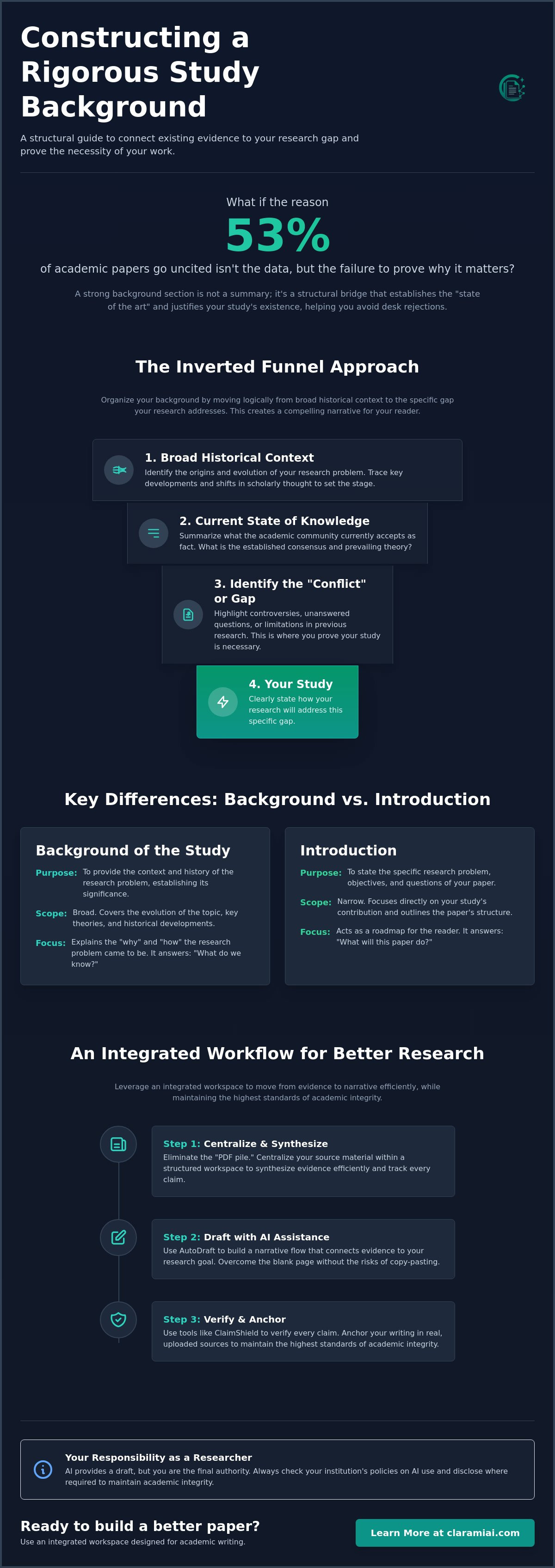
What if the reason 53% of academic papers go uncited isn't the data, but the failure to prove why that data matters in the first place? You've likely spent weeks drowning in PDFs; you're trying to find the exact line where historical context ends and your literature review begins. It's a common struggle to synthesize dozens of sources while maintaining a tone that is both professional and original. Writing the background of a study requires more than a summary of past events. It demands a structural bridge that connects existing evidence to your specific research gap.
This guide will show you how to construct a rigorous background section that contextualizes your research and establishes the necessity of your work. You'll learn a clear structural template, a faster way to synthesize source material, and a workflow to ensure all claims are verified and cited correctly. While tools like Clarami provide structured drafts to help you overcome the blank page, you remain the final authority on the accuracy and depth of your arguments. Please remember to check your institution's specific policies regarding AI tools and disclose their use as required by your school’s academic integrity guidelines.
Key Takeaways
- Identify the origins and evolution of your research problem to establish the "state of the art" and justify your study's existence.
- Apply the "Inverted Funnel" approach to organize the background of a study, moving logically from broad historical context to specific research gaps.
- Centralize your source material within a structured workspace to synthesize evidence efficiently and eliminate the disorganization of the "PDF pile."
- Utilize an integrated editor and AutoDraft to build a narrative flow that connects your evidence directly to your research necessity without the risks of copy-pasting.
- Verify every claim with ClaimShield to anchor your writing in real, uploaded sources and maintain the highest standards of academic integrity.
Table of Contents
- Understanding the background of a study in academic research
- Core components of a rigorous study background
- Evidence synthesis: Organizing literature for contextual depth
- Writing the draft: From evidence to narrative flow
- Verification and integrity: Polishing the background section
Understanding the background of a study in academic research
The background of a study identifies the origins and evolution of your research problem. It isn't a mere chronological list of past events. This section functions as the structural foundation of your entire paper. It establishes the "state of the art" to justify why your study needs to exist right now. By tracing the development of your topic, you demonstrate that you aren't working in a vacuum. You're anchoring your inquiry in established scholarly conversations and substantiating the need for further exploration.
With over 3.4 million scientific papers published worldwide in 2025, journal editors face an immense volume of submissions. They often use the background section to determine if a paper is worth a full review. A weak background often leads to "desk rejections." This happens when you fail to prove that your research addresses a pressing, unresolved issue. A strong background builds immediate trust. It shows you've done the intellectual labor required to move the field forward and connects the dots between what's known and what remains unknown. Just as scholars must navigate these academic requirements, international researchers moving to North America can manage their own transitions using canadapathwaycoach.ca, a self-service platform for residency applications.
To better understand this concept, watch this helpful video:
Academic integrity is the cornerstone of your work. Before using tools like Clara to organize your research, verify your institutional policies. You're responsible for every claim in your paper. Always disclose AI use where your school requires it. This ensures your workflow remains transparent and ethically sound. Maintaining a human-in-the-loop approach allows you to leverage technology while preserving your intellectual agency.Background vs. introduction: Key differences
It's easy to confuse these two sections, but they serve distinct purposes. Think of the Introduction as a roadmap. It tells the reader where you're going and what you'll find. The background of a study is the foundation. It explains how the topic reached its current state. Your background has a much broader scope. It provides the context necessary to understand the specific problem you've identified. Field conventions vary. Some disciplines combine these sections, while others keep them separate to allow for a deeper dive into the historical or technical evolution of the problem.
The role of the background in your thesis
In a thesis or dissertation, the background provides the essential historical, social, or technical context of your inquiry. You use this space to define specific terminology and foundational theories. This prevents confusion later in your work. It also sets the stage for the literature review that follows. While the background focuses on the "what" and "why" of the problem's history, the literature review focuses on the "who" and "how" of previous research. Managing these sources effectively requires an organized workspace where you can track every citation and claim.
Core components of a rigorous study background
A rigorous background of a study acts as a strategic narrative rather than a simple summary. It guides the reader through the evolution of a research problem. Precision is vital. You must synthesize existing data to prove your study is necessary. This requires a historical overview that traces how your topic has developed over time. You aren't just listing dates; you're identifying shifts in scholarly thought. By summarizing the current state of knowledge, you establish what the community accepts as fact.
The most critical part of this section is identifying the "Conflict." This involves highlighting controversies or unanswered questions. According to a research paper writing guide from the University of Wisconsin–Madison, presenting this contextual material is essential for reader comprehension. If there's no conflict, there's no reason for your study. You must show where previous research reaches its limits. This creates a logical bridge to your research question. It transforms a list of facts into a compelling argument for new inquiry.
Applying the inverted funnel structure
The inverted funnel is a reliable structural framework. It ensures your writing remains focused and logical. You begin with a broad overview of the research area. This establishes global significance. Next, you focus on the specific sub-topic and cite foundational studies. These are the "pillars" of your field. Finally, you pinpoint the exact gap. This narrowing process prevents you from including irrelevant information. It keeps the reader's attention on your specific contribution. You can start building this logical flow by using a structured academic template to keep your sections organized.
Defining the research gap
Your background of a study must culminate in a clearly defined gap. A knowledge gap exists when specific data is simply missing from the current literature. This is the most common reason for new research. A methodological gap occurs when previous research used insufficient or outdated methods. You might argue that a new approach would yield different results. Finally, a practical gap highlights how current theories fail in real-world applications. Perhaps a theory works in a lab but fails in a classroom or hospital setting. For scholars examining modern organizational structures, looking at how tools like Humae integrate AI into workforce management can reveal significant practical gaps in existing literature. Clearly identifying these gaps proves your study is not just an exercise, but a necessary contribution to the field.
Evidence synthesis: Organizing literature for contextual depth
The "PDF pile" is a significant hurdle for modern researchers. You likely have dozens of files scattered across various folders. This disorganized approach makes it nearly impossible to trace the evolution of your topic. Traditional file management systems fail because they treat sources as isolated objects. To build a comprehensive background of a study, you need to see the threads connecting these documents. You need a system that highlights relationships rather than just storing text.
Verification requires rigorous attention to metadata. DOIs, publication dates, and impact factors aren't just administrative details. They're indicators of a source's structural integrity and relevance. For instance, a paper published in 2026 will carry different weight than a foundational study from 2015. You need to balance both to show a complete timeline. An intelligent research workspace centralizes this information. By using systematic literature review software, you can visualize how different authors interact. This systematic order is essential for substantiating your claims.
Using Clara for source-grounded insights
Clara functions as a reliable intellectual companion within your workspace. You can ask specific questions across your entire PDF library to find relevant data points quickly. Instead of manually skimming hundreds of pages, you can extract foundational theories directly. This process keeps you in control of the narrative. The integrated document editor ensures a direct connection between your draft and the source evidence. You don't need to copy-paste between windows. This workflow reduces technical inaccuracies and maintains the structural connection between your statements and supporting data. Remember to check your institutional policies regarding AI tools to ensure your workflow remains compliant.
Synthesizing multiple perspectives
Writing the background of a study requires thematic synthesis. You shouldn't just list what Author A or Author B said. Instead, group your findings by theme or school of thought. This approach demonstrates your cognitive grasp of the field. You'll need to identify seminal works. These are the foundational studies that everyone in your discipline recognizes. If you miss a seminal work, your background appears incomplete to specialized readers. Show how these perspectives have evolved over time. Highlighting these shifts provides the necessary depth to your argument. It proves you understand the historical context of your inquiry. This methodical approach transforms a collection of summaries into a polished, verified narrative.
Writing the draft: From evidence to narrative flow
Moving from organized sources to a written draft is often where the most stress occurs. You don't want to rely on generic chat interfaces that force you to copy and paste text back and forth. This disjointed workflow often leads to formatting errors and lost citations. Using an In-App Editor allows you to maintain a direct connection to your research. When you write the background of a study, the structural integrity of your argument depends on how well you bridge your evidence with your narrative.
You can use AutoDraft to generate an initial version of your background section. This feature uses your uploaded sources to build a logical structure. It's a starting point, not a final product. You remain the expert. You must review and refine every sentence to ensure it aligns with your specific research objectives. This human-in-the-loop approach is essential for maintaining academic integrity. Always verify your school's AI policies and disclose your use of drafting assistants as required.
Maintaining your scholarly voice
A professional academic tone is disciplined and precise. You should use a tone checker to identify and remove informal language. Avoid common AI clichés like "delve" or "comprehensive landscape." These phrases often signal a lack of original thought to experienced editors. Instead, adjust your writing persona to match the specific norms of your discipline. Scientific writing requires objectivity, while humanities papers might allow for more interpretive language. Using selection-level edits, you can rewrite specific paragraphs for better clarity and precision without altering your entire document.
Structuring paragraphs for flow
Every paragraph in the background of a study should follow a clear logical sequence. This ensures the reader follows your argument from the broad context to your specific research gap. A methodical structure prevents your background from becoming a disorganized list of facts.
- Topic sentences: Introduce the specific contextual element or historical shift you are discussing.
- Evidence integration: Support your claims with multiple citations directly from your workspace to show scholarly consensus.
- Transitions: Use logical connectors to lead the reader to the next point in your inverted funnel.
By following this workflow, you move from a state of initial disorganization to a polished, verified output. This systematic approach ensures that every statement is anchored in your primary sources. Sign up for Clarami to start building your research background with structured templates.
Verification and integrity: Polishing the background section
Verification is the final gatekeeper of your scholarship. When you finalize the background of a study, you must ensure that your narrative hasn't drifted from the evidence. General-purpose AI tools are prone to hallucinations; they frequently invent DOIs or misattribute theories to the wrong authors. In a rigorous academic environment, these errors are unacceptable. You must maintain a human-in-the-loop workflow where technology assists your drafting, but you remain the final arbiter of truth.
Clarami utilizes ClaimShield to anchor every sentence in a real, uploaded source. This feature allows you to trace every argument back to its primary data point within your PDF Manager. If a claim lacks a verifiable source, it doesn't belong in your background. This methodical approach ensures organizational cohesion and eliminates the anxiety associated with technical inaccuracies. It allows you to present your work with the calm assurance of a specialist.
Standardizing your citations is equally critical. Whether your department requires APA 7th Edition, MLA 9th Edition, or the Chicago Manual of Style 18th Edition (published in September 2024), your formatting must be flawless. Automated citation management within your editor allows you to switch between these styles instantly. This prevents manual errors and ensures your bibliography is as rigorous as your prose. It respects the intellectual agency of the reader by providing a clear path back to your sources.
Your final review should focus on logical consistency. Check for evidence gaps where your argument might feel thin. Ensure that the transitions between your historical context and your research gap are seamless. This is the moment to verify that your background isn't just a collection of facts, but a persuasive justification for your study's existence. A polished section proves that your research is both necessary and well-grounded.
Verifying citations and DOIs
You must verify AI citations before you submit your work. Check every DOI against official databases to ensure they are active and accurate. Every claim in your background needs a corresponding reference to maintain structural integrity. If you're working with an advisor, use suggest-mode for collaborative editing. This allows for transparent feedback and ensures that your final output meets institutional standards. Please check your school’s policies regarding AI use and disclose it where required by academic integrity guidelines.
Final checklist for a successful background
Use this checklist to verify the strength of your background of a study before moving to the literature review.
- Does the section explain the history and evolution of the problem clearly?
- Is the research gap explicitly stated and justified by the preceding context?
- Are all foundational and seminal studies cited correctly according to your required style guide?
- Does the narrative flow logically from broad global significance to your specific inquiry?
Substantiating your research necessity
Constructing a rigorous background of a study is the first step toward moving your research from a collection of notes to a defensible scholarly contribution. You've learned how to organize evidence using the inverted funnel structure and how to synthesize multiple perspectives into a cohesive narrative. By focusing on the evolution of your research problem and identifying specific knowledge gaps, you provide the context required to justify your inquiry. This methodical approach ensures your work stands up to the scrutiny of peer reviewers and academic advisors.
Maintaining a human-in-the-loop workflow allows you to use technology without sacrificing your intellectual agency. With a source-grounded assistant like Clara, you can generate drafts that remain anchored in your primary data. Features such as real-time claim verification with ClaimShield and an integrated citation manager for APA, Chicago, and MLA styles help you maintain structural integrity. These tools are designed to alleviate the stress of technical inaccuracies so you can focus on the cognitive work of analysis. Start building your study background with Clarami for free. You're now equipped to turn your disorganized source material into a polished, verified foundation for your research.
Frequently Asked Questions
How long should the background of a study be?
The length typically ranges from two to five pages for a thesis or dissertation, while journal articles require a more concise version of one to three paragraphs. Your primary objective is to establish the necessity of your research rather than meeting a specific word count. The complexity of your research problem will ultimately dictate the depth of the historical and technical context required.
What is the difference between the background and a literature review?
The background of a study focuses on the origins and evolution of the research problem to provide context for the inquiry. In contrast, a literature review analyzes specific methodologies and findings from existing studies to show what has been done. The background explains why the problem exists. The literature review explains how others have attempted to solve it.
Can I use AI to write the background of my study?
You can use AI tools like AutoDraft to generate initial structures and synthesize your source material, but you must remain the final authority on the content. These tools assist in the cognitive process of organizing evidence while you ensure the accuracy of every claim. Please check your institution's specific policies regarding AI tools and disclose their use as required by your school’s academic integrity guidelines.
Where does the background section go in a research paper?
The background typically appears immediately after the introduction or functions as the final subsection of the introduction itself. It serves as the logical bridge that leads the reader into the statement of the problem. In longer works like dissertations, it may be placed in its own dedicated chapter to allow for a more expansive historical overview.
What are the most common mistakes when writing the background?
Common errors include providing excessive irrelevant history and failing to explicitly link the context to your specific research gap. Many researchers also neglect to cite seminal works that founded the field. This results in a narrative that feels disconnected from the actual study. Using a structured workspace helps you maintain the connection between your context and your research necessity.
How many citations should I include in the background section?
There is no fixed number, but you must cite every foundational theory and seminal work relevant to your research problem. A standard journal article often includes five to ten key citations in this section to demonstrate scholarly consensus. Utilizing a Citation Generator ensures these references are formatted correctly according to APA, MLA, or Chicago standards without manual errors.
Related on Clarami
- Best AI writing tool for students (full guide) →
- AI academic integrity checklist →
- Clarami pricing: Free vs PRO vs Platinum →
- Editor vs ChatGPT for writing →
- Export DOCX, PDF, and hand-in checklist →
- How to outline a paper →
- Prompt to structured essay draft →
- Revise with AI on a selection →
- Sign up free →
- Clarami home →
- More guides on the Clarami blog →