
How to tell if writing is ai: A 2026 checklist for academic integrity
Learn how to tell if writing is ai with our 2026 checklist. Spot structural voids and verify sources to ensure academic integrity and protect your work.
Write with structure in Clarami AI
Editor-first AI drafting, citations, and two Workflows for student writing.
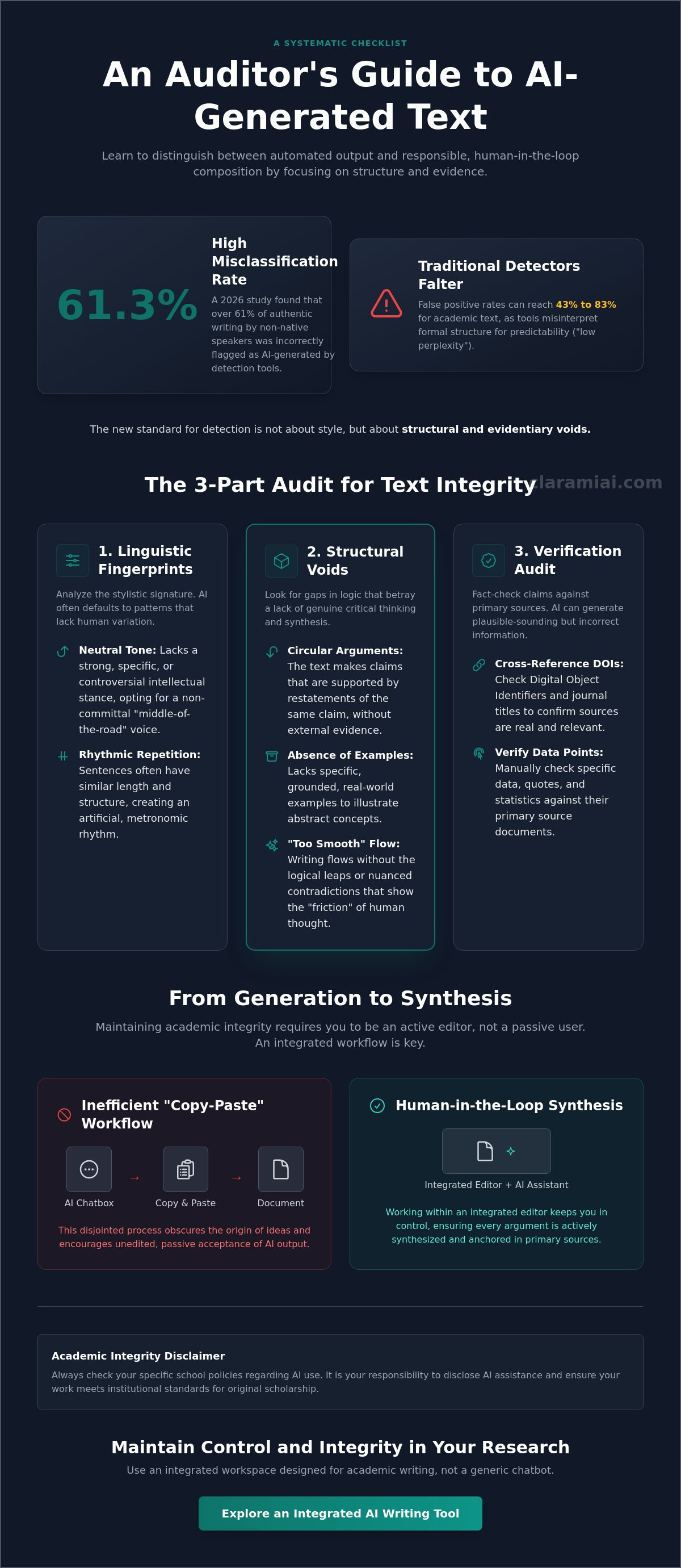
A 2026 study revealed that 61.3% of authentic writing by non-native speakers was misclassified as machine-generated. This statistic highlights the growing tension in academic circles where you must know how to tell if writing is ai to protect your reputation. You likely feel the pressure to maintain rigorous standards while navigating an environment where the line between human and machine is increasingly blurred. It's frustrating when generic detection tools flag legitimate work or when you can't quite pinpoint why a draft feels "off."
This article provides a systematic checklist for auditing text based on intellectual agency and evidentiary grounding. Rigorous verification. Structural integrity. Intellectual agency. You'll learn to identify structural voids and apply a verification audit that distinguishes between a purely automated output and a responsible, human-in-the-loop composition. We'll examine the specific patterns found in modern models like GPT-5.5 and Claude Opus 4.8 to ensure your work meets the highest integrity standards. By focusing on the structural connection between a statement and its supporting data, you can maintain confidence in your scholarly output.
Note: Always check your specific institutional policies regarding AI use. It's your responsibility to disclose the use of any AI tools in your research and writing process as required by your school or publisher.
Key Takeaways
- Identify linguistic fingerprints like rhythmic repetition and a neutral, middle-of-the-road tone that avoids specific intellectual stances.
- Apply a systematic checklist to understand how to tell if writing is ai by spotting circular arguments and the absence of grounded, real-world examples.
- Conduct a verification audit to cross-reference DOIs, journal titles, and specific data points against primary sources to detect ungrounded claims.
- Transition from automated generation to active synthesis by maintaining a human-in-the-loop framework within an integrated document editor.
- Distinguish between high-quality AI-assisted research and unedited drafts to maintain rigorous academic integrity and institutional compliance.
Table of Contents
- The evolving landscape of AI writing detection
- Linguistic fingerprints: A stylistic checklist for AI text
- Structural voids: Identifying the lack of human-centric logic
- The verification audit: Spotting ungrounded claims
- Maintaining integrity: Moving from generation to synthesis
The evolving landscape of AI writing detection
Identifying automated content in 2026 requires a shift in perspective. You aren't looking for a simple vocabulary list or a handful of overused buzzwords. Modern models like GPT-5.5 and Claude Opus 4.8 have been trained to avoid the predictable language patterns that once gave them away. Detection now focuses on identifying structural and evidentiary voids. Rigorous verification. Structural integrity. Intellectual agency. These are the new benchmarks for authenticity. Authentic scholarship requires a specific type of connection between a claim and its supporting data that machines often fail to replicate.
Knowing how to tell if writing is ai starts with recognizing the absence of human-centric logic. While an AI can produce a polished draft, it often lacks the "frictional" nature of critical thinking. A human-in-the-loop approach involves active synthesis where the user remains the primary editor. This ensures every argument is anchored in primary sources rather than statistical probability. Using an integrated document editor allows you to maintain this control, moving away from the "copy-paste" workflow that often obscures the origins of a thought.
To better understand the nuances of modern detection, watch this helpful overview:
### Why traditional AI detectors struggle with academic textCurrent AI content detection methods often fail in rigorous scholarly environments. Technical papers and writing from ESL students frequently trigger false positives. In fact, 2026 studies show false positive rates can range from 43% to 83% for authentic student writing. Detectors rely on metrics like perplexity and burstiness. Perplexity measures the predictability of word choices. Burstiness looks for variation in sentence structure. Because academic writing is often formal and follows specific conventions, it can appear "predictable" to an algorithm. Automated scores are merely preliminary indicators; they require manual verification to ensure academic integrity.
The shift from stylistic tells to structural voids
Advanced models mimic human tone with startling accuracy. They've moved past the empty prose of earlier iterations. However, they still struggle with complex, non-linear logic. AI text often lacks the "intellectual fingerprint" that defines original research. You might notice a lack of specific, real-world examples that ground abstract concepts. Human writing has friction. It shows the effort of connecting disparate ideas. AI writing is often too smooth. It flows without the logical leaps or nuanced contradictions that characterize deep thought. By auditing for these structural voids, you can verify if a document represents genuine synthesis or mere word prediction.
Academic Integrity Disclaimer: Always check your specific school policies regarding AI use. It's your responsibility to disclose AI assistance and ensure your work meets institutional standards for original scholarship.
Linguistic fingerprints: A stylistic checklist for AI text
Text generated by large language models often carries a distinct stylistic signature. While 2026-era AI has improved, it still defaults to a "middle-of-the-road" tone. This neutrality is a safeguard against bias, but it results in a lack of strong, controversial, or unique stances. Scholarly work typically requires a firm position on a thesis. If a piece of writing feels excessively balanced to the point of being non-committal, it may be an indicator of how to tell if writing is ai. Authentic researchers aren't afraid to challenge established norms with specific, grounded arguments.
Another common marker is the repetitive sentence architecture. AI often generates sentences of similar length and structure, creating a metronomic rhythm that feels artificial. Rhythmic monotony. Predictable flow. You should also watch for the "summary trap." Automated systems frequently conclude every section with a redundant wrap-up that restates the previous points without adding new insight. This differs from human writing, where conclusions usually synthesize information or point toward future research. AI also over-relies on transitional phrases like "furthermore," "moreover," and "in conclusion" to link ideas artificially. If every H3 header ends with a predictable summary paragraph, the text's integrity warrants closer inspection.
Vocabulary patterns and the "thesaurus" effect
A research-backed look at the Linguistic Characteristics of AI-Generated Text reveals a tendency toward lower lexical diversity. Forced precision. Contextual absence. You'll often see high-frequency use of specific, high-utility adjectives such as "pivotal," "comprehensive," or "multifaceted." This stylistic choice often lacks context-specific nuance. The voice becomes blandly professional, lacking a distinct scholarly persona or the "voice" of a specialist. Human experts use technical jargon precisely; AI uses it broadly to sound authoritative.
Syntactic rhythm and the lack of "burstiness"
Human writing is characterized by "burstiness," which is the natural variation in sentence length and complexity. You might write a long, complex sentence to explain a methodology, followed by a short, punchy statement for emphasis. AI writing lacks this rhythmic variation. It feels steady and instructional but lacks the natural flow of human thought. For example, a human might write: "The data was flawed. Consequently, the entire study required a full structural audit of the primary sources." An AI draft might say: "The data contained several inaccuracies, and therefore, the researchers decided that a comprehensive audit of the sources was necessary for the project's success."
Identifying these patterns allows you to verify the structural integrity of your own work. If you're looking for a reliable ai writing tool for students, focusing on human-centric logic is essential. If you find your drafts feeling too "smooth," you can use a Draft Tone Checker to identify areas where your unique voice needs more emphasis. Maintaining this human-in-the-loop approach ensures your final submission reflects your own intellectual agency rather than a machine's statistical average.
Academic Integrity Disclaimer: Always check your specific school policies regarding AI use. It's your responsibility to disclose AI assistance and ensure your work meets institutional standards for original scholarship.
Structural voids: Identifying the lack of human-centric logic
Logic in scholarly writing is rarely a straight line; it involves a series of interconnected claims, counter-arguments, and syntheses. One of the most effective ways to understand how to tell if writing is ai is to look for structural voids where human reasoning should be. Automated text often prioritizes grammatical correctness over logical depth. You might find that a paragraph sounds professional but fails to move the reader toward a specific conclusion. This lack of "logical friction" is a primary indicator of a machine-generated draft that hasn't been properly audited by a human editor.
A common structural tell is the circular argument. AI often starts a paragraph with a claim and ends it by simply restating that same claim in different words. There's no progression of thought. For example, a paragraph on climate policy might begin by stating that regulations are necessary and end by concluding that rules are essential. It fails to explain the specific mechanisms or evidence that link the two points. Authentic human writing uses each sentence to build upon the last, adding layers of nuance or specific, real-world examples that ground abstract concepts in reality.
You should also watch for the "everything is important" fallacy. AI models often struggle to prioritize arguments based on their scholarly impact. Instead of highlighting a cornerstone piece of evidence, they list several points with equal weight. This results in a flat hierarchy where the most critical data is buried among secondary information. When you use a structured integrated document editor, you can more easily spot these flat structures and reorganize them to reflect your own intellectual priorities.
Analyzing the logical thread of a research argument
To test for logical friction in a draft, try to remove a middle sentence; if the argument still makes sense without it, the text is likely filler rather than a structured progression of thought. You should also look for "hollow synthesis." This occurs when a text mentions several authors or studies but fails to analyze the relationship between them. A human researcher explains why two studies disagree; an AI might simply state that both exist. This absence of critical analysis is a key component of how to tell if writing is ai in complex academic papers.
The "hallucinated" transition: Where AI loses the plot
AI often uses non-sequiturs that are masked by sophisticated language. It might link two unrelated ideas with a smooth transition that sounds authoritative but lacks a logical basis. You must also check for internal contradictions. A machine might support one methodology in the introduction but inadvertently contradict that stance in the results section because it doesn't "remember" the specific constraints of the earlier argument. This "drift" between sections happens because AI generates text based on local probability rather than a global understanding of the entire research argument.
Academic Integrity Disclaimer: Always check your specific school policies regarding AI use. It's your responsibility to disclose AI assistance and ensure your work meets institutional standards for original scholarship.
The verification audit: Spotting ungrounded claims
The most critical indicator of machine-generated text in 2026 isn't the prose; it's the data. While models have become adept at mimicking scholarly tone, they frequently fail the test of evidentiary grounding. Learning how to tell if writing is ai requires you to move beyond reading and into auditing. This process involves a meticulous cross-examination of every claim against its cited source. Ungrounded claims. Imaginary data. Misattributed quotes. These are the markers of a document that lacks the necessary human-in-the-loop oversight.
A "fake citation" remains a significant red flag. AI often generates plausible-sounding journal titles and DOIs that do not exist. It might also link a real, respected author to a specific claim they never actually made in their published work. This occurs because the model prioritizes the statistical probability of a word sequence over the factual accuracy of the underlying data. You must verify that the structural connection between a statement and its supporting evidence is authentic rather than merely aesthetic. If the citations don't lead back to a primary source, the integrity of the entire document is compromised.
A 5-step checklist for evidentiary verification
- Step 1: Cross-reference every direct quote against the original source file using a PDF Manager to ensure the text exists exactly as written.
- Step 2: Verify that specific page numbers in citations actually contain the information described.
- Step 3: Identify "imaginary" consensus; look for phrases like "studies show" or "experts agree" that lack specific, named citations.
- Step 4: Use a tool like ClaimShield to map statements back to source data and highlight ungrounded assertions.
- Step 5: Check for "generic data" where a claim sounds plausible but lacks a specific, verifiable source.
The "hallucination" audit for scholarly integrity
AI creates "plausible-sounding" research findings that can mislead even experienced readers. This often manifests as a "drift" where a model summarizes a source's actual conclusion into a generalized, slightly inaccurate statement. Such summaries lack the nuance of human synthesis. You should learn how to verify AI citations to ensure your work maintains the highest standards of integrity. If you want to automate this verification process and ensure every claim is anchored in reality, you can get started with Clarami today.
Academic Integrity Disclaimer: Always check your specific school policies regarding AI use. It's your responsibility to disclose AI assistance and ensure your work meets institutional standards for original scholarship.
Maintaining integrity: Moving from generation to synthesis
Authentic scholarship isn't about avoiding technology; it's about maintaining intellectual agency within a human-in-the-loop framework. When you understand how to tell if writing is ai, you can use those same criteria to audit your own drafts. The goal is to move from passive generation to active synthesis. You remain the primary editor, responsible for every claim and citation. This approach ensures that your final output reflects your specific research methodology rather than a machine's generic average. Rigorous verification. Intellectual agency. Structural order.
One major risk to academic integrity is the "copy-paste" trap. Using a disconnected chat interface often leads to disorganized source material and accidental plagiarism. An integrated editor allows you to refine text directly within your workspace, maintaining a clear trail of your drafting process. This structural cohesion is what distinguishes a professional workflow from a mere shortcut. Source-grounded assistants like Clara are designed to surface real data rather than hallucinate plausible-sounding text, providing a reliable intellectual companion for your scholarly labor. This specialized approach treats data management and output as an integrated whole.
Building an authentic scholarly voice
Developing a unique persona requires more than just correcting grammar. You can use selection-level edits to rewrite specific paragraphs, ensuring the rhythmic variation matches your natural style. This process helps in building confidence in your academic writing as you take ownership of the assistant's suggestions. For those working in collaborative environments, establishing a clear AI writing style guide ensures everyone maintains consistent standards for verification and substantiation. This methodical expert approach values transparency over creative flair.
The Clarami workflow: Integrity by design
An integrated workspace eliminates the need to jump between tabs, reducing the risk of technical inaccuracies. Using "suggest-mode" allows for a transparent collaboration where you can accept, reject, or modify every automated suggestion. This creates a linear narrative of progress from initial disorganization to a polished, verified output. You can explore the features of a purpose-built research workspace to see how grounded drafting maintains the structural connection between your arguments and your data. This methodical approach is the mature alternative to general-purpose platforms that treat specialized tasks as secondary features.
Academic Integrity Disclaimer: Always check your specific school policies regarding AI use. It's your responsibility to disclose AI assistance and ensure your work meets institutional standards for original scholarship.
Securing the future of academic authorship
Understanding how to tell if writing is ai has evolved from spotting overused adjectives to auditing the structural and evidentiary integrity of a document. You've learned that authentic scholarship requires more than just grammatical correctness; it demands a specific logical friction and a verifiable connection to primary sources. By identifying structural voids and conducting rigorous verification audits, you can ensure that your work reflects genuine synthesis rather than statistical probability. This methodical approach protects your reputation and maintains the high standards of your institution.
Maintaining this level of accuracy is easier when you use a purpose-built workspace. You can start your grounded research journey with Clarami to access tools like ClaimShield verification technology, the source-grounded Clara AI Assistant, and integrated reference management. These features support a workflow that prioritizes your intellectual agency. You remain the primary editor, ensuring every claim is substantiated and every argument is original. Moving from generation to synthesis is the most reliable way to uphold academic integrity in a changing technological environment.
Academic Integrity Disclaimer: Always check your specific school policies regarding AI use. It's your responsibility to disclose AI assistance and ensure your work meets institutional standards for original scholarship.
Frequently asked questions
Can AI detectors be 100% accurate in 2026?
No, AI detectors cannot achieve 100% accuracy. Current 2026 data indicates that accuracy rates range between 83% and 94%, meaning a significant margin for error remains. False positive rates for authentic student writing can be as high as 43% to 83% in some studies. You should treat detection scores as preliminary indicators that require manual verification of the text's structural and evidentiary integrity rather than definitive proof of misconduct.
Does using an AI writing assistant count as plagiarism?
Whether using an AI assistant counts as plagiarism depends on your institution's specific policies and your level of disclosure. Most 2026 university guidelines view uncredited AI generation as a violation of academic integrity. However, using a tool for brainstorming or grammar checking is often permitted if you disclose it. You're responsible for the final submission, so ensuring the work reflects your own synthesis and research is essential for maintaining authorship.
How do I fix writing that "sounds" like AI but is actually mine?
To fix writing that sounds like AI, you should focus on increasing sentence length variation and adding specific, grounded examples. AI often produces a metronomic rhythm with predictable word choices. You can break this pattern by inserting short, punchy statements and anchoring your arguments in unique primary data. Focus on the structural connection between your claims and your evidence to ensure your intellectual fingerprint is visible throughout the document.
What are the most common words that trigger AI detection filters?
Common triggers for AI detection filters include high-frequency adjectives like "pivotal," "comprehensive," and "multifaceted." Predictable connectors that link paragraphs artificially also contribute to a machine-like signature. When you're learning how to tell if writing is ai, look for these neutral terms that lack context-specific nuance. Replacing generic vocabulary with specialized jargon and precise methodology descriptions helps demonstrate the technical depth expected in scholarly work.
How can I prove my work is human-written to my professor?
You can prove your work is human-written by providing a clear audit trail of your research and drafting process. Sharing your initial outlines, research notes, and previous versions of the document demonstrates a logical progression of thought. Using an integrated editor that tracks revisions allows you to show how you synthesized source material into a final draft. This evidence of human-in-the-loop labor is more convincing than a single detection score.
Is it ethical to use AI to draft my literature review?
Using AI to draft a literature review is ethical only if you disclose its use and perform a rigorous verification of all claims. You must cross-reference every citation and ensure the AI hasn't hallucinated research findings or misattributed quotes. Scholarly ethics require you to be the primary architect of the synthesis. If a tool provides a starting point, your role is to refine that draft into a grounded, critical analysis of the field.
Related on Clarami
- Best AI writing tool for students (full guide) →
- AI academic integrity checklist →
- Clarami pricing: Free vs PRO vs Platinum →
- Editor vs ChatGPT for writing →
- Export DOCX, PDF, and hand-in checklist →
- How to outline a paper →
- Prompt to structured essay draft →
- Revise with AI on a selection →
- Sign up free →
- Clarami home →
- More guides on the Clarami blog →