

Creating an AI writing style guide for academic and professional integrity
Tired of generic AI text? Learn to create a custom ai writing style guide to maintain your unique voice and ensure academic integrity. Refine your work with ...
Write with structure in Clarami AI
Editor-first AI drafting, citations, and two Workflows for student writing.
What if the most significant risk to your academic reputation isn't the AI itself, but the generic, repetitive prose it produces? You've likely felt the frustration of receiving a draft filled with "fluffy" language that sounds nothing like your actual scholarly voice. It's exhausting to spend hours manually removing clichés when you could be refining your arguments. By establishing a systematic ai writing style guide, you can transform these disorganized outputs into a polished, verified narrative that respects your intellectual agency.
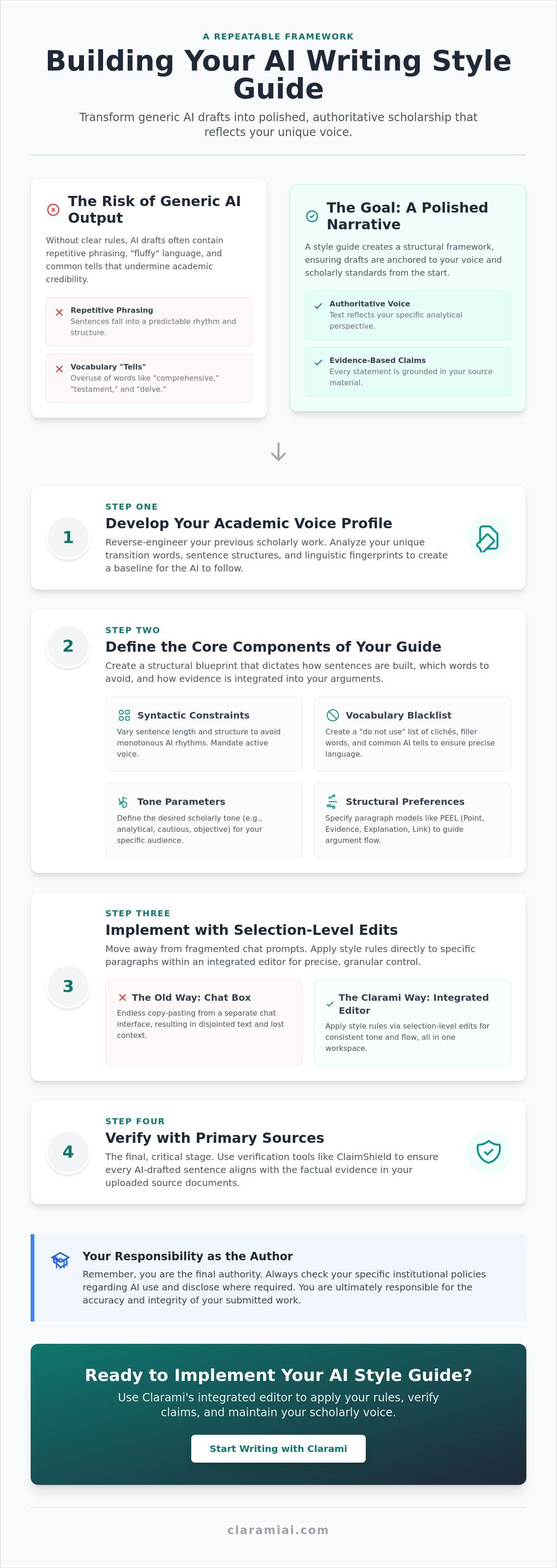
This article provides a repeatable framework for building a guide that ensures your AI-assisted drafting remains precise and authoritative. You'll learn how to anchor your work in primary sources while maintaining a consistent tone across complex documents. We'll examine how Clarami’s selection-level edits and ClaimShield allow you to verify every statement without the need for constant copy-pasting from a separate chat interface.
Before implementing these methods, please check your specific institutional policies regarding AI and ensure you disclose its use as required by your school's academic integrity code. Regardless of the tools you use, you are ultimately responsible for the accuracy and integrity of your submitted work. This guide focuses on a human-in-the-loop approach where you remain the final editor and authority of your scholarship.
Key Takeaways
- Define specific syntactic constraints and vocabulary blacklists to eliminate repetitive AI phrasing and common "tells" like "comprehensive" or "testament."
- Build a custom ai writing style guide by reverse-engineering your previous scholarly work to capture your unique transitions and linguistic fingerprints.
- Use an integrated In-App Editor to apply style rules via selection-level edits; this maintains your control over specific paragraphs rather than relying on broad chat outputs.
- Establish a verification workflow using ClaimShield to ensure that every drafted sentence aligns with the factual evidence in your uploaded source documents.
Table of Contents
- Defining the AI writing style guide for scholarly work
- Core components of a rigorous AI style guide
- Developing your custom academic voice profile
- Implementing the guide within an integrated workspace
- Verification: The final stage of the AI style guide
Defining the AI writing style guide for scholarly work
An ai writing style guide is a systematic set of parameters that governs the tone, syntax, and vocabulary of machine-generated drafts. It functions as a structural framework to ensure that AI-assisted content remains anchored to your unique scholarly voice. While a traditional Style guide like APA or Chicago provides the rules for citations and formatting, these standards don't address the specific linguistic tendencies of large language models. These models often default to a generic, "hallucinated" style characterized by repetitive marketing fluff and empty adjectives. A specialized guide prevents this by setting hard boundaries on word choice and sentence structure.
To better understand how to structure your personal writing systems, watch this helpful video:
Before proceeding, you must check your institution's specific policies regarding AI-assisted drafting. Always disclose your use of AI tools when required by departmental standards or academic integrity codes. Regardless of the drafting assistance you use, you are ultimately responsible for the accuracy and integrity of your submitted work.The shift from chat prompts to structural guidelines
Relying on single-use chat prompts often results in inconsistent, fragmented output across long documents. Telling an AI to "write like a professor" is too vague; it often leads to the very clichés and "fluff" you want to avoid. You need specific linguistic constraints instead. This involves a human-in-the-loop philosophy where you define the boundaries of the draft before a single word is written. Within the Clarami workspace, this means moving away from the "chat box" and toward an integrated editor that respects your pre-defined structural rules. You are not just asking for text. You are providing a blueprint for how that text must behave.
Determining your primary objectives
Your guide's complexity should reflect your specific academic or professional goals. An ESL writer might prioritize clarity and the removal of complex idioms to ensure their research remains accessible. A graduate student preparing a literature review might focus on structural organization and the extraction of methodology from source material. Consider your audience carefully. Peer reviewers expect a high level of technical precision and specific terminology, while an undergraduate audience might require more foundational explanations. By aligning your guide with specific academic rubrics and departmental standards, you ensure the AI provides a draft that serves as a solid foundation for your final, human-led edits and verification.
Core components of a rigorous AI style guide
A rigorous ai writing style guide must move beyond simple word lists. It requires a structural blueprint that dictates how sentences are built and how evidence is weighed. Generic AI output often fails because it lacks the nuanced rhythm of peer-reviewed research. To achieve professional integrity, your guide must address four specific pillars: syntactic constraints, vocabulary blacklists, tone parameters, and structural preferences. By defining these early, you transform a generic text generator into a specialized drafting assistant that respects the conventions of your field.
Structural preferences are the foundation of academic cohesion. You should specify how evidence is integrated into your paragraphs, such as following the PEEL method (Point, Evidence, Explanation, Link). This ensures the AI doesn't just list facts but instead anchors them to your central argument. You can test these parameters within the Clarami In-App Editor to see how they refine your drafts in real-time.
Syntax and sentence architecture
Machine-generated text often falls into a predictable, mid-length sentence rhythm. This "staccato" pattern is a common indicator of AI use. To fix this, your guide should instruct the AI to use varied sentence starts, avoiding repetitive noun-phrase openings. Establish clear rules for voice: use the active voice for your analysis and the passive voice for describing methodology. Additionally, limit the use of intensifying adverbs like "very," "extremely," or "highly." These qualifiers often signal a lack of technical precision and weaken the structural integrity of your claims.
Vocabulary and the anti-cliché list
Certain transitional phrases and adjectives sound inherently "bot-like" to a trained academic ear. Words like "delve," "comprehensive," "testament," and "transformative" are frequently overused by standard models. Your guide should include a custom list of forbidden terms, replacing them with field-specific terminology that prioritizes accuracy over creative flair. A forbidden word list acts as a filter that preserves your professional credibility by removing hollow superlatives. This ensures the lexicon remains functional, high-utility, and focused on the substantiation of your research.
Formatting and citation standards
Consistency in formatting is a marker of professional labor. Specify that headers must use sentence-case and that lists should follow a logical, numbered sequence. Integrating citation requirements directly into the style guide ensures the AI knows exactly where to place references within the narrative flow. This is a critical step in maintaining traceability. You should also verify AI citations to ensure your style guide includes specific fact-checking steps. This workflow prevents the inclusion of non-existent sources while maintaining the organizational cohesion required for scholarly submission.
Developing your custom academic voice profile
Your voice is unique. It's built on years of specific reading and habitual phrasing. To create a functional ai writing style guide, you must first identify your "linguistic fingerprints." These are the specific ways you transition between arguments and the unique cadence of your analysis. If you skip this step, the AI defaults to a generic persona that sounds neither professional nor personal. You can start this process by using a Draft Tone Checker to audit your existing drafts for patterns that sound too robotic or "stiff."
There's a critical difference between "formal" and "stiff" in a professional context. Formal writing is precise and authoritative. Stiff writing is clunky and lacks logical flow. By reverse-engineering your previous work, you extract measurable style markers that ensure your AI-assisted drafts remain formal without losing their human rhythm. This systematic approach transforms the AI from a simple text generator into a reliable intellectual companion that mirrors your established expertise within the Clarami workspace.
Analyzing your successful publications
Your best work is your "gold standard." Take your most successful publications and extract the average sentence length and reading level. Do you prefer long, complex sentences for theoretical explanations? Do you use shorter, punchy statements for your results? Identifying these habits allows you to set specific constraints in your guide. Look for your preferred rhetorical devices and metaphors. If you always use certain verbs to describe methodology, ensure those are prioritized in your guide's vocabulary list. This keeps the output consistent with your body of work.
Defining the 'persona' for different research stages
A single paper requires different "personas" at different stages. Your introduction might require an "Explainer" persona that provides clarity for a broader audience. In contrast, your results and discussion sections need an "Analytical" persona that focuses on technical precision and the substantiation of claims. You should adjust the level of technicality based on the specific chapter or section you're drafting. Building confidence in your scholarly writing voice comes through this iterative refinement. You are the final authority; the AI simply provides a draft that matches your pre-defined persona, allowing you to focus on the high-level synthesis of your data.
Implementing the guide within an integrated workspace
Implementing your ai writing style guide requires a workspace that prioritizes structural integrity over conversational speed. Traditional chat interfaces are built for brief exchanges, not the rigors of long-form scholarly drafting. When you copy and paste text from a chat box, you risk losing formatting, citation links, and the specific stylistic parameters you worked hard to define. An integrated editor solves this by embedding your style rules directly into the drafting environment. You can start building your organized research environment by creating a Clarami account today.
AutoDraft utilizes your specific style profile to generate initial versions that already reflect your preferred sentence architecture. This eliminates the need to fix repetitive AI patterns manually. By grounding these drafts in your personal source material, the system ensures that the initial output is both stylistically consistent and factually anchored. This methodical approach reduces the stress of starting from a blank page while maintaining your intellectual agency throughout the synthesis process.
Moving away from the chat box
Chat threads suffer from context drift. As a conversation grows longer, the AI often forgets the specific syntactic constraints or vocabulary blacklists you established at the beginning. By writing directly in a workspace, you maintain a persistent environment where your ai writing style guide remains active. Clara acts as a source-grounded assistant, referencing your uploaded PDFs to ensure every claim is anchored in data. This workflow preserves the structural connection between a statement and its supporting evidence, preventing the "hallucinated" tone common in general-purpose tools.
Iterative editing and the human-in-the-loop
Effective AI assistance relies on a human-in-the-loop workflow. You should follow a 3-step review process for every draft. First, audit the syntax for repetitive AI rhythms. Second, verify that all technical terminology matches your field's standards. Third, use selection-level rewriting to refine specific paragraphs. Selection-level edits provide a surgical alternative to broad essay generation. Rather than rewriting an entire section, you can highlight a single paragraph that sounds too generic and apply your style constraints to that specific selection. This maintains the surrounding context and ensures your logical transitions remain intact. Suggest-Mode further enhances this by allowing you to accept or reject changes, mirroring the professional relationship between a researcher and an assistant. Human-led editing is the final safeguard of academic integrity.
Verification: The final stage of the AI style guide
Style parameters provide the aesthetic frame for your research, but verification provides its structural integrity. In scholarly work, a well-crafted sentence is worthless if it contains a hallucination or an unverified claim. Your ai writing style guide must include a final verification stage where every drafted statement is cross-referenced against your primary data. This transition from a draft to a submission-ready manuscript requires a methodical audit of both tone and accuracy.
ClaimShield allows you to verify that drafted sentences align with the evidence in your uploaded PDFs. This isn't just about catching errors. It's about ensuring that every argument is anchored in a verifiable source. Automated citation building completes the stylistic finish, turning a raw draft into a documented scholarly argument. By integrating these checks into your workflow, you maintain the high-utility standards required for professional peer review.
Anchoring arguments in primary sources
Every stylistic flair must be backed by a verified claim. You can use Clara to find supporting evidence for your drafted points within your own library of research papers. This process ensures that your analysis isn't just well-written but is also substantiatable. Reference management is a core component of a professional style guide. It creates a traceable path from your final manuscript back to the original methodology or data point, reinforcing the organizational cohesion of your work. This level of transparency is what distinguishes a specialized research tool from a general-purpose text generator.
The submission checklist
Before you submit your work, perform a final audit. Look for remaining AI-isms or stylistic inconsistencies that may have slipped through the initial drafting phases. Use this time to verify all DOIs and citations for technical accuracy. The Clarami workspace allows you to export your work to DOCX or LaTeX while preserving all stylistic and citation metadata. This ensures your formatting remains consistent with the standards of your target journal or department. A final check of the ai writing style guide parameters ensures that your voice remains authoritative and your data remains anchored.
Please check your specific institutional policies regarding AI-assisted drafting and disclose its use when required. Regardless of the tools you use for collection or synthesis, you are ultimately responsible for the accuracy and integrity of your submitted work. Always verify AI-generated citations against the original source documents before final submission.
Mastering your scholarly narrative
Establishing a systematic ai writing style guide transforms the drafting process from a series of disjointed prompts into a rigorous, professional workflow. By defining your syntactic constraints and reverse-engineering your unique linguistic fingerprints, you maintain the authoritative voice required for peer-reviewed research. This structural approach ensures that your work remains consistent and precise. Your voice is the final safeguard.
A successful transition from an initial draft to a submission-ready manuscript relies on the human-in-the-loop methodology. Clarami supports this through an integrated workspace featuring AutoDraft with custom tone control and ClaimShield for claim verification. These tools allow you to anchor every statement in your primary source material without the disorganization of a chat interface. You remain the final authority on every sentence. It's essential to check your institution's specific policies and disclose AI use where required.
Try Clarami's integrated editor for source-grounded drafting and start refining your professional voice with precision today.
Frequently asked questions
What is an AI writing style guide exactly?
An AI writing style guide is a structured set of parameters that directs an AI to produce drafts matching a specific scholarly voice. It functions as an operating manual rather than a single prompt, defining rules for syntax, vocabulary, and tone. This ensures organizational cohesion by specifying how the AI should transition between arguments and integrate evidence from your primary sources.
Can I use an AI style guide to bypass AI detectors?
You shouldn't use a style guide for the purpose of deception. Its primary function is to maintain your unique scholarly voice and technical precision. While a guide reduces the generic patterns that detectors flag, many universities now classify "AI humanizers" as academic misconduct. Focus on a human-in-the-loop workflow where you act as the final editor and authority for every claim.
How do I stop AI from using clichés like 'delve' and 'tapestry'?
Implement a vocabulary blacklist within your ai writing style guide that explicitly forbids these terms. By identifying and removing common AI "tells," you force the model to use field-specific terminology instead of hollow superlatives. Use the In-App Editor to perform selection-level edits on paragraphs where these phrases appear, replacing them with precise, high-utility verbs that substantiating your research.
Is it ethical to use a style guide to make AI sound like me?
It is ethical when used as a drafting aid that you personally synthesize and verify. The goal of an ai writing style guide is to align the AI's initial output with your established expertise, not to replace your intellectual agency. You remain responsible for the accuracy of the final manuscript. Ensure your use complies with your institution's specific academic integrity policies regarding AI-assisted drafting.
Should I disclose the use of an AI style guide to my university?
Yes, you should check your school's specific policies and disclose AI use whenever required by your department. Transparency is a core component of academic integrity. Many institutions updated their codes in 2026 to categorize different levels of AI assistance. Providing a description of your style guide or a prompt log can serve as "proof of process" to demonstrate your engagement with the work.
How often should I update my AI writing style guide?
Update your guide whenever your research focus shifts or new editions of traditional style guides are released. For example, the 18th edition of The Chicago Manual of Style, published in September 2024, is the current authoritative version for that style. Regular audits ensure your guide remains a reliable intellectual companion that reflects the latest technical requirements and inclusive language standards in your specific field.
Related on Clarami
- Best AI writing tool for students (full guide) →
- AI academic integrity checklist →
- Clarami pricing: Free vs PRO vs Platinum →
- Editor vs ChatGPT for writing →
- Export DOCX, PDF, and hand-in checklist →
- How to outline a paper →
- Prompt to structured essay draft →
- Revise with AI on a selection →
- Sign up free →
- Clarami home →
- More guides on the Clarami blog →