
Building confidence in your academic writing
Stop fearing the blank page. Our guide to building confidence in your academic writing offers a verifiable system to create polished, authoritative drafts.
Write with structure in Clarami AI
Editor-first AI drafting, citations, and two Workflows for student writing.
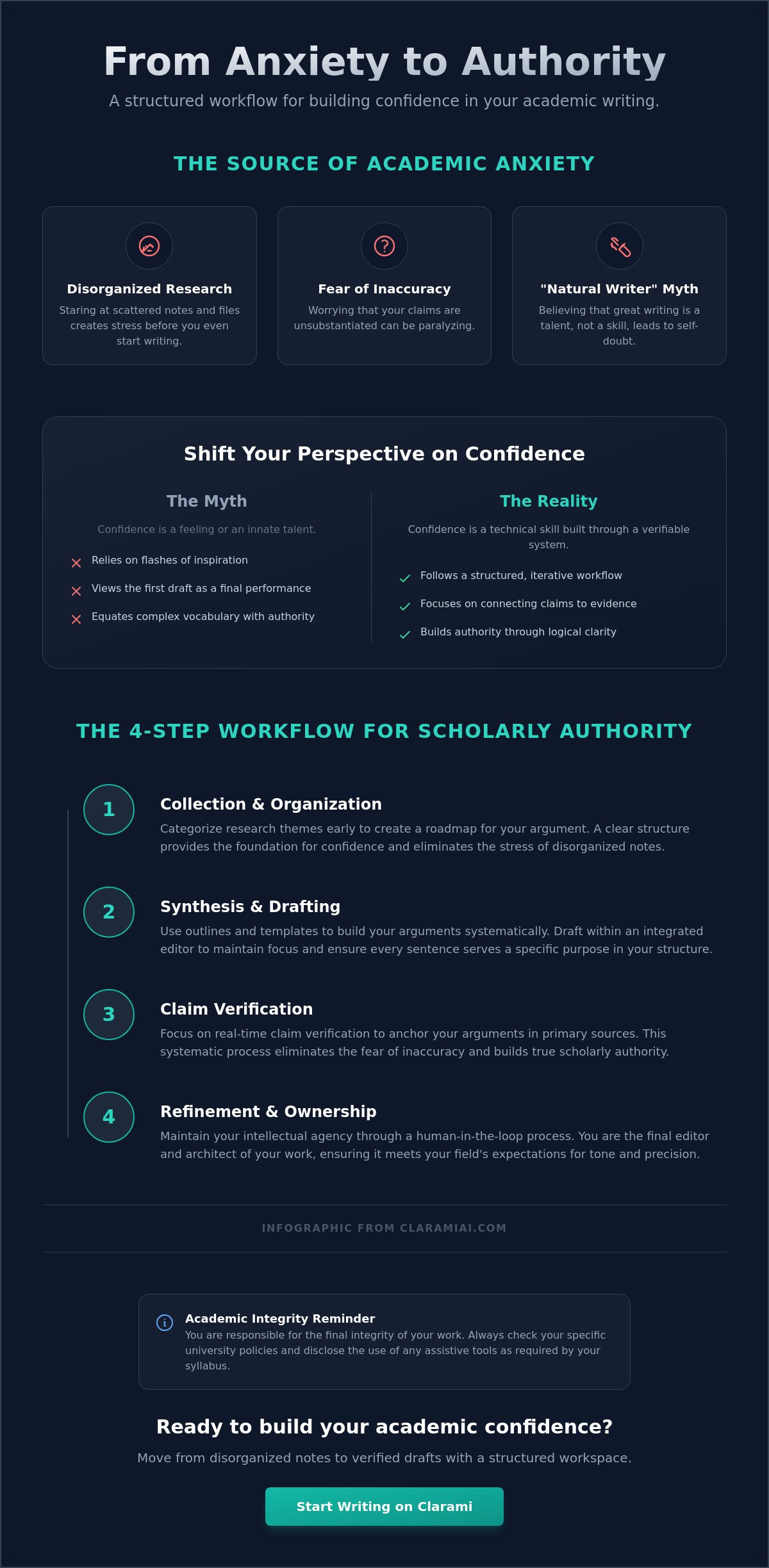
Academic confidence is not an innate talent. It's a byproduct of a verifiable research system that connects every sentence to a primary source. You likely recognize the specific stress of staring at a cursor while surrounded by disorganized research notes. The fear of making an unsubstantiated claim can be paralyzing. You might worry that your vocabulary lacks the precision required for scholarly standards. These feelings are common, but building confidence in your academic writing is possible when you move from a state of disorganization to a polished, verified output.
This article teaches you how to transform writing anxiety into scholarly authority through structured workflows and evidence-based drafting. Collection. Synthesis. Verification. We'll examine how to anchor your arguments in primary sources and use systematic order to maintain organizational cohesion. By following this chronological path, you'll find a clear way to produce verified drafts that meet the rigorous expectations of modern academia. Note that you should always check your specific university policies and disclose the use of any assistive tools in your work as required by your syllabus.
Key Takeaways
- Shift your perspective by viewing academic confidence as the result of iterative practice and the ability to defend your claims with evidence.
- Create a foundation for your work by categorizing research themes early, which provides a roadmap for logical transitions and structural clarity.
- Focus on building confidence in your academic writing by implementing real-time claim verification to eliminate the fear of inaccuracy or misrepresentation.
- Refine your scholarly authority by maintaining a precise and objective tone that meets the specific expectations of your academic field.
- Maintain intellectual agency through a human-in-the-loop workflow, ensuring you remain the final editor and architect of every submitted document.
Table of Contents
- Redefining confidence in the academic context
- Building a foundation through structural clarity
- Eliminating the fear of inaccuracy with claim verification
- Refining your scholarly voice and tone
- Implementing a human-in-the-loop workflow
Redefining confidence in the academic context
Confidence in scholarly work isn't a feeling of invulnerability. It's the grounded belief that your claims are defensible and substantiated. Many writers view confidence as a fixed personality trait, but it's actually a technical skill developed through iterative practice. Building confidence in your academic writing starts with shifting your focus from personal talent to systematic verification. When you know every sentence is anchored in data, the pressure of the first draft diminishes. Disorganized research notes often cause more stress than the writing itself. By organizing your evidence before you begin, you create a foundation that supports your intellectual agency.
Academic anxiety often stems from a lack of clarity in the relationship between your evidence and your argument. If you're unsure how your notes support your thesis, the writing process feels unstable. You must remember that you are responsible for the final integrity of your work. Before using any assistive tools, check your specific school policies and disclose AI use where required.
To better understand this concept, watch this helpful video:
### The difference between fluency and authorityFluency relates to the ease of your language use, but authority stems from the strength of your evidence. You don't need an exhaustive vocabulary to write a powerful paper. Readers and peer reviewers value clear, evidence-backed arguments over complex sentences that lack support. By following established academic writing conventions, you signal to your audience that your work is part of a rigorous scholarly conversation. Authority is built when you prioritize the structural connection between a statement and its supporting data. If you're an ESL writer, focus on the logic of your claims first. A well-substantiated argument in simple language is more authoritative than a vague one filled with jargon.
Overcoming the myth of the natural writer
The idea that great scholars sit down and produce perfect prose in one sitting is a myth. Most published researchers rely on structured workflows, multiple rounds of feedback, and specific templates to organize their thoughts. Writing is simply an extension of the research process, not a separate creative performance. Success isn't found in a flash of inspiration. It's found in the transition from disorganized notes to a structured synthesis within a dedicated in-app editor. When you use an integrated workspace, you eliminate the need to copy-paste between windows, which helps maintain your focus. This methodical approach ensures that your final output is verified, traceable, and logically sound. You aren't discovering a hidden talent; you're applying a discipline.
Building a foundation through structural clarity
Confidence in scholarly work is often treated as a psychological hurdle, but it is primarily a structural one. You don't need a surge of inspiration to begin. Instead, you need a reliable framework that connects your evidence to your arguments. Building confidence in your academic writing starts with a solid outline. This serves as a roadmap that prevents the feeling of being lost mid-paragraph. When you know exactly where each piece of evidence fits, the intimidation of the blank page disappears. High-quality scholarly work relies on this systematic order. By following a clear, linear narrative, you ensure that every sentence serves a specific purpose.
Structural confidence grows when you stop viewing the first draft as a final performance. It is a working document. Utilizing templates matched to academic rubrics ensures you meet institutional expectations from the start. Carnegie Mellon University notes that overcoming writing anxiety often involves breaking complex tasks into smaller, logical units. This methodical approach allows you to focus on one claim at a time. It's helpful to remember that you are the primary architect of this research. You are responsible for the final submission, so checking your course syllabus for specific AI disclosure policies is essential.
Moving from research notes to a first draft
The transition from reading to writing is where many students feel overwhelmed. Start by grouping your PDF highlights into logical thematic clusters rather than chronological order. This process helps you see the connections between different sources. Write one sentence defining the core argument of each section before you add any supporting detail. This ensures your argument remains the priority. You can use this guide on organizing research references to streamline your pre-writing phase. Starting with a structured academic writing workspace keeps your citations and notes in one view, eliminating the friction of switching tabs.
The power of the reverse outline
After you complete a draft, use a reverse outline to verify its structural integrity. Summarize each paragraph into a single bullet point. This exercise reveals the logical flow of your paper. If a paragraph doesn't directly support your primary thesis, it needs to be reorganized, removed, or refined. This step also helps you identify gaps where an argument lacks a corresponding citation. Traceability is the foundation of academic authority. When you can see the skeleton of your argument, you can edit with precision. This disciplined review process transforms a disorganized draft into a verified scholarly document.
Eliminating the fear of inaccuracy with claim verification
Academic anxiety often boils down to a single fear: being wrong. You might worry about misrepresenting a researcher's findings or failing to support a complex argument. This fear can stall your progress and make the writing process feel like a series of risks. Building confidence in your academic writing requires a shift from retroactive checking to real-time verification. When you verify every claim as you write, you prevent the accumulation of small errors that eventually require massive revisions. Objective certainty comes from a direct, visible link between your sentence and the source data. This systematic order allows you to move forward with calm assurance.
Grounding your work in primary sources is the most effective way to eliminate this stress. Broad generalizations without specific citations weaken your authority and increase the chance of technical inaccuracies. A workspace that allows you to view your source material alongside your draft provides the structural integrity needed for scholarly labor. It anchors your arguments in reality. You can use selection-level editing to refine a specific paragraph's logic without losing the broader context of your paper. This methodical approach ensures that every statement is substantiated before you move to the next section. When you know your evidence is solid, your voice naturally becomes more authoritative.
Grounding your arguments in primary sources
Scholarly authority is built on the structural connection between your claims and your data. Avoid the temptation to write first and find sources later. This citation-last method often leads to forced or inaccurate mapping. Instead, use a specialized in-app editor to keep your PDF highlights within your immediate field of vision. This allows for the precise extraction of methodology and relevant data. When you can see the source while you draft, you maintain high integrity. Traceability is the goal. Every claim should have a clear path back to a verified document, ensuring your work stands up to rigorous scrutiny.
Avoiding unintentional plagiarism
Understanding the difference between original synthesis and simple paraphrasing is vital for your confidence. Synthesis involves combining multiple sources to form a new, cohesive argument, whereas paraphrasing is merely restating a single source. You must always verify that your citations accurately reflect the content of the cited work. Misattribution is a common source of anxiety that can be avoided through systematic order. Academic integrity disclaimer: Always check your institution's specific policies regarding the use of AI tools. You are responsible for the final product, so ensure you disclose AI use according to your school's guidelines. Using an integrated workspace helps you track these requirements without the need for risky copy-pasting from external chat interfaces. This human-in-the-loop approach keeps you in control of the intellectual agency of your work.
Refining your scholarly voice and tone
Academic tone should be precise and objective. It shouldn't be unnecessarily complex. Many writers mistake density for authority. In reality, building confidence in your academic writing comes from knowing your work meets the standard expectations of your specific field. You aren't performing a creative act; you're participating in a professional dialogue. This requires a shift from subjective expression to evidence-based claims. Precision. Objectivity. Formal structure. These are the markers of a mature scholarly voice. Confidence grows when you stop trying to sound "academic" and start trying to be clear.
For ESL writers, the path to a scholarly voice lies in clarity. Don't worry about complex idioms or rare vocabulary. Focus instead on the logical structure of your sentences. A well-organized argument in simple English carries more weight than a confusing one in sophisticated language. Scholarly authority is a byproduct of logical integrity. You build this through iterative editing, refining a single paragraph multiple times until the tone is professional and the argument is sharp. You are the final editor and architect of your work. Always check your specific school policies regarding AI tools and disclose their use where required by your syllabus.
Using a tone checker for objective feedback
Objective feedback is essential for growth. An academic writing tone checker online helps you identify phrases that are too informal or subjective. It's a methodical way to learn the rules of scholarly discourse without relying on trial and error. For example, the tool might flag an "I feel" and suggest a more objective framing. You should also aim for a balance in your sentence structures. Use the active voice to describe your original findings for clarity. Use the passive voice to describe established methodologies for objectivity. This distinction shows you understand the nuances of academic conventions and helps you maintain a consistent scholarly persona.
Selection-level edits for precision
Don't try to fix an entire paper at once. This leads to overwhelm. Instead, focus on improving one paragraph at a time. This is the core of a human-in-the-loop workflow. You remain the primary architect while using technology to refine your output. You can use suggest-mode to experiment with different phrasings before you commit to a final version. This allows you to see how a sentence sounds without losing your original thought. Identify and remove filler phrases like "basically" or "it could be argued that." These weaken your authority. By stripping away the fluff, you reveal the strength of your evidence. To start refining your drafts with professional precision, you can create your writing workspace today.
Implementing a human-in-the-loop workflow
A human-in-the-loop approach means you remain the primary architect of the research. You aren't handing off the intellectual labor to an automated system. Instead, you're using specialized tools to support your own critical thinking and synthesis. This distinction is the final step in building confidence in your academic writing. When you stay in control of the agency of your paper, you eliminate the anxiety of submitting work you don't fully understand. Confidence is maintained through traceability. You should always be able to see the connection between an assisted suggestion and your original source material. This methodical oversight ensures your scholarly authority remains intact.
This workflow ensures your work is verified and substantiated. It respects your role as the specialist. Academic integrity disclaimer: Always check your institution's specific policies regarding the use of AI tools. You must disclose AI use according to your school's guidelines and remain responsible for the accuracy and integrity of your final submission.
Why an integrated editor beats a chat box
General-purpose chat interfaces often lead to fragmented workflows. You're forced to copy-paste between a chat box, your research notes, and your document. This creates opportunities for technical inaccuracies and formatting errors. Staying within the Clarami workspace keeps your arguments and evidence connected in a single environment. You avoid the mental fatigue caused by switching between research tabs and drafting windows. Real-time citation building is integrated into the editor. This prevents the stress of formatting references at the last minute and ensures your structural integrity remains consistent throughout the process. Cohesion is a byproduct of an integrated environment.
Steps for a confident drafting session
A disciplined drafting session follows a chronological path. By following these steps, you maintain organizational cohesion and steady momentum:
- 1. Import your PDFs and highlights: Centralize your research within a single workspace to keep your data immediately available for extraction.
- 2. Create a detailed outline: Build a roadmap based on the core themes identified in your evidence to prevent mid-paragraph stalling.
- 3. Draft using source-grounded assistance: Use tools like Clara to maintain accuracy and verify claims while you compose your sections.
- 4. Review sentence-by-sentence: Evaluate every suggestion to ensure it aligns with your intended meaning and meets the rigorous expectations of your field.
This methodical progression transforms the drafting process from a stressful performance into a manageable series of technical tasks. You aren't guessing. You're building a verified output. By focusing on the structural connection between your statements and your data, you achieve the calm assurance required for high-level scholarly labor. Building confidence in your academic writing is the natural result of this rigorous, human-centered system. It's about moving from initial disorganization to a polished, verified result with absolute transparency.
Establishing your scholarly authority
Building confidence in your academic writing is a technical achievement rather than a matter of innate talent. By implementing a systematic workflow that prioritizes structural clarity and real-time claim verification, you remove the ambiguity that often causes writing anxiety. You now have the framework to maintain intellectual agency through a human-in-the-loop approach, ensuring every paragraph is grounded in evidence. This methodical progression transforms the drafting process from a stressful performance into a manageable series of technical tasks.
Transitioning from disorganized notes to a polished draft requires a workspace built for the specific rigors of scholarly labor. Clarami provides an integrated editor with source-grounded research assistance and ClaimShield technology to verify your arguments against primary sources. With automated citation management for APA and Chicago styles, you can focus on synthesis while the system handles the structural integrity of your references. This ensures your arguments are traceable and your evidence is substantiated.
It's essential to check your specific university policies and disclose the use of assistive tools according to your course requirements. You remain the final editor and architect of your work. Start building your confident drafting workflow with Clarami today and produce verified, authoritative submissions with calm assurance.
Frequently asked questions
How can I start writing when I feel completely stuck?
Start by organizing your research into thematic clusters rather than trying to draft immediately. This structural approach shifts the focus from creative performance to technical synthesis. By using a centralized workspace to view your PDF highlights alongside your document, you eliminate the intimidation of the blank page. Breaking the task into small, logical units makes the first draft feel manageable and reduces the initial pressure to be perfect.
Is it possible to sound professional without using complex vocabulary?
Professional academic writing values clarity and evidence over complex terminology. Scholarly authority is built on the structural connection between your claims and your data. By using a precise and objective tone, you meet the standard expectations of your field. Focus on making defensible statements anchored in primary sources. Building confidence in your academic writing is easier when you prioritize logical integrity over linguistic density.
How do I know if my academic writing is good enough for submission?
Your writing is ready for submission when every claim is substantiated and the document follows a logical, linear narrative. Check your draft against the specific rubric of your assignment or the standards of your target journal. Use a reverse outline to verify that each paragraph supports your primary thesis. You are responsible for the final output. Always check your institution's specific policies regarding AI tools and ensure you disclose their use according to those guidelines.
What is the best way for ESL students to build writing confidence?
ESL students should focus on mastering logical structure and clear, evidence-based drafting. Clarity is often more respected in scholarly circles than the use of rare idioms. Utilizing structured templates matched to academic rubrics provides a reliable roadmap for your arguments. By following a chronological path from research collection to verification, you can produce a verified output that meets rigorous scholarly standards without unnecessary linguistic anxiety.
Can using AI tools actually help build long-term writing skills?
Using AI as a human-in-the-loop assistant helps you learn the conventions of scholarly discourse through iterative feedback. Building confidence in your academic writing involves observing how suggestions refine your tone and structure. By reviewing every suggestion sentence-by-sentence, you develop a better understanding of objective framing and claim verification. This disciplined practice reinforces the cognitive processes required for professional composition and strengthens your independent writing ability over time.
Guide maintained by Clarami AI. If you found this useful, consider sharing it with a classmate or research group.
Clarami AI is a All-in-one AI academic writing workspace for students and researchers. Draft, cite, and revise from outline to submission — in one editor, with traceable citations. Try free. Get started free
Related on Clarami
- Best AI writing tool for students (full guide) →
- AI academic integrity checklist →
- Clarami pricing: Free vs PRO vs Platinum →
- Editor vs ChatGPT for writing →
- Export DOCX, PDF, and hand-in checklist →
- How to outline a paper →
- Prompt to structured essay draft →
- Revise with AI on a selection →
- Sign up free →
- Clarami home →
- More guides on the Clarami blog →