

How to improve academic writing style: A guide to clarity and precision
Want to improve academic writing style? This guide offers practical techniques for clarity, active voice, and precise structure to create impactful research.
Write with structure in Clarami AI
Editor-first AI drafting, citations, and two Workflows for student writing.
What if the secret to a professional scholarly voice isn't adding more complex vocabulary, but stripping it away? Many students believe that academic rigor requires dense, multi-syllabic sentences and a heavy reliance on the passive voice. In reality, the most impactful research is built on a foundation of clarity. You can improve academic writing style by focusing on structural precision rather than linguistic flair. You likely feel the pressure to sound authoritative while struggling to transition between complex ideas or fearing that your prose sounds too much like an unedited AI output. It's a common tension in modern scholarship where the expectation for high-volume output often clashes with the need for meticulous accuracy.
This guide provides actionable techniques to refine your scholarly voice, eliminate wordiness, and maintain academic integrity throughout your drafting process. We'll examine specific workflows for better sentence structure, strategies for managing citations in real-time, and methods to ensure you remain the primary architect of your work. The goal is a faster drafting process that preserves your intellectual agency and meets the highest standards of your institution. By focusing on the structural connection between your claims and your evidence, you can produce work that is both sophisticated and accessible.
Before you begin, verify your institution's specific policies regarding generative AI. Standards vary significantly by department and individual course requirements. You're responsible for disclosing any tools used and ensuring your final submission reflects your own critical analysis, original synthesis, and careful verification of all primary sources.
Key Takeaways
- Replace passive constructions with the active voice to clarify agency and increase the impact of your scholarly claims.
- Implement the "old-to-new" information flow to improve academic writing style and ensure logical continuity between complex ideas.
- Use human-in-the-loop editing to refine AI-assisted drafts, ensuring your prose avoids predictable patterns and maintains structural integrity.
- Anchor your arguments in verified data by using source-grounded citation tools that connect every statement to its supporting evidence.
- Eliminate the need for copy-pasting by using an integrated editor that keeps your research templates and drafting workspace in one location.
Table of Contents
- Foundations of academic clarity and sentence structure
- Developing a logical flow and structural integrity
- Refining your voice and avoiding the AI-tell
- Precision through verification and citation accuracy
- Optimizing style with an integrated research workspace
Foundations of academic clarity and sentence structure
Many writers believe that scholarly work requires a dense, impenetrable style to appear credible. This misconception often leads to "purple prose" that obscures the actual research. The true foundations of academic writing rest on the unambiguous transmission of ideas. If a reader has to work too hard to decode your syntax, your argument loses its impact. Clarity is the primary vehicle for authority.
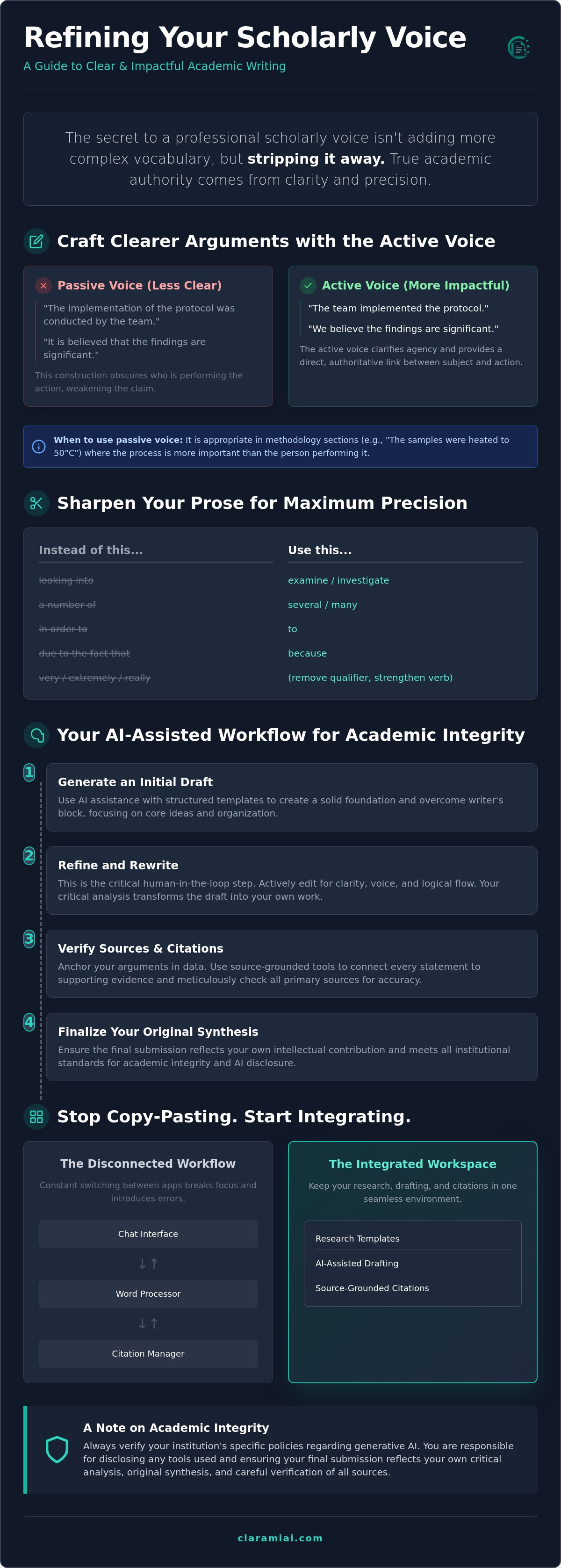
To improve academic writing style, you must treat clarity as a technical requirement rather than an optional aesthetic. This starts with sentence-level discipline. Avoid nominalization, which is the habit of turning useful verbs into heavy nouns. For example, instead of writing "The implementation of the protocol was conducted," write "We implemented the protocol." This small shift reduces cognitive load and keeps the focus on the action. Using an integrated workspace allows you to perform these selection-level edits without the distraction of external chat interfaces, keeping your focus on the text itself.
To better understand how these foundational shifts impact your work, watch this video on immediate improvements for scholarly writing:
### Active vs. passive voice in researchThe active voice clarifies who is performing an action or making a claim. It provides a direct link between the subject and the verb. In most sections of your draft, the active voice increases engagement and authority. However, the passive voice has a specific functional role in methodology sections. When the process is more important than the person performing it, the passive voice is appropriate. For example, "The samples were heated to 50°C" is more precise than "I heated the samples." Outside of these technical descriptions, you should identify the agent of every argument. If you can't name who is performing the action, the sentence is likely too vague for a peer-reviewed standard.
Eliminating wordiness and filler
Precision is often a result of subtraction. Redundant qualifiers like "very," "extremely," or "basically" weaken scholarly claims by adding unnecessary padding. Scholarly authority comes from the data, not the intensity of the adjectives. Replace multi-word phrases with single, precise verbs to sharpen your prose. Instead of "looking into" a problem, you should "examine" or "investigate" it. You can often cut 10% of your word count from a first draft without losing any meaning. This process forces you to evaluate the necessity of every word. Use the Oxford comma to prevent ambiguity in lists of complex research variables, such as participant demographics, socioeconomic status, and geographic location. It ensures that each factor remains distinct and easily identifiable.
Remember that while AI tools can assist in identifying these patterns, you're responsible for the final output. Always verify your school's specific policies regarding AI use and disclose its assistance where required. Maintaining a human-in-the-loop approach ensures that the final draft reflects your original synthesis and critical thinking.
Developing a logical flow and structural integrity
Logical flow is the structural skeleton of your argument. Even the most rigorous data loses its impact if the reader can't follow the connection between your claims. To improve academic writing style, you must move beyond individual sentence clarity and focus on how ideas connect. This requires meticulous paragraph unity where every sentence supports a single, clear topic sentence. When your structure is sound, your reader can focus on the substance of your research rather than trying to decode your organization.
The old-to-new information principle
This technical principle ensures that your reader always has a familiar anchor. You should start your sentences with concepts established in the previous sentence before introducing new, complex data. This creates lexical chains that guide the reader through dense material. For instance, consider a disjointed draft: "The study utilized a randomized control trial. Participants reported a 20% reduction in symptoms." An improved version would read: "The study utilized a randomized control trial. Within this trial, participants reported a 20% reduction in symptoms." By repeating "trial," you bridge the gap between the method and the result.
Maintaining this flow reduces the cognitive burden on your audience. It's a hallmark of sophisticated prose mentioned in UC Berkeley's guide to academic style. When you anchor new information in established facts, your argument feels inevitable rather than forced. This steady progression is essential for building a persuasive case in any scholarly discipline.
Signposting for complex arguments
Signposting acts as a map for your reader. You should use specific transition words to indicate the relationship between ideas. Use additive markers like "similarly" to build on a point, adversative markers like "conversely" to show contrast, and causal markers like "consequently" to demonstrate results. To truly improve academic writing style, your signposting should be invisible yet effective. Avoid starting every sentence with "however," as this becomes repetitive and predictable. Instead, vary your transition placement within the sentence to maintain a steady rhythm and keep the reader engaged.
Managing these transitions while drafting can be difficult. Using the best research writing workflow software helps you maintain this structural integrity by keeping your outline and draft in one view. If you're ready to organize your next project with a methodical approach, you can start building your draft today. This integrated environment helps you maintain focus on the logical progression of your work.
Always remember that clarity is your ultimate responsibility. While software can suggest transitions, you must verify that the logic holds and accurately represents your findings. Check your specific school policies regarding AI assistance and ensure you disclose any tools used in your process. Maintaining a human-in-the-loop workflow ensures that the final submission is a true reflection of your intellectual labor.
Refining your voice and avoiding the AI-tell
AI-generated text often suffers from a lack of "burstiness," which is the natural variation in sentence length and complexity found in human prose. When you use general-purpose tools, the resulting drafts often rely on predictable mathematical averages of language. This creates a flattened, generic voice that lacks the specific nuance required for high-level research. To improve academic writing style, you must actively disrupt these patterns by injecting your own critical voice and disciplinary expertise into every draft. Authenticity in scholarship isn't just about original ideas; it's about the specific, technical way you express them.
A common sign of automated writing is the overuse of generic transitions and a lack of precise disciplinary terminology. To maintain a professional standard, you should use a tone checker to verify that your voice remains consistent across different sections of your paper. This is especially important when transitioning from a literature review to your own methodology. Consistency reinforces your authority as a researcher and ensures your reader isn't distracted by sudden shifts in prose quality or style.
Identifying repetitive prose patterns
Varying your sentence length is one of the most effective ways to create a natural, engaging rhythm. If every sentence is fifteen words long, your reader will eventually lose focus. You should also watch for "hallucinated" metaphors or clichés that feel out of place in a formal paper. AI often defaults to flowery language that doesn't align with the grounded, evidence-based nature of academic work. When you review a draft, rewrite conclusions to ensure they reflect your specific research findings rather than broad, non-committal summaries. Your conclusions should be the most distinct part of your paper, anchored firmly in the data you've presented.
The human-in-the-loop drafting process
You should treat AI as a collaborative partner for initial drafting rather than a final output generator. This "human-in-the-loop" approach ensures that you remain the primary architect of your work. By using selection-level edits, you can refine specific paragraphs that feel clunky or informal without having to rewrite the entire document. This focused ai-humanizer strategy prioritizes academic integrity by keeping your intellectual agency at the center of the process. You're responsible for the final verification of all claims and the structural integrity of the argument.
Before submitting any work, verify your school's specific policies regarding generative AI. Many institutions require mandatory disclosure of any tools used during the writing process. Proper attribution and transparency are just as important as clarity and precision. By following these guidelines, you ensure that your use of technology supports your scholarship rather than replacing it.
Precision through verification and citation accuracy
Precision is often overlooked as a stylistic choice. Vague claims such as "it is widely accepted" or "studies show" without specific attribution weaken the authority of your writing. Professional prose requires the substantiation of every significant assertion with a source-grounded citation. This practice removes the ambiguity that often plagues student drafts. You can improve academic writing style by treating verification as a core part of the composition process rather than a final, administrative step. When your claims are anchored in evidence, your scholarly voice becomes naturally more confident and persuasive.
Automated citation management prevents the stylistic "clutter" of inconsistent formatting. If your references shift between styles or contain errors in DOI placement, it signals a lack of attention to detail that can undermine your research findings. Using an integrated workspace helps you maintain organizational cohesion from the first draft. It ensures that your bibliography remains a live, accurate reflection of your in-text citations. This systematic order allows peer reviewers to focus on your arguments rather than your formatting errors.
Anchoring arguments in primary sources
You should use the Clara AI Assistant to find sources that directly support your specific claims. Avoid "lazy" citations that only provide a general overview of a broad topic. Instead, look for data that substantiates the granular details of your methodology or results. This level of specificity is what distinguishes professional scholarship from introductory writing. For a detailed workflow on maintaining these standards, consult this guide on how to verify ai citations. Using primary sources effectively creates a stronger structural connection between your statement and the supporting data.
Using ClaimShield for substantiation
Identifying claims in your draft that lack sufficient evidence is a critical step in the revision process. ClaimShield allows you to cross-reference your statements against your own uploaded library of PDFs in real time. This tool highlights areas where your argument might be overreaching or where a specific citation is missing. By verifying the integrity of every reference before you export, you build a foundation of trust with your audience. If you're ready to substantiating your work with a methodical, evidence-based approach, you can start your verified draft today.
Always remember to verify your institution's specific policies regarding the use of AI tools in your research. You're responsible for the accuracy of every citation and the integrity of your final submission. A human-in-the-loop workflow ensures that you remain the primary investigator, using technology to enhance the precision of your original synthesis and critical thinking.
Optimizing style with an integrated research workspace
Fragmented workflows often lead to fragmented prose. If you're constantly switching between a PDF reader, a chat interface, and your document, you lose the logical thread of your argument. An integrated editor eliminates this cognitive load by keeping your source material and your draft in a single window. You can improve academic writing style by using environments designed for the specific rigors of scholarship rather than general-purpose text editors. This systematic order allows you to maintain focus on the structural connection between your claims and your evidence.
Sophisticated writing requires adherence to specific academic rubrics and formatting standards. Structured templates within the Clarami workspace provide a blueprint for your work, ensuring you meet institutional requirements from the first draft. These templates help you organize complex data into a coherent narrative. When you're ready to share your progress, collaboration tools like "suggest-mode" allow advisors to provide precise feedback directly on your text. This ensures that every revision is intentional and contributes to the overall clarity of the project.
The no-copy-paste workflow
The habit of copy-pasting text from external AI tools into a document often introduces stylistic inconsistencies and formatting errors. To maintain a professional scholarly voice, you should draft directly within an integrated environment where your research notes are always visible. You can use AutoDraft to generate initial sections based on your specific PDF annotations and source-grounded data. This process keeps your evidence connected to your prose. It prevents the vague paraphrasing that often occurs when you work from memory. Maintaining this proximity to your primary sources is essential for achieving the precision required in peer-reviewed work.
Preserving your stylistic choices during the final stages of a project is equally important. Direct export options to LaTeX or DOCX ensure that your carefully calibrated formatting remains intact. This eliminates the need for manual reformatting, which is often a source of technical inaccuracies. By streamlining the transition from draft to final submission, you can focus your energy on the intellectual substance of your research.
Academic integrity and school policies
Academic Integrity Disclaimer: You must always check your institutional policies regarding the use of AI tools before starting a project. University guidelines on generative AI are evolving rapidly. As of mid-2026, many institutions have moved from broad prohibitions to nuanced requirements for mandatory disclosure and proper attribution. You should disclose the use of AI assistants in your methodology section or acknowledgments as required by your specific department or course instructor.
While technology can provide structural and stylistic assistance, you remain the final authority on your research. A human-in-the-loop approach ensures that you're responsible for the verification of every claim and the synthesis of every argument. You must verify that the final output accurately reflects your findings and meets the ethical standards of your field. Using AI as a methodical expert's companion allows you to enhance your productivity without sacrificing your intellectual agency.
Advancing your scholarly precision
Refining your scholarly voice is a continuous process of synthesis and verification. Clarity is the goal. By prioritizing active sentence structures and the old-to-new information flow, you create a narrative that is both authoritative and accessible. You can improve academic writing style by moving your drafting process into an environment that keeps your primary sources and citations connected to your prose. This systematic approach ensures that every claim is substantiated and every transition is logical.
Maintaining academic integrity requires a human-in-the-loop workflow. Always check your institutional policies regarding the use of AI tools and disclose their assistance as required by your department. You remain the final authority on your research. You're responsible for the accuracy of every reference and the originality of your synthesis.
If you're ready to move beyond fragmented chat boxes and disorganized notes, start refining your academic style in the Clarami workspace. With features like source-grounded drafting via AutoDraft, real-time verification through ClaimShield, and integrated citation management for APA, MLA, and Chicago styles, you can maintain focus on your intellectual labor. Your research deserves a workspace that values precision as much as you do.
Frequently asked questions
How can I make my academic writing sound more formal without using big words?
Focus on precision and sentence structure to improve academic writing style rather than relying on complex vocabulary. Use specific verbs like "examine" or "evaluate" instead of multi-word phrases. Replace vague pronouns with clear subjects and maintain an objective tone by avoiding personal anecdotes. This structural discipline creates a professional atmosphere without obscuring your meaning with unnecessary jargon.
What are the most common stylistic mistakes in PhD dissertations?
Over-reliance on the passive voice and excessive nominalization are the most frequent errors in doctoral work. These habits turn active processes into static nouns, which slows down the reader and hides the agent of the research. Additionally, many candidates struggle with inconsistent signposting, making it difficult for the committee to follow the logical progression across long, complex chapters.
Is it okay to use AI to improve my writing style if I don't use it to generate ideas?
Yes, provided you disclose its use and verify the final output against your institutional policies. Many universities now permit AI assistance for refining clarity, grammar, and syntax as long as the student remains the primary author. You can improve academic writing style by using a human-in-the-loop approach where you approve every selection-level edit to ensure the prose remains your own.
How do I fix a draft that sounds too robotic or repetitive?
Vary your sentence length and structure to create a natural rhythm. Robotic prose often results from a series of sentences that are all the same length or follow identical patterns. By mixing short, punchy statements with longer, explanatory ones, you disrupt the predictable flow. You should also replace generic transitions with specific causal or adversative markers that reflect your actual logic.
What is the best way to handle transitions between different research sections?
Use bridging sentences that summarize the previous section while introducing the next one. This old-to-new flow ensures that each chapter feels like a logical extension of the previous work rather than a disconnected silo. Effective transitions should act as signposts, explicitly stating the relationship between the two sections, such as how a methodology justifies the subsequent data analysis.
How do I ensure my citations are accurate when using an AI writing assistant?
Use an integrated citation helper that anchors your text in real, verified sources from your own PDF library. General AI tools often hallucinate references, so you must verify every DOI and bibliography entry manually or through a specialized tool like ClaimShield. This keeps your evidence connected to your draft and prevents the stylistic clutter of incorrect or missing citations.
Related on Clarami
- Best AI writing tool for students (full guide) →
- AI academic integrity checklist →
- Clarami pricing: Free vs PRO vs Platinum →
- Editor vs ChatGPT for writing →
- Export DOCX, PDF, and hand-in checklist →
- How to outline a paper →
- Prompt to structured essay draft →
- Revise with AI on a selection →
- Sign up free →
- Clarami home →
- More guides on the Clarami blog →