Best AI Translators for Academic Writing: A 2026 Guide
Find the best AI translators for academic writing. Our 2026 guide helps you maintain accuracy, preserve citations, and uphold academic integrity with a safe ...
Write with structure in Clarami AI
Editor-first AI drafting, citations, and two Workflows for student writing.
A 2026 survey found that 86% of students across 16 countries now use AI in their academic work. While the adoption of ai translators for academic writing is high, the stakes for researchers remain even higher. You likely understand the frustration of seeing a precise technical term lose its meaning during translation or discovering a hallucinated citation in a generated draft. It's difficult to trust a general purpose tool when your research integrity and professional reputation are on the line.
This guide will show you how to select and use translation tools that preserve technical accuracy without compromising your scholarly voice. You'll learn to move beyond the inefficiency of switching between translation tabs and editors by adopting a methodical, human-in-the-loop workflow. We'll examine the top tools for 2026, the importance of source-grounded verification through assistants like Clara, and how to maintain compliance with university and publisher policies.
Academic Integrity Disclaimer: Always review your specific institutional policies before using AI tools. Most universities and publishers require clear disclosure of AI assistance and prohibit the submission of machine-generated text as your own original work.
Key Takeaways
- Distinguish between generic machine translation and specialized models designed to preserve field-specific terminology and rhetorical structures.
- Evaluate ai translators for academic writing based on their ability to maintain citation stability, ensuring DOIs and reference formats remain unchanged.
- Maintain academic integrity by adopting a human-in-the-loop workflow, where you remain responsible for the final verification and disclosure of AI assistance.
- Improve translation accuracy by using selection-level edits to process specific paragraphs rather than translating entire documents at once.
- Eliminate the risks of manual copy-pasting by using an integrated workspace where the Clara AI Assistant grounds suggestions in your verified source material.
Table of Contents
- What is an ai translator for academic writing?
- Evaluating ai translators for technical and research integrity
- The ethical use of ai translation in higher education
- A systematic workflow for translating and drafting research
- Integrating translation into your research workspace with Clara
What is an ai translator for academic writing?
Academic AI translation represents a specialized branch of linguistic technology. It utilizes large language models to convert scholarly text while preserving technical lexicon and rhetorical structure. To understand what machine translation is at its core, one must look at the transition from statistical word-swapping to deep semantic understanding. This technology ensures your methodology remains intact across language barriers by prioritizing the structural connection between a statement and its supporting data.
Accuracy in research translation is measured by the preservation of logical arguments. It isn't just about grammatical correctness. Domain-specific training allows these tools to handle the nuanced terminology of STEM, social sciences, and the humanities. You need a system that recognizes the difference between a casual observation and a substantiated claim, ensuring the final draft respects your intellectual agency.
To better understand the ethical considerations of these tools, watch this helpful video:
### The shift from neural networks to large language modelsBy 2026, the shift from basic neural networks to sophisticated large language models has redefined the workflow. Older statistical models often missed the subtle relationships between technical nouns and their modifiers. Modern transformer architectures identify these connections with high precision. Contextual linguistic mapping is the process of aligning specialized terminology across languages based on the surrounding semantic framework and methodological intent.
Why general-purpose translators often fail researchers
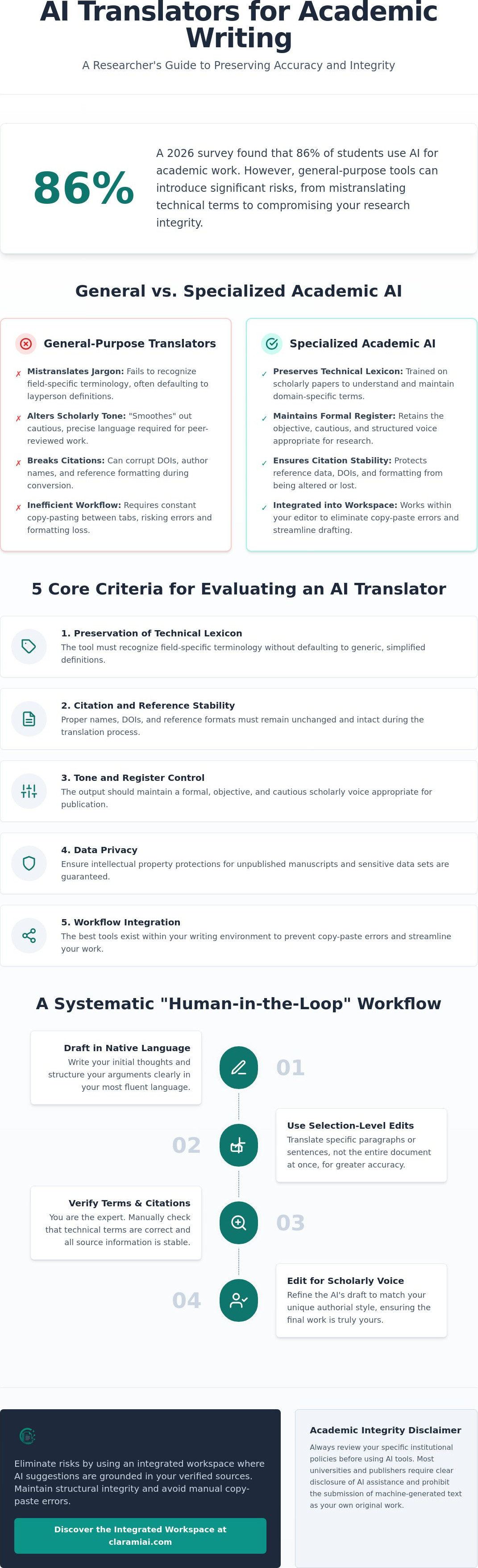
General-purpose tools often struggle with specialized jargon. For example, the word "significance" carries a specific mathematical weight in statistics that generic models often mistranslate as mere importance. There is also the risk of "smoothing," where the AI removes the cautious, precise tone required for peer review. Selecting the right ai translators for academic writing requires a focus on field-specific nuance and the preservation of your original rhetorical intent.
Inefficiency is another major hurdle when using standard ai translators for academic writing. Standard interfaces require you to constantly switch between translation tabs and your document editor. This process often results in the loss of formatting and citation anchors. Using an integrated research workspace helps you maintain structural integrity by keeping your citations and data grounded in one environment. You avoid the manual copy-paste errors that lead to hallucinated references or broken DOIs.
Evaluating ai translators for technical and research integrity
Selecting a tool for scholarly work requires more than a simple fluency test. You need a system capable of handling the structural complexity of a peer-reviewed manuscript. Many ai translators for academic writing prioritize speed over technical verification. This introduces significant risk into your submission process. To ensure your work meets publication standards, evaluation must focus on five core criteria:
- Preservation of technical lexicon: The tool must recognize field-specific terminology without defaulting to layperson definitions.
- Citation and reference stability: Proper names, DOIs, and specific formatting must remain unchanged during the conversion process.
- Tone and register control: The output should maintain a formal, objective, and cautious scholarly voice.
- Data privacy: Intellectual property protections are vital for unpublished manuscripts and sensitive data sets.
- Workflow integration: The tool should exist within your writing environment to prevent copy-paste errors.
Data privacy is a critical metric. Many free tools use your input to train their models, which can compromise the originality of your research. Before uploading a draft, consult your institution's guidance on AI writing tools to ensure you are following ethical data-handling protocols. Precision is the baseline. If a tool cannot guarantee the security of your methodology, it's not fit for professional use.
Preserving the integrity of your citations
Generic tools often treat citations as standard strings of text. This leads to the translation of proper names or the corruption of DOI links. For example, a translator might incorrectly translate the name "White" into a target language's word for the color. This breaks the link between your claim and its source. By choosing an ai research assistant tool that treats citations as protected entities, you ensure that your reference list remains accurate and stable throughout the drafting process.
Managing technical terminology and jargon
Methodology sections are the ultimate stress test for any translator. You should test a translator's performance by inputting a paragraph dense with field-specific jargon. Watch for "over-translation." This occurs when the AI translates established English-language technical terms that should remain in English within the target language. Using custom glossaries or specific prompts can help the AI understand which terms are non-negotiable. If you want to maintain this level of control within a unified editor, you can create a professional workspace today.
Academic Integrity Disclaimer: Always check your school or journal policies regarding AI use. You're responsible for the final accuracy of your work and should disclose AI assistance where required by your institution.
The ethical use of ai translation in higher education
Ethical integration of ai translators for academic writing requires a clear understanding of institutional boundaries. You must prioritize your intellectual agency over automated convenience. Academic Integrity Disclaimer: Always check your school policies and disclose AI use where required. Submitting machine-generated text without disclosure often violates student conduct codes and can lead to severe disciplinary action. By 2026, most research universities and major publishers, including Elsevier and Springer Nature, have established strict guidelines that prohibit listing AI as an author but permit it as a linguistic aid.
You must distinguish between translation assistance and ghostwriting. Translation serves as a tool to communicate your original thoughts across language barriers. Ghostwriting occurs when the AI generates new concepts, arguments, or data on your behalf. Accountability remains entirely with you. A human-in-the-loop approach is the only way to ensure that the final output accurately reflects your findings. You are responsible for every claim, citation, and conclusion within your manuscript.
Defining acceptable use for students and researchers
For many ESL writers, AI acts as a vital linguistic bridge. It allows you to express complex methodology in English without losing the nuance of your original hypothesis. Acceptable use often includes using AI to parse difficult primary sources in foreign languages to broaden your literature review. However, submitting unedited outputs is a high-risk practice. It bypasses the cognitive process of synthesis and verification, which are the hallmarks of scholarly labor. You should use AI to refine your existing drafts, not to generate the substance of your research from scratch.
How to disclose ai translation use
Transparency is your best defense against integrity charges. Most journals and departments require a disclosure statement in the Methods or Acknowledgements section. You can use specific phrasing such as: "Portions of this manuscript were translated from [Language] to English using [Tool Name], followed by manual editing for technical accuracy and tone." This level of honesty substantiates your commitment to research integrity. Providing your original language draft alongside the final version for your supervisor also demonstrates transparency.
After the translation process is complete, you must meticulously verify ai citations to ensure no references were corrupted or hallucinated. Ai translators for academic writing sometimes struggle with the structural integrity of bibliographic data. You must manually cross-reference every DOI and author name against your original source material. This systematic order preserves the structural connection between your statements and your supporting data, ensuring your work is ready for peer review or grading.
A systematic workflow for translating and drafting research
Translating high-stakes research requires more than a single click. You need a structured sequence that maintains the connection between your data and your claims. Bulk translation often obscures logic and detaches citations from their specific context. Following a methodical workflow ensures that your final manuscript remains academically sound and professionally polished. This process shifts the focus from simple word replacement to the preservation of your structural integrity.
- Step 1: Prepare your source text. Ensure your original language draft is logically clear. Ambiguity in the source text leads to significant errors in the translated output.
- Step 2: Use selection-level translation. Process your document paragraph by paragraph. This allows you to maintain cognitive control over each technical claim as it is generated.
- Step 3: Verify technical terms. Use an academic writing tone checker online to ensure your translated lexicon matches the expected scholarly register of your field.
- Step 4: Re-anchor citations. Manually check that every citation still points to the correct evidence. Translation can sometimes shift the placement of reference markers, leading to misattributed data.
- Step 5: Perform a final human pass. Read the entire section to ensure the argument flow is cohesive. Your intellectual agency is the final filter for quality and accuracy.
Selection-level editing vs. bulk translation
Bulk translation tools often treat a document as a single block of text. This approach frequently results in "contextual drift," where the AI loses the specific nuance of your methodology by the middle of the paper. By focusing on ai translators for academic writing that support selection-level edits, you can verify each segment individually. Working paragraph by paragraph allows you to utilize suggest-mode features to compare the original and translated versions side-by-side. This prevents the AI from making unauthorized changes to your research findings and keeps you in the loop throughout the process.
Verifying the accuracy of the translated claims
Verification is the most critical stage of the synthesis process. You can use back-translation to check for meaning shifts. This involves taking the translated English text and running it back into the original language to see if the core concepts remain consistent. You should also cross-reference every translated data point with your original data set to prevent numerical hallucinations. Ensuring the research writing workflow software you use supports real-time verification is essential for maintaining organizational cohesion. To start building your own verified research drafts, create your professional workspace today.
Academic Integrity Disclaimer: Always check your school policies and disclose AI use where required. You're responsible for the final accuracy of your work and must ensure that any AI-assisted translation is clearly disclosed in your submission.
Integrating translation into your research workspace with Clara
Most ai translators for academic writing function as isolated web interfaces. This forces you to copy text back and forth between a translation tab and your manuscript. It's a fragmented process that invites errors. Clarami replaces this disjointed workflow with an integrated In-App Editor. Within this workspace, the Clara AI Assistant provides translation suggestions grounded in your uploaded source material. You maintain a single source of truth where your arguments and evidence remain physically connected.
This integration ensures that your technical claims don't lose their substantiation during the transition between languages. Instead of treating translation as a final, separate step, you can incorporate it into your active drafting process. Use AutoDraft to turn your translated research notes into a structured academic first draft. This methodical approach prioritizes organizational cohesion and ensures that your intellectual agency remains central to the composition.
The advantage of an integrated document editor
Working within a unified environment reduces the risk of formatting errors and citation loss. When you use external ai translators for academic writing, the structural integrity of your bibliography is often the first thing to fail. Clarami's editor maintains your citation anchors. Clara assists in refining the scholarly tone of translated passages, ensuring they meet the specific requirements of your field's rubric. You're not just swapping words; you're anchoring your arguments in primary sources while maintaining a consistent professional register.
Verification with ClaimShield
Verification is the final, non-negotiable stage of scholarly labor. ClaimShield allows you to verify that translated sentences still accurately reflect the data in your source PDFs. It surfaces the specific paragraph from your original research that supports a translated claim. This traceability eliminates the anxiety of machine-induced inaccuracies. The system also features automated citation building that works across multiple languages, keeping your reference list stable and verified. You can start your next project with this level of precision by signing up for the Clarami workspace today.
Academic Integrity Disclaimer: Always check your school policies and disclose AI use where required. You're responsible for the final accuracy of your work and must ensure that any AI-assisted translation is clearly disclosed in your submission. Clarami is designed to support your writing process, but the final responsibility for the integrity of the research rests with you.
Advancing your research with technical precision
You've seen how the right tools transform translation from a risky shortcut into a rigorous scholarly process. Effective communication in global research requires a methodical approach that keeps your citations anchored and your technical lexicon precise. Selecting the right ai translators for academic writing is ultimately about choosing verification over mere automation. By maintaining a human-in-the-loop workflow, you protect your intellectual agency and ensure every claim remains substantiated.
Clarami's workspace provides the structural order needed for high-stakes drafting. With source-grounded AI assistance and integrated PDF and citation management, you don't have to worry about the fragmentation of your data. ClaimShield verification technology allows you to cross-reference every translated statement against your original evidence, ensuring your integrity remains uncompromised. Your research deserves to be understood clearly by your peers worldwide.
Academic Integrity Disclaimer: Always check your institutional policies and disclose AI use where required by your school or publisher. You're responsible for the final accuracy and submission of your work.
Start drafting your research with Clara today
Frequently Asked Questions
Are AI translations acceptable for academic journal publication?
Most academic journals accept AI translation as a tool for linguistic clarity, provided you remain responsible for the final content and technical accuracy. You should always check the specific 'Instructions for Authors' for your target publication. Disclose the use of AI in your methodology or acknowledgments section to maintain transparency and follow established publisher standards.
How do I maintain citation accuracy when using an AI translator?
You maintain citation accuracy by avoiding general-purpose translators that treat citations as plain text. Instead, use a specialized workspace like Clarami that anchors citations directly to your source documents. After using ai translators for academic writing, manually verify that every author name, date, and DOI matches your original source material. This prevents hallucinated or mismatched references from entering your final draft.
Can AI handle highly technical terminology in fields like medicine or law?
Modern AI translators based on large language models are significantly more capable of handling technical terminology than older statistical tools. However, they still require professional oversight. You should provide the AI with a specific glossary of terms or field-specific context. Always perform a back-translation check on critical methodology sections to ensure the technical meaning hasn't shifted during the process.
What is the difference between a free AI translator and a research workspace?
A free AI translator is typically a standalone interface where you paste text and receive a result without context. A research workspace, such as Clarami, integrates translation directly into a document editor with citation management and source-grounding. This prevents the loss of context and ensures your writing remains connected to your evidence, supporting data, and specific formatting requirements.
Is it ethical to use AI to translate my entire dissertation?
Using AI to assist with language translation is generally acceptable if the original ideas and research findings are your own. However, submitting a full dissertation translation without significant manual editing and disclosure is often viewed as a violation of academic integrity. Always consult your supervisor and follow your university's specific AI usage guidelines. You're responsible for the final accuracy of your work.
How do I disclose the use of AI translation to my committee?
Transparency is essential when defending your work to your committee. You can include a statement in your acknowledgments or a footnote in your methodology section. For example: "This manuscript was drafted in [Original Language] and translated into English using [Tool Name]. The author has reviewed and edited the translated text for technical accuracy and scholarly tone." This demonstrates a professional commitment to integrity.
Related on Clarami
- Best AI writing tool for students (full guide) →
- AI academic integrity checklist →
- Clarami pricing: Free vs PRO vs Platinum →
- Editor vs ChatGPT for writing →
- Export DOCX, PDF, and hand-in checklist →
- How to outline a paper →
- Prompt to structured essay draft →
- Revise with AI on a selection →
- Sign up free →
- Clarami home →
- More guides on the Clarami blog →