
Best AI Tools for Academic Research: A 2026 Guide
Find the best AI tools for academic research. Our 2026 guide helps you select verified systems to improve your workflow and maintain citation accuracy.
Write with structure in Clarami AI
Editor-first AI drafting, citations, and two Workflows for student writing.
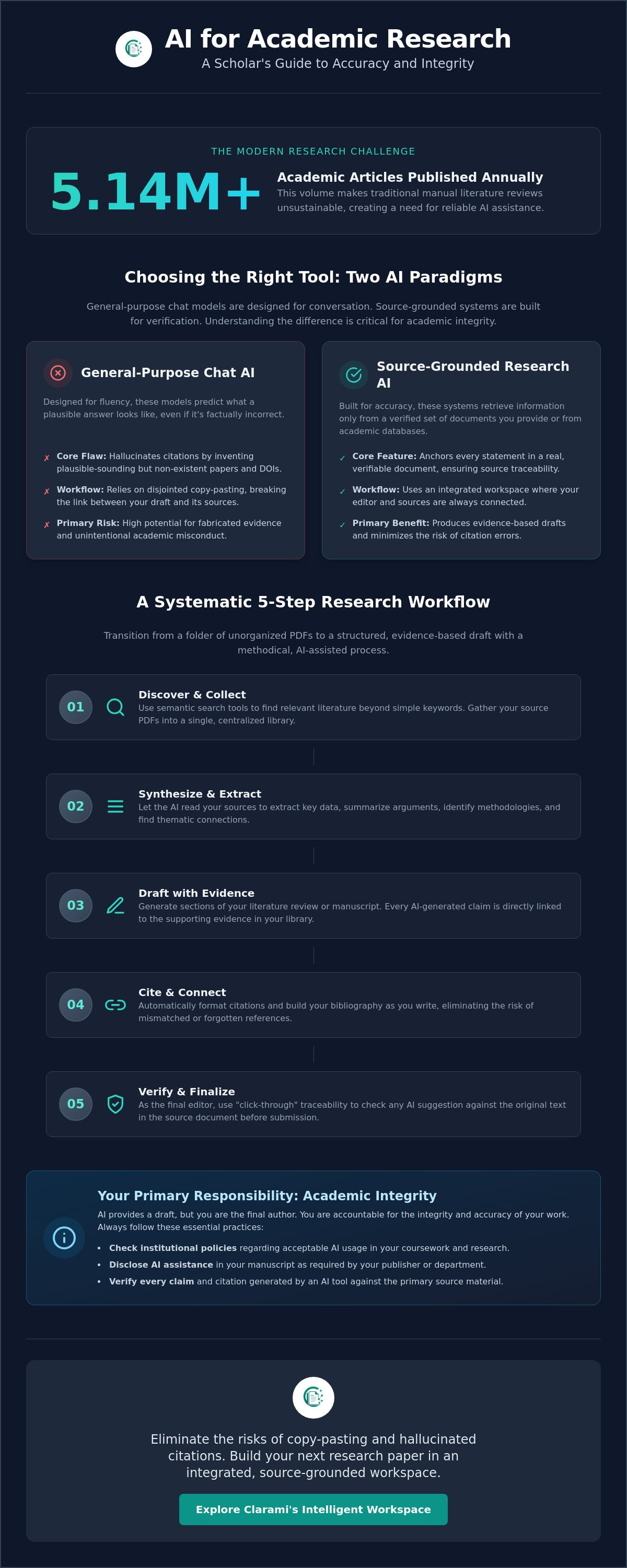
With over 5.14 million academic articles published annually, the traditional manual literature review is no longer a sustainable practice for the modern scholar. You likely feel the pressure of this information volume. It's difficult to maintain a rigorous pace when general-purpose AI tools frequently hallucinate citations or force you into disjointed, copy-paste workflows. Finding the right ai tools for academic research is now a matter of professional survival and ethical precision.
You need a system that prioritizes verification over creative flair. This guide explains how to select and integrate source-grounded AI tools into your scholarly workflow while maintaining academic integrity and citation accuracy. You'll learn a methodical approach to finding papers, extracting methodology, and anchoring your arguments in primary sources. We'll preview a drafting process that keeps your evidence connected to your claims from the first note to the final bibliography.
Academic integrity remains your primary responsibility. Always check your institution's specific policies regarding AI usage and disclose AI assistance in your manuscripts as required by your publisher or department.
Key Takeaways
- Distinguish between general-purpose models and source-grounded systems to ensure your data is retrieved from verified academic databases.
- Categorize ai tools for academic research by their role in discovery, synthesis, and drafting to build a more efficient scholarly stack.
- Verify claims using the "click-through" method, which connects AI suggestions directly to highlighted evidence within your primary sources.
- Adopt a systematic five-step workflow to transition from an unorganized PDF collection to a structured, evidence-based draft.
- Eliminate the risks of manual copy-pasting by using an integrated workspace where your citations and document editor remain connected.
Table of Contents
- The transition from generative chat to source-grounded research tools
- Essential categories of ai tools for academic research
- Evaluating reliability and source traceability in scholarly ai
- Integrating ai into your literature review and drafting process
- Why an integrated workspace outperforms disconnected ai tools
The transition from generative chat to source-grounded research tools
General-purpose chat boxes were designed for conversation. Source-grounded systems are designed for verification. These specialized systems retrieve information from a specific corpus of uploaded PDFs or verified databases before generating a response. This methodology ensures every statement is anchored in a real document rather than a statistical guess. While AI-assisted literature reviews can be completed up to 30% faster than traditional methods, speed should never compromise accuracy. For a broad perspective on these developments, consult this overview of AI in education.
Choosing the right ai tools for academic research requires understanding this technical distinction. General-purpose models predict the next word based on patterns in their training data. They don't have a concept of truth or a connection to a live library. Source-grounded tools prioritize the structural connection between a statement and its supporting data, pulling from databases that include over 200 million peer-reviewed papers.
To better understand this concept, watch this helpful video:
Hallucination is a structural feature of generative AI, not a temporary glitch. Because these models aim for fluency, they fill data gaps with plausible-sounding content. In a scholarly context, this leads to fabricated evidence. You must move toward tools that offer traceability and allow you to verify every claim against the primary source material.Academic integrity is your primary responsibility. Before integrating any software into your workflow, verify your institutional policies. Most universities require you to disclose AI use in your methodology or acknowledgments. As of 2026, major academic publishers like Elsevier and Springer Nature strictly prohibit listing AI tools as authors because authorship requires human accountability.
Why general ai makes up citations
Tools like ChatGPT use statistical token prediction to generate text. When prompted for a source, the model doesn't search a database. Instead, it predicts what a citation "should" look like based on its training. This often results in plausible but non-existent DOIs and paper titles. A hallucinated citation is a probabilistic error in reference generation.
The role of the researcher as the final editor
A human-in-the-loop approach is essential for all scholarly output. AI provides a draft or a summary, but you remain the final editor. You must substantiate every claim and ensure the structural integrity of your argument. Using an integrated workspace helps maintain this connection between your editor and your primary sources, eliminating the risks associated with disjointed copy-paste workflows.
Essential categories of ai tools for academic research
Building a professional research stack requires a modular approach. You shouldn't expect one platform to handle every stage of your work. Instead, you should categorize your ai tools for academic research into three functional pillars: discovery, synthesis, and drafting. This structure allows you to use specialized systems for specific cognitive tasks, ensuring that your output remains accurate and verified.
Discovery and semantic search engines
Modern discovery tools have evolved beyond simple keyword matching. They utilize semantic search to interpret the intent behind your query, identifying relevant literature even when authors use differing terminology. Many of these engines use citation snowballing to map the academic landscape. This technique tracks how papers cite one another, revealing hidden connections between disparate studies. Look for tools that offer:
- Semantic search that understands research intent beyond keywords.
- Citation tracking to identify forward-citing works and newer studies.
- Automated metadata extraction to ensure bibliography accuracy.
Reliable metadata extraction is a critical feature. It ensures that your bibliography is built on verified publication data rather than predicted text. For a detailed framework on these standards, York University's guide on using AI tools provides essential institutional context on finding and evaluating sources.
Synthesis tools take your collection of papers and extract the methodology, sample sizes, and core findings. Instead of reading each PDF in isolation, you can view these data points in a comparative matrix. This high-utility approach helps you identify trends across dozens of papers simultaneously. It's a methodical way to substantiating claims without getting lost in disorganized source material. Selecting the right ai tools for academic research involves finding platforms that prioritize this structural integrity over simple summarization.
Drafting and reference management integration
The most significant friction in a scholarly workflow occurs when moving findings from a chat box to a document editor. This "copy-paste" method is a primary cause of citation errors and lost context. Integrated drafting tools solve this by combining a document editor with a built-in Citation Generator. These systems support APA, Chicago, and MLA styles natively, keeping your evidence anchored to your arguments. When choosing an ai research assistant tool for systematic scholarly work, prioritize an environment where your sources and your editor live together. Selecting a purpose-built ai writing tool for students ensures that your citations remain accurate while you focus on the cognitive work of composition. This "human-in-the-loop" setup ensures you remain the final editor while the technology handles the structural formatting.
If you're ready to organize your research library and start drafting with verified citations, you can get started with a specialized workspace designed for academic rigor.
Evaluating reliability and source traceability in scholarly ai
High-stakes research demands more than a simple summary. It requires a way to prove where every claim originates. Assessing ai tools for academic research involves a specific set of criteria to ensure structural integrity and academic honesty. If a tool doesn't allow you to verify its output against the primary source, it shouldn't be part of your workflow. The goal is to move from blind trust to systematic verification.
Use this checklist when evaluating any platform for your research stack:
- Does the system provide a direct link to the primary PDF?
- Can you click through to the exact page number and highlighted segment?
- Is there an automated Citation Generator to prevent manual entry errors?
- Does the tool support sentence-level approval rather than whole-essay generation?
Mastering the process of verifying ai citations is a core competency for the modern researcher. This skill ensures that your work remains grounded in evidence, protecting you from the probabilistic errors common in general-purpose models. It's a disciplined approach that respects the user's intellectual agency while utilizing technology to manage large volumes of data.
The click-to-source verification model
Reject any AI tool that doesn't provide direct links to its sources. A professional workflow relies on a click-through requirement where every AI-generated claim leads back to a highlighted PDF segment. This level of transparency allows you to check the context of a quote or finding in seconds. Source-anchoring is the direct link between a generated draft and its evidentiary PDF. By using a system that supports this, you eliminate the anxiety of searching through hundreds of pages to find a single reference. This methodical approach ensures your arguments remain anchored to their supporting data throughout the entire composition process.
Checking claims against sources in real time
Effective verification happens during the drafting process, not after it's finished. Specialized features like ClaimShield allow you to find contradictions between your draft and your uploaded library. It's a systematic way to ensure you haven't misrepresented a study's findings or methodology. You should approach AI as a collaborator that provides suggestions for you to approve or reject at the sentence level. This human-in-the-loop framing ensures you maintain intellectual agency over your final submission. By reviewing suggestions within an integrated workspace, you keep the drafting process connected to the evidence. This makes the transition from notes to a verified draft seamless and logical.
Integrating ai into your literature review and drafting process
Fragmented workflows are the primary cause of data loss in scholarly work. When you use one tool for search, another for PDF management, and a third for drafting, the structural connection between your claims and evidence often breaks. Effective ai tools for academic research should exist within a single environment to maintain this traceability. Moving from a collection of papers to a verified draft requires a disciplined, five-step workflow that keeps your sources and your editor in constant sync.
- Centralize your library: Upload your documents into a dedicated PDF Manager. This creates a private corpus that the AI can reference without pulling from unverified external data.
- Extract core themes: Use your Clara AI Assistant to identify methodologies and findings across multiple papers. This synthesis replaces the manual extraction of data into spreadsheets.
- Establish structural integrity: Generate a structural outline based on your specific research questions. This ensures your argument follows a logical progression before you begin writing prose.
- Perform selection-level edits: Use AutoDraft to refine specific paragraphs rather than generating whole essays. This human-in-the-loop approach ensures you remain the primary author of every argument.
- Finalize and export: Move your verified draft into DOCX or LaTeX formats. A built-in Citation Generator ensures your bibliography matches your chosen style guide perfectly.
This systematic approach eliminates the need for constant copy-pasting. By keeping your workspace organized, you reduce the risk of citation errors and maintain the momentum of your intellectual labor.
From research notes to first draft
The gap between reading and writing is where most researchers stall. You likely have dozens of highlights and annotations that feel disconnected from your final prose. AutoDraft helps bridge this gap by suggesting ways to incorporate your notes into your current draft. It provides a starting point for your arguments while prioritizing your unique scholarly voice. You aren't handing the writing over to a machine. Instead, you're using technology to organize your evidence so you can focus on high-level analysis and synthesis.
Managing collaborative feedback
Academic research is rarely a solitary endeavor. When working with advisors or co-authors, you need a way to track changes and discuss refinements without leaving your document. The "suggest-mode" feature allows for seamless collaboration, mirroring the review process found in traditional word processors but with the added benefit of AI-assisted verification. For teams managing large-scale projects, choosing the best research writing workflow software is essential for maintaining version control and data security. This creates a transparent environment where every contributor can see the evidence behind each proposed edit.
If you're tired of disjointed workflows and want to keep your evidence connected to your arguments, you can start building your integrated research workflow today.
Why an integrated workspace outperforms disconnected ai tools
Fragmented workflows are the primary cause of citation errors. When you use a disconnected stack of ai tools for academic research, you're forced into a constant cycle of copy-pasting between a search engine, a PDF manager, and a chat box. This manual movement of data breaks the structural connection between your claims and your evidence. It creates a state of intellectual disorganization that increases the risk of technical inaccuracies and lost context.
The Clarami workspace eliminates this risk by keeping your editor and your sources in a single, unified environment. Within this space, Clara acts as a source-grounded assistant that lives inside your document. Instead of prompting a general-purpose model in a separate tab, you can query your own uploaded library for specific data points or methodologies. This methodical approach ensures your arguments remain anchored in primary sources from the first note to the final draft.
Security is equally paramount for professional labor. A purpose-built workspace provides a single, encrypted location for your intellectual property. You don't have to worry about your research data being used to train broad-market models or being spread across five different third-party platforms. This centralized system protects your intellectual agency while providing a reliable companion for the synthesis of complex information.
Eliminating the copy-paste friction
Selection-level rewrites keep you in the flow of composition. Rather than generating whole essays that require extensive manual correction, you can highlight specific paragraphs for refinement. This human-in-the-loop framing ensures you maintain control over the narrative while the AI handles structural clarity. It's a significant improvement over the distraction of switching tabs to prompt a chatbot. You can also utilize structured templates matched to specific academic rubrics, ensuring your work meets technical requirements from the start. This transition from high-level benefits to granular execution is seamless and logical.
Maintaining integrity with automated citation helpers
Automated Citation Generators save hours of manual formatting. By pulling metadata directly from your verified PDF library, these tools build APA, MLA, and Chicago citations that are structurally accurate. You can focus on the cognitive work of refining your scholarly voice while the software manages the technical standards of your bibliography. A built-in Draft Tone Checker further assists by ensuring your prose remains professional and precise. This disciplined process guides you toward a polished, verified output that respects the rigors of scholarly labor.
Academic integrity is your responsibility as a researcher. You must check your school's specific policies regarding the use of AI and disclose its use where required by your institution or publisher. To begin your next project with a methodical, ethics-focused approach, start your research project in an integrated AI workspace today.
Establishing a systematic research workflow
The transition toward source-grounded systems marks a shift from probabilistic guessing to evidentiary precision. By moving your literature review into an integrated environment, you eliminate the fragmentation that leads to citation errors and lost context. You've seen how ai tools for academic research can enhance discovery and synthesis when they're anchored to a verified PDF library. This methodical approach ensures your arguments remain substantiated by primary data rather than statistical predictions.
Your intellectual agency is the most critical component of this process. Utilizing the source-grounded Clara AI Assistant and ClaimShield verification technology allows you to maintain a rigorous human-in-the-loop workflow. With an integrated Citation Generator for APA and Chicago styles, you can focus on high-level analysis while the software manages technical formatting. Always check your institution's academic integrity policies and disclose AI assistance as required by your department or publisher.
You can start your research project with Clarami today to experience a more disciplined way of writing. We're here to support you in turning disorganized source material into a polished, verified scholarly output.
Frequently Asked Questions
How do I know if an AI research tool is hallucinating citations?
To identify hallucinated citations, look for the absence of direct source-anchoring. General-purpose models often generate plausible but fake DOIs and paper titles based on statistical patterns. Reliable ai tools for academic research will provide a click-through link that takes you directly to the highlighted segment in the original PDF. If you cannot verify the claim against a primary source within seconds, you should treat the citation as a statistical error.
Is it ethical to use AI tools for academic research and writing?
Using AI is ethical when it functions as a research assistant rather than a ghostwriter. You must maintain intellectual agency by reviewing every claim and ensuring your work adheres to academic integrity standards. Most institutions require you to disclose AI assistance in your methodology or acknowledgments. It's your responsibility to check school policies and ensure your final submission reflects your own critical analysis and synthesis.
What is the difference between a chat-based AI and an integrated research workspace?
A chat-based AI operates in a separate tab, requiring constant copy-pasting that breaks your concentration and risks citation errors. An integrated research workspace connects your PDF library directly to your document editor. This setup allows your assistant to reference your specific sources in real time. It eliminates the friction of disjointed workflows and keeps your evidence structurally connected to your arguments throughout the drafting process.
Can AI tools help with systematic literature reviews?
Specialized ai tools for academic research are highly effective for systematic literature reviews. These systems can extract methodologies, sample sizes, and findings from dozens of papers to create a comparative matrix. This automated synthesis allows you to identify trends and gaps in the literature up to 30% faster than manual methods. You remain the final editor, interpreting the data that the AI has organized and verified.
Do I need to disclose the use of AI in my dissertation or thesis?
You must disclose AI usage in almost all academic contexts as of 2026. University policies and major publishers, including Elsevier and Wiley, mandate transparency regarding the tools used during the research and writing phases. Disclosure usually happens in the methodology section, acknowledgments, or a dedicated cover letter. Failure to disclose can lead to allegations of academic misconduct, so you should always verify the latest departmental guidelines.
How can I ensure my AI-assisted draft sounds like my own voice?
You can maintain your scholarly voice by using selection-level edits rather than generating entire sections of text. By focusing on rewriting specific paragraphs, you keep the human-in-the-loop and ensure the narrative follows your logic. Utilizing a Draft Tone Checker helps refine the prose for academic precision and structural integrity. This methodical approach ensures the technology supports your unique perspective without replacing your intellectual contribution to the field.
Related on Clarami
- Best AI writing tool for students (full guide) →
- AI academic integrity checklist →
- Clarami pricing: Free vs PRO vs Platinum →
- Editor vs ChatGPT for writing →
- Export DOCX, PDF, and hand-in checklist →
- How to outline a paper →
- Prompt to structured essay draft →
- Revise with AI on a selection →
- Sign up free →
- Clarami home →
- More guides on the Clarami blog →