
Accurate APA 7 citation generator for dissertation writing in 2026
Perfect your reference list with a dedicated APA 7 citation generator for dissertation writing. Learn a workflow to avoid errors and secure academic integrity.
Write with structure in Clarami AI
Editor-first AI drafting, citations, and two Workflows for student writing.
You are three hundred pages into your dissertation when you realize your database citations look identical to your repository entries. The technical distinction is subtle. The consequences for your reference list are not. It's exhausting to manage a bibliography that spans hundreds of sources while trying to maintain the cognitive load of original research. Using a dedicated apa 7 citation generator for dissertation writing helps eliminate the manual entry errors that often lead to accidental plagiarism. You've likely spent hours squinting at DOI strings and punctuation rules.
This guide provides a methodical workflow for using citation tools to ensure every entry is technically perfect. We'll examine how to integrate these helpers directly into your drafting process to eliminate formatting mistakes and secure your academic integrity. You'll learn to distinguish between complex source types, build a verified reference list, and maintain structural precision. By anchoring your arguments in primary sources through a structured system, you can focus on your methodology instead of punctuation. Always check your specific institutional policies regarding AI tools and disclose their use as required by your department.
Key Takeaways
- Learn to distinguish between published and unpublished dissertation formats to maintain technical precision in your reference list.
- Discover how an integrated apa 7 citation generator for dissertation writing prevents formatting drift by managing sentence-case titles and complex author lists automatically.
- Establish a systematic workflow by organizing your PDF library by chapter or theme before you begin the drafting phase.
- Eliminate the risks associated with a fragmented copy-paste workflow by building your bibliography within an integrated document editor.
- Ensure academic integrity by using tools that anchor your arguments in verified, real-world source material while maintaining human-in-the-loop oversight.
Table of Contents
- Understanding the complexity of APA 7 dissertation citations
- Essential elements of an APA 7 citation generator for dissertation
- Comparing standalone generators with integrated research workspaces
- Workflow for managing citations throughout the dissertation lifecycle
- Enhancing dissertation integrity with Clarami
Understanding the complexity of APA 7 dissertation citations
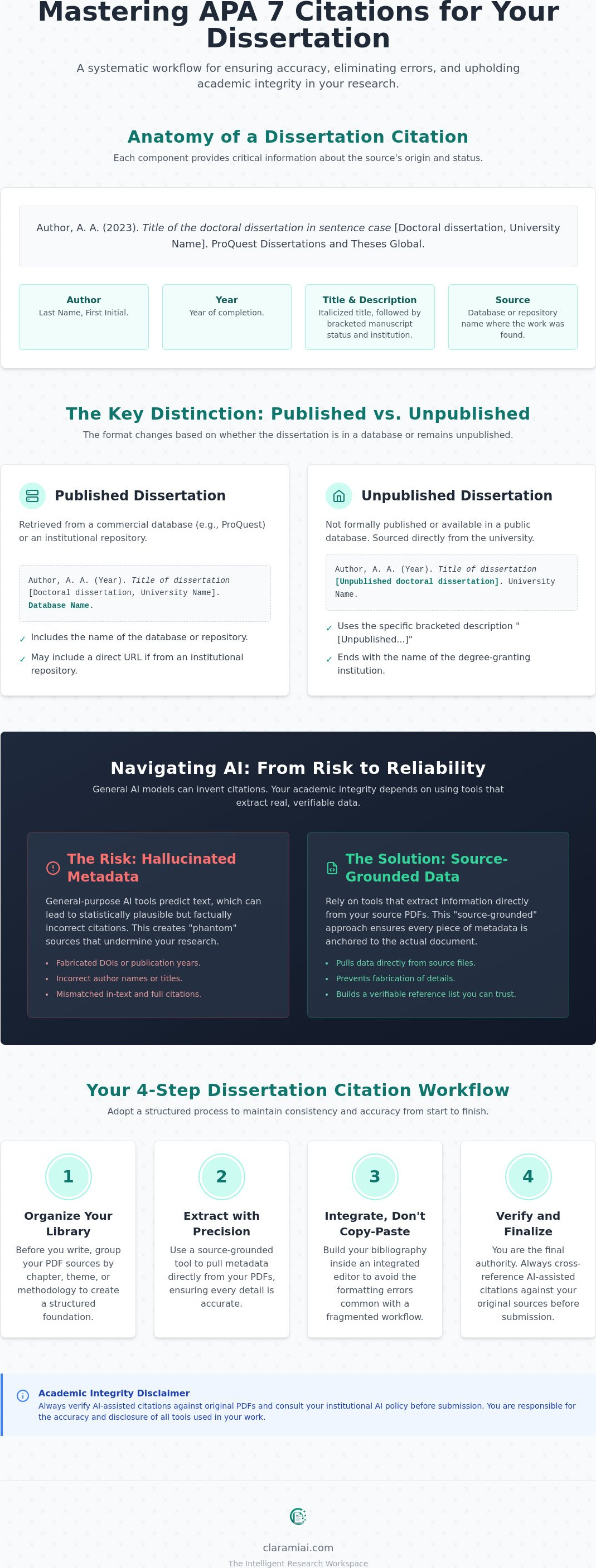
APA 7 dissertation citations are structural anchors for your research. They require more than just a name and a date. A complete reference must include the author, the year of completion, the title in sentence-case italics, and the specific institutional context. An accurate apa 7 citation generator for dissertation work must account for the manuscript's status. The distinction between a work found in a database and one that remains unpublished changes the bracketed description that follows the title. These technical details ensure your bibliography meets the rigorous standards of scholarly labor.
Using Reference management software helps maintain this order throughout your project. However, software is a companion, not a replacement for your own technical oversight. You must understand why the bracketed tag [Doctoral dissertation, University Name] is necessary. It provides essential provenance for your peers and verifies the level of the degree awarded. This systematic approach transforms a simple list into a verified map of your intellectual influences.
To better understand the practical application of these rules, watch this helpful video:
### Published vs. unpublished dissertations in APA 7The 7th edition of the APA manual creates a clear divide based on how you accessed the document. If you retrieve a dissertation from a commercial database like ProQuest, you must include the database name at the end of the citation. Work found in an institutional repository requires the repository name and a direct URL. Unpublished manuscripts are handled differently; they use the bracketed description [Unpublished doctoral dissertation] followed by the name of the university. Using an apa 7 citation generator for dissertation writing helps automate these distinctions, but you should always confirm the source type before finalizing your entry.
The risk of hallucinated metadata in automated tools
General-purpose AI models often prioritize pattern prediction over factual extraction. They might fabricate a DOI or a publication year because the predicted string looks statistically plausible. This leads to "hallucinated" metadata that can undermine your academic integrity. To prevent this, rely on tools that use source-grounded data extraction. This method pulls information directly from the primary PDF rather than guessing based on a title. You can learn more about how Clara assists in surfacing real, source-grounded evidence within your workspace. Always cross-reference automated output with your original source files to ensure every claim is properly anchored.
Academic Integrity Disclaimer: Always verify AI-assisted citations against original PDFs and consult your institutional AI policy before submission. You are responsible for the accuracy and disclosure of all tools used in your work.
Essential elements of an APA 7 citation generator for dissertation
Precision in academic referencing requires a systematic approach to metadata. A high-quality apa 7 citation generator for dissertation work must distinguish between different levels of authorship and publication status. While most sources feature a single author, dissertations often require you to manage multiple contributors or committee members if they are credited as authors in specific institutional contexts. You must ensure the ampersand is placed correctly before the final author name in the reference list. Small errors in punctuation can compromise the structural integrity of your entire bibliography.
The hierarchy of information is critical. You are responsible for ensuring that the generator pulls the correct year of completion rather than the year of digital archiving. These dates can differ by several years. Referencing the APA 7 formatting and style guide from Purdue OWL helps confirm these nuanced requirements. Maintaining this level of detail manually is difficult during the final stages of writing. A dedicated integrated research workspace allows you to manage these technical requirements without leaving your editor.
Formatting the title and bracketed descriptions
APA 7 rules for dissertation titles are specific. You must apply sentence-case capitalization. This means you capitalize only the first word of the title, the first word of the subtitle, and proper nouns. The title itself is italicized, but the bracketed description that follows is not. The bracketed information is a mandatory label that identifies the work as a [Doctoral dissertation] or [Master’s thesis] and names the awarding institution. This label acts as a technical identifier for the source's academic level.
Identifying the database or repository source
Source location is often where manual entry fails. If you find a dissertation in a commercial database like ProQuest, you must list the database name before the URL or DOI. Work retrieved from an institutional repository follows a different pattern; you omit the database name and provide the repository name followed by the direct link. Persistent links and DOIs are preferred over temporary browser URLs. If you encounter a manuscript on a faculty website, you should treat it as an informal publication, providing the website name and the most direct link available.
Refining these details while you write keeps your momentum steady. You can create a project-specific account to begin organizing your reference collection with technical precision. Always cross-reference the generated output with your primary PDF files to ensure the data extraction is accurate and grounded in the original source material.
Comparing standalone generators with integrated research workspaces
Standalone citation tools treat referencing as a post-script to the writing process. This perspective is flawed. For a project as rigorous as a dissertation, citation is a continuous act of substantiation. When you use a traditional apa 7 citation generator for dissertation formatting, you often find yourself managing a "copy-paste tax." This is the time lost switching between your draft, your PDF reader, and a web-based generator. For a reference list exceeding 100 sources, this friction accumulates into hours of lost productivity and increased risk of manual entry errors.
Integrated workspaces change the fundamental relationship between your evidence and your argument. Instead of treating sources as external data points, they become accessible components of your writing environment. This structural cohesion ensures that you never lose the connection between a specific claim and its primary source. It provides a level of organizational order that standalone platforms can't replicate. By keeping your research and your draft in the same space, you maintain the logical continuity required for high-level academic work.
The efficiency of an integrated document editor
Academic labor requires deep focus. Switching tabs to format a single entry disrupts this state. Using citation management tools that are built directly into your editor eliminates this disruption. A robust workspace integration allows you to surface metadata in a sidebar while you type. You don't have to leave your document to verify a DOI or check a publisher's name. This setup prioritizes your intellectual agency by handling the technical minutiae of APA 7 in the background. It's a methodical approach that turns citation from a chore into a seamless part of the drafting process.
Source-grounding vs. pattern-matching
Traditional generators often rely on pattern-matching. They search crowdsourced databases to find a "best fit" for your source. If the original entry in that database contains an error, your citation will too. Precision requires source-grounding. This process extracts metadata directly from your uploaded PDFs to ensure technical accuracy. It ensures that every in-text citation has a corresponding, verified entry in your bibliography. By anchoring your work in real data rather than predicted patterns, you protect the integrity of your research. This is especially vital when using an apa 7 citation generator for dissertation chapters that rely on niche or recently published repository work.
Academic Integrity Disclaimer: Always verify AI-assisted citations against original PDFs and consult your institutional AI policy. You are responsible for the accuracy and disclosure of all tools used in your work.
Workflow for managing citations throughout the dissertation lifecycle
Dissertation writing is a multi-year intellectual commitment. You shouldn't treat your bibliography as a task for the final week before submission. Effective research management requires a chronological workflow: collection, organization, and verification. By using an apa 7 citation generator for dissertation work from the start, you create a stable foundation for your arguments. This systematic approach ensures that every claim is anchored in verified data, reducing the anxiety of potential formatting errors during the defense phase.
Organizing references and metadata early
Your research begins with a disorganized pile of PDFs. Before you write a single paragraph, use a PDF manager to clean and standardize your metadata. Automated tools can extract author names and publication years, but you must verify these details against the primary files. Tag your sources by chapter or theme to maintain organizational cohesion. This allows you to filter your collection quickly when you move from the literature review to the methodology section. Standardizing your collection early prevents the frustration of correcting 150 entries in a single sitting.
Verifying claims against citations in real time
The "citation-after-the-fact" trap is a common cause of academic integrity issues. You might write a paragraph from memory and plan to find the source later, only to realize the source doesn't exactly support your claim. To avoid this, utilize ClaimShield to verify that your draft matches your supporting evidence in real time. This human-in-the-loop process keeps you responsible for the final output while the AI identifies potential discrepancies. Anchoring every statement in a verified reference as you write ensures your dissertation maintains technical perfection throughout the drafting lifecycle.
Finalizing your work involves more than a simple export. You should review your integrated apa 7 citation generator for dissertation output one last time to confirm that all repository URLs and database names are correctly formatted. Once your reference collection is verified, you can generate a polished, error-free bibliography with a single click. To start building your organized research library today, you can sign up for a workspace account and centralize your dissertation workflow.
Academic Integrity Disclaimer: Always verify AI-assisted citations against original PDFs and consult your institutional AI policy. You are responsible for the accuracy and disclosure of all tools used in your work.
Enhancing dissertation integrity with Clarami
Clarami functions as a specialized environment where the drafting process and citation management occur simultaneously. This workspace prioritizes the structural connection between your claims and your evidence. When you use an apa 7 citation generator for dissertation writing within an integrated editor, you eliminate the risk of disconnected data. You maintain complete control over the narrative while the system manages the technical requirements of the 7th edition. This ensures your final submission is both intellectually rigorous and technically perfect.
Using AutoDraft allows you to generate structured sections based on the specific sources you have already verified. This feature does not replace your intellectual labor; it provides a grounded starting point for your analysis. You act as the primary editor, refining the generated text to ensure it reflects your specific research findings. This human-in-the-loop approach keeps you responsible for the final output while reducing the mechanical burden of initial drafting.
Leveraging Clara for source-grounded assistance
Using Clara allows you to interact with your research library with specific intent. You can ask the assistant to surface methodology details or specific data points from your uploaded papers. This system is designed to use only the sources you provide. It avoids the pattern-matching errors common in general-purpose AI. It assists you in building a literature review that is grounded in real-world data. You remain the expert, reviewing every suggestion to ensure it aligns with your dissertation goals.
Maintaining your scholarly voice with precision
Refining your prose is a critical step in the dissertation lifecycle. You can use the academic writing tone checker to ensure your language remains formal and authoritative. This tool helps you identify informal phrasing or repetitive structures that might weaken your argument. It provides a methodical way to polish your work without losing your unique scholarly voice. Every draft requires your editorial oversight before it becomes part of your final manuscript.
The final stage of your project involves exporting your work into a professional format. Clarami supports direct exports to DOCX or LaTeX, maintaining perfect APA 7 formatting throughout the document. This includes the correct placement of headers, page numbers, and the comprehensive reference list you built during the drafting phase. By centralizing these tasks, you ensure that your apa 7 citation generator for dissertation output is consistent from the first chapter to the final appendix.
Academic Integrity Disclaimer: Always verify AI-assisted citations against original PDFs and consult your institutional AI policy. You are responsible for the accuracy and disclosure of all tools used in your work.
Securing technical perfection in your final manuscript
Managing a reference list of over 100 sources requires more than basic automation. You've learned that successful dissertation writing depends on the structural connection between your claims and your primary data. By organizing your metadata early and distinguishing between published and unpublished work, you protect the integrity of your research. Utilizing a dedicated apa 7 citation generator for dissertation writing ensures that your formatting remains consistent from the initial proposal to the final defense. This methodical approach eliminates the anxiety of last-minute corrections and prevents formatting mistakes from undermining your scholarly labor.
You can maintain this level of precision by using an integrated workspace that keeps your evidence and draft in one place. Clarami offers a source-grounded AI assistant named Clara to help you surface data without leaving your editor. With ClaimShield, you can verify every statement against your uploaded PDFs, creating a no copy-paste citation workflow that saves hours of manual entry. Start your dissertation draft with verified citations on Clarami to ensure your work meets the highest technical standards. Your research deserves a foundation of accuracy and order. Always verify your citations against original files and follow your institution's AI disclosure policies.
Frequently Asked Questions
How do I cite a dissertation in APA 7 if it was found on a university website?
You should format this as an institutional repository source. Provide the author's name, the year of completion, and the italicized title of the work. Follow the title with [Doctoral dissertation, University Name] in brackets. Finally, list the repository name and the direct URL to the document. This ensures that your readers can trace the manuscript back to its original academic archive.
What is the difference between a dissertation and a thesis in APA 7 citations?
The distinction is found in the bracketed label following the work's title. You must use [Doctoral dissertation] for PhD-level work and [Master’s thesis] for graduate-level work. This technical label identifies the academic level of the source for your readers. Ensuring this distinction is correct maintains the structural integrity of your reference list and respects the original author's degree level.
Do I need to include a DOI for a dissertation retrieved from ProQuest?
You must include a DOI if the database provides one for the document. If a DOI isn't available, list the database name, which is often ProQuest Dissertations & Theses Global, and the document's permanent URL or publication number. Using an apa 7 citation generator for dissertation work helps automate this hierarchy. Always verify the string against the original PDF to prevent technical inaccuracies in your bibliography.
How can I tell if an AI citation generator is hallucinating a source?
Check the DOI or URL against a neutral registry like Crossref or a university library catalog. If the link fails to resolve or the metadata doesn't match the author's name and title, the tool is likely pattern-matching rather than extracting real data. You should cross-reference every automated entry with your primary source files. This human-in-the-loop verification is essential for maintaining academic integrity during the final drafting stages.
Can I use an APA 7 citation generator for an unpublished dissertation?
You can use these tools for unpublished work by selecting the specific manuscript source type in the settings. The reference must include the bracketed description [Unpublished doctoral dissertation] followed by the university's name. Using a dedicated apa 7 citation generator for dissertation management allows you to toggle between published and unpublished formats. This systematic distinction ensures your bibliography accurately reflects the source's archival status.
Is it ethical to use an AI citation assistant for my PhD dissertation?
Using an AI assistant for formatting and metadata extraction is ethical when you maintain intellectual agency over the final document. You must act as the primary editor, verifying every generated entry against original PDFs for accuracy. It's your responsibility to check your institutional AI policy and disclose the use of these tools where required. Transparency and verification are core components of professional scholarly labor.
Related on Clarami
- Best AI writing tool for students (full guide) →
- AI academic integrity checklist →
- Clarami pricing: Free vs PRO vs Platinum →
- Editor vs ChatGPT for writing →
- Export DOCX, PDF, and hand-in checklist →
- How to outline a paper →
- Prompt to structured essay draft →
- Revise with AI on a selection →
- Sign up free →
- Clarami home →
- More guides on the Clarami blog →