
Writing a research proposal outline: A systematic guide for scholars
Struggling with writing a research proposal outline? Our systematic guide helps you build a logical, evidence-based framework that meets rigorous academic st...
Write with structure in Clarami AI
Editor-first AI drafting, citations, and two Workflows for student writing.
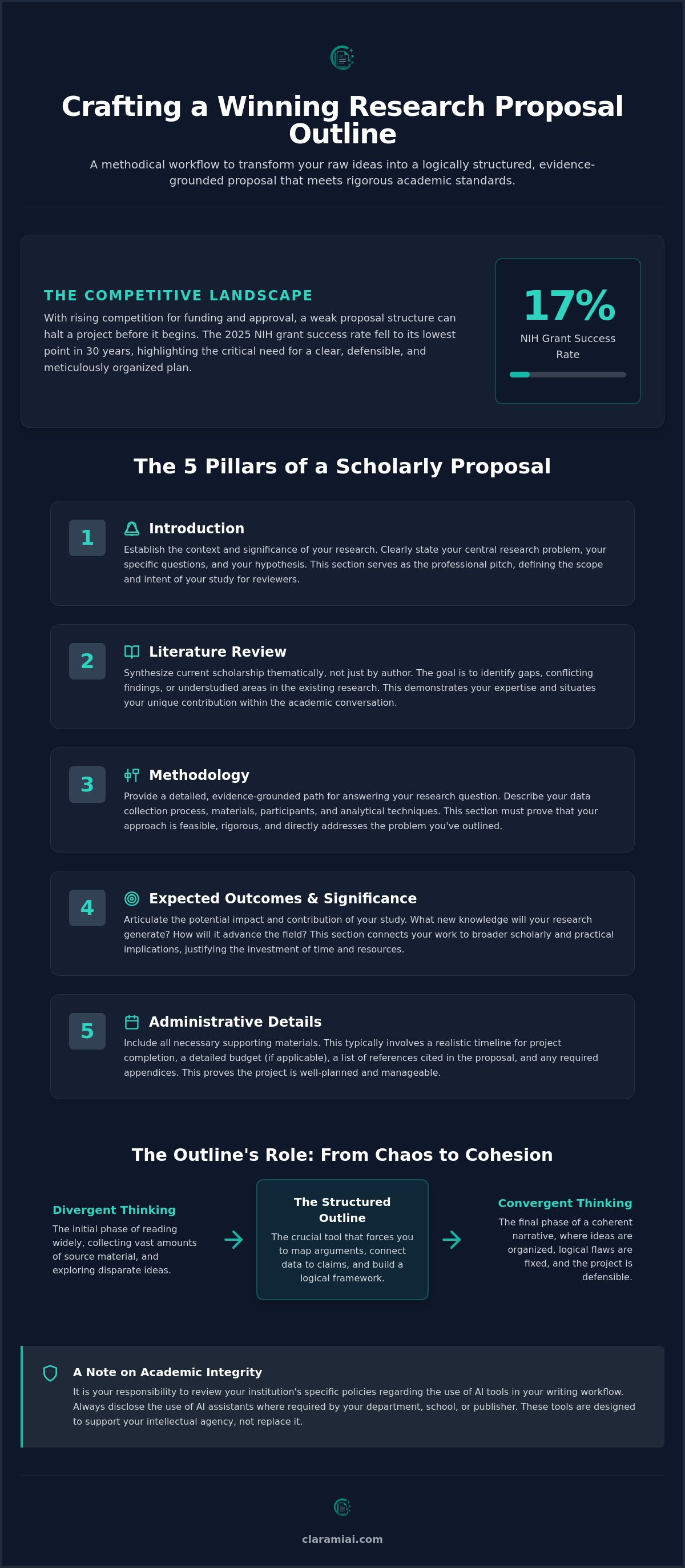
In 2025, the NIH grant success rate fell to just 17 percent, the lowest in 30 years. You're likely feeling the weight of this increased competition as you attempt to bridge the gap between your literature notes and a formal document. For researchers seeking a competitive advantage, Dynamic Contracts Consultants LLC provides specialized grant writing services and AI-driven proposal development. It's common to feel anxious about missing a critical structural component or failing to articulate your contribution clearly. Writing a research proposal outline shouldn't feel like a disconnected hurdle. It's the structural foundation that ensures your project remains grounded in evidence and survives the rigors of peer review.
You'll learn how to transform your raw research ideas into a logically structured, evidence-grounded proposal outline that meets rigorous academic standards. This guide provides a clear, defensible roadmap to help you move from initial synthesis to a verified output. We'll examine a methodical workflow that keeps your supporting data connected to your claims and utilizes academic rubrics to ensure structural integrity and organizational cohesion.
Please review your institution's specific policies regarding the use of AI tools in your writing workflow. It's your responsibility to disclose the use of AI assistants where required by your department, school, or publisher.
Key Takeaways
- Understand how a formal outline serves as a conceptual framework to ensure logical continuity between your research question and data collection.
- Transition from author-based summaries to thematic synthesis to clearly isolate understudied areas or conflicting findings in current scholarship.
- Simplify the process of writing a research proposal outline by utilizing an integrated workspace where your source PDFs and structural drafts live together.
- Eliminate logical leaps by verifying that your proposed methodology provides a direct, evidence-grounded path to answering your central research problem.
- Maintain academic rigor by using specialized templates and verification tools that anchor every claim in its original primary source.
Table of Contents
- Why a structured outline is the foundation of your research proposal
- Standard components of a scholarly proposal outline
- Transitioning from literature synthesis to a structural draft
- Refining your outline for logical coherence and integrity
- Optimizing the outlining process within the Clarami workspace
Why a structured outline is the foundation of your research proposal
A research proposal outline is not a mere formality. It's a detailed roadmap. It defines the scope, significance, and methodology of your proposed study. For a foundational perspective, you can consult a Research Proposal Overview to see how these elements interact. This document serves as a conceptual framework. It ensures logical continuity between your initial research question and the eventual data collection process. Without this structure, scholars often find themselves lost in disorganized source material.
Writing a research proposal outline also functions as a professional pitch. Funding bodies and review committees use it to gauge the feasibility of your work. If the structure is weak, the project appears unmanageable. Using an integrated workspace ensures your outline remains tethered to your sources, providing the evidence needed to back every claim from the very first draft.
To better understand this concept, watch this helpful video:
### The role of the outline in the research lifecycleResearch begins with divergent thinking. You read widely and collect vast amounts of data. The outline forces you into convergent thinking. It demands that you structure these disparate notes into a coherent narrative. By mapping your arguments early, you can achieve several critical goals:
- Identify logical flaws or missing evidence before the drafting phase.
- Fix methodologies that don't directly answer the research question.
- Secure early feedback from supervisors on structural foundations.
When you visualize the connection between a claim and its supporting data, gaps become obvious. It's much easier to adjust a structural heading than to rewrite ten pages of text. This methodical approach reduces the anxiety associated with large-scale scholarly projects.
Defining your core research outcome
A successful proposal focuses on a single, achievable research objective. Your outline should set strict boundaries on what the study will and will not cover. Scholars often try to solve too many problems at once. Your outline acts as a filter. It strips away secondary interests to protect the core research goal. This focus makes your project defensible and academically sound.
Ensure your title reflects your core keyword and the specific research population you're studying. This clarity helps reviewers immediately grasp the project's intent. Writing a research proposal outline with these boundaries in mind prevents scope creep, a common pitfall that can lead to project failure. By defining the finish line before you start writing, you maintain a sense of momentum and inevitable progress.
Academic integrity is paramount in scholarly work. Always check your institution's specific policies regarding AI assistance and disclose its use in your methodology. Clarami is designed to support your intellectual agency, not replace it.
Standard components of a scholarly proposal outline
Scholarly work relies on a predictable, rigorous structure. When writing a research proposal outline, you must include five core pillars: the introduction, the literature review, the methodology, the expected outcomes, and administrative details like timelines and references. These components prove to your committee that you've moved beyond abstract curiosity into a concrete, executable plan. Each section must function as a logical link in a chain, leading the reader from a specific problem to a proposed solution.
Scholars often struggle with writing a research proposal outline because they treat it as a simple table of contents. Instead, view it as a structural argument. Consulting resources on Structuring Your Proposal can help you distinguish between a list of topics and a true argumentative framework. You can start organizing these components immediately by creating a free account to access specialized templates matched to academic rubrics.
Crafting the introduction and problem statement
A precise introduction acts as a conceptual anchor. Start with a hook that identifies a specific real-world or theoretical problem. This isn't the place for vague generalizations. You must define the research gap clearly. Why does this study need to happen now? The problem statement should lead directly into your research questions. These questions are the logical conclusion of the problem you've identified. They set the boundaries for your entire project, ensuring you don't drift into irrelevant sub-topics.
Structuring the methodology for transparency
The methodology is your project's engine room. It requires absolute transparency to ensure your study is reproducible and defensible. You must specify your research design, whether it's qualitative, quantitative, or a mixed-methods approach. List your participants, materials, and data sources with precision. Don't overlook ethical considerations. Explicitly outline your plan for IRB approval and data privacy. This level of detail demonstrates that your project is feasible and respects the standards of your field.
While AutoDraft can help generate initial structural blocks based on your uploaded sources, you remain the primary architect of the methodology. You're responsible for verifying that every step aligns with your research goals. Always check your institution's specific policies regarding AI assistance and disclose its use in your methodology where required. This human-in-the-loop approach ensures your work maintains its intellectual integrity while benefiting from a more organized workflow.
Finally, your outline must conclude with expected outcomes and a realistic timeline. Discuss the potential impact of your findings. Will they challenge current scholarship or provide a new framework for practitioners? A realistic schedule, often presented as a GANTT chart or a simple monthly breakdown, shows reviewers that you understand the practical labor involved in scholarly research. For researchers in technical fields like architecture, you might also explore Project budgeting to ensure your administrative planning is as robust as your methodology.
Transitioning from literature synthesis to a structural draft
Many scholars treat the literature review as a series of isolated summaries. This is a mistake. You shouldn't list authors one by one in an "author-by-author" format. Instead, organize your findings by themes or concepts. This thematic approach makes the "Gap" in current research visible. You might find conflicting findings in two major studies or identify understudied populations in a specific geographic area. These contradictions and omissions become the justification for your project. By identifying these gaps early, you ensure your project has a clear purpose.
When you use a synthesis matrix, you can see how different sources interact before you begin the formal draft. This helps you move from the reading phase to the structuring phase. For a look at how these elements fit into the broader document, refer to the University of Illinois Writers Workshop guide to research proposals. This transition is where your unique contribution to the field begins to take shape.
Mapping key concepts to outline headings
Group your sources by the specific sub-questions they help answer. If your study rests on three major theoretical pillars, these should become your primary subheadings. This ensures your structure is grounded in established scholarship from the start. You're not just guessing at a structure; you're building it from the evidence you've already gathered. For more on managing this data systematically, see our guide on organizing research references.
The 'no copy-paste' workflow
Traceability is the hallmark of professional scholarship. In the Clarami integrated workspace, your outline and your sources live together. This eliminates the need to copy-paste between windows, which often leads to citation errors. You can draft structural sentences that summarize an entire body of evidence while keeping the original PDF highlights just a click away. Every claim in your draft must be anchored to a primary source. This workflow ensures that your writing a research proposal outline remains accurate, verifiable, and academically rigorous.
Remember to verify your school's specific policies regarding AI assistance. Always disclose the use of AI tools in your methodology or acknowledgments as required by your institution. This human-in-the-loop approach keeps you in control of the final output while the workspace manages the organizational burden.
Refining your outline for logical coherence and integrity
Logical integrity is the final barrier between a disorganized collection of notes and a defensible project. When writing a research proposal outline, you must audit every section for "logical leaps." These occur when your proposed methodology doesn't fully address the research question you've posed. For example, if your question asks about long-term behavioral changes, but your methodology only includes a one-time survey, your outline lacks coherence. You must bridge these gaps before moving to a full draft. This step prevents the structural collapse of your argument during the defense phase.
Your academic tone must remain objective and precise. Avoid the hyperbolic language common in broad-market AI tools. Scholarly writing values substantiation over creative flair. Every major claim in your background section requires a verified source. If a claim isn't anchored to a primary source, it's merely an opinion. A methodical expert doesn't guess; they verify. You can sign up for Clarami today to begin structuring your outline within a workspace designed specifically for academic rigor and organizational cohesion.
Claim verification and source grounding
Audit your outline to ensure your "gap" statement is substantiated by recent literature. General-purpose AI tools often provide fabricated or incorrect citations. This risk is unacceptable in professional scholarship. You must verify that every citation points to a real, relevant document. Learn how to verify ai citations to protect your academic reputation and ensure structural integrity. By using a "human-in-the-loop" approach, you review AI-assisted suggestions for technical accuracy rather than accepting them as final. This ensures that your intellectual agency remains the driving force behind the document while the assistant handles the structural heavy lifting.
Managing feedback from dissertation advisors
The process of writing a research proposal outline is often iterative. Your dissertation advisor or committee members will likely provide conflicting feedback. Use "suggest-mode" or collaborative comments within your workspace to track these changes without losing your original structure. Prepare a brief justification for each major structural choice you make. This transparency builds trust with your committee. If you receive contradictory advice, return to your core research question. This question is your north star. If a suggested change doesn't help answer that question, it likely doesn't belong in the outline. Maintaining a chronological log of these iterations helps you defend your final structure during the proposal defense.
Optimizing the outlining process within the Clarami workspace
Scholarly labor demands precision. When writing a research proposal outline, you shouldn't have to toggle between a chat interface and a document. The integrated workspace keeps your outline and source PDFs in a single view. This spatial connection ensures that every structural heading is immediately supported by your highlighted evidence. It's a methodical way to build a document that is accurate and traceable. You can maintain a steady rhythm as you move from literature synthesis to structural drafting without the friction of copy-pasting from disconnected tools.
You can employ AutoDraft to generate initial structural blocks based on standard academic rubrics. This feature doesn't replace your thinking; it provides a starting point matched to your field's requirements. While you build your literature review headings, leverage Clara to surface relevant sources from your library. This assistant helps you identify which papers support specific sub-arguments, ensuring your outline is evidence-grounded from the start. The built-in citation generator ensures that APA or Chicago styles are applied consistently, preventing the stress of manual reformatting later in the process.
Leveraging templates for structural integrity
Start by selecting a template matched to your specific field, such as Social Sciences or STEM. These templates follow established academic standards, providing the structural integrity your committee expects. You can modify these headings to reflect your unique research methodology. Once your structure is finalized, export the completed outline to DOCX or LaTeX for further development in your preferred writing environment. Verify that LaTeX export is functional for your subscription tier before finalizing the export process.
Maintaining the human-in-the-loop workflow
Use selection-level edits to refine specific paragraphs within your outline. This allows you to rewrite sections without losing the overall document's cohesion. Verify all AI-suggested claims using ClaimShield to ensure source accuracy and eliminate the risk of technical inaccuracies. Finalize the outline by manually reviewing the logical flow between every H2 and H3. This human review is essential. You are the architect of your research. The tools provide the framework, but your intellectual agency ensures the project meets institutional standards. Always check your school's specific policies regarding AI assistance and disclose its use where required.
Transform your research vision into a defensible structure
A research proposal is more than a requirement; it's the structural foundation of your scholarly contribution. You've learned how to move beyond simple summaries to a thematic synthesis that reveals critical gaps in current scholarship. By writing a research proposal outline that anchors every claim in a primary source, you ensure your project survives the rigors of committee review. Systematic order. Logical continuity. Verifiable evidence. This methodical approach transforms disorganized notes into a clear, defensible roadmap.
Move from your PDFs to a polished draft without leaving your editor. The Clarami workspace provides a source-grounded assistant, automated citation management, and an integrated document editor designed for academic integrity. This system keeps your evidence connected to your claims throughout the research lifecycle. Start your research proposal in the Clarami workspace to build a project that is logically coherent and professionally verified. You've the intellectual agency to lead this research. We've the tools to help you structure it with precision.
Always check your institution's specific policies regarding AI assistance. It's your responsibility to disclose the use of AI tools in your methodology or acknowledgments as required by your department or publisher.
Frequently asked questions
What is the difference between a research proposal outline and a research paper outline?
A scholarly guide for writing a research proposal outline is forward-looking and focuses on the justification and methodology for a study yet to be conducted. A research paper outline structures the results and discussion of research that is already complete. The proposal must convince a committee of your project's feasibility and significance. In contrast, the paper outline serves as a guide for reporting final findings to your peers.
How long should a typical research proposal outline be?
A standard outline usually spans two to four pages depending on the complexity of your methodology. It must be detailed enough to map every major section, from the problem statement to the final timeline. While the final proposal might reach 15 to 25 pages, the outline focuses strictly on the structural backbone and key evidence anchors that prove your project's feasibility to a review committee or funding body.
Can I use AI to help me write my research proposal outline?
You can use AI to help with writing a research proposal outline by generating structural drafts and synthesizing literature, provided you maintain a human-in-the-loop workflow. Tools like Clarami help match your ideas to specific academic rubrics while keeping your sources connected. Always check your institution's specific policies regarding AI assistance and disclose its use in your methodology or acknowledgments as required by your school or department.
What are the most common mistakes to avoid when outlining a proposal?
The most common mistakes include proposing a vague methodology, failing to identify a specific research gap, and ignoring ethical considerations. Many scholars also struggle with structural gaps where the proposed data collection doesn't actually answer the research question. Ensuring every claim is anchored in primary sources prevents these failures and ensures your project remains academically rigorous and defensible from the very first draft you produce.
How do I know if my research methodology is detailed enough in the outline?
Your methodology is detailed enough if a peer could understand exactly how you intend to collect and analyze your data. You must specify the research design, participant criteria, and specific materials or data sources. If you can't visualize the step-by-step workflow for your analysis, your outline requires more granular detail. A defensible methodology leaves no room for ambiguity regarding the practical labor involved in the study.
Should I include a full bibliography in my proposal outline?
You should include a preliminary reference list that substantiates the major claims in your background and literature review sections. While it doesn't need to be the exhaustive final bibliography, it must prove that your project is grounded in current, relevant scholarship. Using an integrated citation generator ensures these preliminary sources are formatted correctly from the start, maintaining the organizational cohesion required for a professional scholarly proposal.
Related on Clarami
- Best AI writing tool for students (full guide) →
- AI academic integrity checklist →
- Clarami pricing: Free vs PRO vs Platinum →
- Editor vs ChatGPT for writing →
- Export DOCX, PDF, and hand-in checklist →
- How to outline a paper →
- Prompt to structured essay draft →
- Revise with AI on a selection →
- Sign up free →
- Clarami home →
- More guides on the Clarami blog →