Top 7 AI Tools for Scientific Research to Save Time
Discover the top 7 AI tools for scientific research that help you organize sources, verify claims, and write faster while maintaining academic integrity.
Write with structure in Clarami AI
Editor-first AI drafting, citations, and two Workflows for student writing.
What if your writing environment could automatically verify every claim against your source library? You've likely felt the frustration of manual citation management or the anxiety that a general-purpose model might fabricate a reference. Finding reliable ai tools for scientific research is no longer just about speed. It's about ensuring your methodology remains sound and your data stays organized without the constant need to copy-paste between browser tabs and your document.
We understand the pressure to manage hundreds of PDFs while adhering to strict institutional policies. This guide will show you how to select and implement AI tools that maintain source traceability and academic integrity throughout your research process. You'll learn about specialized platforms that prioritize evidence over probability, and how an integrated writing workspace can eliminate the structural gaps that lead to errors. Before using these technologies, always check your school's specific policies and disclose AI assistance where required. We'll explore seven essential tools that help you move from a disorganized folder of papers to a verified, polished draft.
Key Takeaways
- Identify the specific functions of discovery engines and synthesis tools to build a more efficient, evidence-based workflow.
- Apply the traceability gold standard to verify claims by ensuring every AI-generated statement is anchored to a specific sentence in your source material.
- Reduce the fragmentation tax by selecting integrated ai tools for scientific research that eliminate the need for constant copy-pasting between separate applications.
- Maintain academic integrity by using a human-in-the-loop framework where you serve as the final editor and ethical lead for all synthesized content.
- Move from source synthesis to a structured first draft using AutoDraft and Clara to ensure your writing remains grounded in your uploaded PDFs.
Table of Contents
- Navigating the categories of ai tools for scientific research
- Evaluating tool reliability and source traceability
- Building a modern research workflow without the copy-paste fatigue
- Upholding academic integrity with a human-in-the-loop approach
- Integrating your research process with the clarami workspace
Navigating the categories of ai tools for scientific research
AI research tools are specialized software built for evidence-based tasks. They differ fundamentally from general-purpose creative assistants. While a standard chatbot might help you brainstorm a title, it often fails in a scientific context by prioritizing linguistic patterns over factual accuracy. This leads to fabricated citations and methodology errors. Specialized ai tools for scientific research solve this through Retrieval-Augmented Generation (RAG). This architecture forces the AI to ground every claim in actual documents before it provides an answer. Rapid progress in artificial intelligence has allowed these systems to act as methodical experts rather than just text predictors. They function as reliable intellectual companions that respect your intellectual agency.
To better understand this concept, watch this helpful video:
### Discovery tools for literature searchThe first stage of any project is discovery. Traditional keyword-based queries often miss relevant papers because they rely on exact word matches. Semantic search uses vector-based understanding to find papers based on the intent and meaning of your query. Tools like Consensus, which indexes over 220 million peer-reviewed papers, allow you to ask natural language questions and receive evidence-based answers. Similarly, Semantic Scholar provides access to 200 million academic papers. These platforms limit their search parameters to reputable journals and institutional repositories. This ensures you aren't wasting time on unverified blog posts or non-academic sources. Discovery is only the first 20% of the research workflow.
Synthesis and analysis platforms
Once you have your sources, the heavy lifting begins. Synthesis tools help you move beyond reading individual PDFs to identifying cross-study themes. They extract methodologies, sample sizes, and key findings into structured tables. This process allows you to visualize connections between different research groups and detect gaps in the literature. Tools like Litmaps help you see how one paper's citations influence a broader field of study through visual mapping. Using an integrated workspace ensures that these synthesized insights remain connected to the original text. This methodical approach guides you from initial disorganization to a polished, verified output. Always check your institution's specific AI policies and disclose usage as required by your advisor or publisher.
Evaluating tool reliability and source traceability
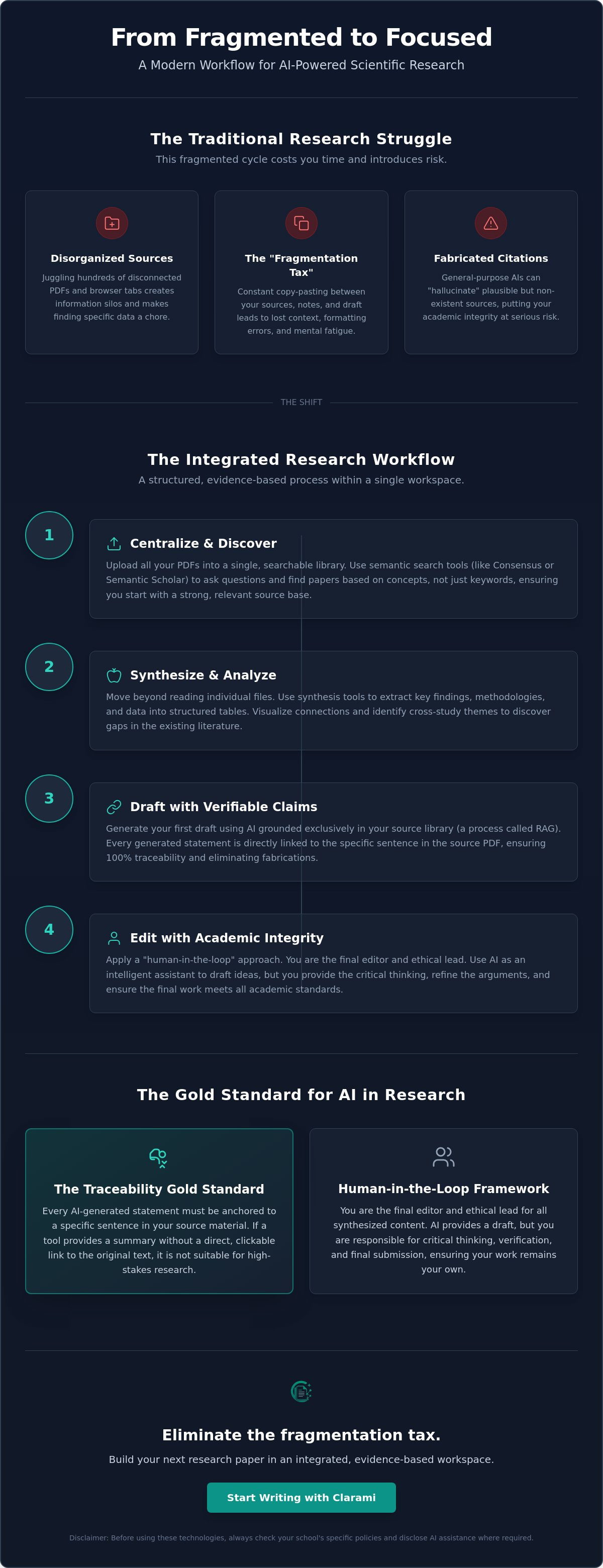
Reliability is the cornerstone of academic labor. You can't afford a single error in a citation or a methodology summary. The traceability gold standard is simple: can you see the exact sentence in the source PDF? If a tool provides a summary without a direct link to the source text, it isn't suitable for high-stakes research. General AI models predict the next word in a sequence based on probability. They don't know facts; they synthesize patterns. This often leads to hallucinations where the AI creates a plausible but nonexistent citation. Specialized ai tools for scientific research prevent this by using a closed library of your sources. This ensures the output is grounded in the documents you provide rather than the unverified open web.
Verifying evidence in real time is a requirement for maintaining structural integrity. This aligns with the frameworks being established through NIST's AI research, which focuses on developing standards for trustworthy and reliable systems. When your drafting environment is connected to your source manager, you can substantiation claims as you write. This prevents the accumulation of small errors that often occur when synthesis and drafting are treated as separate tasks.
The danger of fabricated citations
Hallucinations occur because large language models are optimized for fluency rather than truth. An AI might generate a DOI that looks legitimate but leads to a 404 error. You must verify these identifiers manually or use software designed for academic integrity. It's helpful to learn how to verify ai citations to mitigate academic risk before you submit your work. Checking a URL takes seconds; fixing a retracted paper is a far more difficult process. If you're ready to build a more secure workflow, you can create a source-grounded workspace today.
Verification frameworks for scholarly work
A disciplined verification process ensures your arguments are anchored in primary sources. Following a step-by-step framework reduces the anxiety associated with technical inaccuracies.
- Check the claim: Compare the AI's summary against the provided source snippet. Ensure the summary reflects the author's original intent without adding external bias.
- Confirm source existence: Validate that the paper exists in a reputable database like PubMed or JSTOR. This confirms the metadata is accurate and the source is peer-reviewed.
- Analyze the context: Ensure the AI hasn't taken a finding out of context. An AI might extract a result from the methodology section's "expected outcomes" rather than the actual "results" section.
By treating ai tools for scientific research as assistants rather than replacements, you maintain your intellectual agency. Always check your institution's specific AI policies and disclose usage as required by your advisor or publisher. This human-in-the-loop approach ensures that you remain the final authority on your research findings.
Building a modern research workflow without the copy-paste fatigue
A fragmented workflow is a silent drain on your cognitive resources. When you switch between a reference manager, a separate chat window, and a word processor, you pay a "fragmentation tax." This isn't just about lost time. It's about the errors introduced during the manual transfer of data. Every instance of copy-pasting increases the risk of detaching a claim from its supporting evidence. Modern ai tools for scientific research eliminate this friction by providing an integrated editor where your sources and your draft live on the same screen. This proximity ensures that your arguments remain anchored in primary data throughout the entire writing process.
Transitioning from raw notes to a structured draft requires a disciplined approach. You can explore the Clarami research workspace to see how a unified environment maintains organizational cohesion. By keeping your PDF library accessible within your drafting area, you can substantiate claims instantly. This structural connection is essential for professional submission. Prioritize platforms that support industry-standard exports like LaTeX, DOCX, and PDF to ensure your final output meets publisher requirements.
Moving from discovery to drafting
Organizing PDF highlights into a coherent argument is often the most difficult part of composition. In a source-aware environment, you can drag insights directly into your outline. Use "suggest-mode" to refine AI-generated paragraphs. This allows you to accept, reject, or modify specific sentences without losing your intellectual agency. This method prevents accidental plagiarism; the system tracks which segments are direct quotes and which are synthesized ideas. Always check your institution's specific AI policies and disclose usage as required by your publisher or advisor. The researcher must remain the final editor of every submission.
Maintaining structural integrity in your workspace
Systematic order is non-negotiable in scholarly work. Managing your project requires more than a simple text editor. It requires a methodical framework.
- Use structured templates: Align your draft with academic rubrics such as the IMRaD structure (Introduction, Methods, Results, and Discussion).
- Project-based management: Organize reference collections by specific projects rather than maintaining a single, overwhelming folder.
- Version control: Maintain a clear history of edits. This is vital for collaborative research and responding to peer review feedback.
This disciplined setup alleviates the stress of disorganized material. It guides you from initial synthesis to a verified, polished output through a clear, linear narrative. By choosing ai tools for scientific research that value structural integrity, you ensure your work remains professional and substantiated.
Upholding academic integrity with a human-in-the-loop approach
A human-in-the-loop approach positions you as the final editor and ethical lead of your work. While ai tools for scientific research provide drafting assistance, they do not replace the intellectual agency of the researcher. You are responsible for every claim, citation, and conclusion in your manuscript. This methodical oversight ensures that the final output reflects your expertise rather than a machine's probability-based predictions. Using AI as a reliable intellectual companion requires a disciplined commitment to accuracy.
Academic Integrity Disclaimer: Always check your institution's specific AI policies and disclose usage as required by your advisor or publisher.
Relying on AI to generate an entire paper is a significant risk to your academic standing and the structural integrity of your research. This "generate whole paper" trap often leads to generic, poorly substantiated prose. Instead, use these tools to refine specific arguments or synthesize data points you have already verified. The distinction between linguistic polish and data fabrication is critical. Using AI to improve the readability of a methodology section is an exercise in clarity. Using it to invent data points or "fill in the gaps" of a study is scientific misconduct. Purpose-built ai tools for scientific research are designed to prevent such errors by restricting their outputs to the data you provide.
Ethical use of ai drafting assistants
Drafting assistants help you overcome writer's block by generating multiple perspectives on a complex claim. This isn't about letting the machine think for you. It's about exploring different ways to articulate your findings. Review the AI's output sentence by sentence. Technical accuracy is your priority. If an AI suggests a correlation, substantiating that claim with your raw data is your duty. Transparency is key. Many publishers now require you to disclose AI assistance within your methodology or acknowledgments section. This disclosure protects your reputation and maintains the transparency required in scholarly labor.
The role of selection-level editing
Selection-level editing is a safer and more effective strategy than broad-market automation. It involves using an In-App Editor to rewrite a specific paragraph for better flow or clarity. This targeted approach allows you to maintain your unique scholarly voice while benefiting from linguistic polish. You can refine your tone with an academic writing tone checker online to ensure your prose remains precise and professional. This process ensures the AI acts as a functional tool rather than a replacement for your expertise. If you're ready to implement this ethical drafting workflow, you can start your research project in a secure workspace.
Integrating your research process with the clarami workspace
The Clarami workspace is designed to bridge the gap between source management and composition. Unlike general-purpose platforms, Clara acts as a source-grounded research assistant. She only generates answers based on the PDFs you upload to your private library. This ensures your work remains anchored in primary data rather than the fluctuating information of the open web. When you're ready to transition from a synthesis matrix to a first draft, AutoDraft facilitates this progression by organizing your verified notes into a structured narrative. It's a methodical way to ensure your initial insights aren't lost during the drafting phase.
Using integrated ai tools for scientific research allows you to maintain structural integrity without the constant need to switch between browser tabs and external documents. This proximity of evidence to the drafting area is a core differentiator. It transforms the writing process from a series of disconnected tasks into a linear, verified workflow. You can learn more about choosing an ai research assistant tool to find the specific features that match your methodology. By centralizing your PDF Manager and In-App Editor, you reduce the cognitive load associated with disorganized source material.
Connecting arguments to evidence with clara
Clara allows you to query your PDF library for specific methodologies or granular data points. Instead of manually searching through hundreds of pages, you can ask Clara to locate where a specific variable was discussed across multiple studies. This assistant helps you find supporting citations for claims you've already written. She ensures every statement is substantiated. Every suggestion Clara provides includes a link to the specific page number in the source document. This transparency allows you to verify the context immediately. It maintains the human-in-the-loop standard required for professional scholarly labor.
Verifying claims with claimshield
ClaimShield provides a technical layer of security for your draft. It checks your writing against your uploaded source material to identify "weak links" where the evidence doesn't fully support your argument. This real-time verification prevents the accumulation of technical inaccuracies. If a claim lacks sufficient substantiation, the system highlights the segment for your review. Within the editor, you can also use the Citation Generator to automate building references in APA, MLA, or Chicago styles. This ensures your formatting is precise and compliant with academic standards.
By utilizing these ai tools for scientific research, you move from a state of initial disorganization to a polished, verified output. Always check your institution's specific AI policies and disclose usage as required by your advisor or publisher. This disciplined approach respects your intellectual agency while utilizing technology as a reliable intellectual companion. You remain the final authority on the integrity of your research.
Advancing your research with structural integrity
Selecting the right ai tools for scientific research is a strategic decision that impacts the accuracy and ethics of your final manuscript. You've seen how a unified environment prevents the fragmentation tax and keeps your arguments anchored in primary data. By prioritizing source-grounded systems and real-time verification, you protect your work from hallucinations and technical inaccuracies. The transition from discovery to a polished draft requires a methodical approach where you remain the final authority on every claim.
Clarami provides the specialized infrastructure needed for this level of scholarly rigor. You can utilize Clara to query your private PDF library and ClaimShield to verify your draft against your sources in real time. With an integrated editor that supports APA and Chicago citations, you can focus on the cognitive work of synthesis rather than the manual labor of formatting. Always remember to check your institution's specific policies and disclose AI assistance as required by your advisor. You can start your integrated research workflow with Clarami for free. We look forward to seeing your verified findings move the field forward.
Frequently Asked Questions
Can ai tools for scientific research replace traditional literature reviews?
No. AI tools for scientific research serve as synthesis assistants rather than replacements for human judgment. While discovery engines can screen millions of papers in seconds, they lack the ability to evaluate methodology flaws or nuanced bias. You must still perform the final critical appraisal to ensure the review meets the rigorous standards of your field. These tools manage the volume of data, but the intellectual synthesis remains your responsibility.
How do I know if an AI tool is hallucinating a citation?
You can identify a hallucinated citation by checking the Digital Object Identifier (DOI) or searching for the title in a reputable database like PubMed. If the AI provides a snippet of text, compare it directly to the source PDF to ensure the context hasn't been altered. Hallucinations often involve plausible-sounding titles that don't exist in reality. Using a source-grounded assistant ensures that every generated reference is anchored to a specific document in your library.
Is it ethical to use AI to draft parts of a dissertation or thesis?
Using AI to assist with a dissertation is ethical when used for linguistic polish or structural organization, provided you follow your institution's policies. Most universities allow AI for brainstorming or refining prose but prohibit it for data analysis or generating original arguments. Check your department's specific guidelines regarding generative technology. Maintain a human-in-the-loop approach to ensure intellectual ownership and disclose AI assistance in your methodology section where required.
Do AI research tools work with non-English scientific papers?
Many modern ai tools for scientific research support non-English papers through advanced translation and cross-lingual retrieval capabilities. These platforms often index global repositories, allowing you to synthesize findings from diverse linguistic sources. However, you should manually verify the technical accuracy of translated methodologies. This ensures that specific scientific terminology hasn't lost its precise meaning during the automated translation process within your workspace.
What is the difference between specialized discovery engines and an integrated research workspace like Clarami?
Specialized discovery engines are designed to surface relevant papers from massive databases using semantic search. They are excellent for the initial stage of your workflow. An integrated workspace like Clarami picks up where discovery ends. It provides the environment for drafting, selection-level editing, and real-time claim verification. This eliminates the need to move text between separate applications, preserving the structural connection between your draft and your evidence.
How can I ensure my unpublished research data remains private when using AI?
To protect unpublished research data, use tools that offer private workspaces and explicitly state they don't use your uploads for model training. Avoid entering identifiable or confidential data into public, general-purpose chatbots. Specialized research platforms often provide enterprise-grade security where your PDFs remain isolated. Review the privacy policy of any tool you use to confirm your data isn't being indexed by external search engines or shared with third parties.
What are the tell-tale signs of AI-generated writing in a scientific paper?
AI-generated writing often exhibits a repetitive sentence structure and a lack of granular, methodology-specific detail. You might notice overly rhythmic prose or the use of generic transition words that don't add technical value to the argument. Another sign is the presence of citations that look correct but refer to nonexistent studies. Maintaining your unique scholarly voice through selection-level edits is the most effective way to prevent your paper from appearing automated or superficial.
Related on Clarami
- Best AI writing tool for students (full guide) →
- AI academic integrity checklist →
- Clarami pricing: Free vs PRO vs Platinum →
- Editor vs ChatGPT for writing →
- Export DOCX, PDF, and hand-in checklist →
- How to outline a paper →
- Prompt to structured essay draft →
- Revise with AI on a selection →
- Sign up free →
- Clarami home →
- More guides on the Clarami blog →