Reliable tool to check claims against sources for verified research
Find a reliable tool to check claims against sources. Learn a workflow to ground your research in evidence and avoid accidental plagiarism or AI hallucinations.
Write with structure in Clarami AI
Editor-first AI drafting, citations, and two Workflows for student writing.
90% of U.S. adults report encountering inaccurate information at least sometimes. For researchers and students, this statistic represents a professional anxiety: the risk of accidental hallucination or a misattributed quote. Finding a reliable tool to check claims against sources shouldn't be a secondary task that happens after your draft is finished. It needs to be a fundamental part of your composition workflow.
You likely know the frustration of managing disconnected PDFs while trying to maintain the structural integrity of your argument. It's time-consuming and prone to error. You deserve a streamlined verification process that protects your research integrity without the manual grind. Manual fact-checking often feels like a separate, grueling phase that interrupts your creative momentum.
This article explores how to use ClaimShield to ground your writing in evidence and ensure every claim is traceable to a primary source. We will walk through a verification workflow that replaces the fear of plagiarism with the confidence of verified data. Please remember to check your school’s academic integrity policies and disclose your use of AI tools where required.
Key Takeaways
- Understand why general-purpose search engines fail to address AI hallucinations. Structural verification is a requirement for professional research, not an option.
- Identify the essential criteria for selecting a professional tool to check claims against sources. Focus on accuracy, workspace integration, and ethical standards.
- Learn a methodical workflow to organize primary sources. Anchor your draft in verified data using a centralized PDF manager to avoid disconnected drafts.
- Discover how ClaimShield flags unsupported statements. Maintain high research standards by receiving real-time feedback directly within your document editor.
- Adopt a human-in-the-loop framework. Ensure your final output remains compliant with institutional academic integrity policies through active editorial oversight.
Table of Contents
- The rising necessity of claim verification in professional writing
- How automated claim verification technology functions
- Evaluating the best tool to check claims against sources
- A methodical workflow for verifying claims in your research
- ClaimShield: Integrating verification into your drafting process
The rising necessity of claim verification in professional writing
Large language models often prioritize linguistic patterns over factual precision. This tendency results in hallucinations, where an AI generates confident but entirely false statements. When you're drafting a research paper or a technical report, these inaccuracies aren't just minor errors; they're structural failures. Relying on standard chat interfaces often leaves you with the burden of verifying every sentence against your original PDFs, a process that is both tedious and prone to human oversight.
Traditional search engines are equally insufficient for rigorous academic fact-checking. They prioritize popularity and SEO over the history and methodology of fact-checking found in peer-reviewed literature. A search engine might point you toward a blog post, but it won't help you map a specific claim to a dataset hidden on page 42 of a technical white paper. The professional risks of publishing unsubstantiated claims include loss of institutional credibility and potential retractions. You must check your school policies regarding AI usage and disclose its use where required. You remain responsible for the final accuracy of your submission.
To better understand the mechanics of automated verification, watch this helpful video:
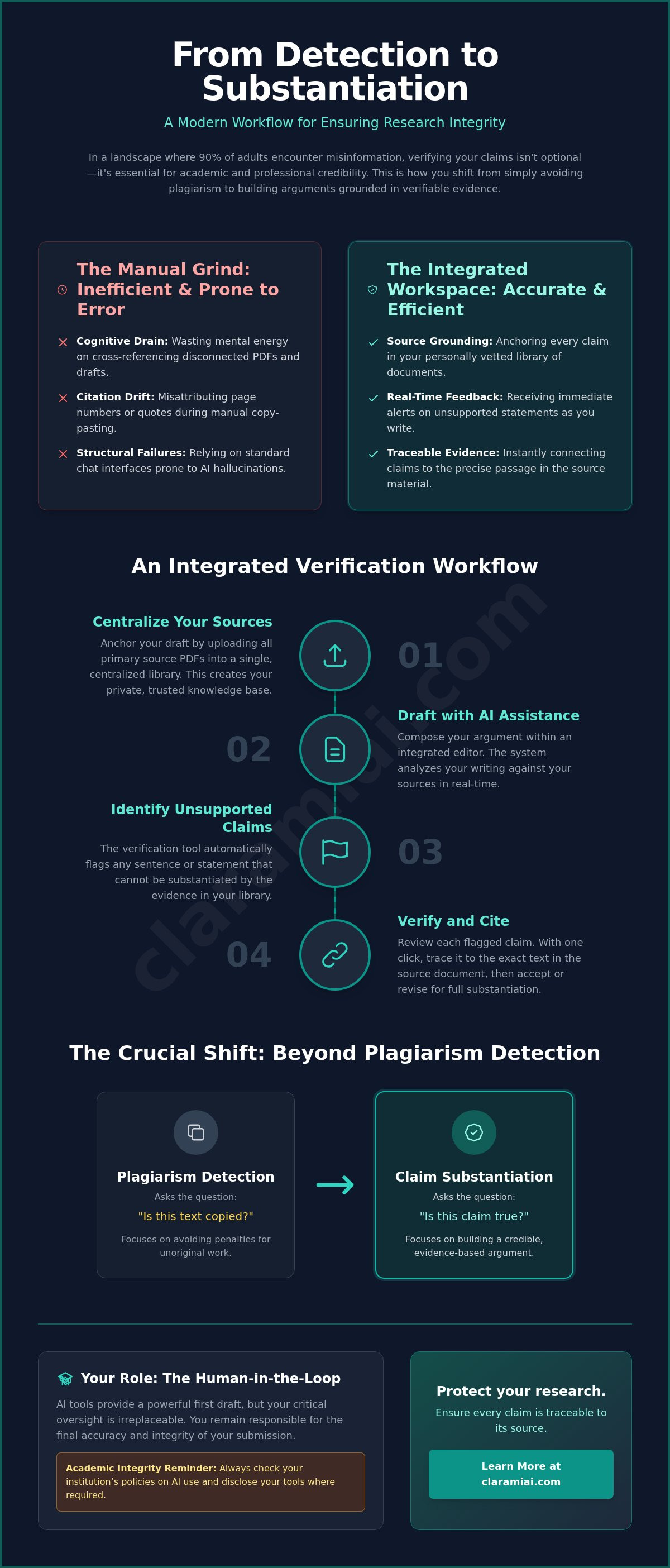
### The cost of manual fact-checkingManual verification is a significant drain on cognitive resources. Researchers often spend more time cross-referencing disconnected PDFs and drafts than they do on actual synthesis. This mental fatigue leads to "citation drift," where a quote or data point is slightly altered during the copy-paste process. Common errors include misattributed page numbers or the loss of context when a claim is separated from its original methodology. Without a systematic approach, the labor of keeping your sources organized becomes a barrier to the writing itself.
Moving from detection to substantiation
Most students are familiar with plagiarism detection, but that's only half of the solution. Detection tells you if you've copied someone else's work; substantiation tells you if your own claims are actually true. Using a dedicated tool to check claims against sources shifts your focus from avoiding penalties to building an evidence-based argument. By adopting a source-grounded workspace, you ensure that every statement you write is anchored in your uploaded data. Real-time evidence visibility means you don't have to hunt for citations at the end of the process. Instead, verification becomes a continuous, integrated part of your drafting workflow.
How automated claim verification technology functions
At its core, a tool to check claims against sources functions as a digital bridge between your composition and your research library. Unlike standard AI models that predict the next likely word based on probability, verification technology uses Natural Language Processing (NLP) to parse the semantic meaning of your statement. It then maps that statement against specific blocks of text within your primary documents. This process, known as grounding, transforms a generic draft into a substantiated argument by ensuring every factual claim has a corresponding piece of evidence.
Semantic search plays a vital role in this workflow. Instead of looking for exact keyword matches, which often miss relevant data, the algorithm identifies the underlying intent and context of your writing. This is a critical distinction from internet-wide scanning. While broad scans can pull in irrelevant or unverified web content, document-specific grounding limits the AI search space to the high-quality sources you've personally vetted. Organizations like the RAND Corporation have cataloged various Tools That Fight Disinformation Online, emphasizing the importance of these systematic verification methods in modern research.
Understanding source grounding
Grounding creates a closed-loop system for your data. When you upload your primary sources into a centralized PDF manager, the AI is restricted to that specific dataset. This technical constraint is what prevents the fabrication of DOIs and quotes. If a claim doesn't exist within your uploaded files, the system cannot verify it. This creates a direct, traceable link between your draft and the original page number. You can verify the context immediately without leaving your editor, ensuring that your citations remain accurate through every revision.
The mechanics of semantic verification
Algorithms assess the structural connection between a claim and its source using a tripartite logic: substantiated, unsupported, or contradicted. This level of granularity is essential for academic integrity. Using a dedicated tool to check claims against sources helps identify these contradictions before they reach your final draft. It allows for selection-level editing, where you can refine a single paragraph based on the evidence provided rather than regenerating an entire document.
- Substantiated: The source explicitly supports the claim with data or direct quotes.
- Unsupported: The source contains no information regarding the claim, suggesting a need for further research.
- Contradicted: The source contains data that directly refutes the claim, highlighting a factual error.
This human-in-the-loop approach ensures you remain the primary architect of your work. Before finalizing your draft, you should set up a verified workspace to manage your sources effectively. Remember to check your school policies and disclose AI use where required.
Evaluating the best tool to check claims against sources
Selecting a tool to check claims against sources requires more than a simple accuracy check. You need a system that respects the ethical standards of the International Fact-Checking Network (IFCN), prioritizing transparency and evidence-based substantiation. Accuracy is the baseline requirement. However, for a professional workflow, integration and data privacy are equally critical. Your research often involves sensitive or unpublished data. Ensuring that your tool doesn't use your uploads to train public models is a non-negotiable security standard for maintaining intellectual agency.
Consistency in citation style support is another vital factor. A tool that fails to recognize the nuances between APA, Chicago, and MLA styles adds more manual work than it saves. You should look for a platform that automates the verification of these formats while keeping you in control of the final output. This includes checking for proper parenthetical citations and the structural integrity of your bibliography. Always check your school policies and disclose AI use where required to maintain academic integrity. These choices directly impact the reliability of your final submission.
Standalone detection tools
Many users start with standalone checkers like GPTZero. These tools are often designed for a final, reactionary check to see if a draft looks AI-generated. While they provide a quick assessment, they often treat the user with suspicion rather than as a researcher. The primary drawback is the copy-paste friction. Moving text back and forth between a draft and a separate detector breaks your focus. It creates opportunities for version-control errors and disconnected citations. A standalone check is sufficient for a quick pulse-check, but it doesn't support the structural development of a complex argument.
Integrated research workspaces
A more methodical approach involves using an integrated research workspace. Instead of treating verification as a final filter, these environments embed the process into the act of writing. The Clara AI Assistant maintains a persistent connection between your draft and your evidence. You can see your sources directly alongside your editor. This proximity eliminates the need to switch tabs or manage disconnected PDFs across multiple windows.
This integration supports a human-in-the-loop writing style. You remain the decision-maker. You use AI to surface relevant data points while you provide the critical analysis and synthesis. The system suggests evidence blocks, but you choose how to interpret and integrate them. This workflow ensures that your arguments are anchored in verified research from the start. It reduces the stress of retroactive fact-checking and protects the overall integrity of your work.
A methodical workflow for verifying claims in your research
Verification is a structural requirement. It ensures your work stands on a foundation of evidence. To achieve this, you need a disciplined sequence that integrates your research material directly into your writing environment. This methodical progression prevents the common errors associated with manual cross-referencing. By following a clear path from collection to citation, you maintain the intellectual agency required for professional scholarship.
The first step is to upload and organize your primary sources. A dedicated PDF Manager prevents the fragmentation of your data and ensures every document remains searchable. Centralizing your library is the only way to maintain a clear line of traceability throughout the writing process. When your sources are disorganized, the risk of misattribution increases significantly.
Next, draft your arguments using source-grounded assistance. By using the Clara AI Assistant, you ensure that the initial synthesis is based on your vetted documents rather than generic internet data. This keeps your draft focused on the specific evidence you've gathered. Once the draft is in place, you should utilize a tool to check claims against sources to highlight sentences lacking evidence. This feature, known as ClaimShield, scans your draft for any statement that cannot be mapped back to your specific PDFs. It acts as a real-time integrity check before you proceed to the final review.
The final stages involve manual review and citation. You must verify that the AI's interpretation aligns with the source's original context. AI can identify patterns, but you provide the critical judgment. Finally, use the Citation Generator to anchor your evidence in the required format. This ensures your work is ready for professional submission and meets all technical standards.
Organizing for verification
Preparing your PDF workspace for structured analysis is the first step toward structural integrity. You should extract key methodologies and data points early in the process. Labeling your sources by theme or relevance ensures that attribution remains accurate during the drafting phase. This organization allows for the immediate availability of supporting data when you begin to compose your arguments. It transforms a pile of documents into a functional research library.
The human-in-the-loop review
You are the primary architect of your research. This means you must approve every AI suggestion sentence by sentence. Algorithms are precise, but they might miss the subtle nuances of complex arguments or specific disciplinary jargon. Refining the tone and clarity of your work after factual verification is essential for professional quality. You are responsible for the final output. Always check your school policies and disclose AI use where required to ensure full compliance with academic standards.
Create your verified workspace to start grounding your research today.
ClaimShield: Integrating verification into your drafting process
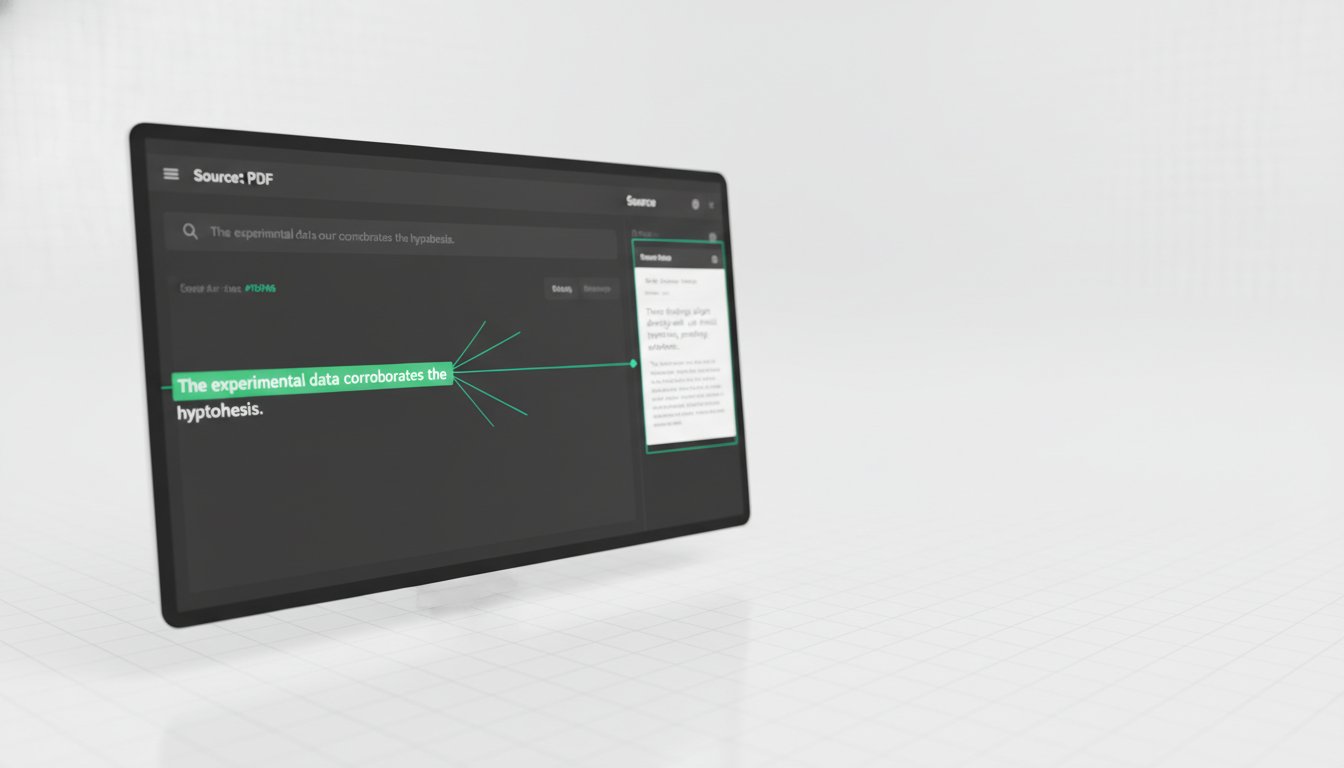
ClaimShield operates as the final layer of your integrated editor. It is a specialized feature designed to maintain research integrity by providing immediate, visual feedback on the substantiation of your work. While earlier sections discussed the broader workflow, ClaimShield is the specific tool to check claims against sources that identifies gaps in your evidence as you write. It flags sentences that lack a direct connection to your uploaded library, allowing you to address weaknesses before they become structural flaws in your final draft.
This integration eliminates the need to verify AI citations through a manual, external process. Using a dedicated tool to check claims against sources ensures that your final output is grounded in the primary data you provided. Consider the case of a graduate researcher managing thirty different technical papers. By using ClaimShield, they moved from a messy, disorganized draft to a substantiated paper in a single afternoon. The system identified three claims that were technically hallucinations from an earlier brainstorming session, preventing a significant accuracy error before submission.
Seamless evidence anchoring
ClaimShield connects your text directly to your uploaded library. It visualizes the link between a claim and its source citation, ensuring that every statement has a clear origin. This level of traceability is the most effective way to reduce the risk of ChatGPT fake citations. Because the tool only recognizes data within your PDF Manager, it cannot invent a source that does not exist. You maintain full intellectual agency, using the editor to refine your arguments while the software handles the structural verification.
Building trust in your scholarly work
The psychological benefit of knowing every sentence is verified cannot be overstated. It alleviates the anxiety of accidental plagiarism and allows you to prepare for committee reviews with a substantiated draft. You aren't just writing; you're building a defensible body of work. To begin this process, you can get started with a research workspace that prioritizes evidence over creative flair. Please remember to check your school policies and disclose AI use where required to ensure you meet all academic integrity standards.
Grounding your research in structural evidence
Maintaining research integrity requires a fundamental shift from reactive fact-checking to proactive, structural verification. By utilizing a dedicated tool to check claims against sources, you transform your drafting process into a precise, evidence-based workflow that respects your intellectual agency. You've seen how a centralized PDF Manager and the Clara AI Assistant work together to anchor every sentence in your vetted data from the very first draft.
The ClaimShield verification engine acts as a persistent safeguard, highlighting unsupported statements before they compromise the integrity of your work. This systematic approach ensures your arguments remain defensible, clear, and structurally sound. Please remember to check your school policies and disclose AI use where required to maintain full academic compliance. You remain the final editor of your submission, ensuring every nuance is accurate and every source is properly attributed.
Start your verified research project with Clarami to build a substantiated body of work that you can submit with total confidence. Your academic labor deserves the precision of a purpose-built workspace.
Frequently asked questions
How do tools to check claims against sources work?
These tools utilize Natural Language Processing (NLP) and semantic search to compare your writing against specific evidence. A tool to check claims against sources maps the meaning of your sentences to your uploaded documents or an external database. This process, known as source grounding, ensures the AI operates within the boundaries of your research. It prevents the system from generating generic information by anchoring every statement in verifiable data.
Can these tools detect hallucinated citations?
Specialized verification tools can identify non-existent DOIs, fabricated titles, and fake quotes. By cross-referencing your citations against academic libraries or your own PDF Manager, the system flags instances where an attribution doesn't exist. This is a vital safeguard against AI hallucinations. It ensures that your research integrity remains intact by highlighting plausible-sounding but entirely invented data points before you finalize your draft.
Is it ethical to use a claim-checking tool for university assignments?
Verifying the accuracy of your work is generally considered a responsible use of academic technology. It functions similarly to a citation manager or a spell-checker. However, you must always follow your institution's specific academic integrity policies. Ensure the final intellectual synthesis is your own work. Always disclose your use of AI tools if required by your school and avoid using these systems to ghostwrite entire papers.
What is the difference between a claim checker and a plagiarism detector?
A plagiarism detector identifies copied text, while a claim checker verifies factual substance. Plagiarism tools ensure you aren't using someone else's words without credit. Conversely, a tool to check claims against sources ensures your original phrasing is actually supported by evidence. While one protects against theft of expression, the other protects against the misrepresentation of facts or the invention of data.
Do I need to upload my own sources for the tool to work?
The requirement to upload sources depends on the specific platform you choose. Some tools scan the public internet, but workspaces like Clarami allow you to upload your own research library. This document-specific grounding is often more precise for specialized scholarship. It allows the system to check your claims against the exact methodology and data you intend to use, providing a more reliable verification for niche academic topics.
How accurate are automated claim-checking tools?
Automated tools are highly advanced but shouldn't be considered infallible. They excel at spotting clear contradictions or missing data but may struggle with highly nuanced arguments or metaphors. This is why a human-in-the-loop approach is mandatory. You should use the tool to flag potential errors while performing the final review yourself. Your critical judgment ensures the scholarly logic and voice of your paper remain sound.
Related on Clarami
- Best AI writing tool for students (full guide) →
- AI academic integrity checklist →
- Clarami pricing: Free vs PRO vs Platinum →
- Editor vs ChatGPT for writing →
- Export DOCX, PDF, and hand-in checklist →
- How to outline a paper →
- Prompt to structured essay draft →
- Revise with AI on a selection →
- Sign up free →
- Clarami home →
- More guides on the Clarami blog →