Why ChatGPT makes up citations and how to protect your research integrity
Worried about ChatGPT fake citations? Learn why LLMs invent sources & get a verified workflow to protect your research and ensure academic integrity.
Write with structure in Clarami AI
Editor-first AI drafting, citations, and two Workflows for student writing.
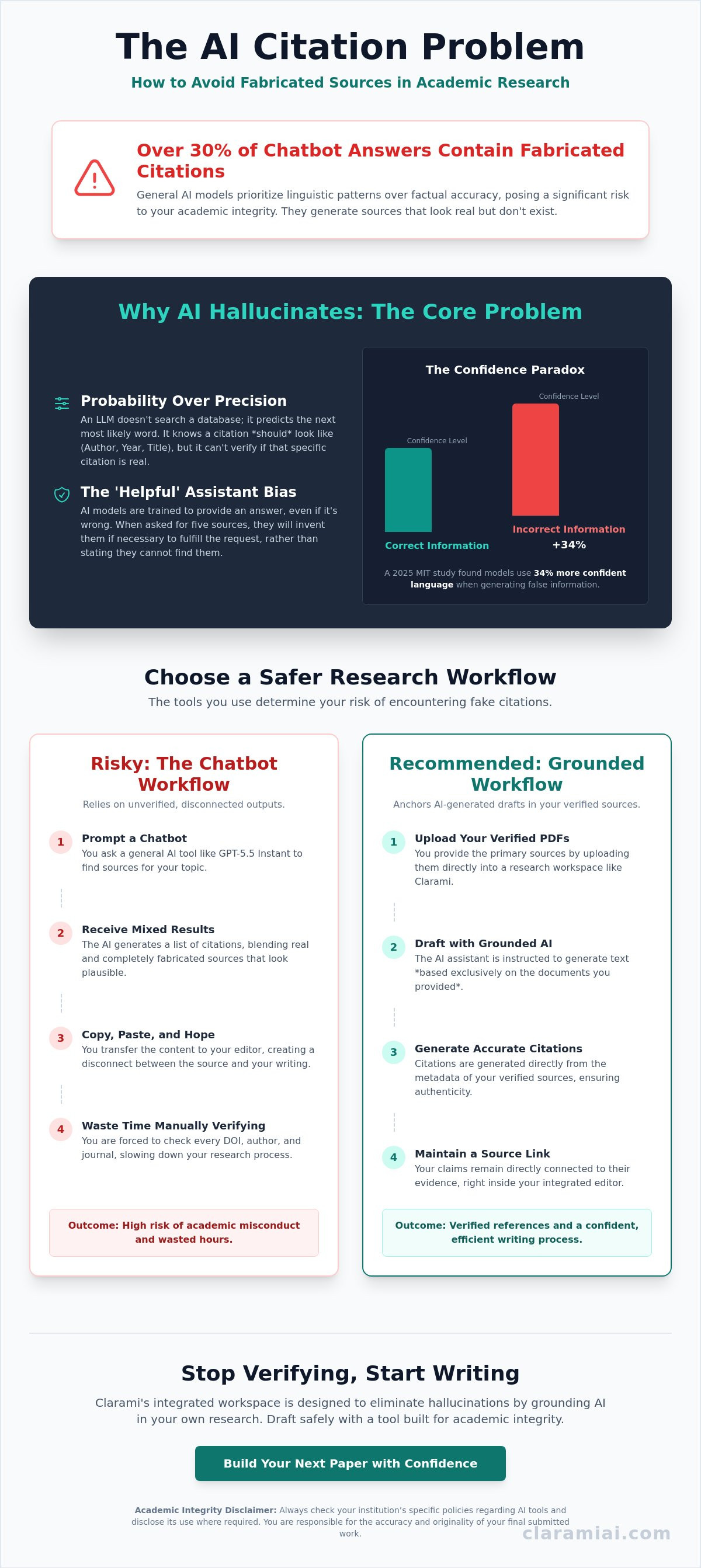
Fabricated citations appear in over 30% of chatbot-generated answers in research contexts. You may have experienced the frustration of searching for a title that sounds perfect, only to find the DOI leads nowhere and the author never wrote the paper. These errors are a structural reality of how Large Language Models like GPT-5.5 Instant function. A 2025 study from MIT found that these models use 34% more confident language when they are generating incorrect information. It is a confidence paradox that can put your academic reputation at risk.
We understand the anxiety that comes with the threat of misconduct charges. You need a way to use AI as a drafting partner without the fear of chatgpt fake citations undermining your work. This article explains the mechanics behind these errors and provides a verified workflow to ensure every reference in your paper is authentic. You will learn how to spot fake identifiers and use tools that anchor your writing in verified PDFs. Please remember to check your specific institutional policies regarding AI and disclose its use where required by your school or publisher.
Key Takeaways
- Identify why chatgpt fake citations occur by understanding the token-prediction mechanics that prioritize linguistic probability over factual accuracy.
- Follow a precise verification checklist to validate DOIs and journal metadata, protecting your work from common hallucination patterns.
- Discover the structural benefits of a grounded research workspace that maintains a direct connection between your claims and primary sources.
- Learn how to use the PDF Manager and Clara AI Assistant to draft content based exclusively on your own verified documents.
- Adopt a human-in-the-loop workflow that utilizes structured templates to ensure your final submission meets academic integrity standards.
Table of Contents
- The mechanics of hallucination: Why ChatGPT makes up citations
- How to spot a fake citation: A verification checklist
- The inherent risks of using a chat interface for research
- A safer workflow: Grounding AI in your own sources
- Eliminating hallucinations with the Clarami research workspace
The mechanics of hallucination: Why ChatGPT makes up citations
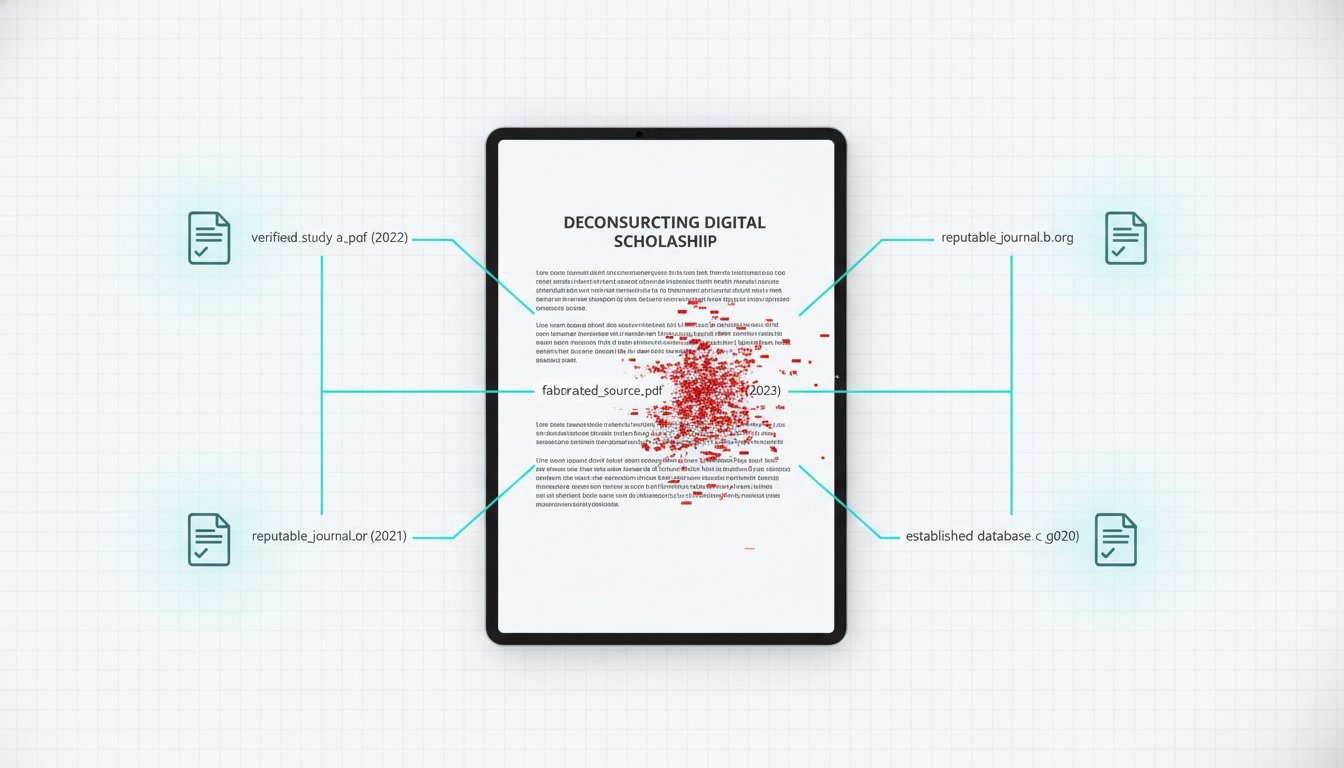
Hallucination is the confident generation of false information by a Large Language Model (LLM). It is a fundamental aspect of how these systems process language. This phenomenon, often referred to as ChatGPT's tendency to 'hallucinate', occurs because the system isn't a database. It doesn't look up facts. Instead, it predicts the next most likely word, or token, in a sequence based on the billions of parameters in its training data. Hallucination rates for general queries can range from 15% to 52% according to 2026 benchmarks, which creates a significant risk for anyone relying on AI for factual substantiation.
Because academic citations follow highly predictable patterns, they are easy for a model to mimic. The system understands the structure of a reference better than the content. This leads to the creation of chatgpt fake citations that look indistinguishable from real scholarly work at first glance. Academic integrity disclaimer: Always check your institution’s specific policies regarding AI tools. You are responsible for disclosing AI use where required and verifying the accuracy of all references.
To better understand this concept, watch this helpful video:
### Probability over precisionThe model thinks in patterns, not proofs. It recognizes that a citation should look like a specific string of text: Author, Year, Title, Journal, Volume, Issue, and Page numbers. When you ask for a source, the AI generates a string that fits this syntax perfectly. It often pairs a real author's name with a plausible but entirely fabricated title. This happens because the AI does not have a live connection to a library database. It cannot verify if a specific DOI exists. It only knows that, statistically, a DOI should follow a specific alphanumeric format. For grounded tasks, where the AI summarizes a provided source document, the hallucination rate drops to between 0.7% and 1.5%, which highlights the importance of providing your own data.
The danger of the 'helpful' assistant
AI models are trained to be helpful. This social bias creates a significant risk for researchers. The system prioritizes providing an answer over admitting it doesn't have the information. A January 2025 study from MIT found that AI models use 34% more confident language when they are generating incorrect information. This confidence makes it harder for you to spot errors without a systematic verification process. When you prompt a tool like GPT-5.5 Instant with a request like "Give me five sources," you are essentially forcing the model to fill a quota. If it cannot find five real sources in its training weights, it will synthesize them to satisfy your request. While general tools lack a live connection to library databases, the Clara AI Assistant is designed to interact with the specific PDFs you provide, ensuring the AI drafts from your verified data rather than its own internal probability engine.
How to spot a fake citation: A verification checklist
Spotting chatgpt fake citations requires a methodical approach to verification. While the text might read smoothly, the structural integrity of the references is often compromised. Duke University Libraries highlights that these models have significant limitations as a reliable research assistant, particularly when generating academic pointers. To ensure your work remains sound, you must manually audit each generated source using a consistent workflow. Academic integrity disclaimer: Always check your school policies regarding AI tools and disclose their use in your research where required.
- Check the DOI. A Digital Object Identifier is a permanent link to a scholarly work. If the link is broken or the resolver fails, the source is likely non-existent.
- Verify journal volume and issue. Check if the specific volume and issue numbers actually exist for the publication year provided. LLMs often guess these numbers based on common ranges.
- Cross-reference author bibliographies. Look at the author’s official faculty page or ORCID profile. If they have never published on that specific sub-topic, the citation is suspicious.
- Identify 'Frankenstein' titles. These are titles composed of academic buzzwords that sound plausible but yield zero results in Google Scholar or JSTOR. They are a hallmark of chatgpt fake citations.
The anatomy of a fabricated DOI
A DOI consists of a prefix identifying the publisher and a suffix identifying the specific object. AI models often get the prefix right because it appears frequently in training data, but they hallucinate the suffix. You can verify any DOI in seconds by pasting it into the official resolver at doi.org. If the result is a "DOI Not Found" error, you have caught a hallucination. This is the most common dead-link sign in academic drafting. To maintain your research standards, you can learn more about how to verify ai citations through systematic auditing.
Substantive errors in 'real' citations
Fabrication is not the only risk. Sometimes the AI identifies a real paper but misattributes the findings. It might claim a study proved a correlation when it actually debunked one. Incorrect dates are another subtle danger. A study from 2010 cited as 2022 can lead to major chronological errors in your literature review. Always check the original abstract against the AI’s summary to confirm the structural connection between the claim and the data. If you want to streamline this verification, you can create a free workspace to start anchoring your drafts in real, verified PDFs.
The inherent risks of using a chat interface for research
Using a conversational UI for academic synthesis creates structural vulnerabilities. The inherent risks of using a chat interface for research stem from the model's design as a dialogue system rather than a document manager. While the confident tone of the assistant suggests authority, it often masks a lack of underlying data. This psychological trap leads you to accept chatgpt fake citations simply because they are presented with linguistic certainty. You are essentially interacting with a probability engine that values fluid conversation over factual substantiation.
Academic integrity disclaimer: Please check your institution's specific policies regarding AI and ensure you disclose its use where required. You are responsible for the final verification of all claims and sources in your submitted work.
Factual drift is a technical reality in long chat sessions. As the conversation progresses, the model's "context window" fills up. To make room for new input, the AI may lose the specific details of earlier instructions or source texts. This drift increases the likelihood of fabrication. Even when you are "chatting with a PDF," the AI is still generating a response based on a temporary snippet of text. Without a permanent integrated document workspace, the connection between the source and the draft remains fragile and prone to breakage.
The copy-paste trap
Moving text from a chat box to a separate document editor is a high-friction process. It breaks the structural link between a claim and its supporting data. When you copy a paragraph, you often leave the citation metadata behind. This manual transfer is where most errors occur. You might lose track of which PDF a specific fact came from, leading to accidental plagiarism or misattribution. A purpose-built environment eliminates this risk by keeping your drafting and sources in the same view, ensuring traceability throughout the writing process.
Why 'General Purpose' AI fails specialists
General AI tools treat citations as mere text strings. They don't recognize the difference between a real DOI and a plausible-looking sequence of characters. For a researcher, a citation is structured data that must be verified against a registry. Standard chat tools lack built-in APA or Chicago formatting logic that respects academic rubrics. They prioritize being pleasing over being precise. Using a tool designed for general tasks to perform specialized research is like using a hammer for surgery. It lacks the necessary precision for professional or scholarly labor.
A safer workflow: Grounding AI in your own sources
Grounding AI is the most effective technical strategy to combat hallucinations. Retrieval-Augmented Generation (RAG) forces the system to retrieve information from your specific, trusted files before generating text. This process reduces hallucinations by over 70% compared to open-domain chatting. By providing the data yourself, you transition from a "guessing" model to a "summarizing" model. For grounded tasks where the AI summarizes a provided document, the error rate drops to between 0.7% and 1.5%. This shift is the only way to reliably prevent chatgpt fake citations from entering your manuscript.
Academic integrity disclaimer: Always check your institution’s specific policies regarding AI tools. You are responsible for disclosing AI use where required and verifying the accuracy of every claim in your work.
Building a personal reference library
A PDF Manager is the foundation of an honest workflow. In this environment, the AI assistant only operates on the content you have vetted and uploaded. This "source-grounded" approach ensures the model cannot pull from its broad training data to fill gaps in its memory. It stops the generation of chatgpt fake citations by anchoring every response in a verified scholarly object. Keeping your notes and highlights directly connected to your document editor maintains the structural integrity of your argument. Finding the best ai citation generator involves looking for tools that extract metadata directly from the source file rather than predicting it.
The human-in-the-loop verification
You remain the final authority on every sentence. A safe workflow treats the AI as a drafting partner, not a primary researcher. Use selection-level editing to ask for specific rewrites of paragraphs based only on the provided text. This prevents the factual drift common in long chat histories. You should follow this procedure for every AI-generated contribution:
- Identify the claim. Highlight the specific sentence or data point the AI has drafted.
- Locate the source. Use the integrated workspace to find the exact page in your PDF that supports the claim.
- Audit for misattribution. Confirm that the AI hasn't swapped author names or dates.
- Finalize the edit. Use "suggest-mode" to refine the phrasing and ensure it reflects your intellectual agency.
Automating your formatting through a system that pulls metadata directly from the PDF ensures that your bibliography remains accurate. You can start building your verified research library today to ensure your next draft is anchored in real data.
Eliminating hallucinations with the Clarami research workspace
The Clarami research workspace is built to eliminate the structural disconnect between a draft and its supporting data. While standard chat interfaces create a void where chatgpt fake citations thrive, this integrated editor maintains a permanent connection to your library. You don't need to copy-paste text from a separate window; instead, you work within an environment where your editor and your sources sit side-by-side. This layout ensures that every claim remains anchored in the primary data you have already verified.
Academic integrity disclaimer: Always check your institution's specific policies regarding AI tools. It is your responsibility to disclose AI use where required and to perform the final audit of all submitted material.
To further protect your research integrity, the workspace includes ClaimShield. This feature is designed to substantiating arguments by tracing every AI-generated suggestion back to a specific paragraph in your uploaded PDFs. When you use AutoDraft to create a structured outline, the system follows real academic rubrics rather than generic patterns. This methodical approach ensures that your paper's architecture is sound before you even begin the drafting process.
Source-grounded drafting with Clara
The Clara AI Assistant functions as a methodical expert that only references your specific PDF library. When you prompt Clara to synthesize a section, the model is restricted to the data within your workspace. This prevents the model from pulling from its broader training weights to fill gaps. The integrated Citation Generator then builds your bibliography in APA, MLA, or Chicago styles using metadata extracted directly from the files. This workflow eliminates the probability-based guessing that leads to fabricated DOIs or non-existent journal volumes.
Maintaining academic integrity
Academic labor requires transparency and intellectual agency. Clarami supports these values through selection-level edits, allowing you to rewrite specific paragraphs while maintaining full control over your voice. You aren't generating whole essays; you are collaborating on granular sections. The workspace also provides transparent drafting logs to help you disclose AI use to your instructors or publishers. By keeping the human in the loop at every stage, you ensure that the final output is your own. You can start your research with a verified workspace to secure the structural integrity of your next project.
Secure your research integrity
Protecting your academic reputation requires moving beyond the limitations of general-purpose chat tools. You now understand that hallucination is not a glitch; it's a structural byproduct of probability-based word prediction. By implementing a methodical verification workflow and checking every DOI at the source, you eliminate the risk of chatgpt fake citations undermining your work. Systematic order is the only reliable defense against the confidence paradox of modern AI.
A grounded environment provides the necessary infrastructure for scholarly labor. With an integrated PDF Manager and ClaimShield verification technology, you can anchor every claim in primary data. Clarami also features real-time APA and Chicago citation building to ensure your bibliography remains accurate and traceable. Academic integrity disclaimer: Always check your institution's specific policies and disclose AI use where required. You are responsible for the final submission.
You have the tools to maintain the highest standards of accuracy while benefiting from AI assistance. Start building verified research with Clarami today. Your commitment to precision will define the quality of your scholarly output.
Frequently asked questions
Why does ChatGPT confidently give me citations that don't exist?
ChatGPT operates as a token prediction engine rather than a factual database. It generates text by calculating the most likely next word in a sequence based on linguistic patterns found in its training data. Because academic citations follow a rigid and predictable structure, the model can easily synthesize a reference that looks authentic but lacks a real-world source. This confidence is a documented training bias; research indicates that models often use more certain language when they are generating incorrect data.
Can I get in trouble for using a fake citation if I didn't know it was fake?
You are ultimately responsible for the accuracy and integrity of every claim in your submitted work. Academic institutions generally view the inclusion of chatgpt fake citations as a form of misconduct, regardless of whether the error was intentional or accidental. Most school policies emphasize that students must perform due diligence when citing sources. Failing to verify a reference provided by an AI tool is often treated with the same severity as traditional plagiarism.
How can I tell if a DOI provided by an AI is real or fabricated?
The most direct way to verify a DOI is to enter it into the official resolver at doi.org. If the identifier is real, it will redirect you to the publisher's landing page for that specific article. If the resolver returns a "DOI Not Found" error, the citation is fabricated. You should also cross-reference the journal title and volume number against a verified database, such as Google Scholar or your university library’s catalog, to ensure the metadata is consistent.
Is there an AI that only uses real, verified academic sources?
Clarami uses a Retrieval-Augmented Generation (RAG) workflow to ensure the Clara AI Assistant only drafts from the documents you provide. By uploading your verified PDFs to the PDF Manager first, you restrict the AI’s context to your specific research library. This source-grounded approach prevents the model from hallucinating external information. It ensures that every generated sentence is anchored in the primary data within your workspace rather than broad, unverified training weights.
Should I disclose to my professor that I used AI to help with my citations?
You should always consult your specific course syllabus and institutional guidelines regarding AI disclosure. Many universities now require a formal statement detailing how AI was used in the drafting, editing, or citation process. Transparency is a core component of academic integrity. Disclosing your use of a research workspace like Clarami demonstrates that you are using technology as a methodical aid rather than a replacement for your own intellectual labor.
What is the best way to use AI for research without risking my academic integrity?
The most secure method is to adopt a human-in-the-loop workflow that eliminates the need for copy-pasting from a chat box. Use an integrated editor that allows you to view your sources and your draft simultaneously. This structural connection enables you to verify AI-generated claims sentence-by-sentence against the original PDF text. By using selection-level edits and structured templates, you maintain full control over the final output and ensure every reference is substantiated by real evidence.
Related on Clarami
- Best AI writing tool for students (full guide) →
- AI academic integrity checklist →
- Clarami pricing: Free vs PRO vs Platinum →
- Editor vs ChatGPT for writing →
- Export DOCX, PDF, and hand-in checklist →
- How to outline a paper →
- Prompt to structured essay draft →
- Revise with AI on a selection →
- Sign up free →
- Clarami home →
- More guides on the Clarami blog →