
Paraphrasing tool for students: Refining academic drafts with integrity
Learn to use a paraphrasing tool for students to refine your academic drafts with integrity. Move beyond word-swapping to synthesize ideas and improve clarity.
Write with structure in Clarami AI
Editor-first AI drafting, citations, and two Workflows for student writing.
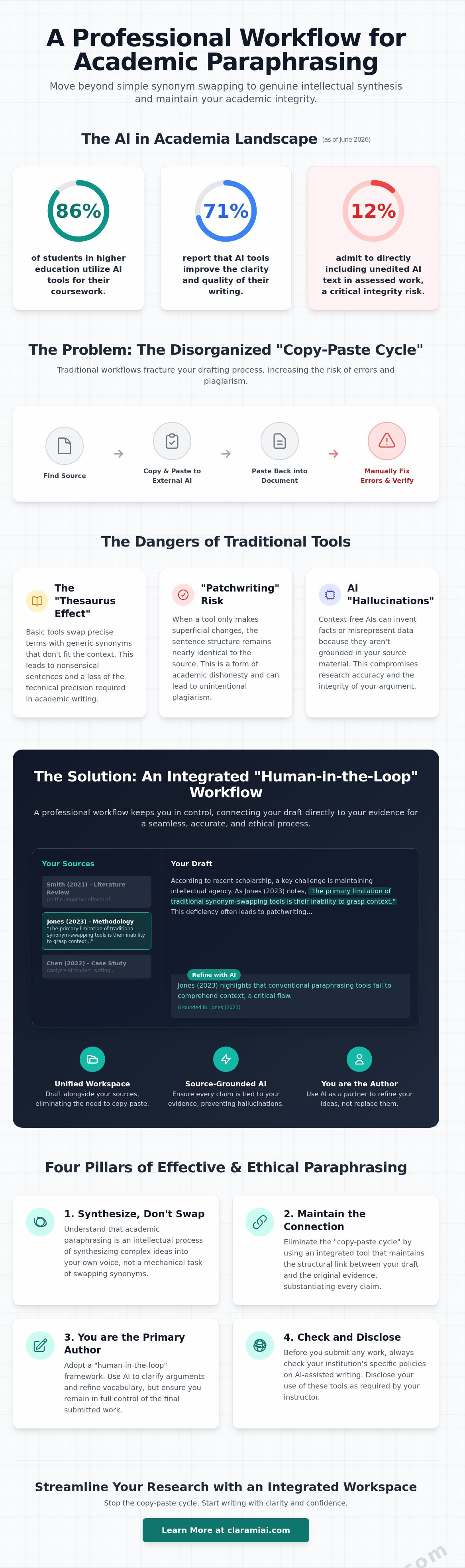
As of June 2026, 86% of students in higher education utilize AI tools to assist with their coursework. While 71% of these students report that these tools improve the clarity of their writing, a concerning 12% admit to including AI-generated text directly in their assessed work. This gap highlights a critical challenge in modern scholarship. Finding a reliable paraphrasing tool for students is no longer about finding a shortcut. It's about refining the connection between your claims and your evidence while maintaining your intellectual agency.
You likely understand the anxiety of unintentional plagiarism and the frustration of tedious copy-pasting between chat windows and your document. It's difficult to find the right academic vocabulary when you're focused on the structural integrity of a literature review. You can use these technologies to clarify your arguments and maintain strict academic integrity within a professional research workflow. This guide demonstrates how to move from disorganized source material to a polished, verified output by focusing on synthesis rather than simple word replacement. Before you begin, always check your specific school policies and disclose your use of AI assistance as required by your instructor.
Key Takeaways
- Understand that academic paraphrasing is an intellectual process of synthesizing complex ideas into your own voice, rather than a mechanical task of swapping synonyms.
- Eliminate the disorganized "copy-paste cycle" by utilizing an integrated paraphrasing tool for students that maintains the structural connection between your draft and your evidence.
- Adopt a "human-in-the-loop" framework to ensure you remain the primary author, using AI specifically to clarify arguments and refine academic vocabulary.
- Implement a professional research workflow that transitions raw notes into a polished narrative through systematic verification and the substantiation of every claim.
Table of Contents
- Understanding paraphrasing in scholarly writing
- The limitations of traditional synonym-swapping tools
- Maintaining your academic voice and integrity
- A professional workflow for rephrasing complex ideas
- Streamlining your drafting process with a source-grounded workspace
Understanding paraphrasing in scholarly writing
Academic paraphrasing isn't a simple exercise in synonym swapping. It's a cognitive act. You aren't just changing words; you're demonstrating comprehension. Understanding paraphrasing requires moving beyond the surface level of a sentence to capture its underlying logic. Many writers use a paraphrasing tool for students to bridge the gap between reading a source and articulating its significance in their own words. This is often a response to the "blank page" problem, where the pressure of maintaining a formal academic tone prevents the first draft from taking shape.
A sophisticated tool helps you re-interpret a passage while preserving its core meaning. It allows you to focus on the structural connection between your claims and the evidence. However, you must remain the primary author. Use these tools to refine your drafts, not to generate them from scratch. You are responsible for the final output and the accuracy of the synthesized information.
Academic Integrity Notice: Before you submit any assignment, you must consult your institution's specific policies on AI-assisted writing. Always disclose your use of these tools to your instructor if required.
The role of synthesis in a literature review
Literature reviews require you to weave multiple academic voices into a single, coherent narrative. You show mastery of your subject by moving away from direct quotes and toward synthesis. Paraphrasing helps you connect disparate arguments within your draft, creating a logical flow between different researchers' findings. The goal is to maintain the original author's intent while fitting the information into your specific argument. This requires a methodical approach to ensure that your rephrased content remains grounded in the source data.
Common pitfalls of basic rephrasing tools
Many basic tools suffer from the "thesaurus effect." They replace precise technical terms with generic synonyms that don't fit the context. This often results in sentences that are overly complex or entirely nonsensical. In specialized fields like STEM or law, losing technical precision can invalidate your entire argument.
Another significant risk is "patchwriting." This occurs when a tool only makes superficial changes to the original text, leaving the sentence structure nearly identical to the source. This can lead to unintentional plagiarism. Using an integrated workspace allows you to see your source material and your draft side-by-side, helping you avoid these mechanical errors and maintain the integrity of your work.
The limitations of traditional synonym-swapping tools
Traditional tools often fail because they treat text as a series of isolated strings. They lack the capacity to understand how a specific sentence supports a broader thesis. This mechanical approach results in a copy-paste cycle that fractures your drafting process. You lose the connection between your evidence and your claim, which increases the risk of organizational failure. When you rely on a basic paraphrasing tool for students, you often spend more time fixing the output than you would have spent writing it yourself.
Generic AI models frequently struggle with the nuance of a scholarly tone. They may produce text that is either too casual for a dissertation or so laden with jargon that it loses clarity. According to Penn State's guide to paraphrasing, the goal is to restate the author's ideas in your own words while maintaining the original meaning. A generic tool often misses this balance because it isn't purpose-built for the rigors of academic labor. It treats a legal brief the same way it treats a blog post, leading to a loss of technical precision.
Why context-free AI leads to hallucinations
When a tool doesn't have access to your primary sources, it relies on probability to predict the next word. This leads to hallucinations, where the AI inadvertently changes facts or invents data points that weren't in the original text. You lose the structural connection between a claim and its evidence. Source-grounded AI is essential for research accuracy because it anchors every rephrased sentence in the verified data of your uploaded documents. Without this grounding, a paraphrasing tool for students can become a liability rather than an asset.
The efficiency gap in traditional workflows
Traditional workflows are plagued by technical debt. You waste significant time switching between browser tabs, PDF managers, and word processors. This fragmentation makes it difficult to track where a paraphrased idea originally came from. It's a disorganized system that invites error. An integrated document editor solves the fragmentation problem by bringing your sources and your draft into a single, cohesive workspace.
This systematic order ensures that your research remains traceable. You can verify every claim without leaving your writing environment. If you want to experience a more disciplined approach to academic composition, you can create your workspace today and begin refining your drafts with confidence.
Maintaining your academic voice and integrity
You are not a passive consumer of information. You are a methodical expert responsible for every claim within your draft. A paraphrasing tool for students should function as a sophisticated intellectual companion, not a replacement for your own critical thinking. This "human-in-the-loop" framework ensures that you maintain intellectual agency over your work. You provide the logic and the evidence; the AI assists with the structural refinement of your sentences.
Integrity requires transparency and disciplined verification. In 2026, the standard for scholarly labor involves disclosing AI assistance when it contributes to the final output. Before you submit any assignment, you must verify your institution's specific requirements regarding AI use. Using an academic writing tone checker online helps you ensure your voice remains consistent and professional. This prevents the formulaic or repetitive styles common in consumer-grade automated tools that treat specialized tasks as secondary features.
Academic Integrity Disclaimer: Always check your school's specific policies regarding AI use. Disclose the use of these tools in your methodology, acknowledgments, or as directed by your instructor.
Support for ESL and international students
International students often face a significant gap between their complex research and their English expression. Paraphrasing helps bridge this divide without compromising scholarly rigor. It allows you to refine sentence structure for better flow while systematically removing idioms or colloquialisms that can detract from your argument. This process focuses on clarity and the precise extraction of methodology. It ensures that your research remains accessible and professional, allowing your ideas to stand on their own merits regardless of your primary language.
The ethics of selection-level edits
Rewriting specific paragraphs is a more ethical and effective approach than generating entire essays. It allows you to maintain control over the narrative arc of your dissertation or thesis. Selection-level edits ensure you understand the structural connection between every sentence and its supporting data. You must perform rigorous verification steps to anchor each claim in primary sources. This methodical approach distinguishes serious scholarship from the disorganized habits of general-purpose platforms. By focusing on paragraph-level refinements, you ensure that the final output reflects your own intellectual contribution and mastery of the subject matter.
A professional workflow for rephrasing complex ideas
Transitioning from raw research notes to a polished first draft requires a disciplined sequence. A paraphrasing tool for students shouldn't be used as a shortcut to bypass the writing process. Instead, it should serve as a mechanism for structural refinement. This workflow ensures that every sentence remains grounded in evidence while you maintain total control over your academic narrative. When you receive conflicting feedback from advisors, this systematic approach allows you to iterate on specific sections without losing the organizational cohesion of your entire document.
Academic Integrity Notice: Consult your school's specific policies on AI-assisted writing before submission. Disclose your use of these tools as required by your instructor or department.
Step 1: Analyzing the source in the workspace
Serious scholarship begins with deep analysis. Before you attempt to rephrase any content, you must highlight key evidence and data points within your primary sources. Using the Clarami workspace, you can keep your PDFs visible directly next to your draft. This eliminates the disorganized habit of switching between browser tabs. You can use the Clara AI Assistant to ask specific questions about the methodology of a study, ensuring you fully comprehend the material before you begin the synthesis process. This step anchors your arguments in verified data from the very start.
Step 2: Executing the rephrase with AutoDraft
Once you understand the source material, you can use AutoDraft for targeted refinements. Avoid the temptation to rewrite entire pages at once. Instead, select a specific paragraph that requires better clarity or flow. You can choose a tone profile that matches your specific rubric or target journal. Review the suggested draft sentence by sentence. This "human-in-the-loop" approach ensures that the final wording reflects your own intellectual contribution. You are the editor; the AI is your technical companion.
Step 3: Verification and citation
The final stage is the most critical for maintaining academic integrity. Use ClaimShield to verify that the new phrasing still accurately represents the original source data. This prevents the "hallucinations" common in general-purpose tools. You should build your citation immediately using the integrated helper to ensure traceability. It is your responsibility to learn how to verify AI citations for total accuracy. This methodical verification process ensures that every claim in your dissertation or thesis is substantiated by primary evidence.
By following this structured path, you move from initial disorganization to a polished, verified output. If you are ready to implement a more rigorous research routine, you can start your first project in the integrated editor to see the difference a purpose-built workspace makes.
Streamlining your drafting process with a source-grounded workspace
A professional research environment should eliminate friction. Most students struggle with the disorganized habit of moving text between disconnected browser tabs and word processors. This fragmentation leads to technical inaccuracies and lost citations. By using an In-App Editor, you maintain a direct connection between your source material and your draft. This "no copy-paste" approach is a significant differentiator for serious scholars who require systematic order. You don't just use a paraphrasing tool for students; you operate within a purpose-built ecosystem designed for structural integrity.
Academic Integrity Notice: Always consult your institution's specific policies regarding AI-assisted writing. It's your responsibility to disclose AI use where required by your instructor or department.
Structural drafting is further supported by templates matched to specific academic rubrics. Whether you're writing a dissertation chapter or a lab report, these frameworks guide you from initial disorganization to a polished output. Every claim remains anchored in evidence because your sources are always visible within the same workspace. This cohesion ensures that your arguments are substantiated and your methodology is transparent. You maintain total control over the narrative flow of your manuscript.
The power of an integrated research environment
Maintaining a clean workspace is essential for long-term projects like a thesis. Disorganized drafts often lead to anxiety about unintentional plagiarism. Within the Clarami In-App Editor, your research remains traceable. You can collaborate with peers or advisors using suggest-mode, which allows for collaborative refinement without compromising your intellectual agency. This workflow mirrors the professional standards of academic publishing. It transforms the act of writing from a chaotic struggle into a disciplined, linear narrative. Your progress becomes measurable and steady.
Achieving scholarly precision with Clara
The Clara AI Assistant acts as a reliable intellectual companion throughout your drafting process. It assists you in moving from a rough synthesis of ideas to a submission-ready manuscript. You remain the primary author, making final edits and verifying every citation. This human-in-the-loop framing ensures that your unique academic voice is preserved. Once your work is verified, you can export your document to professional formats like DOCX or LaTeX with confidence. You can check the Clarami pricing to find a plan that fits your specific research needs and academic goals.
The final transition from draft to submission requires one last check for organizational cohesion. Verify that all claims are grounded in your primary sources. Ensure your citations are formatted correctly according to your department's standards. By following this methodical approach, you produce work that is not only clear and well-structured but also fundamentally honest.
Advancing your research with systematic order
Effective academic writing requires more than just rephrasing sentences. It demands a disciplined synthesis of complex ideas and a commitment to substantiating every claim with primary evidence. You've learned that moving beyond the disorganized copy-paste cycle is essential for maintaining the structural integrity of your dissertation or thesis. By selecting a specialized paraphrasing tool for students that prioritizes verification over simple word-swapping, you ensure your intellectual agency remains intact throughout the drafting process. This methodical approach transitions your work from a state of initial disorganization to a polished, verified output.
A source-grounded AI assistant helps you maintain this precision within a cohesive workspace. You can verify the accuracy of your refinements with ClaimShield and ensure every argument is traceable through an integrated citation builder. This systematic framework transforms the stress of managing source material into a reliable intellectual process. You are ready to produce work that meets the highest standards of scholarly rigor while honoring your commitment to academic honesty.
Start your research with Clarami for free to begin refining your drafts with confidence. Your dedication to precise, ethical scholarship is the foundation of your success as a researcher.
Frequently asked questions
Is using a paraphrasing tool considered cheating in university?
Using a paraphrasing tool for students is not inherently cheating, but its status depends on your instructor's specific policy. As of 2026, most major universities regulate rather than ban these tools. Misconduct occurs when you use AI to replace your intellectual contribution or to evade plagiarism detection. You should use these technologies for structural refinement while maintaining total control over your arguments.
Can Turnitin detect text that has been paraphrased by AI?
Turnitin and other academic platforms utilize advanced classifiers to detect AI-generated and paraphrased text. These tools don't just look for matching phrases; they analyze linguistic patterns and structural markers characteristic of AI. A high detection score is typically treated as a trigger for a manual review of your writing history and the quality of your citations. Always assume that your work will be scrutinized for AI involvement.
What is the difference between a paraphrasing tool and a summarizer?
A paraphrasing tool restates specific ideas to improve clarity or flow while maintaining a similar level of detail to the original. In contrast, a summarizer condenses large sections of text into a few core points. Paraphrasing is used for refining your arguments during the drafting stage, whereas summarizing is best for the initial extraction of methodology from your research sources.
How do I ensure a paraphrasing tool doesn’t change the meaning of my research?
You ensure accuracy by using a source-grounded workspace where the original document is always visible next to your draft. Tools like ClaimShield verify that the rephrased sentence remains anchored in the verified data of your primary source. This prevents "hallucinations" where the AI inadvertently changes facts or loses the structural connection between your claim and the supporting evidence.
Should I cite the AI if I use it to help rephrase a sentence?
You should always disclose the use of AI assistance in your academic work to maintain transparency. Modern integrity codes in the US, UK, and Australia emphasize disclosure as a core requirement for ethical scholarship. Disclosing your use of a paraphrasing tool for students protects you from allegations of academic misconduct and demonstrates your role as a methodical expert who values verification.
What is the best way for ESL students to use paraphrasing tools?
ESL students should use these tools for selection-level edits to bridge the gap between their complex research and formal English expression. Focus on refining specific paragraphs to remove idioms or colloquialisms that might detract from scholarly rigor. This "human-in-the-loop" approach ensures that your unique academic voice is preserved while improving the technical precision and flow of your manuscript.
Related on Clarami
- Best AI writing tool for students (full guide) →
- AI academic integrity checklist →
- Clarami pricing: Free vs PRO vs Platinum →
- Editor vs ChatGPT for writing →
- Export DOCX, PDF, and hand-in checklist →
- How to outline a paper →
- Prompt to structured essay draft →
- Revise with AI on a selection →
- Sign up free →
- Clarami home →
- More guides on the Clarami blog →