Master Academic Integrity: Avoiding Plagiarism Guide
Worried about unintentional plagiarism in academic writing? Learn a repeatable workflow to manage sources, use AI ethically, and ensure your work is original.
Write with structure in Clarami AI
Editor-first AI drafting, citations, and two Workflows for student writing.
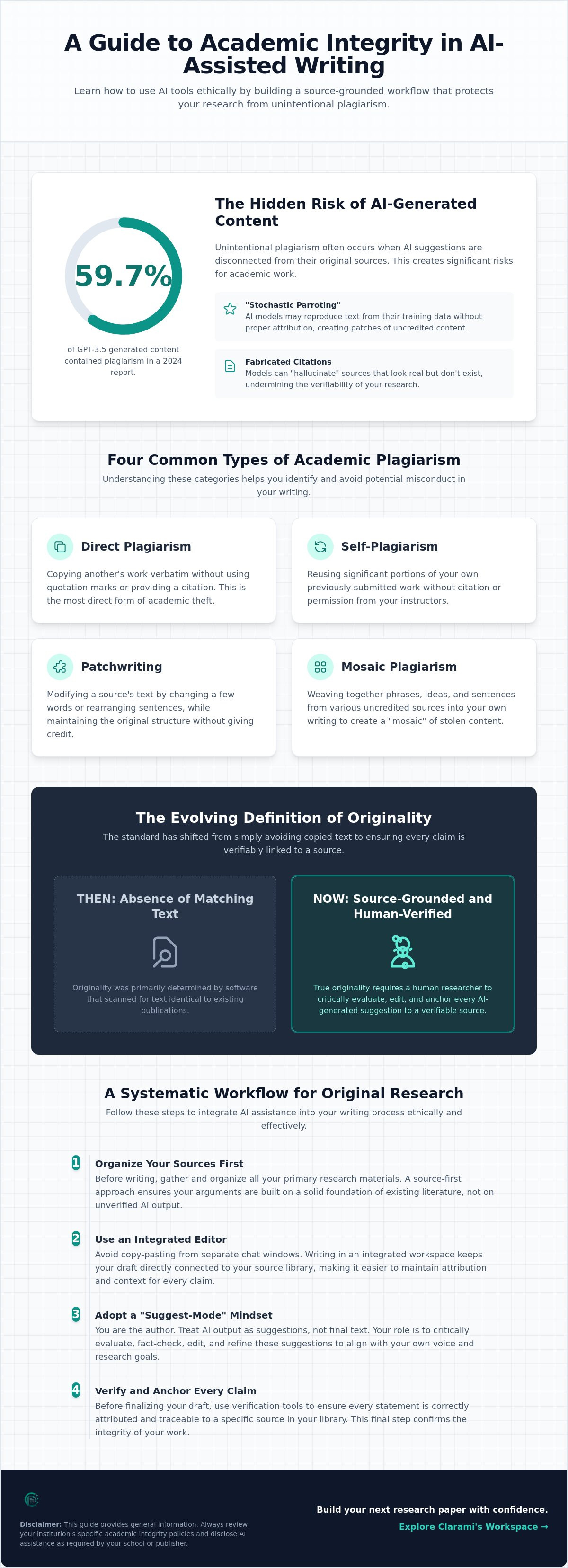
A 2024 report revealed that 59.7% of content generated by GPT-3.5 contained some form of plagiarism. For many researchers, this statistic turns the convenience of digital tools into a source of deep anxiety. You likely worry about unintentional plagiarism in academic writing through poor paraphrasing or the fear of "hallucinated" citations that appear real but lack substance. It's a high-stakes environment. One where the line between a helpful suggestion and an ethical breach feels thin. We recognize the labor required to maintain original thought while managing complex sources.
This guide provides a precise path forward. You'll learn to identify modern plagiarism boundaries and build a source-grounded workflow that ensures your research remains ethical and original. We'll move from initial synthesis to a final, verified output using a repeatable system for anchoring every claim in primary data. Disclaimer: Always review your institution's specific academic integrity policies and disclose AI assistance as required by your school or publisher.
Key Takeaways
- Understand the evolving definition of integrity and why uncredited AI output is now classified as a form of misconduct.
- Identify how "stochastic parroting" and fabricated citations lead to unintentional plagiarism in academic writing.
- Build a source-first workflow by organizing your primary research in a PDF Manager before drafting begins.
- Adopt a "suggest-mode" approach to maintain intellectual agency while refining AI-generated suggestions.
- Use ClaimShield to verify that every statement in your final document is anchored to a legitimate source.
Table of Contents
- Defining plagiarism in a shifting academic landscape
- Categorizing academic plagiarism and its impact
- Addressing the risk of unintentional AI-generated plagiarism
- Establishing a systematic workflow for original research
- Anchoring your arguments with Clarami's integrated workspace
Defining plagiarism in a shifting academic landscape
Academic integrity is a personal commitment to ethical scholarship. Before we begin, it's essential to check your specific institutional policies and disclose your use of AI tools as required by your school or publisher. At its core, plagiarism is the representation of another person's ideas, data, or language as your own. For a comprehensive overview of plagiarism, one must look at how it encompasses everything from verbatim copying to the uncredited use of conceptual frameworks. It isn't just about stolen words; it's about the failure to acknowledge the intellectual labor of others.
Many instances of plagiarism in academic writing stem from the friction between a chat interface and a final document. When you copy and paste text from an external AI window, you lose the structural connection to your primary sources. This creates a high-risk environment. AI-generated suggestions are easily and accidentally treated as original thoughts when they're stripped of their context. Maintaining a tight link between your research and your draft is the only way to ensure every sentence remains ethical.
To better understand this concept, watch this helpful video:
You are the final authority over your text. While tools like Clara AI Assistant provide drafting support, the responsibility for every claim and citation remains with you. Submitting work involves an implicit promise that you've verified its accuracy and substantiated its arguments. Using an integrated editor helps maintain this link, but your human oversight is the final safeguard against technical inaccuracies.The core principles of academic honesty
- Attribution. Giving credit where it's due for every external idea, whether it's a direct quote or a paraphrased concept.
- Transparency. Being explicit about the methodology and the tools used in your research process.
- Verifiability. Ensuring every claim can be traced back to a primary source within your workspace.
These principles don't change because the tools change. They simply require a more methodical approach to plagiarism in academic writing. When you prioritize these three pillars, you build a draft that's structurally sound and ethically defensible.
Why the definition of originality is evolving
The standard for originality has shifted. In previous years, originality was defined primarily by the absence of matching text in a database. Today, it focuses on source-grounding. The distinction lies between content that is merely generated and content that is human-verified. Editors and educators now look for the "human-in-the-loop" signature: evidence that a researcher has critiqued, edited, and validated every suggestion. Academic integrity in 2026 represents the disciplined commitment to anchoring every synthesized statement in a verifiable, primary source while maintaining total transparency regarding the tools used in the composition process.
Categorizing academic plagiarism and its impact
Direct plagiarism is the most recognizable violation. It involves verbatim copying without quotation marks or citations. However, plagiarism in academic writing often manifests in more subtle ways that are equally damaging to a researcher's reputation. Self-plagiarism occurs when you reuse your own previous work without permission or citation. Many students assume they own their previous output entirely. In reality, academic standards require transparency regarding the origin of every claim to prevent the "recycling" of credit for a single piece of research.
Patchwriting is a frequent risk for those working in a second language or under tight deadlines. This involves deleting or changing a few words while maintaining the original sentence structure. It's a symptom of a writer struggling to synthesize complex data into their own voice. Mosaic plagiarism is similar. This involves interweaving your own words with phrases from various sources without providing credit. This creates a fragmented narrative that lacks structural integrity and traceability.
The consequences of academic misconduct
Institutional penalties. Failing grades. Expulsion. These are the immediate risks of academic misconduct. Schools such as the University of Nevada, Las Vegas (UNLV) and SUNY Brockport have explicitly updated their policies for 2025 to include the unauthorized use of AI as a form of misconduct. Beyond the classroom, the long-term professional damage is significant. A single instance of proven plagiarism can result in the loss of credibility in the scholarly community. Professional publishing also carries legal implications. Unauthorized use of copyrighted material can lead to expensive infringement claims and the retraction of published papers.
Common misconceptions about "fair use"
A common myth suggests that changing 30% of a paragraph makes it original. This is incorrect. If the underlying logic, data, and structure belong to another author, the work remains derivative. You must also distinguish between common knowledge and original arguments. While you don't need to cite the fact that the Earth is round, you must cite the specific data or methodology used to prove a nuanced claim. This distinction is vital for upholding academic integrity throughout your career.
Developing a systematic way to track these boundaries is the only way to protect your work. If you find the process of organizing citations overwhelming, you can start building your first verified project within a structured workspace.
Addressing the risk of unintentional AI-generated plagiarism
General-purpose Large Language Models (LLMs) prioritize linguistic probability over factual accuracy. This often leads to hallucinations. These are fabricated citations that appear legitimate but lack any primary source. For many, this is the most dangerous form of plagiarism in academic writing because it creates a false trail of evidence. Another risk is stochastic parroting. This occurs when an AI accidentally mimics its training data too closely, repeating specific phrases or sentence structures without attribution. A 2024 report by G2 found that 59.7% of content generated by GPT-3.5 contained some form of plagiarism.
Relying on a standalone plagiarism checker is a reactive strategy. It identifies problems after they've already been integrated into your draft. In 2024, Turnitin's AI detection system flagged between 6% and 11% of student papers as containing substantial AI-generated content. These students likely relied on whole-document generation rather than selection-level edits. A proactive approach involves using AI to refine specific paragraphs or synthesize data you've already verified. This keeps you in control of the narrative and ensures the final output is yours. You remain the expert.
Why chat-based AI tools fail the integrity test
The "black box" problem is a significant hurdle for scholars. When you use a chat interface, you don't know where the AI got its information. Copying text from a chat window into your editor without verification breaks the chain of evidence. These disconnected workflows lead to lost citations and broken references. You're left with a draft that looks polished but lacks structural integrity. Verification becomes an afterthought rather than a core part of the process. It's a fragmented way to work.
Verifying claims in real time
You must check every data point against a PDF or primary source before it enters your final document. This is why we prioritize an integrated workspace where your research and your writing exist in the same environment. Integrating your sources directly into your editor allows you to substantiate every argument as you write. You can learn more about how to verify ai citations to protect your professional reputation. An AI draft is a probabilistic prediction of text, whereas a verified scholarly claim is a substantiated statement anchored in evidence through rigorous human oversight.
Establishing a systematic workflow for original research
Organization is the foundation of integrity. Preventing plagiarism in academic writing requires a shift from reactive checking to proactive organization. You should centralize your primary sources in a dedicated PDF Manager before you type a single word. This ensures that every piece of data you interact with is already tied to its bibliographic metadata. When your research is disorganized, you're more likely to lose track of where an idea originated. A methodical setup eliminates this risk from the start.
Adopt a suggest-mode approach to drafting. This means you treat AI-generated text as a set of suggestions to be critiqued rather than a final product. You are the lead investigator. Every paragraph should be anchored to specific evidence using a source-grounded assistant like Clara. By using AutoDraft features, you can transform your raw research notes into structured arguments while maintaining total traceability. This workflow ensures that the final document is a reflection of your own synthesis and critical thinking.
Mastering the art of paraphrasing and synthesis
Effective paraphrasing requires more than just swapping synonyms. Try the "Look Away" method: read a source, close the file, and write the core idea from memory. This forces you to process the information through your own cognitive lens. Synthesis takes this further by combining multiple sources to form a unique perspective. You can use a tone checker to ensure your voice remains consistent throughout these transitions. This preserves your intellectual agency while utilizing external data.
Citation management as you write
Waiting until the end of a project to format citations is a common mistake. It often leads to the "forgotten source" error, where a claim remains uncredited because the original reference was lost. An integrated citation builder tracks your sources in real time as you compose. This systematic approach is a core factor when choosing an ai research assistant tool. Real-time tracking provides calm assurance that your bibliography is as accurate as your arguments. It turns a tedious technical requirement into a seamless part of your creative process.
A disciplined workflow is the most effective defense against accidental misconduct. You can create your free Clarami account to begin building a more resilient and original research process today.
Anchoring your arguments with Clarami's integrated workspace
Copying and pasting text from a chat window is a broken process. It disconnects your writing from its evidence. Clarami’s In-App Editor solves this by keeping your research and your draft in a single, unified view. You don't have to toggle between tabs or lose the context of your primary sources. This structural cohesion is your strongest defense against plagiarism in academic writing. When your sources are always visible, you maintain a constant awareness of which ideas are yours and which require attribution.
Verification is a continuous process, not a final step. ClaimShield acts as a structural integrity layer for your work. It allows you to verify that every statement in your draft is substantiated by your uploaded PDFs. You can see the exact page and paragraph that supports your argument. This creates a transparent research trail that you can share with advisors or peer reviewers. If someone questions a claim, you have a documented path from source to statement. You aren't just writing; you're building an evidence-based document.
AutoDraft helps you move from research to structure without losing traceability. It generates outlines that follow specific academic rubrics, ensuring your work meets institutional standards. You remain the final authority. You critique every suggestion and edit every sentence. This human-in-the-loop model ensures that the final output reflects your intellectual agency while utilizing the organizational power of AI.
Source-grounded research with Clara
Clara operates on a strictly source-grounded model. It only uses the documents you provide to answer questions or generate text. This eliminates the hallucination risk found in general-purpose tools. For complex projects like a dissertation or thesis, this precision is vital. You use Clara to extract specific methodologies or highlight relevant data, but the synthesis remains yours. You can explore the Clarami Features to see how this workspace environment supports ethical scholarship.
Exporting with confidence
The final stage of your workflow should be a rigorous quality check. Use the Draft Tone Checker to ensure your voice remains scholarly and consistent. Once you're satisfied with the draft, the Citation Generator creates accurate references in APA, Chicago, or LaTeX formats. This prevents the technical errors that often lead to accusations of negligence. You can start building your ethical research workspace today to ensure your final submission is 100% verified and original.
Disclaimer: Always check your institutional policies and disclose AI use where required by your school or publisher.
Frequently Asked Questions
What counts as plagiarism in academic writing in 2026?
Plagiarism includes direct copying, uncredited paraphrasing, and the undisclosed use of AI-generated content. Modern standards require that any text or idea not originally yours, including those suggested by AI assistants, must be properly cited and anchored to a primary source.
How do I avoid AI hallucinations in my research?
Avoid using general chat interfaces that lack access to your specific research files. Use a source-grounded assistant that only draws information from your uploaded PDFs, and verify every claim using a tool like ClaimShield before finalizing your draft.
Is using an AI writing assistant considered cheating?
It depends on your institution's policy. Many schools allow AI for brainstorming or refining drafts if it's disclosed and the student remains the "human-in-the-loop" who edits and verifies the work. Always consult our guide on AI writing tools for students to learn about ethical implementation.
Related on Clarami
- Best AI writing tool for students (full guide) →
- AI academic integrity checklist →
- Clarami pricing: Free vs PRO vs Platinum →
- Editor vs ChatGPT for writing →
- Export DOCX, PDF, and hand-in checklist →
- How to outline a paper →
- Prompt to structured essay draft →
- Revise with AI on a selection →
- Sign up free →
- Clarami home →
- More guides on the Clarami blog →