Managing dissertation research anxiety through systematic organization
Learn how managing dissertation research anxiety is possible with a systematic workflow. Turn scattered notes into a structured argument and reduce cognitive...
Write with structure in Clarami AI
Editor-first AI drafting, citations, and two Workflows for student writing.
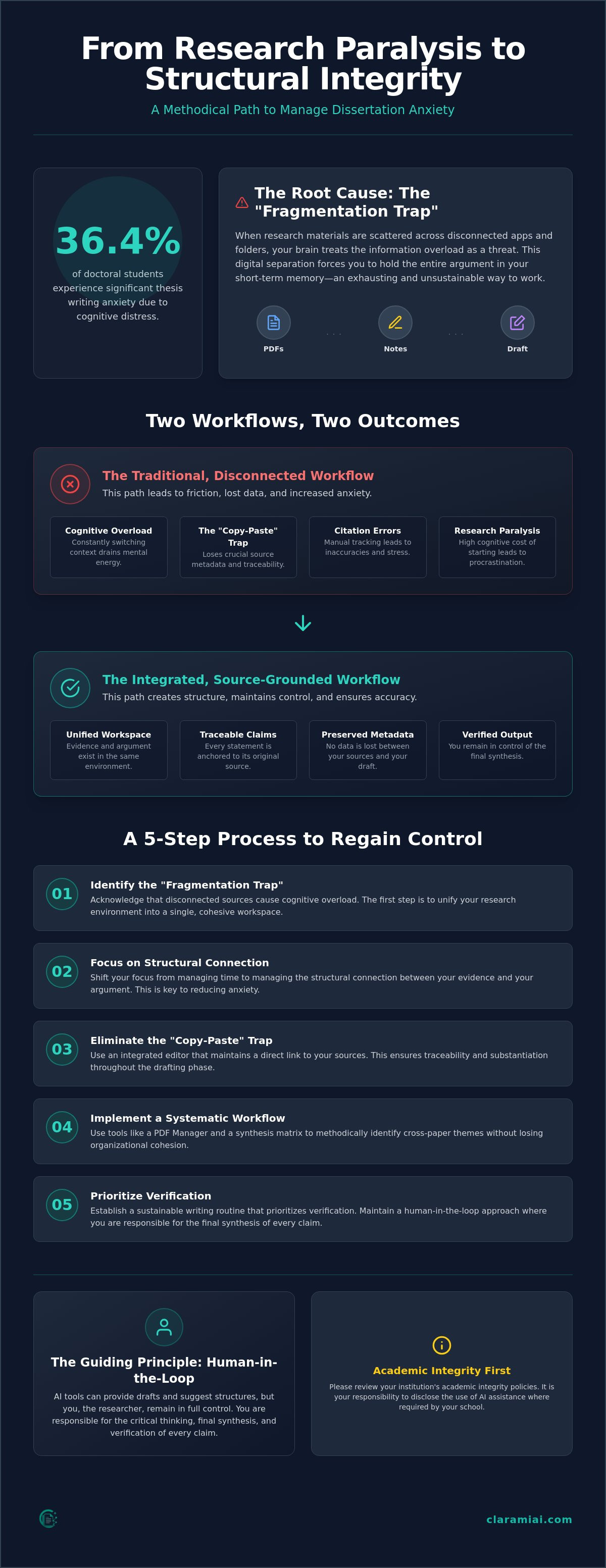
A 2025 study of doctoral students found that 36.4% experience significant thesis writing anxiety, with cognitive distress being the most prevalent factor. You likely recognize the weight of information overload and the persistent fear that an unorganized source might undermine your entire argument. Managing dissertation research anxiety is not a matter of increasing your willpower; it's a matter of refining your structural integrity. When your research materials are scattered across disconnected folders, the blank page becomes an obstacle rather than a workspace.
You will learn how to transform research-induced paralysis into a structured, manageable workflow using source-grounded tools. This article provides a methodical path to move from initial disorganization to a verified output by anchoring every claim in primary data. We will focus on the extraction of methodology and the structural connection between your statements and their supporting evidence. This repeatable process reduces cognitive load while keeping you in full control of the final synthesis. Please review your institution's academic integrity policies and disclose the use of AI assistance where required by your school.
Key Takeaways
- Identify the "fragmentation trap" where disconnected sources cause cognitive overload. Learn to unify your research environment into a single, cohesive workspace.
- Shift your focus from time management to the structural connection between evidence and argument. This approach is essential for managing dissertation research anxiety.
- Eliminate the "copy-paste" trap that leads to lost metadata. Use an integrated editor to maintain traceability and substantiation throughout the drafting phase.
- Implement a systematic workflow using a PDF Manager and a synthesis matrix. These tools help you identify cross-paper themes without losing organizational cohesion.
- Establish a sustainable writing routine that prioritizes verification. Maintain a human-in-the-loop approach where you remain responsible for the final synthesis of every claim.
Table of Contents
- Understanding the source of dissertation research anxiety
- Breaking the cycle of research paralysis through structural order
- Comparing traditional research methods with intelligent workflows
- Practical steps to regain control over your research process
- Building a sustainable writing routine with Clarami
Understanding the source of dissertation research anxiety
Dissertation research anxiety is a physiological and cognitive response to high-stakes information overload. It isn't a personal failure of discipline. It's a structural problem. When you face thousands of pages of literature across multiple disciplines, your brain often treats the sheer mass of data as a threat. This leads to the "fragmentation trap." You likely keep your PDFs in one application, your notes in another, and your draft in a third. Digital separation. Friction. Loss of focus. This lack of cohesion forces you to hold the entire structure of your argument in your short-term memory, which is an exhausting and unsustainable way to work.
Traditional chat-box AI tools often exacerbate this stress. Because these tools operate in an isolated interface without direct, anchored access to your verified sources, they frequently hallucinate citations. This creates a new, technical fear: the risk of unintentional academic dishonesty. Managing dissertation research anxiety requires a move away from these disconnected systems and toward a workspace that prioritizes traceability. Please review your institution's academic integrity policies and disclose the use of AI assistance where required by your school.
To better understand this concept, watch this helpful video:
### The cognitive load of disorganized informationContext-switching between tabs and folders drains your mental energy. When you spend twenty minutes performing "digital archaeology" to find a specific methodology detail, you aren't writing. You're searching. This administrative burden fuels procrastination. You don't avoid the work because you're lazy; you avoid it because the cognitive cost of re-orienting yourself is too high. At a certain point, data collection stops being a productive task and becomes a barrier to synthesis. You need a unified workspace where your evidence and your argument exist in the same environment.
Imposter syndrome and the fear of academic inaccuracy
The fear of misrepresenting a primary source is a legitimate scholarly concern. It often manifests as Understanding Impostor Syndrome, where you feel that a single citation error might expose you as inadequate despite your hard work. Manual citation management is a high-risk task. Tracking dozens of authors, dates, and page numbers across a complex bibliography creates immense pressure. Without a clear line of traceability from your draft back to the original source, you'll likely spend hours second-guessing your own claims. This lack of structural integrity makes the drafting phase feel precarious. Accuracy requires a technical solution that anchors every sentence in verified data.
Breaking the cycle of research paralysis through structural order
Managing dissertation research anxiety requires a fundamental shift in perspective. You shouldn't focus on managing your time. You should focus on managing the connection between your evidence and your argument. Traditional productivity hacks often fail because they don't address the underlying structural chaos. When your sources are buried in folders and your draft is a separate document, the mental effort required to bridge that gap causes paralysis. An empowered response to dissertation anxiety involves creating a workspace where data and composition exist in the same view. This proximity reduces the cognitive friction that leads to procrastination. Please review your institution’s academic integrity policies and disclose the use of AI assistance where required by your school.
Moving from folders to an integrated workspace
Traditional folder-based systems are static storage units. They are where research goes to be forgotten. In contrast, an integrated research environment treats your data as active components of your writing. Having your PDFs and your document editor in a single view prevents the mental fatigue of constant context-switching. You don't have to hunt for a quote or verify a methodology in another window. It's right there. This setup allows for a "living bibliography." Your citations grow alongside your draft. Every time you mention a source, the system tracks the metadata. This organizational cohesion ensures that you never lose the structural integrity of your work.
The role of source-grounded drafting in reducing stress
Source-grounded drafting is the practice of writing where every claim is anchored in a verified document. It removes the "blank page" panic by providing immediate access to the substantiation you need. You aren't guessing. You aren't "making things up" for a first draft with the hope of finding the source later. Tools like Clara allow you to summarize complex papers or extract key data points while maintaining the original context. This human-in-the-loop approach ensures you remain the intellectual lead. The AI provides the summary, but you determine its relevance to your thesis. By seeing your sources alongside your draft, you maintain a sense of momentum. If you are ready to move from research paralysis to a verified workflow, you can start building your integrated workspace today.
Comparing traditional research methods with intelligent workflows
Traditional research methods rely on manual synchronization. You read a PDF, highlight a passage, and then manually type a summary into a separate document. This fragmentation is a primary catalyst for research-induced paralysis. Managing dissertation research anxiety is difficult when your evidence is physically separated from your argument. Every time you switch from a browser tab to a word processor, your brain must re-calibrate. This process is inefficient. It's exhausting. It's a structural flaw that drains your mental energy before you've written a single paragraph.
The ethical use of AI in this context focuses on assistance rather than replacement. You remain the intellectual lead. The AI serves as a structural companion that helps organize your thoughts without overriding your voice. This approach respects your intellectual agency while removing the administrative burden of data management. Please review your institution's academic integrity policies and disclose the use of AI assistance where required by your school.
The copy-paste trap vs. selection-level editing
Many researchers fall into the "copy-paste trap." They use a separate chat interface to summarize a paper and then paste that summary into their draft. This creates a disconnected document. You lose the metadata. You lose the direct link to the page number. If you need to verify a claim later, you're back to digital archaeology. You're searching instead of synthesizing.
Selection-level editing offers a more precise alternative. Instead of generating long blocks of text in a vacuum, you use tools like AutoDraft to refine specific paragraphs or arguments directly within your editor. This keeps you in control of the narrative flow. You decide which sentences to keep and which to discard. This "human-in-the-loop" framing ensures that the final output is your own, supported by systematic organization rather than disconnected automation.
Why a unified editor beats a fragmented toolset
A fragmented toolset is a primary source of technical anxiety. When your citation generator, PDF viewer, and document editor are three different applications, the risk of formatting error increases. A unified interface eliminates this friction. It allows for a sustained flow state during deep work sessions because your tools don't fight for your attention.
- Reduced cognitive load: You don't have to remember which tab contains the relevant methodology details.
- Traceable claims: Every statement remains anchored to its primary source within the same window.
- Automatic formatting: Managing complex bibliographies becomes a background task rather than a manual chore.
Having everything in one application saves hours of administrative labor. It allows you to focus on the intellectual labor of your dissertation. Structural cohesion leads to mental clarity. When you eliminate the need to hunt for data, you eliminate the panic that often accompanies the drafting phase.
Practical steps to regain control over your research process
Regaining control over your work is a matter of adopting a disciplined methodology. You can reduce the friction of the drafting phase by following a chronological path from collection to verification. Managing dissertation research anxiety becomes a manageable task when you replace abstract goals with concrete, repeatable procedures. This process ensures that your intellectual labor is spent on synthesis rather than organization. Please review your institution’s academic integrity policies and disclose the use of AI assistance where required by your school.
Follow these five steps to establish a verified research workflow:
- Step 1: Centralize your library. Move every relevant document into a professional PDF Manager. Ensure the metadata is correct. This is the foundation of structural integrity.
- Step 2: Utilize a synthesis matrix. Map your sources against your research questions. This identifies thematic overlaps across your literature.
- Step 3: Draft with source-anchored assistance. Use your integrated editor to maintain a direct connection between your sentences and the original PDFs.
- Step 4: Verify claims sentence-by-sentence. Use technical verification tools to ensure every argument is substantiated.
- Step 5: Export for submission. Move your polished draft into standard formats like DOCX or LaTeX for final formatting.
Establishing a systematic literature synthesis
A successful literature review identifies the "conversations" between different authors in your field. You aren't just summarizing individual papers. You're analyzing how they agree, conflict, or build upon one another. You can use structured templates to organize these themes according to your specific academic rubrics. For a deeper look at the methodology behind this, consult our guide on systematic literature review software 2026. This approach ensures your review is evidence-based and structurally sound.
Validating claims in real time to eliminate citation fear
The "fear of being wrong" is a significant hurdle in managing dissertation research anxiety. You can eliminate this stress by using ClaimShield to check your arguments against your uploaded sources in real time. This ensures that every footnote leads to a real DOI and that your summaries remain faithful to the original text. You must learn how to verify ai citations to avoid the risk of hallucinated data. This level of traceability provides the calm assurance you need during the final drafting stages. If you are ready to secure your citations, you can start building your verified research library today.
Building a sustainable writing routine with Clarami
Building a sustainable writing routine requires a workspace that respects your cognitive limits. Traditional workflows often break down because the tools are disconnected. You spend more time managing windows than managing arguments. Clarami provides an integrated environment where your PDFs, citations, and draft exist in a single view. This structural cohesion is the most effective method for managing dissertation research anxiety. It replaces the chaos of multiple browser tabs with a steady, instructional flow. When you eliminate the friction of context-switching, you create space for deep, intellectual labor. You move from a state of initial disorganization to a polished, verified output through a clear, linear narrative.
Maintaining integrity with the human-in-the-loop model
Academic integrity is non-negotiable. Please review your institution's academic integrity policies and disclose the use of AI assistance where required by your school. Clarami operates on a human-in-the-loop model. This means the AI provides structural support and drafting assistance, but you remain the sole author. You are responsible for the final approval of every claim and every citation. You should disclose the use of AI as a research aid rather than a ghostwriter. This transparency protects your intellectual agency. It ensures that your dissertation remains an honest reflection of your scholarly work. Verification is a core part of the process, not an afterthought. Every statement must be anchored in the primary sources you have carefully selected.
Next steps for your dissertation workflow
Moving from research-induced paralysis to organized synthesis starts with a single step. You don't have to tackle the entire dissertation today. Begin by organizing your first chapter in the Clara AI Assistant workspace. Many researchers find it useful to start with the methodology section. It's a concrete, data-driven chapter that helps build momentum and confidence. You can explore the pricing options to find a plan that fits your current academic stage. Whether you are an undergrad or a doctoral candidate, a methodical workspace provides the calm assurance needed for success.
The transition from disorganized source material to a verified output is inevitable when you have the right tools. You've already learned how to centralize your library and validate claims in real time. Now, it's time to establish the routine that will carry you to submission. Focus on the structural connection between your evidence and your argument. The anxiety will fade as the order increases. Your dissertation is a significant professional labor, and it deserves a workspace built for specialists.
Establishing your verified research workflow
Managing dissertation research anxiety is a structural challenge that requires a technical solution. You've learned that paralysis often stems from fragmented data rather than a lack of discipline. By unifying your evidence and your draft within an integrated PDF manager, you eliminate the cognitive fatigue caused by constant context-switching. This organizational cohesion allows you to focus on the intellectual labor of synthesis rather than the administrative burden of searching for lost notes.
Structural integrity is maintained through rigorous verification. Use ClaimShield to anchor every argument in your primary documents, ensuring your work remains grounded in substantiated data. This human-in-the-loop approach keeps you in full control of the narrative while providing the technical scaffolding necessary for academic success. Please review your institution's academic integrity policies and disclose the use of AI assistance where required by your school. You now have the methodical framework needed to move from research-induced paralysis to a polished, verified output.
Start your organized research journey with Clarami
Frequently asked questions
Is it ethical to use an AI assistant for dissertation research?
Using an AI assistant is ethical when you maintain full intellectual agency and use the tool as a structural support system rather than a ghostwriter. You are responsible for the final synthesis of ideas and the verification of every claim. Please review your institution's academic integrity policies and disclose the use of AI assistance where required by your school. This human-in-the-loop methodology ensures your work remains an honest reflection of your own scholarly labor.
How can I be sure the citations provided by an AI tool are real?
You can verify your sources by using ClaimShield to anchor every argument directly in your uploaded PDFs. Unlike general-purpose chat interfaces that may hallucinate data, an integrated workspace ensures that every footnote corresponds to a specific page in your library. This level of traceability is vital for managing dissertation research anxiety and maintaining a verified workflow. You can start building your secure library on our signup page.
Does using an integrated editor really save more time than Word and Zotero?
An integrated editor saves time by removing the administrative burden of context-switching between separate drafting and reference management tools. While traditional setups require you to manually sync data, a unified workspace keeps your evidence and your draft in a single view. This reduces the cognitive load and allows you to maintain a sustained flow state during deep work. You can find more details in our guide on the best ai writing tool for students.
What should I do if my dissertation advisor is skeptical of AI tools?
Address advisor skepticism by demonstrating the traceability of your work and explaining your methodical workflow. Show them how the integrated editor keeps your arguments anchored in primary sources. By illustrating that the AI serves as a structural aid for organization rather than a replacement for your analysis, you can build trust in your research process. Transparency regarding your tools often alleviates concerns about academic integrity.
Can I use Clarami for different citation styles like APA, Chicago, or MLA?
Clarami supports standard academic formats, including APA, Chicago, and MLA, through its built-in citation helper. You can switch between these styles within the editor to ensure your bibliography meets your department's specific requirements. This automation eliminates the risk of technical inaccuracies and ensures your references are precise, consistent, and professionally formatted. It allows you to focus on the content of your research rather than the mechanics of punctuation.
Related on Clarami
- Best AI writing tool for students (full guide) →
- AI academic integrity checklist →
- Clarami pricing: Free vs PRO vs Platinum →
- Editor vs ChatGPT for writing →
- Export DOCX, PDF, and hand-in checklist →
- How to outline a paper →
- Prompt to structured essay draft →
- Revise with AI on a selection →
- Sign up free →
- Clarami home →
- More guides on the Clarami blog →