

How to Write a Research Methodology: A Step-by-Step Guide
Learn how to write a research methodology with this step-by-step guide. Justify your qualitative or quantitative approach and document your data collection.
Write with structure in Clarami AI
Editor-first AI drafting, citations, and two Workflows for student writing.
Your research methodology isn't a mere list of tasks you performed; it's the documented trail of evidence that connects your initial workspace to your final claims. Learning how to write a research methodology is often the most stressful part of the scholarly process, especially when you're resolving the technical distinction between a method and a methodology. You likely feel the pressure to justify your choice of qualitative or quantitative approaches while ensuring every data collection step is recorded with precision. It's a rigorous task that demands both clarity and academic honesty.
This guide provides a systematic framework for describing your research design, data collection, and analysis. You'll learn how to align your methods with your research aims and establish a repeatable workflow for documenting complex procedures. We'll explore how to maintain structural integrity in your writing, moving from initial design to final analysis. Note: Always consult your institution’s specific university policies regarding the use of AI tools like Clarami. You're responsible for disclosing AI assistance where required to maintain academic integrity.
Key Takeaways
- Distinguish between specific tools and your overarching strategy to ensure your study remains logically sound.
- Learn how to write a research methodology by aligning your qualitative, quantitative, or mixed-method approach with your primary research question.
- Document the precise "who, what, where, and when" of your data collection to provide a verifiable evidence trail.
- Defend your methodological choices and acknowledge potential biases to establish the structural integrity of your findings.
- Refine your technical procedures through selection-level editing, ensuring you maintain full intellectual agency throughout the drafting process.
Table of Contents
- The purpose of a research methodology
- Selecting your methodological approach
- Describing data collection and analysis procedures
- Evaluating and justifying your methodological choices
- Drafting the methodology with intelligent workspace tools
The purpose of a research methodology
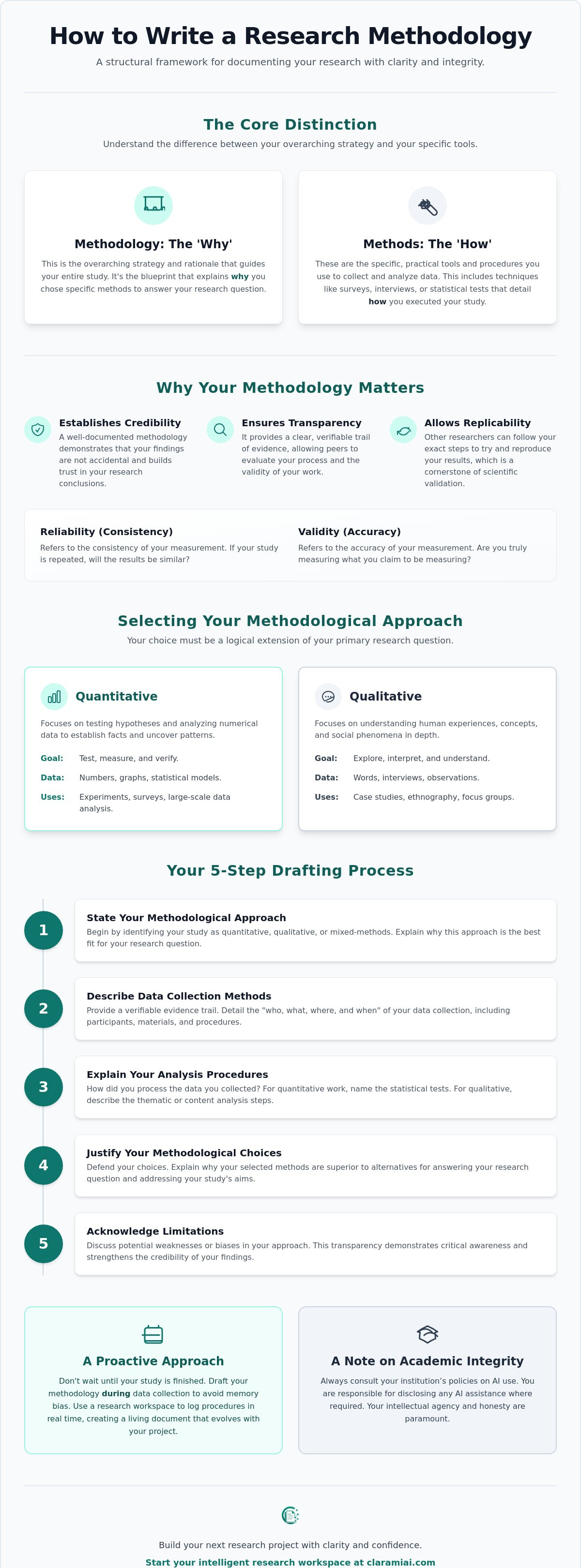
Your methodology chapter acts as the structural integrity of your entire project. It's more than a simple list of actions; it's a strategic justification of your research design. To understand how to write a research methodology, you must first distinguish between your methods and your methodology. Methods are the specific tools or techniques you use to collect and analyze data, such as surveys or statistical tests. In contrast, What is research methodology? It's the overarching strategy and rationale that guides your study. It explains why specific methods were chosen and how they satisfy your research aims.
This section establishes the credibility of your findings by showing that your results aren't accidental. By providing a transparent account of your process, you allow other researchers to evaluate your work through peer review or attempt to replicate your study. Transparency is the bedrock of academic trust. Without a clearly documented path, your conclusions lack the substantiation required for professional or scholarly acceptance.
Academic Integrity Disclaimer: Always check your institution's specific policies regarding AI use and disclose any assistance in your methodology.
To better understand this concept, watch this helpful video:
### Establishing reliability and validityA rigorous methodology must address two core pillars: reliability and validity. Reliability refers to the consistency of your measurement over time. If another researcher follows your exact steps, they should produce similar results. Validity represents the accuracy of your measurement in relation to the real world. It ensures you're actually measuring what you claim to measure. To satisfy these requirements, you should document a clear audit trail. This is a chronological record of every decision, adjustment, and data point encountered during your study. Maintaining this level of detail ensures your research stands up to intense scrutiny.
When to write your methodology
Don't wait until your study is finished to start writing. Drafting the methodology during the data collection phase is a practical way to prevent memory bias. Small details about participant recruitment or equipment calibration are easily forgotten weeks later. Using a dedicated research workspace allows you to log procedures in real time as they occur. This creates a living document that evolves with your project. Remember that your writing will undergo a tense transition; your initial research proposal is written in the future tense, but your final report must be updated to the past tense to reflect the work you've completed.
Selecting your methodological approach
Your choice of approach is not an arbitrary preference. It is a logical extension of your research question. When determining how to write a research methodology, you must ensure your framework aligns with your study's objectives. A mismatch here compromises the structural integrity of your entire project. If your goal is to test a specific hypothesis, a quantitative approach is required. If you aim to understand human experience or social phenomena, a qualitative framework is more appropriate. This alignment ensures your results are substantiated by a relevant and rigorous logic.
Consistency is the hallmark of professional scholarship. Your approach must reflect its philosophical underpinnings. Positivism, often associated with quantitative research, assumes that objective truths can be measured. Interpretivism, usually linked to qualitative study, suggests that reality is socially constructed. Understanding these foundations helps you justify your design choices to peer reviewers. Every decision, from your sampling method to your analysis technique, must flow from this central methodological core. This creates a cohesive narrative that supports your final claims.
Quantitative vs. qualitative frameworks
The distinction between these two frameworks dictates your entire data collection process. For a detailed breakdown of these requirements, refer to this guide on Writing the methodology section. Use the following comparison to identify which framework fits your current research aim.
<table> <thead><tr><th>Feature</th><th>Quantitative</th><th>Qualitative</th></tr> </thead> <tbody><tr><td>Primary Goal</td><td>Testing relationships and hypotheses</td><td>Exploring meanings and concepts</td></tr><tr><td>Data Type</td><td>Numerical and statistical</td><td>Textual, visual, or sensory</td></tr><tr><td>Analysis Technique</td><td>Regression, ANOVA, or correlation</td><td>Thematic, content, or discourse analysis</td></tr> </tbody></table>Quantitative research is a deductive process aimed at testing hypotheses. Qualitative research is an inductive process aimed at exploring concepts. Selecting the wrong framework can lead to data that fails to answer your research question, so choose based on the specific evidence you need to provide.
The rise of mixed methods
Sometimes a single approach is insufficient. Combining both quantitative and qualitative methods can provide a more comprehensive answer to complex questions. For example, you might use a survey to identify broad trends and follow up with interviews to explore the reasons behind those trends. This triangulation strengthens your findings by viewing the problem through multiple lenses. However, mixed methods introduce significant logistical challenges. Managing diverse data sets in one project requires meticulous organization to avoid confusion.
The Clara assistant helps you synthesize these diverse source materials into a cohesive narrative. By maintaining a centralized workspace, you can track how different data types relate to each other without losing your logical thread. This ensures your methodology remains transparent and verifiable even as it grows in complexity. If you are ready to begin organizing your approach, you can sign up for a structured workspace to manage your documentation effectively.
Describing data collection and analysis procedures
This section is the technical core of your study. It provides the granular detail necessary for other scholars to verify your work. When you're determining how to write a research methodology, you must move beyond abstract strategy and document the physical execution of your study. This involves a precise chronicle of the "who, what, where, and when" of your data collection. Every action you took must be anchored in established academic standards to ensure your findings carry weight during peer review.
Accuracy here prevents the suspicion of data manipulation or procedural bias. You should specify the exact instruments used, whether they were standardized surveys, semi-structured interview guides, or specific laboratory equipment. If you used digital tools to manage your sources, describe how those tools supported your workflow without replacing your analytical judgment. The goal is to provide enough detail that a reader could recreate your study exactly as you performed it.
Step-by-step data collection documentation
Your documentation must be exhaustive. If your research involves human subjects, detail your recruitment process and the specific sampling criteria you used to select participants. For experimental research, describe the controlled setting and the independent and dependent variables involved. Clarity is essential for substantiating your claims.
Organizing your evidence is often the most difficult part of this stage. Utilizing a dedicated PDF Manager within your workspace allows you to anchor your procedural notes directly to your primary sources. This ensures that no detail regarding participant consent, site access, or equipment calibration is lost during the transition from collection to drafting. This methodical approach creates a verifiable audit trail that protects the integrity of your research.
Data analysis techniques
Once your data is collected, you must explain the specific techniques used to process it. For quantitative studies, identify the statistical tests applied to your data set. You should name the specific tests, such as t-tests for comparing means or regression analysis for identifying relationships, and justify why these were appropriate for your data distribution.
Qualitative analysis requires a different type of transparency. You must outline your process for thematic or content analysis, explaining how you moved from raw transcripts to final codes and categories. Software plays a supporting role here by helping you organize vast amounts of text, but the final interpretation remains your responsibility. The "human-in-the-loop" approach is vital; while digital assistants can help highlight patterns, they assist human interpretation rather than replacing it. You are the one who must synthesize those patterns into a meaningful scholarly argument. This distinction ensures your analysis is both technologically assisted and intellectually rigorous.
Evaluating and justifying your methodological choices
Justifying your choices is the final step in establishing the structural integrity of your study. It isn't enough to describe your actions; you must defend why those specific methods were the most appropriate for your research aims. When learning how to write a research methodology, you must realize that a defensible chapter requires more than a simple description of actions. You need to provide a logical rationale that connects your approach to existing scholarly standards. This prevents your work from appearing arbitrary and ensures your results are substantiated by a clear, intellectual trail.
Avoid defensive language in this section. Instead, use objective evidence to support your logic. If you chose a specific sampling technique because it's the gold standard in your field, cite the relevant literature. If you rejected a common method, explain why it was insufficient for your particular research question. This transparency demonstrates your intellectual agency and your command over the subject matter. It shows that you are a methodical expert who has considered all viable alternatives.
Addressing research limitations
Honesty about your study's constraints actually increases its credibility. Every project faces limitations such as sample size, time, or resource availability. Rather than hiding these factors, explain how they influence the generalizability of your results. For instance, a small sample size might limit your ability to apply findings to a global population, but it often allows for deeper, more nuanced insights into a specific group. Understanding how to write a research methodology that justifies every constraint ensures your work remains credible under peer review.
Consider the difference in tone between a weak justification and a strong one. A weak statement might say: "I only had a few weeks for this study, so I could not do many interviews." A strong, scholarly justification would be: "Due to the three-month timeframe of the data collection phase, the study utilized a purposive sampling strategy. This ensured that, while the breadth of data was constrained, the relevance of the participants to the research aims remained high." This shift in language moves from a simple excuse to a strategic decision.
Ethical considerations and bias
Your methodology must detail the steps taken to protect your participants. This includes ensuring anonymity, securing informed consent, and adhering to institutional review board standards. In qualitative studies, you should also discuss researcher reflexivity. This involves acknowledging your own potential biases and explaining how you mitigated them to maintain objectivity. Transparency regarding your personal influence on the data collection process is a requirement for high-quality scholarship.
Verification is key to this process. You must ensure that all your ethical claims and procedural justifications are supported by your source material. Using a workspace that anchors your claims to primary sources prevents the accidental inclusion of inaccuracies. This systematic order allows you to audit your own logic before submission. To ensure your methodology meets these rigorous standards, start building your defensible research framework within a structured workspace today.
Drafting the methodology with intelligent workspace tools
The final phase of documenting your research involves transforming raw procedural logs into a polished chapter. Many scholars treat the methodology as a static text, but it is actually a living record of your research workspace. When you are determining how to write a research methodology, the transition from disorganized notes to formal prose is where technical inaccuracies often occur. Using an integrated document editor allows you to maintain structural cohesion between your research notes and your final draft. This ensures that every step you took in the field or lab is accurately reflected in your writing.
Adopting a human-in-the-loop workflow is essential for maintaining intellectual agency. Rather than generating whole chapters from a single prompt, you should use selection-level editing to refine specific technical descriptions. This granular approach ensures you remain the primary architect of your work. You are responsible for the final output, while the technology serves as a sophisticated intellectual companion that assists with the structural organization of your data. This methodical progression from collection to synthesis protects the ethical integrity of your study.
Moving from research notes to a structured draft
Converting your informal logs into formal academic prose requires precision. You can use AutoDraft to transform your chronological notes into a structured narrative that follows your institution's rubric. This tool assists by suggesting formal phrasing for your data collection steps, but you must maintain control by approving or editing every suggested sentence. This workflow prevents the memory bias discussed in previous sections by keeping your original notes immediately available within your workspace. For a deeper look at this process, see our guide on moving from research notes to first draft. By keeping your evidence anchored to your draft, you ensure your methodology remains a verifiable account of your labor.
Verifying claims and citations
A defensible methodology requires every procedure to be substantiated by project data or established literature. You should use a citation helper to surface real, verifiable sources for your methodological framework. This is especially important when justifying complex statistical tests or specific qualitative traditions. If you claim to have used a specific sampling technique, your project data must support that assertion. Accuracy is paramount.
Using a Draft Tone Checker can also help you maintain the authoritative and objective voice required for professional scholarship. It ensures your language remains precise and avoids the defensive tone that can undermine your credibility. This final refinement is a critical part of refining your scholarly voice for professional clarity. By verifying every claim and citation before submission, you provide a transparent and rigorous methodology that stands up to the highest levels of academic scrutiny. Note: Always disclose your use of AI tools in accordance with your school's academic integrity policies.
Establishing a defensible research framework
A methodology chapter is the technical foundation of your scholarly work. By mastering the distinction between overarching strategy and specific tools, you ensure your study maintains its structural integrity. You have learned to document a precise audit trail and justify your design choices through objective, scholarly evidence. As you finalize your understanding of how to write a research methodology, remember that transparency is your greatest asset in the peer-review process.
You can maintain this level of organizational cohesion by utilizing a purpose-built workspace. The Clara assistant provides source-grounded support, while integrated citation management for APA, and Chicago ensures your formatting remains precise. With claim-verification tools at your disposal, you can substantiate every procedural detail with confidence. You remain the primary architect of your research, supported by technology designed for the rigors of academic labor. Note: Always check your school policies regarding AI tools and disclose their use in your methodology section where required.
Streamline your research methodology in the Clarami workspace to produce a polished, verified chapter. Your methodical approach is the key to a successful study.
Frequently asked questions
What is the difference between a research method and a methodology?
Research methods are the specific techniques or tools you use to collect and analyze data, such as surveys, interviews, or statistical tests. Methodology is the broader strategic framework and rationale that justifies why those specific methods were chosen. It explains the philosophical approach and how your choices align with your research aims to ensure the structural integrity of your findings.
Should the methodology section be written in the past or present tense?
Use the past tense for your final research report because the methodology describes actions you've already completed. While a research proposal is written in the future tense to outline intended steps, the final submission must reflect the actual procedures performed. This chronological shift ensures your report is an accurate record of your completed scholarly labor.
How long should the methodology section be in a dissertation?
A methodology section typically accounts for 10% to 15% of your dissertation's total word count. For a 10,000-word dissertation, this section should be approximately 1,000 to 1,500 words. The exact length depends on the complexity of your data collection and the depth of justification required for your specific approach. Focus on clarity and substantiation rather than meeting a specific word quota.
Can I use AI to help write my research methodology?
You can use AI as an intellectual companion to help organize your procedural logs or refine technical prose. However, you must maintain a human-in-the-loop approach by approving every suggestion and ensuring all citations are grounded in real sources. Always consult your university's policies regarding how to write a research methodology with AI assistance and disclose its use to maintain academic integrity.
Where does the methodology section go in a research paper?
The methodology section is positioned immediately after the literature review and before the results chapter. This placement allows you to transition from existing scholarly theory to your specific practical application. It provides the necessary context for readers to understand how your data was generated before they evaluate your final findings and conclusions.
What should I do if my methodology changed during the research process?
Document any changes transparently in your final report to maintain a verifiable audit trail. Research often encounters unexpected hurdles, such as limited access to participants or equipment failure. Explaining how you adapted your design to mitigate these challenges demonstrates your intellectual agency and strengthens the credibility of your study rather than undermining it.
Related on Clarami
- Best AI writing tool for students (full guide) →
- AI academic integrity checklist →
- Clarami pricing: Free vs PRO vs Platinum →
- Editor vs ChatGPT for writing →
- Export DOCX, PDF, and hand-in checklist →
- How to outline a paper →
- Prompt to structured essay draft →
- Revise with AI on a selection →
- Sign up free →
- Clarami home →
- More guides on the Clarami blog →