How to verify claims in a research paper: A systematic guide to academic accuracy
Our guide on how to verify claims in a research paper offers a clear workflow to check sources, assess methodology, and maintain your academic integrity.
Write with structure in Clarami AI
Editor-first AI drafting, citations, and two Workflows for student writing.
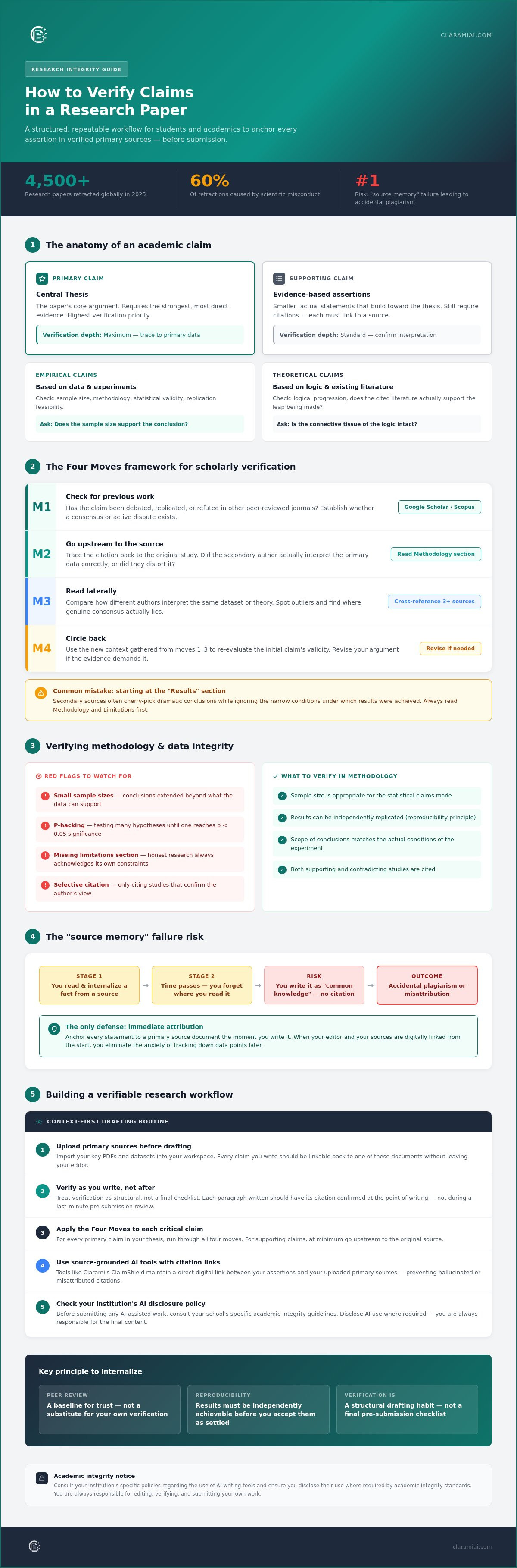
In 2025, more than 4,500 research papers were retracted globally, with scientific misconduct accounting for 60% of those cases as of April 2026. You've likely felt a sense of doubt when a secondary source seems inconsistent or when an AI tool presents a citation that feels slightly off. Tracking the original source of a specific data point shouldn't be an exercise in frustration. Knowing how to verify claims in a research paper is no longer a luxury for the meticulous; it's a structural requirement for maintaining your technical integrity.
You want to feel certain that every sentence in your dissertation is anchored in verified data. This guide provides a precise, source-grounded workflow to validate evidence and ensure your arguments remain substantiated. We'll walk through a repeatable system that integrates verification into your drafting process, allowing you to move from initial synthesis to a polished, verified output with calm assurance.
Disclaimer: Please consult your institution’s specific policies regarding the use of AI writing tools and ensure you disclose their use where required by academic integrity standards.
Key Takeaways
- Define the structural difference between primary and supporting claims to better allocate your verification time.
- Implement the "Four Moves" framework to assess whether a claim has been successfully replicated or debated in previous literature.
- Learn how to verify claims in a research paper by scrutinizing methodology for common integrity risks like small sample sizes or p-hacking.
- Use source-grounded tools like ClaimShield to maintain a direct, digital link between your assertions and your uploaded primary sources.
- Establish a "context-first" drafting routine that treats verification as a structural habit rather than a final checklist.
Table of Contents
- The anatomy of an academic claim
- The Four Moves framework for scholarly verification
- Verifying methodology and data integrity
- Leveraging source-grounded AI for real-time validation
- Building a verifiable research workflow
The anatomy of an academic claim
An academic claim is an assertion of fact that requires substantiation through data or logic. It's the building block of scholarly discourse. You'll encounter these assertions in every paragraph of a journal article, but not all carry the same weight. You must distinguish between the primary claim-the central thesis of the work-and supporting claims that serve as evidence-based assertions. Understanding this hierarchy is the first step in learning how to verify claims in a research paper effectively.
Academic Integrity Disclaimer: Always verify your specific institutional policies regarding AI use and disclosure.
While peer review serves as a baseline for trust, it's never a substitute for your own individual verification. Reviewers are human; they can miss errors in data interpretation or logic. You should apply the principle of reproducibility to any critical data point you cite. This standard ensures that results can be independently achieved again before you accept them as settled truth. Verification isn't a final check. It's a structural drafting habit.
To better understand this concept, watch this helpful video:
### Empirical vs. theoretical claimsEmpirical claims rely on specific datasets, experiments, or observations. When you analyze these, you're looking for the structural integrity of the data. Does the sample size support the conclusion? Theoretical claims are different. They rely on logical progression and existing literature to build a new argument. Verification for these claims involves checking the "connective tissue" of the logic. You're ensuring that the author hasn't made a leap that the cited literature doesn't support. Different claim types require different verification strategies to maintain technical accuracy.
The risk of "source memory" failure
Researchers often internalize an idea and eventually forget its original source. This cognitive lapse is a primary cause of accidental plagiarism. When you remember a "fact" but can't place the paper it came from, you're at risk of misattributing the claim or presenting it as common knowledge when it requires a citation. Immediate attribution is your only defense. By anchoring every statement to a primary source document the moment you write it, you eliminate the anxiety of tracking down data points later. Learning how to verify claims in a research paper means building a workflow where your editor and your sources are digitally linked from the start.
The Four Moves framework for scholarly verification
Verifying complex academic assertions requires more than a cursory glance at a reference list. You need a structured protocol to separate robust evidence from speculative noise. By adapting the "Four Moves" framework specifically for scholarly work, you can master how to verify claims in a research paper without succumbing to source fatigue. This system isn't just about finding errors; it's about building a map of the intellectual landscape surrounding an idea.
- Move 1: Check for previous work. Determine if the claim has been debated, replicated, or refuted in other peer-reviewed journals.
- Move 2: Go upstream to the source. Trace a citation back to the original study to see if the secondary author interpreted the data correctly.
- Move 3: Read laterally. Compare how different authors interpret the same dataset or theory to find the consensus.
- Move 4: Circle back. Use the new context you've gathered to re-evaluate the initial claim's validity.
Going upstream to primary data
When you find a compelling claim, your first instinct might be to look at the "Results" section. This is often a mistake. You must go deeper into the "Methodology" and "Limitations" to understand the boundaries of the findings. Secondary sources often cherry-pick dramatic conclusions while ignoring the narrow conditions under which those results were achieved. Using established methods for evaluating sources allows you to spot these discrepancies early. Always verify the DOI to ensure you're reviewing the final version-of-record paper rather than an uncorrected proof or a retracted draft. This step is vital for anyone learning how to verify claims in a research paper with professional precision.
Lateral reading in academic databases
Lateral reading involves stepping away from the paper itself to see what the wider community thinks. Use databases like Google Scholar, Scopus, or Web of Science to see who has cited the work. If a paper has high citation counts but mostly negative commentary regarding its methodology, the claim is likely contested. You should pay close attention to your own emotional reactions. If a claim makes you feel immediate validation or intense frustration, it's a signal to check your bias and perform a deeper lateral search. This habit ensures your writing remains grounded in consensus rather than outliers. To keep your verification steps organized, you can start building a verified workspace that links your notes directly to your primary PDFs.
Verifying methodology and data integrity
The methodology section is the engine of a research paper. If the engine is flawed, the conclusion is unreachable. When you're learning how to verify claims in a research paper, you must prioritize the "how" over the "what." A compelling result means nothing if the study design is structurally unsound. You should view the "Limitations" section as a boundary of truth. Authors use this space to admit where their data is weak or where their findings don't apply. If an author claims a universal truth while their limitations section notes a narrow sample, the claim is likely overextended.
Look for red flags like p-hacking. This is the practice of mining data until a statistically significant result appears by chance. It's a form of scientific misconduct that contributed to the high retraction rates seen in early 2026. Small sample sizes are equally problematic. A study with ten participants can't provide the same level of certainty as a longitudinal study with thousands. Verification requires you to ask if the data presented actually supports the author's specific conclusion or if they've made a logical leap to a more dramatic headline.
Evaluating study design
Causation isn't correlation. In social sciences, it's easy to mistake a shared trend for a direct cause. You should also audit the funding sources. Research funded by an organization with a direct financial stake in the outcome requires a higher level of scrutiny. Institutional affiliations can also introduce subtle biases. Age is another factor. In fields like AI or biotechnology, a study from three years ago might already be outdated compared to current 2026 standards. Always check if the methodology matches the current best practices of the field.
Cross-referencing data points
Inconsistencies are often hidden in plain sight. Check the abstract against the internal tables. If the summary claims a significant improvement but the raw data shows marginal gains, the author is likely spinning the results. Get into the habit of spot-checking one or two random citations to see if the author is representing the original work accurately. If you find a single misrepresentation, you should treat the entire paper with skepticism. This is a core part of how to verify claims in a research paper. Claims without specific page numbers are inherently harder to verify. They force you to hunt for evidence that might not exist, which is a common tactic used to mask weak substantiation.
Leveraging source-grounded AI for real-time validation
General-purpose chatbots prioritize conversational flow over factual precision. This is a dangerous trade-off when you're trying to figure out how to verify claims in a research paper. These broad models often hallucinate citations, creating plausible-sounding references that don't exist in reality. To maintain technical integrity, you need a source-grounded AI research assistant that operates exclusively within your personal library of uploaded PDFs. This approach ensures that every suggestion is anchored to a document you've already vetted. It eliminates the risk of outside misinformation leaking into your technical work.
Using suggest-mode allows you to draft claims while the evidence remains visible in your sidebar. You aren't handing off the writing process to an automated tool. Instead, you're using a human-in-the-loop model where the AI provides a draft based on your sources, and you approve, edit, or reject every verification step. This workflow transforms verification from a separate, exhausting task into a structural part of your writing. You remain the primary investigator. The AI serves as a methodical expert that surfaces the relevant data points exactly when you need them.
Avoiding the hallucination trap
A broad AI tries to "know everything" by predicting the next word in a sequence based on a massive, unverified dataset. A source-grounded tool "reads your sources" to find specific, verified data points. This distinction is critical for academic accuracy. You can ask the assistant to summarize a complex methodology section, allowing you to verify the study design's logic more quickly. If the AI can't find a direct quote to support a summary, it won't invent one. It tells you the information is missing. This transparent failure is the only acceptable response in scholarly work. It forces you to return to the primary text when the data is inconclusive.
Real-time claim verification with ClaimShield
ClaimShield technology automates the tedious parts of lateral reading by checking your draft in real-time against the specific text of your source library. When you write a sentence, you can instantly see the exact paragraph in a PDF that supports your assertion. This reduces the cognitive load of toggling between multiple browser tabs or searching through hundreds of pages for a single data point. It keeps your focus on the argument rather than the mechanics of file management. By integrating these checks directly into your editor, you can start verifying your claims today with professional-grade accuracy and speed.
Building a verifiable research workflow
Verification is a structural habit. It's not a task for the end of the project. Traditional advice often suggests keeping your notes and your draft in separate files; however, this separation increases the risk of losing the link between a claim and its source. You need an environment where your evidence and your assertions coexist. By using an integrated workspace, you ensure that every sentence remains anchored to its primary data. This is the most effective way to master how to verify claims in a research paper without losing track of your citations. It's about creating a workspace that treats data management and output as a single, connected process.
A "context-first" drafting routine starts with your sources. Instead of writing from memory, you begin by highlighting key data points within your PDF manager. These highlights serve as the foundation for your claims. As you pull these highlights into your editor, the connection to the original page and paragraph is preserved. This method creates a digital chain of evidence that follows your argument from the first draft to the final submission. It's a methodical approach that values transparency over creative speed. You'll spend less time searching for where you found an idea and more time evaluating its logical substantiation.
The integrated editor advantage
Copy-pasting from a chat box or an external document creates a structural risk. It's easy to lose the specific context or page number of a source during the transfer. An integrated workspace keeps these elements connected. You can perform selection-level editing, which allows you to refine a specific paragraph or claim without breaking its underlying link to the source material. This ensures that as your paper evolves, your evidence remains intact and verifiable. You can rewrite a sentence to improve its flow while the editor maintains the metadata of the supporting study. It's a sophisticated solution for the rigors of scholarly labor.
Maintaining your scholarly voice
Verified research is characterized by precise language. Words like "suggests," "indicates," or "demonstrates" aren't just stylistic choices; they reflect the strength of the underlying evidence. You can use a tone checker to ensure your writing maintains a professional, objective distance. This tool helps you avoid hyperbolic language that might overextend a verified claim. It's a reliable intellectual companion that catches informal phrasing before it reaches your committee. Accuracy is a byproduct of a disciplined environment. When your workflow is organized, technical integrity becomes inevitable. You can explore the full range of Clarami features to begin building your own systematic research process.
Establishing a new standard for academic accuracy
Technical integrity is the foundation of scholarly trust. By treating verification as a structural drafting habit rather than a final checklist, you protect your work from the risks of accidental plagiarism and cognitive bias. Mastering how to verify claims in a research paper involves a disciplined commitment to lateral reading and methodical methodology scrutiny. You've learned to look past the abstract to the raw data, ensuring every assertion is anchored in primary evidence. This systematic approach transforms verification from an exhausting chore into a core part of your intellectual process.
Clarami provides the specialized tools to maintain this accuracy without the anxiety of disorganized source material. Our integrated workspace links your PDFs directly to your editor, while ClaimShield technology offers real-time evidence verification to keep your arguments substantiated. You can also rely on automated citation management in leading academic styles, including Chicago and MLA, to maintain formal standards. It's time to move from initial synthesis to a polished, verified output with total confidence. Start your source-grounded research journey with Clarami today. Your dedication to accuracy is what sets your work apart; we are here to ensure that dedication is reflected in every sentence you write.
Frequently asked questions
What is the most common reason for claims being unverified in research?
Source memory failure is the primary reason researchers fail to substantiate their assertions. You often internalize an idea and eventually forget the primary document where it originated. Without an integrated workspace that links your editor to your sources, you're forced to hunt for evidence after the drafting process is complete. This organizational gap increases the likelihood of accidental plagiarism or the inclusion of unverified data.
How can I verify a claim if the original source is behind a paywall?
You should first check your institutional library or university portal for subscription access to the specific journal. If that's unavailable, look for a version on preprint servers like arXiv or bioRxiv. You can also use the DOI to find an Open Access copy through services like Unpaywall. Contacting the lead researcher directly often results in a copy of the paper for your personal scholarly use.
Is a peer-reviewed paper always considered a verified source?
No, peer review is a baseline for trust but not a guarantee of technical accuracy. In 2025, over 4,500 research papers were retracted globally due to errors or misconduct. You must apply the principle of reproducibility to any critical claim you cite. Learning how to verify claims in a research paper means scrutinizing the methodology and data integrity yourself rather than relying solely on the journal's stamp of approval.
What should I do if two different sources make conflicting claims?
You must evaluate the methodology and bias of both sources to determine which assertion is more robust. Check the sample sizes, funding sources, and the date of publication. If one source is significantly newer or uses a more rigorous study design, it may carry more weight. You should also look for a meta-analysis or systematic review that addresses the conflict to see where the current scientific consensus lies.
How does lateral reading differ from traditional research?
Traditional research often involves a vertical deep-dive into a single document to understand its internal logic. Lateral reading is a horizontal process where you step away from the paper to see what other scholars say about it. You use databases like Scopus or Google Scholar to track citations and critiques. This method allows you to identify if a claim is widely accepted or remains a point of contention within the field.
Can I use AI to help me verify claims without violating academic integrity?
You can use source-grounded AI tools as long as you maintain a human-in-the-loop approach and follow your institution's disclosure policies. These tools help you locate specific evidence within your vetted library of PDFs rather than generating unverified content from a broad dataset. Always verify the AI's output against the primary text. Accuracy remains your responsibility, regardless of the technological assistance you utilize during the research process.
Related on Clarami
- Best AI writing tool for students (full guide) →
- AI academic integrity checklist →
- Clarami pricing: Free vs PRO vs Platinum →
- Editor vs ChatGPT for writing →
- Export DOCX, PDF, and hand-in checklist →
- How to outline a paper →
- Prompt to structured essay draft →
- Revise with AI on a selection →
- Sign up free →
- Clarami home →
- More guides on the Clarami blog →