

How to use a literature review matrix to identify research gaps in literature
Learn how to identify research gaps in literature with a systematic matrix. This method helps you organize sources, synthesize data, and find your contribution.
Write with structure in Clarami AI
Editor-first AI drafting, citations, and two Workflows for student writing.
You have dozens of PDFs open, multiple tabs active, and a growing sense of dread that you're merely summarizing rather than synthesizing. It's exhausting to stare at a sea of digital documents, hoping a breakthrough will reveal itself through sheer persistence. You aren't alone in feeling that traditional reading methods often fail to highlight the contradictions or evidence gaps required for a defensible dissertation or grant proposal.
Mastering how to identify research gaps in literature is less about reading faster and more about organizing with precision. This article provides a clear path forward. You'll learn how to construct a literature review matrix, a structural diagnostic tool that forces isolated data points into a comparative grid. This process exposes hidden research gaps and creates a streamlined workflow from reading to drafting. We'll examine how to use an integrated workspace and tools like the Clara AI assistant to automate data extraction, ensuring every claim in your final manuscript is anchored in verified primary sources and maintains total structural integrity.
Key Takeaways
- Understand how a synthesis matrix transforms a collection of PDFs into a structured framework; it's the most reliable way to highlight thematic patterns.
- Learn to configure your matrix with specific methodological columns to expose under-researched populations or outdated data collection instruments.
- Master a systematic procedure for how to identify research gaps in literature by defining matrix headings that target the limitations of current studies.
- Evaluate the transition from static spreadsheets to integrated workspaces that maintain a direct connection between your notes and original sources.
- Streamline your manuscript production by converting structured matrix data into verified prose with tools like AutoDraft and ClaimShield.
Table of Contents
- The role of a literature review matrix in identifying research gaps
- Designing the matrix structure to expose missing literature
- Comparing manual spreadsheets with integrated research workspaces
- A systematic procedure for identifying gaps with high integrity
- Moving from matrix analysis to a verified research draft
The role of a literature review matrix in identifying research gaps
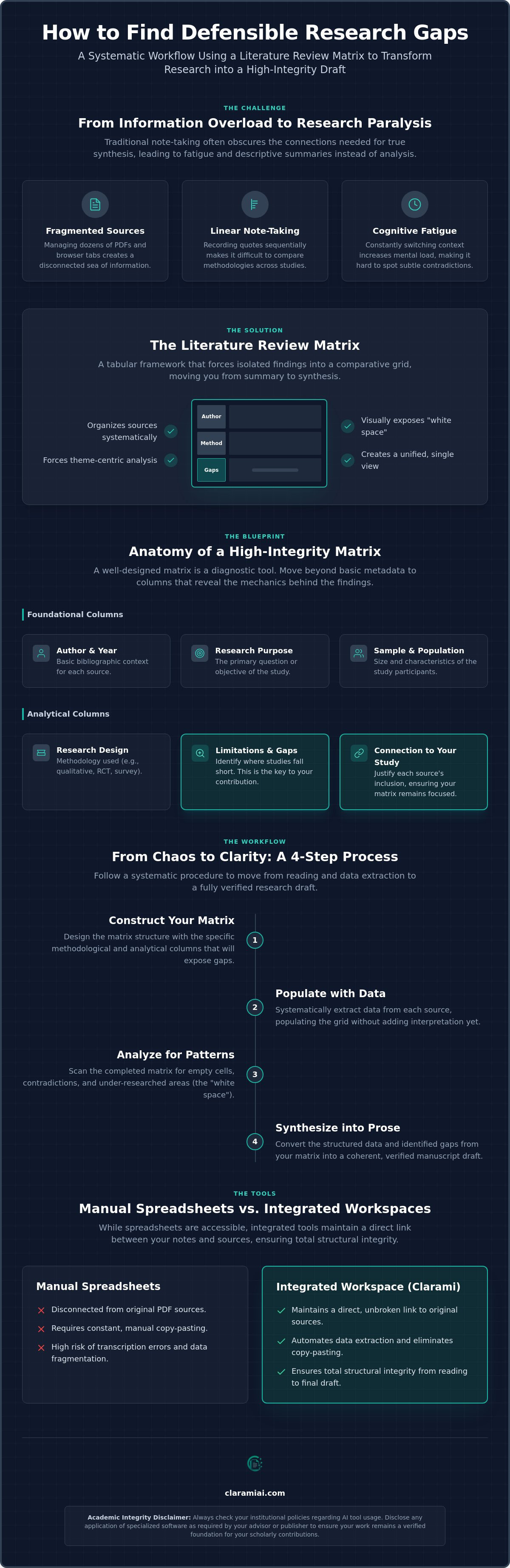
Disorganized source material creates a barrier to intellectual progress. When you're managing dozens of active PDFs, the sheer volume of data often leads to a state of descriptive paralysis. You're summarizing instead of analyzing. A literature review matrix serves as the antidote to this chaos. It's a tabular framework designed to organize, compare, and contrast scholarly sources systematically. By forcing isolated findings into a comparative grid, you move beyond basic summaries toward a high-level synthesis of the field.
Maintaining academic integrity is paramount in this process. Always check your institutional policies regarding AI tool usage. Disclose any application of specialized software as required by your advisor or publisher. This transparency ensures your synthesis remains a verified foundation for your scholarly contributions.
A successful literature review doesn't just list what happened in previous studies. It explains how those findings relate to one another. This is the critical distinction between summary and synthesis. By mapping data points into columns, you can visualize the white space where research is missing or where conflicting data points emerge. This visual representation is precisely how to identify research gaps in literature that are defensible for a dissertation or grant proposal. It establishes the matrix as the primary evidence base for your theoretical or methodological framework.
To better understand this concept, watch this helpful video:
### Why traditional note-taking obscures research gapsLinear notes are inherently restrictive. They prevent the simultaneous comparison of methodologies across multiple sources. When you record quotes in a document, they become disconnected from their original context. This fragmentation increases your cognitive load. Managing dozens of open PDF windows creates mental fatigue, making it nearly impossible to spot subtle contradictions between researchers. Mastering how to identify research gaps in literature requires a move away from these fragmented, isolated notes toward a cohesive landscape.
Transitioning from descriptive to analytical synthesis
The matrix structure forces a shift from author-centric reading to theme-centric analysis. You stop reporting what Author A said and start identifying how multiple authors address a specific variable. Instead of writing "Author A found X," you begin to see that while Author A and B agree on X, neither addresses variable Y. This is the psychological clarity required for advanced scholarship. Utilizing an integrated research workspace allows you to maintain this analytical view without the friction of constant copy-pasting. You see the entire research landscape in a single, unified view, making the identification of the next logical step in your field inevitable.
Designing the matrix structure to expose missing literature
A matrix is not merely a data repository; it's a diagnostic instrument. To understand how to identify research gaps in literature, you must move beyond bibliographic metadata. Start with foundational columns: author, year, and research purpose. These provide the necessary context for every subsequent entry. However, the real analytical power lies in the columns that follow. You need methodological columns that record sample sizes, research designs, and specific data collection instruments. This structural integrity allows you to see the mechanics behind the findings.
Incorporating a dedicated "Limitations and Gaps" column is non-negotiable. This is where you track where previous studies fell short, whether due to small sample sizes or narrow geographic focus. Finally, a "Connection to My Study" column justifies the inclusion of each source, ensuring your matrix remains a lean, functional tool rather than an archive of irrelevant summaries. Using a Literature Review Matrix (LRM) based on this structured approach helps you gain new perspectives by visualizing the relationship between what exists and what's missing.
Methodological and demographic columns
Technical gaps are often hidden in the methodology. By recording specific instruments, you can identify if a field relies too heavily on a single type of measurement. If every study uses the same survey, there's a methodological gap waiting for a qualitative or experimental approach. Similarly, tracking population demographics reveals underrepresented groups. If the existing literature focuses exclusively on urban populations, your research can fill the void by targeting rural settings. Distinguishing between primary empirical research and secondary literature reviews is also vital. This prevents you from over-relying on second-hand interpretations and ensures you're anchoring your work in primary data.
Results and synthesis columns
Synthesis requires you to translate findings into your own analytical language. Avoid direct quotes in your results columns. Instead, use tags or keywords to enable easy filtering. This allows you to group sources by theme instantly. A "Theoretical Lens" column is particularly effective for spotting biases. If every study in your matrix approaches a problem through a neoliberal lens, a gap exists for a critical or feminist perspective. This level of granularity makes the transition from reading to drafting seamless.
Managing this level of detail across fifty sources is taxing. You can start building your workspace today to automate the extraction of these key variables, ensuring your matrix remains accurate and source-grounded throughout the drafting process.
Comparing manual spreadsheets with integrated research workspaces
Microsoft Excel and Google Sheets are often the first tools researchers reach for when building a synthesis matrix. They are accessible. They offer basic sorting capabilities. For a small set of ten sources, a simple spreadsheet might suffice for initial organization. However, as your library grows, these static tools quickly become data silos. They are disconnected from the primary evidence they are meant to summarize. This separation is a significant hurdle when you're trying to master how to identify research gaps in literature, as the nuance of the original text is often lost in the transition to a cell.
The solution lies in moving toward an integrated research workspace. Unlike a standalone spreadsheet, a purpose-built workspace functions as a unified ecosystem. It bridges the gap between your raw data and your analytical framework. By maintaining a direct, live link between the matrix and the original PDF, you ensure that every entry remains grounded in its source. This structural cohesion is essential for verifying claims and building a defensible research problem.
The limitations of the spreadsheet approach
Static spreadsheets suffer from the 'dead link' problem. You might record a critical finding in a cell, but weeks later, you can't recall the specific page or paragraph that supported it. The context is gone. Manual citation management also introduces unnecessary risk. Formatting errors and lost references are common when you're juggling multiple platforms. The constant friction of switching between a PDF reader and a spreadsheet drains your cognitive energy. It distracts you from the high-level synthesis required to understand how to identify research gaps in literature effectively.
The benefits of an integrated ecosystem
An integrated workspace transforms the extraction process from a chore into a precise operation. Within this environment, Clara can extract methodology, sample sizes, and key findings directly into your matrix structure. This isn't just about speed; it's about accuracy. Every data point maintains total traceability. You can click a cell and immediately view the original source highlight within the PDF. This transparency eliminates the risk of accidental plagiarism and removes the need for clunky copy-paste workflows. It allows you to focus on spotting patterns and contradictions, which are the true markers of a research gap.
A systematic procedure for identifying gaps with high integrity
Identifying a defensible niche requires more than a casual reading of the literature. It demands a repeatable, mechanical workflow that surfaces contradictions and omissions. This systematic approach ensures your review is exhaustive and your findings are reproducible. Follow these five steps to master how to identify research gaps in literature with clinical precision.
- Step 1: Collection. Conduct a systematic search across primary databases. Organize your results within a dedicated PDF Manager to maintain structural order from the start.
- Step 2: Configuration. Define your matrix headings based on your preliminary research questions. These columns should target the specific variables, methodologies, or theoretical frameworks you intend to challenge.
- Step 3: Extraction. Populate your matrix using a human-in-the-loop AI approach. This ensures efficiency without sacrificing the intellectual agency required for high-level synthesis.
- Step 4: Verification. You must verify every citation against the original source text. Accuracy is the foundation of scholarly authority.
- Step 5: Vertical Analysis. Review the completed matrix vertically. By scanning down columns rather than across rows, you can spot empty cells or recurring limitations that reveal exactly how to identify research gaps in literature that others have overlooked.
Efficient and ethical data extraction
Populating a matrix shouldn't be a mindless copy-paste exercise. Use selection-level AI to summarize dense technical sections without losing the underlying nuance. Focus your extraction efforts on the 'Methods' and 'Discussion' sections. These areas contain the specific data points needed to populate your technical columns. Always summarize findings in your own analytical voice. This practice facilitates a smoother transition to the drafting phase and ensures you've fully synthesized the material.
Quality control and the 3-2-1 rule
High-integrity research relies on rigorous quality control. Apply a 'Verify Before Entry' rule to every row in your matrix. Tools like ClaimShield are invaluable here, providing a real-time check to ensure your notes accurately reflect the source data. Document your search filters and the specific databases you accessed. This transparency makes your review reproducible, which is a hallmark of professional scholarship. You can start your verified workspace today to implement this systematic workflow and move from disorganized PDFs to a polished manuscript.
Moving from matrix analysis to a verified research draft
The matrix is complete. The gaps are visible. Now begins the critical transition from a structured data grid to a persuasive scholarly manuscript. This phase is where many researchers falter, yet it's the most rewarding. You're no longer just collecting data; you're constructing an argument. By grouping sources that share specific column traits or themes, you create the logical clusters that will form your paragraphs. This method ensures your writing remains focused on the synthesis of ideas rather than a chronological list of authors.
Your identified 'Limitations' column serves as the architectural core of your research problem statement. It provides the evidence-based justification for your work. Instead of vaguely claiming a topic is under-researched, you can point to specific methodological or population gaps recorded in your matrix. This level of detail is exactly how to identify research gaps in literature that withstand the scrutiny of a dissertation committee or a peer-review panel. Every row in your matrix eventually becomes a foundational claim, anchored by integrated citations that maintain total traceability to the original source.
Transitioning from structured notes to verified prose requires a disciplined workflow. Leveraging systematic literature review software allows you to maintain the connection between your analytical framework and your draft. This reduces the cognitive friction of manual citation and ensures that your intellectual agency remains the driving force behind the composition. The result is a manuscript that's both rigorous and ready for defense.
Transforming columns into thematic headings
Matrix column themes naturally evolve into the sub-headings of your literature review. This structural alignment demonstrates advanced critical thinking. You aren't merely reporting; you're categorizing the field. For instance, a 'Methodology' column can be converted into a specific section addressing the limitations of current qualitative approaches. Writing thematically allows you to contrast Author A and Author B within the same paragraph, highlighting the nuances in their findings. It's a professional approach that moves beyond the "Author A said X" pattern common in early-stage research.
Finalizing the draft with collaborative feedback
A high-integrity draft requires a final layer of human verification. Review your AI-assisted drafts sentence-by-sentence to ensure your unique scholarly voice remains dominant. Use suggest-mode to share your findings with your dissertation committee or colleagues. This collaborative environment allows for precise feedback without compromising the document's structural integrity. Conduct a final check to ensure every claim is anchored to a verified source. This commitment to accuracy ensures your work isn't just a contribution to the field, but a verified foundation for future inquiry.
Mastering the structural path to original research
A literature review matrix is more than a simple table; it's a diagnostic instrument that transforms disorganized source material into a clear research trajectory. By forcing isolated data points into a comparative grid, you move from passive reading to active synthesis. Mastering how to identify research gaps in literature requires this shift from manual summary toward a systematic, theme-based analysis. You've learned how to design a structure that exposes methodological omissions and how to transition those insights into a verified manuscript draft.
Success in professional scholarship depends on the structural integrity of your claims. Clarami provides the tools to maintain this rigorous standard. Our source-grounded AI assistant, Clara, eliminates the risk of hallucinations by anchoring every extraction in your primary PDFs. With an integrated PDF manager and citation builder, your workflow remains cohesive and focused on academic integrity. Start identifying research gaps with Clarami’s integrated workspace today. Your contribution to the field is within reach once you have the right framework to uncover it.
Frequently Asked Questions
What is the difference between a summary table and a synthesis matrix?
A summary table describes individual studies in isolation, while a synthesis matrix compares themes and variables across multiple sources simultaneously. Summary tables focus on reporting the findings of a single paper. Synthesis matrices focus on the relationship between findings across the entire field. This structural difference allows you to move from descriptive reporting to analytical synthesis.
How do I identify a research gap using a matrix?
You identify a research gap by scanning the vertical columns of your matrix to find empty cells, conflicting results, or recurring limitations. When you see that multiple authors have ignored a specific demographic or variable, you've found a knowledge gap. This systematic approach is the most reliable way to understand how to identify research gaps in literature without relying on guesswork.
Can AI tools help find gaps in the literature?
AI tools accelerate the process by extracting specific data points like sample sizes or methodologies from dozens of PDFs into your matrix. However, the final identification of a gap requires human analysis to ensure findings are contextually relevant. Using a source-grounded assistant like Clara ensures that these extractions are verified and free from the hallucinations common in general-purpose tools.
How many sources are needed for a comprehensive synthesis matrix?
Most scholarly reviews require between 30 and 50 high-quality sources to reach thematic saturation, though the exact number varies by discipline. The goal is to reach a point where adding new literature no longer reveals new themes or variables. For a dissertation chapter, you must ensure you've covered the primary empirical studies that define your specific research landscape.
Should I use Excel or specialized software for my literature review?
Specialized software is superior for complex reviews because it maintains a direct link between your matrix data and the original PDF sources. While Excel is accessible for initial lists, it creates a data silo disconnected from the drafting process. Integrated workspaces like Clarami ensure total traceability, allowing you to verify every claim against primary evidence with a single click.
How do I know if a research gap is worth investigating?
A research gap is worth investigating if it addresses a significant problem that current literature cannot solve. You must evaluate whether filling the gap provides theoretical value or practical utility for your field. This evaluation is part of learning how to identify research gaps in literature that are not just empty spaces, but meaningful opportunities for scholarly advancement.
Related on Clarami
- Best AI writing tool for students (full guide) →
- AI academic integrity checklist →
- Clarami pricing: Free vs PRO vs Platinum →
- Editor vs ChatGPT for writing →
- Export DOCX, PDF, and hand-in checklist →
- How to outline a paper →
- Prompt to structured essay draft →
- Revise with AI on a selection →
- Sign up free →
- Clarami home →
- More guides on the Clarami blog →