
Choosing a Jenni AI alternative for professional research and academic writing
Find the best Jenni AI alternative for academic writing. Learn to choose a tool that verifies sources and integrates your PDFs for reliable research drafts.
Write with structure in Clarami AI
Editor-first AI drafting, citations, and two Workflows for student writing.
Meta Title: Choosing a Jenni AI Alternative for Professional Research
Meta Description: Find a Jenni AI alternative that prioritizes source verification and structural integrity. Build a verified draft grounded in primary sources today.
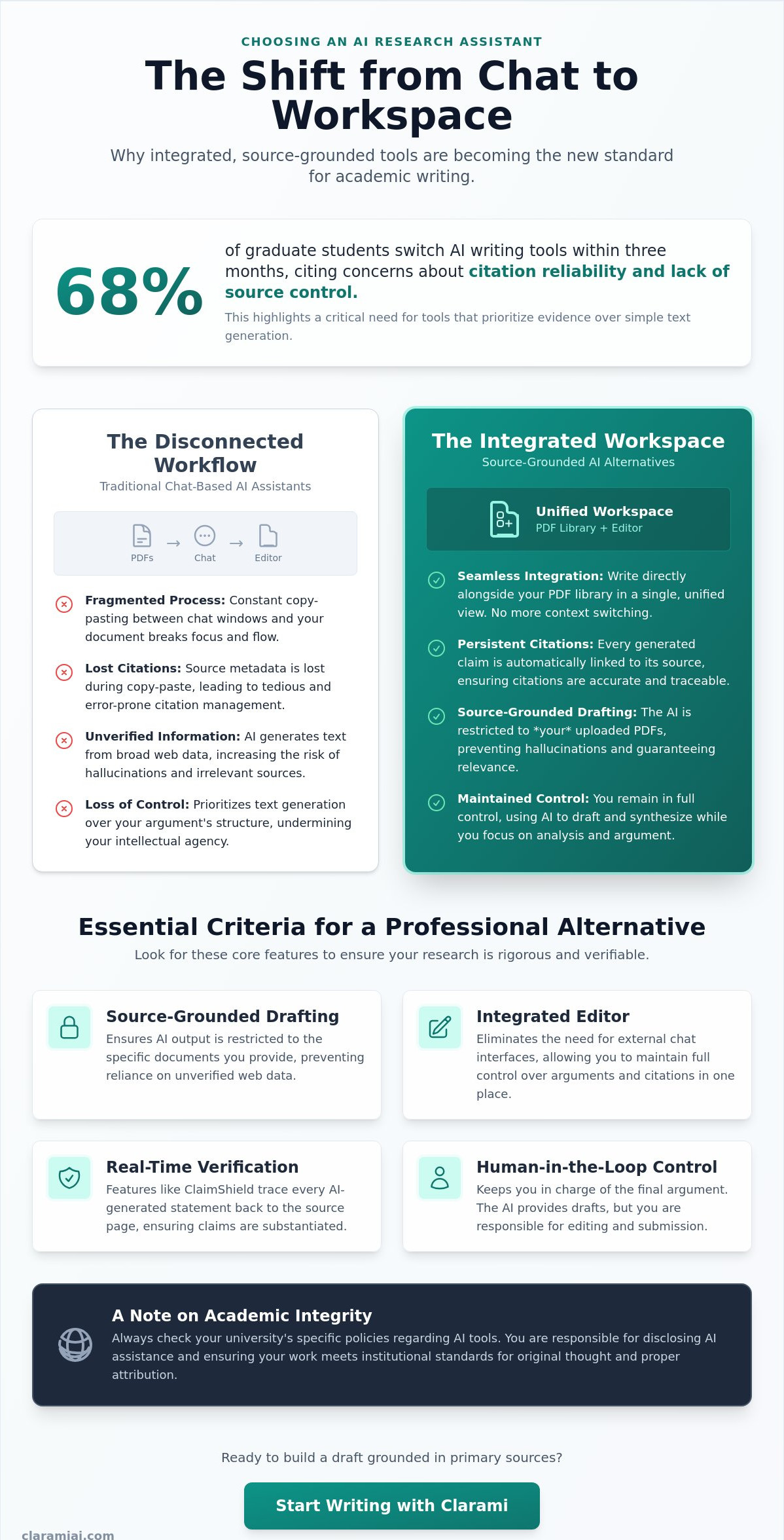
A 2025 survey by the Student Academic Technology Report found that 68% of graduate students who tried AI writing assistants switched tools within three months due to concerns about citation reliability. You've likely felt this same frustration. It's difficult to maintain control over a complex argument when a chat-based interface prioritizes text generation over the actual evidence in your PDF library. You need a workspace that anchors your writing in primary sources rather than one that forces you to copy and paste from an external window. Finding a jenni ai alternative requires looking beyond simple word suggestions to find a system that supports the structural integrity of your research.
This article explains how to select a platform that prioritizes source verification and automated citation management. You'll learn how an integrated editor helps you manage drafts without losing your intellectual agency to a generative algorithm. Before using any AI tool, check your university's specific policies and disclose its use as required. For example, UC Berkeley Law School adopted a policy in 2026 that prohibits AI for drafting, revising, or editing work. Always ensure your workflow aligns with your school's standards for academic integrity.
Key Takeaways
- Identify the core criteria for a jenni ai alternative, focusing on structural integrity and the seamless integration of your PDF library within your writing workspace.
- Learn to distinguish between tools that simply generate text and those that provide verified, source-grounded drafting through features like ClaimShield.
- Discover how an in-app editor eliminates the need for external chat interfaces, allowing you to maintain full control over your arguments and citations.
- Establish a workflow for ethical AI use that aligns with university policies on transparency and the substantiation of claims.
Table of Contents
- Evaluating the shift in academic writing assistants
- Essential criteria for a professional Jenni AI alternative
- Comparing workspace architectures for research
- Maintaining academic integrity with AI tools
- Selecting the right tool for your specific research goals
Evaluating the shift in academic writing assistants
The transition from general-purpose text generators to specialized research environments is a direct response to the specific needs of scholars. Professional writing is the substantiation of claims through primary sources. It's more than stringing sentences together. Many researchers now seek a jenni ai alternative because they require a workspace that links their draft directly to their research data. This integrated approach ensures that every paragraph remains anchored in the evidence you've collected. You maintain control over the narrative while the technology manages the organizational overhead.
Compare how different platforms handle research workflows in this video overview:
Maintaining your intellectual agency is the priority. When you use a tool that merely suggests text based on broad patterns, you risk losing the nuance of your original argument. A structured workspace keeps the human-in-the-loop, placing the responsibility for final editing and submission on you. This process requires a clear view of your PDF library alongside your draft to prevent the hallucinations common in disconnected systems. Modern assistants focus on extraction and synthesis rather than independent creation.The limitations of the chat-based interface
Moving text between a chat window and a document editor creates unnecessary friction. You lose the structural connection between your notes and your final output. Fragmented workflows often result in citation errors because the metadata doesn't follow the text during a copy-paste operation. An editor-first approach treats the document as the primary site of work, not a secondary destination for AI-generated snippets. This prevents the loss of context that occurs when you juggle multiple browser tabs and external chat boxes.
Why source-grounding is the new standard
Source-grounding restricts AI output to the specific documents you provide. This prevents the tool from drawing on unverified web data that may be irrelevant or inaccurate. By using a specialized assistant like Clara, you ensure the drafting process stays within the boundaries of your private PDF collection. This level of precision is essential for maintaining academic integrity and avoiding the generic patterns of general AI. You can verify every claim by tracing it back to the original methodology or data point in your source files.
Academic Integrity Disclaimer: Always check your university's specific policies regarding AI tools. You're responsible for disclosing AI assistance and ensuring your work meets institutional standards for original thought and proper attribution.
Essential criteria for a professional Jenni AI alternative
Speed is a metric for social media, not scholarship. A professional jenni ai alternative must prioritize the substantiation of every sentence over the volume of words produced. This represents a broader shift in academic writing assistants toward tools that act as rigorous research companions. You need to know exactly which page of which PDF supports your argument. High-quality research requires a system that tracks evidence in real time, ensuring that your draft is a reflection of verified data rather than statistical probability.
Verification over generation
Autocomplete features often prioritize linguistic flow over factual truth. This can lead to logical inconsistencies that undermine a thesis or dissertation. You shouldn't settle for citations that look structurally correct but lead to non-existent sources. Real-time verification allows you to anchor your claims as you write. For example, ClaimShield automatically identifies unsubstantiated statements in your draft. It prompts you to link a specific source from your library before the claim is finalized. This human-in-the-loop approach ensures you remain the primary architect of the narrative while Clara assists with the organizational rigor.
Structural integrity and formatting
Complex literature reviews require more than a simple text box. You need a dedicated workspace that manages metadata and citations simultaneously. Professional submission standards aren't optional; they're the foundation of your credibility. Your chosen tool should support:
- Automated citation building for APA, Chicago, MLA, and LaTeX formats.
- Seamless export to DOCX for advisor review or LaTeX for technical publications.
- Integrated PDF management that extracts metadata directly from your source files.
- A collaborative suggest-mode for receiving direct feedback from faculty.
Collaboration is vital for graduate-level work. A suggest-mode allows your advisor to provide corrections and comments directly within the editor, preventing the version-control chaos of emailing document copies. If you're ready to move beyond simple text generation, you can start your first research project today. This transition ensures your work remains technically accurate and professionally formatted from the first draft to the final submission.
Academic Integrity Disclaimer: Always check your university's specific policies and disclose AI use where required. You're responsible for the accuracy and originality of any work you submit for credit or publication.
Comparing workspace architectures for research
Architecture defines the quality of your output. While some tools rely on a predictive next-word model, a robust jenni ai alternative utilizes a structured workspace to organize complex data. This shift from a predictive model to a synthesis model is essential for high-stakes academic work. You need an environment that manages your PDF library and your draft in a single view. This prevents the loss of context that occurs when you switch between browser tabs or external applications. Selecting a tool with a dedicated workspace ensures that your research notes remain physically and logically linked to your document.
Managing dozens of PDFs requires precise metadata extraction. A professional researcher doesn't just need a list of files; you need a system that identifies methodologies and results across your entire library. This is where active claim shielding differs from basic citation linking. Basic tools often link a source after the text is generated, which can lead to "retrospective justification" of inaccurate statements. In contrast, a structured environment identifies unsubstantiated claims as you draft. This proactive approach aligns with the UC Davis guidelines on AI and student writing, which emphasize transparency and the substantiation of every argument. You can also utilize templates matched to specific academic rubrics to ensure your draft meets the structural requirements of your department.
The AutoDraft workflow vs. autocomplete
Autocomplete features prioritize linguistic flow, but they don't understand the nuance of your specific research data. Choosing a jenni ai alternative means moving toward a workflow where the assistant builds sections based on your specific notes. Features like AutoDraft provide a starting point grounded in your uploaded documents. You can then use selection-level editing to refine specific paragraphs without altering the surrounding text. This granular control allows you to maintain a consistent academic tone while ensuring that every sentence remains accurate. It's a human-in-the-loop process where Clara assists with the initial synthesis, but you remain the final editor.
Collaborative features and advisor workflows
Professional research rarely happens in isolation. You need a system that supports the feedback loop between you and your advisor. A suggest-mode that mirrors professional word processors allows you to share drafts with supervisors without losing version control. Your advisor can leave comments or suggest specific edits directly within the research workspace. This integration eliminates the chaos of emailing multiple document versions and ensures that feedback is applied directly to the draft. By centralizing the research, drafting, and feedback phases, you reduce the risk of technical errors and maintain the structural integrity of your thesis or dissertation.
Academic Integrity Disclaimer: Always check your university's specific policies regarding AI tools. You're responsible for disclosing AI assistance and ensuring your work meets institutional standards for original thought and proper attribution.
Maintaining academic integrity with AI tools
Academic integrity is the foundation of scholarly labor. It's the technical and ethical commitment to original thought and accurate attribution. When selecting a jenni ai alternative, the priority must be a system that supports a human-in-the-loop workflow. You're the architect of the argument. The AI is the assistant for synthesis and drafting. This relationship ensures that the final output remains your intellectual property and reflects your unique insights.
Academic Integrity Disclaimer: Always check your university's specific policies and disclose AI use where required. You're responsible for the accuracy and originality of any work you submit for credit or publication.
Transparency is your best defense against accusations of misconduct. If you use AI to summarize a literature review or refine a draft, document that assistance. Mention the specific tool and the extent of its contribution in your methodology section or acknowledgments. This practice aligns with the evolving standards of major research institutions that value disclosure over prohibition. By being open about your process, you demonstrate a commitment to the rigorous standards of your field.
Verification as a core writing step
General AI tools often hallucinate sources. This creates "phantom references" that look real but don't exist in the physical or digital world. You must follow a strict process for verifying AI citations to protect your credibility. Use your PDF Manager to surface real, peer-reviewed sources from your existing library. Never accept a DOI or a journal title from an AI without manually confirming its existence. This verification step isn't an optional task; it's a core component of the professional writing process that prevents the inclusion of fabricated data.
Refining the scholarly voice
Scholarly writing requires a specific register. It's precise, objective, and authoritative. Using a tone checker helps you maintain these standards throughout your document. For ESL writers, this isn't about "humanizing" the text to hide your background. It's about ensuring your arguments are expressed with maximum clarity for a global audience. You can improve the flow of your paragraphs while keeping your unique perspective and methodology intact. This ensures your draft meets professional standards without sacrificing the nuance of your original research.
Ready to build a verified draft grounded in primary sources? You can set up your integrated workspace to start writing with precision and integrity today.
Selecting the right tool for your specific research goals
Selecting a jenni ai alternative requires an honest assessment of your technical requirements. If you're managing a high-stakes project like a dissertation, you can't rely on tools that treat research as a secondary feature. You need a system where integration, verification, and collaboration are the core principles. Focus on how the software handles your primary sources. A research-grounded workspace ensures that your work remains accurate as it grows in complexity. It provides a calm environment where you can focus on the logic of your argument rather than the mechanics of citation management.
Different academic levels have different needs. Undergraduates often prioritize templates and basic citation helpers for shorter assignments. PhD candidates and professional researchers require deep metadata extraction and a way to track claims across dozens of PDF files. A dissertation requires a tool that manages the evolution of an argument over months or years. Testing the source-grounding capabilities of a tool before committing is the most reliable way to ensure it fits your workflow. A jenni ai alternative should prioritize the long-term organization of your intellectual labor rather than just providing quick sentences.
Academic Integrity Disclaimer: Always check your university's specific policies and disclose AI use where required. You're responsible for the accuracy and originality of any work you submit for credit or publication.
Assessing your workflow needs
Before committing to an annual SaaS subscription, evaluate the pricing and feature sets for long-term suitability. Ask whether the tool offers a dedicated PDF manager or if it relies on external storage. Consider the value of having your library directly linked to your editor. This integration prevents the fragmentation that leads to technical errors and lost citations. You should also ensure the platform supports the specific citation styles required by your department. A tool that handles APA, Chicago, and LaTeX seamlessly will save you hours of manual formatting during the final submission phase.
Next steps for a verified draft
Your transition to a structured workspace begins with organizing your current library. Setting up your first project with AutoDraft allows you to see how Clara synthesizes your existing data into a cohesive draft. You can then use the selection-level editing tools to refine the tone and clarity of each section. This methodical approach ensures your final submission is both polished and fully substantiated. Explore the Clarami workspace to see how a purpose-built environment can support your next research project. You can find more information on selecting the right ai writing tool for students in our comprehensive guide.
Establishing a verified research workflow
Professional research demands more than just fluent text. It requires a systematic connection between your draft and your evidence. By selecting a jenni ai alternative that prioritizes structural integrity, you eliminate the risks associated with disconnected chat interfaces. You've seen how integrated tools manage PDF libraries and metadata to ensure every claim is substantiated. This approach protects your academic reputation and reduces the anxiety of disorganized source material.
Your intellectual agency remains the most important part of the writing process. Using features like the integrated PDF manager and AutoDraft allows you to focus on synthesis while maintaining a human-in-the-loop methodology. Real-time ClaimShield verification ensures your citations are accurate before you reach the final review. It's time to build a draft that reflects the true depth of your research.
Academic Integrity Disclaimer: Always check your university's specific policies and disclose AI use where required. You're responsible for the accuracy and originality of any work you submit for credit or publication.
Explore the Clarami research workspace and start your next project with confidence.
Frequently asked questions
How does a Jenni AI alternative like Clarami handle citations differently?
Clarami handles citations by anchoring every generated sentence to a specific file in your private PDF library. While looking for a jenni ai alternative, you'll find that Clarami prioritizes source-grounding over predictive text generation. The Citation Generator extracts metadata directly from your uploaded sources to build accurate bibliographies. This technical link prevents the common issue of fabricated references or phantom DOIs found in general-purpose models.
Can I use an AI research assistant for my PhD dissertation without violating integrity rules?
You can use an AI assistant for high-stakes research if you maintain a human-in-the-loop workflow and adhere to your university's disclosure policies. Clarami is designed for synthesis and drafting support rather than ghostwriting. You remain the primary architect of the original research. Always check your institution's specific guidelines, as some schools now require a formal disclosure of AI use in your methodology section. Your school's policy is the final authority on acceptable use.
Academic Integrity Disclaimer: Always check your university's specific policies and disclose AI use where required. You're responsible for the accuracy and originality of any work you submit for credit or publication.
What is the difference between an integrated editor and a chat-based AI?
An integrated editor places your draft and your research sources in a single, unified view. Chat-based tools require you to constantly move text between windows, which often leads to lost context and formatting errors. This dedicated workspace architecture allows for selection-level edits and real-time verification within the document itself. It's a methodical approach for scholars who need to maintain strict control over their document's structural integrity and version history.
Does Clarami support citation styles like APA, MLA, and Chicago?
Clarami supports standard academic formats including APA, MLA, Chicago, and LaTeX. You can generate these citations automatically within the In-App Editor as you draft each section of your paper. This eliminates the need for external reference management software or manual formatting. The system ensures that your bibliography remains synchronized with your in-text citations throughout the entire research and revision process.
How does ClaimShield verify that my arguments are actually supported by my PDFs?
ClaimShield identifies statements in your draft that lack a direct link to your primary evidence. When evaluating a jenni ai alternative, look for this type of proactive verification engine. The tool scans your text and prompts you to select a supporting document from your PDF Manager. This process ensures that every argument you make is substantiated by the actual data in your research library before you finalize the draft.
Related on Clarami
- Best AI writing tool for students (full guide) →
- AI academic integrity checklist →
- Clarami pricing: Free vs PRO vs Platinum →
- Editor vs ChatGPT for writing →
- Export DOCX, PDF, and hand-in checklist →
- How to outline a paper →
- Prompt to structured essay draft →
- Revise with AI on a selection →
- Sign up free →
- Clarami home →
- More guides on the Clarami blog →