Choosing a Chicago style citation manager for academic integrity in 2026
Choose a reliable Chicago style citation manager to protect your academic integrity. This guide helps you verify sources and format citations without leaving...
Write with structure in Clarami AI
Editor-first AI drafting, citations, and two Workflows for student writing.
What if the tool designed to save you time actually compromises your academic reputation by inventing a source that does not exist? It's a legitimate fear for any scholar. You likely spend hours manually formatting footnotes or correcting the broken indentation that occurs when you copy-paste from a basic chicago style citation manager into your Word or LaTeX document. This administrative burden distracts from your research and creates unnecessary anxiety during the final hours of a deadline.
You deserve a workspace that acts as a reliable intellectual companion. This guide explains how to select a Chicago style citation manager that integrates directly into your writing process. You'll learn to ensure every citation is built as you draft rather than as an afterthought. We will look at how to verify the existence of every source and how to switch between Notes-Bibliography and Author-Date formats without losing your structural cohesion. This methodical approach prioritizes the substantiation of your claims while maintaining full human-in-the-loop control.
Key Takeaways
- Distinguish between the Notes-Bibliography and Author-Date systems to select the correct structural framework for your specific discipline.
- Identify the essential features of a professional chicago style citation manager, such as automatic metadata extraction and verified DOI synchronization.
- Move beyond the inefficiency of standalone generators by adopting an integrated research environment that eliminates the need for constant tab-switching.
- Maintain scholarly integrity by employing source-grounded verification to prevent the fabrication of references or supporting data.
- Establish a chronological workflow that builds your bibliography and footnotes during the composition phase, rather than as a final administrative task.
Table of Contents
- The complexity of Chicago style source management
- Core functionality of a professional citation manager
- Integrated research environments versus standalone generators
- Verification strategies for scholarly integrity
- Implementing the Clarami workflow for Chicago style
The complexity of Chicago style source management
Chicago style functions as a rigorous protocol for anchoring academic claims in primary evidence. It is more than a set of rules; it is a systematic tracking process designed for precision. Managing these requirements manually often triggers citation fatigue during long-form projects. This state of cognitive exhaustion happens when your focus shifts from intellectual synthesis to the placement of commas and periods. The administrative weight of tracking sources can quickly overwhelm even the most disciplined researcher.
The complexity increases with the 18th edition's specific requirements for shortened notes and bibliographic entries. Ensuring that a source is cited correctly the first time and then truncated properly in subsequent mentions is a high-stakes task. A robust chicago style citation manager alleviates this stress by tracking the sequence of your citations automatically. It maintains a logical connection between your assertions and your data, allowing you to focus on the quality of your argument.
To better understand this concept, watch this helpful video:
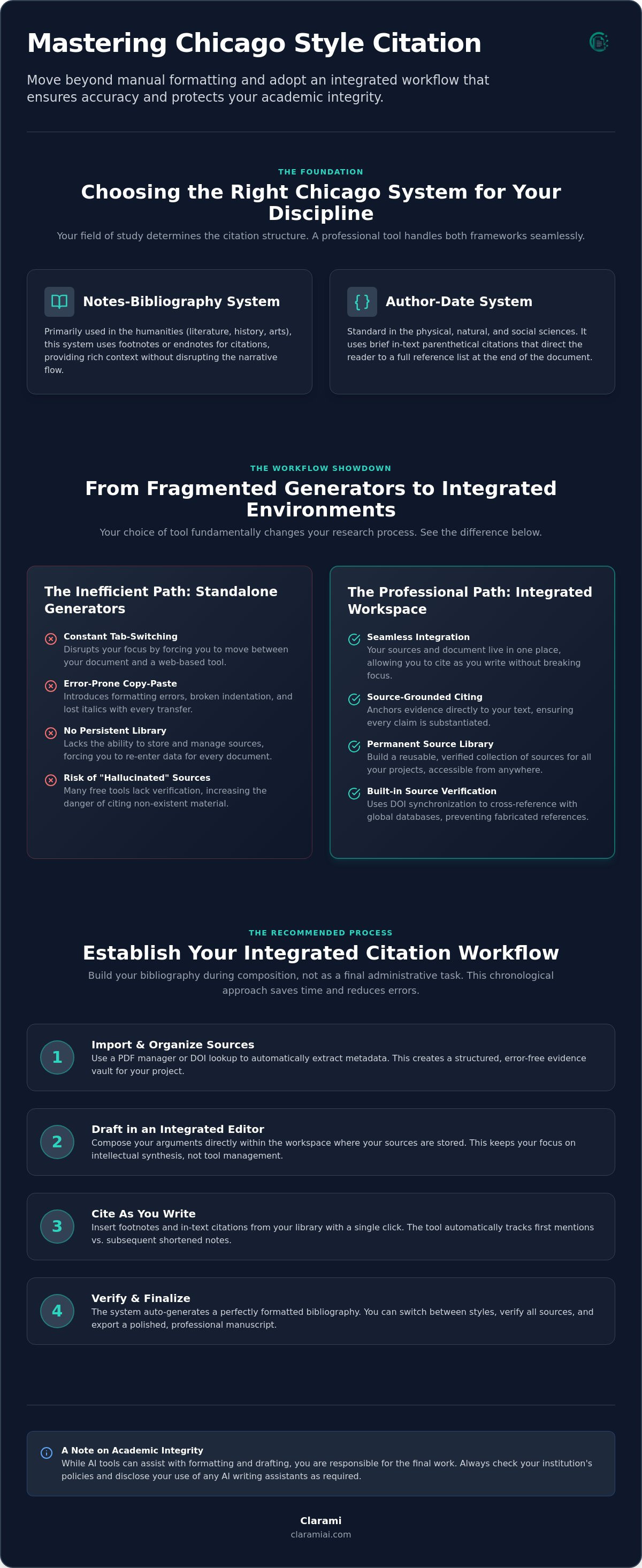
### Notes-Bibliography vs. Author-Date systemsHumanities disciplines typically rely on the Notes-Bibliography system to provide deep context without interrupting the narrative flow. Conversely, the Author-Date system is the standard for physical, natural, and social sciences. A professional manager automates the transition between these two distinct frameworks. It handles the specific structural requirements of the bibliography, such as inverted author names, alphabetical sequencing, and hanging indents. This automation ensures your output is technically flawless regardless of the required system.
Why standalone generators fall short for researchers
Quick-fix web generators often fail the test of long-term scholarly labor. They lack the ability to store metadata permanently, which leads to lost DOIs and broken links. The frequent "copy-paste" cycle between a generator and your editor often destroys the underlying formatting of your manuscript. You can consult a comparison of reference management software to see why dedicated tools are superior for complex work. You need a persistent integrated document editor where your evidence is anchored directly to your text. This prevents the fragmentation of your research and protects the integrity of your final submission.
Core functionality of a professional citation manager
A professional chicago style citation manager serves as the foundation for your manuscript's structural integrity. In 2026, research-grade tools must go beyond simple storage. They must provide active verification and seamless synchronization across your research ecosystem. This ensures your evidence is accessible whether you are working from a library terminal or a personal workstation.
Non-negotiable features include cloud-based accessibility and selection-level edits. This allows you to refine a specific footnote or bibliographic entry without disrupting the entire document's flow. Your evidence remains anchored to your argument. This ensures that your citations are as dynamic as your prose. A methodical approach to source management requires a tool that respects the user's intellectual agency while handling the mechanical burden of formatting.
Automated metadata extraction and PDF organization
Manual data entry is a significant source of error in academic writing. Professional tools utilize a PDF Manager to read document headers and extract author names, publication dates, and volume numbers directly. By using Digital Object Identifiers (DOIs), the system ensures that every source in your library is cross-referenced with global databases. This process creates project-specific collections that provide mental clarity during the synthesis phase. It transforms a disorganized pile of downloads into a structured evidence vault.
Customizing citation outputs for specific journal rubrics
Academic publishing involves complex edge cases. Multi-author volumes, translated primary sources, and archival materials require specific formatting nuances. You can consult the Purdue OWL Chicago Style guide for a deep dive into these requirements. A high-utility chicago style citation manager handles these variations automatically. It ensures your work aligns with the latest standards, including the 18th edition of the Chicago Manual of Style published in 2024.
Collaboration adds another layer of complexity. Using a "suggest-mode" within an integrated document editor allows co-authors to review and refine citations without overwriting original data. This human-in-the-loop approach maintains the accuracy of your bibliography while respecting the peer-review process. If you are ready to organize your research library with professional precision, you can start building your integrated workspace today. This systematic order is the first step toward a polished, verified output.
Integrated research environments versus standalone generators
Many researchers suffer from a "ping-pong" workflow. You switch between your browser, a standalone generator, and your word processor. This fragmented approach increases the risk of technical errors and disrupts your intellectual momentum. A professional chicago style citation manager should exist within your writing space, not as a separate tab. An in-app editor keeps your arguments and evidence in the same view. This structural connection ensures that every statement remains anchored to its supporting data. It eliminates the distraction of managing multiple windows, allowing you to focus on the logical progression of your thesis.
Using AutoDraft within this environment allows the system to suggest relevant citations based on your uploaded library. It doesn't search the open web for random sources; it scans your verified research vault. This ensures that the evidence surfaced is material you have already vetted. It acts as a methodical assistant, highlighting data points as you draft. This reduces the cognitive load of searching through folders while you are in the flow of composition. Synthesis remains the priority.
Eliminating the copy-paste fatigue
Pasting formatted text from a browser into Microsoft Word often leads to a technical breakdown. Indentation, font styles, and italics frequently break during the transfer, requiring manual correction. An integrated environment maintains style consistency across the entire draft. It protects the structural integrity of your footnotes and bibliographies from the first word to the last. This persistence is what distinguishes a professional chicago style citation manager from temporary tools. It prevents "orphan" citations that lose their metadata when moved between platforms. When the draft is complete, you can export directly to DOCX, PDF, or LaTeX without re-formatting the entire manuscript.
Maintaining context between notes and drafts
A professional integrated research workspace allows you to view your research notes alongside your active manuscript. This proximity is vital for maintaining context and ensuring accuracy. You can verify your interpretations against the original text without leaving the document. If a paragraph needs refinement, selection-level AI assistance can suggest rewrites that preserve the integrity of the cited evidence. You remain the final editor, reviewing every suggestion for scholarly merit. For quick verification of specific formatting rules, you can refer to the Chicago Manual of Style official quick guide. This ensures your work adheres to the highest standards of academic integrity while streamlining the structural process of writing.
Disclaimer: Always check your institutional policies regarding AI use and disclose its application in your research where required.
Verification strategies for scholarly integrity
Scholarly integrity requires more than just correct formatting. It demands that every cited source actually exists and supports the specific claim being made. General-purpose AI tools often suffer from hallucinations, creating plausible but entirely fabricated DOIs and journal titles. This risk makes a specialized chicago style citation manager essential for serious academic work. By anchoring the drafting process in a verified library, you eliminate the risk of accidental fabrication. You transition from a state of uncertainty to one of calm assurance.
A source-grounded approach ensures that any citation suggested by an assistant is derived directly from your uploaded research. This method prevents the creation of fake citations. It transforms the AI from a creative generator into a disciplined research companion. You remain the final arbiter of truth, verifying that every interpretation aligns with the primary evidence. This disciplined workflow is the only way to maintain the structural integrity of your manuscript in an era of automated content.
Using ClaimShield for real-time source verification
The ClaimShield feature provides a critical layer of protection by checking your draft against your actual uploaded PDFs. It allows you to verify ai citations with precision. This tool highlights the specific passage in the source document that supports your statement. It is a methodical way to ensure that a quote or statistic hasn't been taken out of context. This level of traceability is vital when managing a complex chicago style citation manager workflow where accuracy is non-negotiable.
Ethical AI use and disclosure in research
Maintaining your intellectual agency is the core of ethical research. You should use AI assistants to provide initial drafts or structural suggestions while retaining full responsibility for the final submission. Using a tone checker helps refine your scholarly voice, ensuring it remains authoritative and objective. Always disclose the use of citation managers and drafting assistants as required by your institution. This transparency builds trust and demonstrates a commitment to rigorous methodology.
Before submitting your work, follow this verification checklist:
- Cross-reference every DOI with a global database like Crossref.
- Verify that the page numbers in your footnotes match the physical source.
- Confirm that shortened notes follow the correct sequence after the first full mention.
- Check that the bibliography is organized alphabetically by the author's last name.
Academic Integrity Disclaimer: Always review your school's specific policies regarding the use of AI tools. You are responsible for disclosing AI assistance and ensuring your work meets all institutional standards for original scholarship.
If you value a workspace that prioritizes truth over speed, you can create your verified research environment today. This systematic approach ensures your work stands up to the closest peer-review scrutiny.
Implementing the Clarami workflow for Chicago style
Professional research follows a chronological progression from initial collection to final verification. A robust chicago style citation manager must support every stage of this journey to ensure your manuscript remains technically sound. The process begins with the organization of your evidence. It continues through the synthesis of your arguments and concludes with the generation of a formal bibliography. This systematic order prevents the administrative friction that often occurs during the final hours of a deadline. Systematic order. Traceable evidence. Polished output.
The Clara AI Assistant acts as a methodical companion during the composition phase. Instead of manually hunting through folders for a specific quote, you can ask the assistant to surface relevant data points from your verified library. Once your evidence is identified, AutoDraft converts your structured research notes into a cohesive first draft. This provides a structural framework that you then refine and edit. You remain the primary investigator, responsible for the intellectual merit and the final submission of the work.
From PDF upload to automated bibliography
The workflow begins in the PDF Manager. You upload your primary and secondary sources, allowing the system to index metadata and DOIs automatically. As you compose your text within the In-App Editor, the citation helper allows you to insert footnotes instantly. This integration ensures that your bibliography is built in real-time as you write. You don't have to wait until the end of the project to format your sources. With one click, the system generates a complete, alphabetized bibliography that adheres to the latest Chicago Manual of Style standards. This reduces the risk of omitting a source or misformatting a complex multi-author entry.
Collaborative drafting and committee feedback
Complex projects like dissertations or peer-reviewed articles require multiple rounds of feedback. You can share your integrated research workspace directly with advisors or co-authors. This approach maintains version control and keeps all suggestions anchored to your cited evidence. It eliminates the confusion of tracking changes across multiple email attachments. You can manage committee feedback within the editor, refining your arguments while ensuring CMOS compliance is never compromised. Before submission, perform a final review of your shortened notes and bibliographic entries. You can then export your manuscript as a polished DOCX or LaTeX file, ready for professional evaluation.
Academic Integrity Disclaimer: Always check your institutional policies regarding the use of AI tools in your writing. You are responsible for disclosing AI assistance and ensuring your work meets all school standards for original scholarship.
Establishing a permanent research workspace
You now understand that a professional chicago style citation manager is more than a formatting tool; it's a permanent workspace for your evidence. By utilizing an integrated editor, you eliminate the mechanical errors caused by copy-pasting and maintain structural integrity throughout your draft. ClaimShield technology acts as a safeguard, ensuring every citation is grounded in your actual sources rather than being fabricated by a general-purpose AI assistant. This methodical approach protects your academic reputation and reduces the administrative burden of manual formatting.
Your final manuscript will be ready for submission with total technical precision, whether you require DOCX, PDF, or LaTeX exports. You can start building your verified Chicago style bibliography in Clarami to ensure your work meets the highest standards of scholarship. Your research deserves a foundation built on accuracy and systematic order.
Academic Integrity Disclaimer: Always check your school's specific policies regarding AI tools. You are responsible for disclosing AI assistance and ensuring your work meets all institutional requirements for original scholarship.
Frequently asked questions
What is the difference between a Chicago style citation generator and a manager?
A citation generator is a temporary tool designed for one-off formatting. In contrast, a chicago style citation manager acts as a persistent research library that stores your PDFs and notes permanently. While generators often lose metadata after a browser session ends, a manager maintains a structural connection between your evidence and your draft. This allows for better organizational cohesion throughout long-term projects.
Does a citation manager support both the Notes-Bibliography and Author-Date systems?
Professional managers support both the Notes-Bibliography and Author-Date systems. You can toggle between these frameworks within the settings of your integrated editor to meet the requirements of your specific discipline. The software automatically adjusts the formatting of footnotes and bibliographic entries. This automation reduces the administrative burden and technical errors associated with manual re-formatting.
How can I prevent my citation manager from creating fake sources?
You prevent fabricated sources by using a source-grounded assistant that only references documents within your verified library. Tools like ClaimShield allow you to check every claim against your uploaded PDFs. You should also perform a manual cross-reference of DOIs with global databases. This methodical approach ensures that every suggested citation exists in reality and substantiates your specific argument.
Can I export my Chicago style paper to formats like LaTeX or DOCX?
You can export your Chicago style manuscripts to multiple professional formats, including DOCX, PDF, and LaTeX. This flexibility ensures your work remains compatible with various submission portals and journal requirements. The export process preserves your structural formatting, such as hanging indents and specific footnote sequences. This eliminates the need for manual correction after the document leaves the editor.
Is it ethical to use an AI citation manager for a dissertation or thesis?
It is ethical to use a chicago style citation manager for advanced research provided you disclose its use and maintain your intellectual agency. You must remain the final editor of every paragraph and citation. A human-in-the-loop approach ensures that the AI provides structural support while you remain responsible for the scholarly merit of the research. Always verify that your assistant is surfacing real data from your library.
How do I handle citations for websites or social media in Chicago style?
Chicago style requires specific metadata for digital sources, including the author, page title, site owner, and access date. Your manager provides dedicated fields for these details to ensure compliance with CMOS standards. For social media, you should include the handle and the content of the post if no title is available. This systematic tracking ensures your digital evidence is as traceable as your print sources.
Academic Integrity Disclaimer: Always review your school's specific policies regarding the use of AI tools. You are responsible for disclosing AI assistance and ensuring your work meets all institutional standards for original scholarship.
Related on Clarami
- Best AI writing tool for students (full guide) →
- AI academic integrity checklist →
- Clarami pricing: Free vs PRO vs Platinum →
- Editor vs ChatGPT for writing →
- Export DOCX, PDF, and hand-in checklist →
- How to outline a paper →
- Prompt to structured essay draft →
- Revise with AI on a selection →
- Sign up free →
- Clarami home →
- More guides on the Clarami blog →