
Best AI Essay Checkers: Improve Your Writing Quality
Understand how ai essay checkers analyze your work. Learn to avoid false positives and use these tools to verify your writing, not just to pass a score.
Write with structure in Clarami AI
Editor-first AI drafting, citations, and two Workflows for student writing.
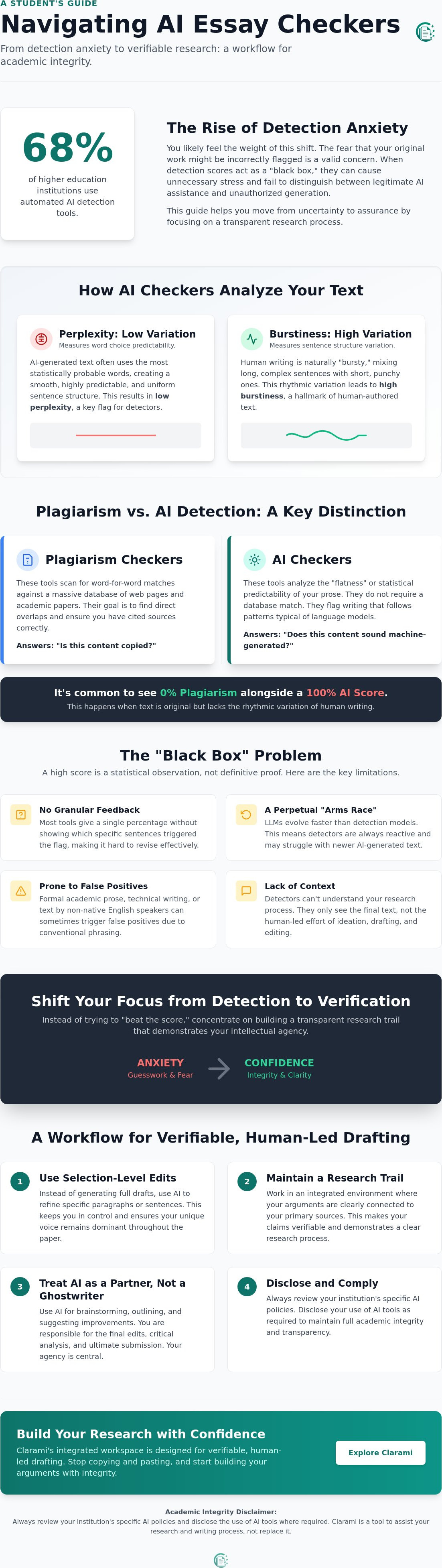
Nearly 68% of higher education institutions now use automated detection tools to scan student work. You likely feel the weight of this shift every time you prepare a submission. It's a common anxiety: the fear that your original analysis might be flagged by ai essay checkers because of a high perplexity score or a specific sentence structure. This frustration is valid. When detection scores act as a black box, they often fail to distinguish between legitimate AI assistance and unauthorized content generation.
You deserve a workflow that prioritizes transparency and human agency. This article explains how AI detection models function, why they frequently struggle with non-native English or technical prose, and how to use an integrated research workspace to verify your claims. You'll learn to move from a state of uncertainty to one of calm assurance by maintaining a clear connection between your arguments and your primary sources. We will show you how to submit your papers with confidence in their structural integrity.
Academic Integrity Disclaimer: Always review your institution's specific AI policies and disclose the use of AI tools where required.
Key Takeaways
- Understand the linguistic patterns used by these tools and why standard academic conventions often trigger false positives.
- Shift your focus from passing a score to verifying your claims through a transparent research trail anchored in primary sources.
- Learn to use ai essay checkers as diagnostic tools while keeping your own intellectual agency at the center of the drafting process.
- Discover how selection-level edits and source-grounded drafting protect the structural integrity of your final submission.
- Establish a clear process for disclosing AI assistance and confirming compliance with your institution's specific academic integrity policies.
Table of Contents
- What are ai essay checkers and how do they function?
- The technical limitations of current ai essay checkers
- Moving from detection to verification in your research
- Strategies to maintain academic integrity with ai essay checkers
- Clarami: A workspace designed for verifiable human-led drafting
What are ai essay checkers and how do they function?
Academic Integrity Disclaimer: Always check your institution's specific policies regarding AI tools and disclose assistance where required.
ai essay checkers are specialized software tools designed to identify linguistic patterns typical of Large Language Models (LLMs). Unlike traditional tools that search for word-for-word matches, these systems utilize predictive linguistic analysis. They calculate the statistical probability of a word following another, often referred to as perplexity and burstiness. If a sentence follows a highly predictable path, the software flags it as likely machine-generated.
To better understand how these tools evaluate text, watch this comparison of popular detection platforms:
Universities are increasingly integrating these tools into submission portals. For example, Turnitin updated its classifier in early 2026 to detect content from GPT-5 and Claude 4.6. The goal is to maintain the structural integrity of academic discourse. However, Wikipedia's guidelines on AI writing remind us that relying purely on automated generation can lead to policy violations and the loss of original voice. This shift from simple matching to predictive modeling means your work must be more than just original; it must be demonstrably human.The difference between plagiarism and ai detection
Plagiarism checkers operate by indexing billions of web pages and academic papers to find direct overlaps. They confirm whether you've cited your sources correctly. AI checkers don't need a database match. Instead, they analyze the "flatness" of prose. If your writing follows a highly predictable sequence, it may trigger a high AI score even if every thought is your own. It's common to see a 0% plagiarism score alongside a 100% AI score. This happens when the text is original in terms of sourcing but lacks the unique rhythmic variations of human composition.
Common use cases for students and educators
Educators now use these tools as a diagnostic starting point rather than a final verdict. A high score often prompts a conversation about the research process. For students, ai essay checkers serve as a self-correction mechanism. Checking a draft helps you identify sections that might sound inadvertently robotic or overly formal. Using an integrated In-App Editor allows you to refine these segments in real-time, ensuring your final output reflects your own intellectual agency and remains verifiable.
The technical limitations of current ai essay checkers
A single percentage score lacks context. Most ai essay checkers operate as a black box. They provide a final probability without highlighting the specific linguistic triggers that generated the result. This lack of transparency causes significant stress for students who have performed their own research. You receive a score of 70% or 80%, but you don't know which paragraph triggered the flag. Without granular feedback, the score remains an abstract number rather than a useful diagnostic tool.
Detection is a reactive process. LLMs evolve faster than the models designed to catch them. While Turnitin updated its classifier in early 2026 to address GPT-5 and Claude 4.6, the underlying technology still relies on historical data. This creates a perpetual arms race. A high score is not an indictment of your character or a definitive proof of academic dishonesty. It's a statistical observation that requires human interpretation. Educators are increasingly aware of this, moving toward a holistic review of the writing process rather than relying on a standalone score.
Understanding perplexity and burstiness
Linguistic classifiers primarily look for two markers: perplexity and burstiness. Perplexity measures word choice predictability. AI models aim for the most probable next word to maintain coherence, resulting in low perplexity. Burstiness tracks structural variation throughout a document. Human writing is naturally bursty. It features a mix of short, punchy fragments and complex, multi-clause sentences. AI tends toward a uniform, monotonous rhythm. When your writing lacks this natural "burst," detectors may categorize your work as machine-generated even if every thought is original.
Why false positives occur in scholarly writing
Scholarly writing relies on standardized terminology and rigid conventions. Phrases like "the data suggests a correlation between" or "further research is required to substantiate" are highly predictable. These are low-perplexity structures by design. ESL writers often rely on these formal, safe sentence patterns to ensure clarity and professional tone. Unfortunately, this adherence to academic standards often mimics the training data used by AI models. Because high-level academic prose prioritizes precision over creative flair, it frequently triggers low-perplexity flags in ai essay checkers. To ensure your work remains verifiable despite these technical hurdles, you can start building your research trail in a dedicated workspace that prioritizes your intellectual agency.
Moving from detection to verification in your research
The primary flaw of current ai essay checkers is their inability to account for the research process. These tools analyze the statistical likelihood of your prose but ignore the intellectual foundation behind it. Verification changes the dynamic. It moves the burden of proof from a machine's guess to your own documented evidence. By proving your arguments are anchored in primary sources, you establish a level of structural integrity that a simple probability score cannot undermine. Substantiation is the only true defense against the "black box" nature of automated detection.
Understanding how to verify ai citations is now a critical skill for any serious scholar. It's far more important than merely avoiding a detection flag. A verifiable citation proves you have engaged with the material and extracted relevant data through your own cognitive effort. While a score can fluctuate based on model updates, a verifiable research trail is permanent. It provides the calm assurance that your work can withstand the most rigorous institutional scrutiny.
The power of source-grounded drafting
LLMs are prone to hallucinations. They often invent sources that look plausible but don't exist. Human-led drafting requires precise, verifiable evidence. When you use a workspace featuring a robust PDF manager, you create a direct link between your draft and your source material. This ensures every claim is traceable to a specific page or methodology. It also marks a psychological shift in your workflow. You stop worrying about "passing" a check. Instead, you focus on documenting the human labor of research. This methodical approach replaces the anxiety of detection with the confidence of systematic order. You aren't just writing; you're building a verified output through a linear narrative of discovery.
Verification as a defense against false flags
If an automated system flags your work, your defense rests on your paper trail. Your version history is your strongest asset. By maintaining a clear record of early outlines and research notes, you provide undeniable proof of human agency. Tools like ClaimShield facilitate this by maintaining a transparent connection between your claims and your evidence.
- Systematic order: Organize your library of sources before writing a single word.
- Traceability: Link specific paragraphs to the data highlights in your uploaded PDFs.
- Substantiation: Use the In-App Editor to ensure every suggestion is backed by your own research.
This structured approach ensures that your work remains original and verifiable. It protects your academic reputation from the limitations of ai essay checkers by providing a clear, logical progression from initial disorganization to a polished final paper. ## Strategies to maintain academic integrity with ai essay checkers
Maintaining academic integrity requires a fundamental shift in how you view digital tools. You are the editor. The AI is the assistant. This human-in-the-loop philosophy ensures that while you may use technology to overcome initial writing blocks, the final analysis remains yours. Unlike broad-market tools that encourage one-click rewrites, a specialized approach focuses on selection-level edits. You don't generate entire essays. You refine specific paragraphs or clarify complex sentences within an integrated environment. This method eliminates the need to copy and paste from external chat interfaces, which is the most effective way to preserve the structural integrity of your document.
The "no copy-paste" workflow is your strongest defense against the algorithmic patterns identified by ai essay checkers. When you write within an integrated editor, your drafting process is naturally more iterative and grounded. You aren't just moving blocks of text; you're synthesizing information from your sources in real-time. This ensures that your unique voice remains dominant throughout the paper.
A step-by-step workflow for responsible AI use
Adopting a methodical progression protects your work from being flagged. It creates a clear trail of human agency that is easy to substantiate if questioned.
- Step 1: Conduct your research and organize your primary sources in a dedicated workspace.
- Step 2: Create a detailed outline based on the specific findings or data points you've extracted.
- Step 3: Use AutoDraft to build a first version of a single paragraph based on your specific research notes.
- Step 4: Manually edit the draft to inject your specific analysis and connect the arguments to your overall thesis.
Improving sentence-level burstiness manually
Human writing is characterized by rhythmic variety. To ensure your work reflects this, you must consciously vary your sentence lengths. Mix short, impactful statements with longer, multi-clause observations. Utilizing an academic writing tone checker online helps you identify where your voice might be slipping into overly predictable patterns. Injecting your personal voice through transition phrases unique to your discipline further differentiates your work. Manual editing of AI-drafted text naturally increases linguistic perplexity by breaking the flat, predictable patterns that detectors scan for. This process transforms a generic draft into a substantiated, professional paper. Join Clarami today to start building a verifiable research trail that proves your work is original.
Clarami: A workspace designed for verifiable human-led drafting
The anxiety surrounding ai essay checkers stems from a lack of control over the detection process. Clarami addresses this by providing an integrated environment where your research and your writing coexist. Most students lose structural integrity when they copy and paste text from external chat interfaces. This practice often imports the very linguistic patterns that detectors scan for. By using an all-in-one editor, you maintain a continuous, documented drafting history. This approach ensures that your intellectual agency is visible at every stage of the composition. You don't just produce text; you build a verified record of your scholarly labor.
Clara acts as a reliable intellectual companion within this workspace. Unlike general-purpose tools, it operates on a source-grounded principle. Every suggestion provided is anchored in the PDFs you upload. This eliminates the risk of hallucination and ensures that your arguments remain traceable. To further strengthen your defense against false flags, ClaimShield allows you to verify that your drafts accurately reflect the data in your primary sources. This creates a transparent connection between your claims and your evidence. Systematic order. Traceable evidence. Substantiated claims.
The integrated editor advantage
Efficiency in scholarly labor requires a reduction in technical friction. Switching between browser tabs and word processors disrupts your cognitive flow and leads to disorganized source material. Clarami keeps your bibliography and your draft in the same view. You can extract methodology or highlight relevant data without leaving the document editor. This organizational cohesion is vital for high-stakes assignments. Additionally, structured templates are matched to specific academic rubrics. Just as professional builders rely on Building Information Modeling to ensure structural integrity—you can learn more about these workflows at CRAYDL—these guides help you organize your thoughts systematically without sacrificing your original voice or the integrity of your research.
Building confidence in your scholarly output
Submitting a paper should be a moment of accomplishment rather than stress. When you focus on the quality of your research, the fear of ai essay checkers diminishes. You aren't just trying to pass a score. You're producing a substantiated, professional document. Clarami allows you to use suggest-mode for collaboration with advisors or peers. This feature lets you receive feedback and incorporate edits while maintaining the final decision-making power. You join a community of researchers who value precision and traceability over simple automation. This methodical approach provides the peace of mind that every statement you make is backed by a verifiable research trail. Submit with confidence. Your work is your own.
Secure your academic future through verification
The transition from detection to verification is a necessary evolution in scholarly labor. While ai essay checkers provide a statistical glimpse into linguistic patterns, they cannot replace the documented rigor of a human-led research process. You now understand that the most effective defense against false flags is not a better "humanizer" but a transparent, source-grounded workflow. By anchoring every claim in primary data and maintaining a continuous drafting history, you ensure your work remains both original and verifiable.
Clarami is purpose-built for this methodical approach. It's designed specifically for academics, not just content creators, who prioritize precision over broad automation. The workspace features an integrated PDF manager and citation builder to keep your evidence immediately available. ClaimShield provides real-time verification to confirm that your drafts reflect verified data. You don't have to navigate the stress of automated scores alone.
Start your verifiable research journey with Clarami. You have the tools to submit your work with absolute confidence in its structural integrity. Your research is valuable, and you deserve a workflow that keeps it traceable.
Frequently asked questions
Are ai essay checkers accurate enough for universities to use?
AI detection tools are not 100% accurate, though they are currently used by approximately 16,000 institutions. Most universities treat these scores as a diagnostic starting point rather than a final verdict. Turnitin itself acknowledges that its system can produce false positives. You should treat a high score as an invitation to discuss your research process and provide evidence of your original labor through drafts and notes.
Can an AI detector flag my work even if I didn't use AI?
Yes, false flags occur frequently in technical or highly formal academic writing. Standardized terminology and predictable sentence structures often trigger the linguistic models used by ai essay checkers. ESL writers are particularly vulnerable to these flags because they often use established academic conventions to ensure a professional tone. Proving your research trail is the most reliable way to resolve these false accusations.
How can I avoid getting a high AI detection score?
You can reduce a high detection score by increasing the linguistic burstiness of your prose. Mix short, direct statements with longer, multi-clause observations to reflect a natural human rhythm. Avoid generating entire sections of text. Instead, use an integrated workspace to ground your drafts in your own uploaded PDFs. This ensures that your specific analysis and unique voice remain the dominant features of the essay.
What is the difference between an AI detector and a plagiarism checker?
Plagiarism checkers identify direct overlaps between your text and a database of existing publications. AI detectors analyze the statistical probability of your word choices to identify machine-generated patterns. It's possible to trigger a high AI score even with 0% plagiarism if your writing follows highly predictable sequences. Plagiarism is about the source of the idea; AI detection is about the rhythm of the prose.
Is it considered cheating to use an AI writing assistant for research?
Academic integrity policies differ between institutions, so you must always check your specific school guidelines. While the Common Application defines submitting AI-generated content as fraud, many universities permit AI for grammar checking or brainstorming. The key is to remain human-in-the-loop. You should always be the primary editor and disclose AI assistance to maintain transparency and comply with institutional standards.
Why is an integrated editor better for academic integrity than a chat interface?
An integrated editor is superior because it eliminates the need to copy and paste from external chat boxes. This no copy-paste workflow prevents the importation of generic AI patterns that often trigger ai essay checkers. By keeping your sources and your draft in the same verifiable workspace, you create a transparent research trail. This provides undeniable proof of human agency and protects the structural integrity of your final submission.
Academic Integrity Disclaimer: Always check your school's specific policies regarding AI tools and disclose assistance where required.
Related on Clarami
- Best AI writing tool for students (full guide) →
- AI academic integrity checklist →
- Clarami pricing: Free vs PRO vs Platinum →
- Editor vs ChatGPT for writing →
- Export DOCX, PDF, and hand-in checklist →
- How to outline a paper →
- Prompt to structured essay draft →
- Revise with AI on a selection →
- Sign up free →
- Clarami home →
- More guides on the Clarami blog →