AI citation generator APA: A guide to accurate and ethical research in 2026
Learn to use an ai citation generator apa without hallucinations. Our guide covers 2026 APA 7th edition rules for accurate, source-grounded research citations.
Write with structure in Clarami AI
Editor-first AI drafting, citations, and two Workflows for student writing.
What if the most stressful part of your research wasn't the argument itself, but the nagging fear that your citations are digital ghosts? You've likely felt the frustration of using a standard ai citation generator apa only to find it hallucinated a DOI or a non-existent journal volume. It's a tedious cycle. You copy text from a chat window, paste it into a document, and then manually hunt for a source that might not even exist. This fragmented process invites error and compromises the structural integrity of your paper.
We understand the pressure to maintain academic integrity while managing the rigors of scholarly labor. You need a workflow that anchors every claim to a verified source without the constant tab-switching. This guide explains how to generate precise APA 7th edition citations for AI-assisted work using a source-grounded method. You'll learn the latest standards, updated as of April 2026, for citing generative models and how to build a bibliography that meets strict faculty requirements. This approach reduces manual formatting time and ensures every statement is traceable to primary data.
Academic integrity remains your primary responsibility. Always check your specific institution's policies regarding AI use and disclose the use of these tools where required.
Key Takeaways
- Understand the 2026 APA 7th edition requirements for citing generative models, including the correct formatting for model versions and developer information.
- Eliminate "citation hallucinations" by adopting a workflow that anchors every claim to a verified source passage from your own research library.
- Transition from a fragmented copy-paste process to an integrated workspace that maintains the structural connection between your draft and its references.
- Learn how to use an ai citation generator apa to surface real, primary sources during the drafting stage rather than searching for them after you finish writing.
- Prioritize academic integrity by verifying all AI-assisted outputs and ensuring your final submission aligns with your specific institutional policies.
Table of Contents
- Why accurate APA citations matter for AI-assisted research
- How to cite AI-generated text in APA 7th edition
- Standalone citation tools vs. integrated research workspaces
- Verifying AI-suggested sources to prevent citation hallucinations
- Streamlining your research with Clarami’s citation helper
Why accurate APA citations matter for AI-assisted research
Research in 2026 requires a shift from simple formatting to rigorous verification. You aren't just looking for a tool to fix your bibliography at the end of the night. You're looking for a way to ensure every claim you make is grounded in reality. The role of an ai citation generator apa has evolved from a passive formatter to an active participant in the verification process. When you use AI to draft, the risk of "hallucinated" data increases. Accurate citations serve as the structural anchor that prevents your work from drifting into misinformation.
To better understand the mechanics of modern citation management, watch this helpful video:
APA style exists to preserve the traceability of academic arguments. It allows your readers to follow your logic back to the primary source. If a citation is broken or a DOI is fake, that trail disappears. This isn't just a technical error. It's a failure of academic transparency. You must ensure that your digital assistant supports this transparency rather than obscuring it through disconnected chat outputs. Verification is the only path to credibility.The evolution of APA 7th edition in the digital age
The transition to APA 7th edition brought significant changes to how we handle online sources. It prioritized the inclusion of DOIs and URLs for nearly all digital materials to ensure permanent accessibility. Metadata accuracy is now the foundation of a credible bibliography. You are the final authority in this process. While tools can extract data, you must verify that the author, date, and source title align with the actual document. This is especially true for AI-generated text, which requires specific formatting to denote the model and version used as the author and title respectively.
Common pitfalls of standalone citation generators
Many students rely on standalone tools that operate outside their writing environment. This creates a fragmented workflow. When you copy and paste metadata between tabs, you lose the direct link between a specific claim and its evidence. General-purpose LLMs often invent plausible-sounding but fake DOIs because they prioritize linguistic patterns over factual data. You can see how these tools differ in this Comparison of reference management software. Using a non-integrated ai citation generator apa often leads to formatting errors that you might miss during a late-night edit.
To maintain order, consider using an integrated in-app editor. This keeps your sources and your draft in one place, ensuring that your bibliography is built alongside your arguments. This systematic approach reduces the anxiety of disorganized source material and ensures every citation is anchored in a real document.
Academic integrity disclaimer: Always check your institution's specific policies regarding AI use. You are responsible for disclosing AI assistance and verifying all facts and citations before submission.
How to cite AI-generated text in APA 7th edition
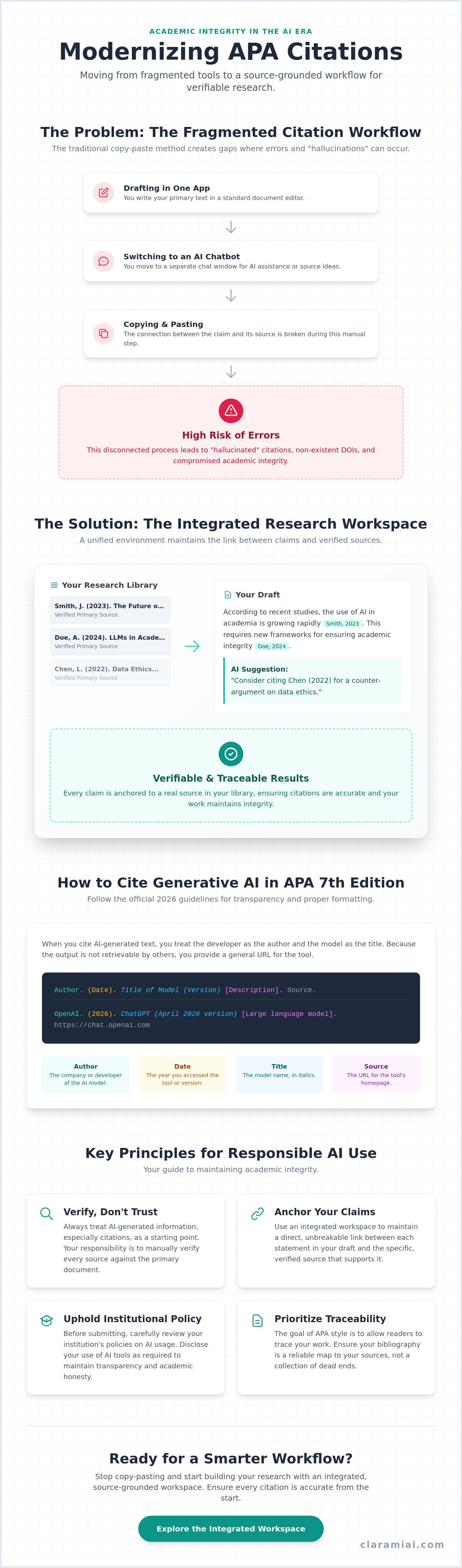
The American Psychological Association provided clear guidance in April 2026 for citing generative AI. They treat these outputs as non-recoverable data. Because a reader cannot access your specific chat session, you must provide enough detail to describe the interaction. If you use an ai citation generator apa, it should follow a specific four-part structure: Author, Date, Title, and Source. This ensures that your work remains transparent and verifiable.
Identify the developer. This is your author. If you used ChatGPT, the author is OpenAI. The date is the year you accessed the tool. The title is the name of the model, including the version number. Finally, include a bracketed description like [Large language model] and the URL. If the prompt you used is central to your methodology, include the full text of that prompt in your Methods section or as an Appendix. This level of detail is essential for ethical research practices for AI. If you're using an ai citation generator apa, ensure it allows for manual overrides of these metadata fields to maintain accuracy.
Formatting an AI citation: A template for success
A standard reference entry follows this pattern: Developer. (Year). Model name (Version) [Model type]. URL. For example: OpenAI. (2024). ChatGPT (Mar 14 version) [Large language model]. https://chat.openai.com/chat. Notice that the model name is italicized. Accuracy here is vital. Don't guess the version number. Check the interface or the developer's documentation for the specific model update date. If you're managing multiple sources, you can start your next project with a structured workspace to keep these details organized from the first draft.
In-text citations for AI-generated content
In-text citations follow the standard (Author, Year) format. You can use parenthetical citations at the end of a sentence or narrative citations within the flow of your writing. Because AI outputs lack page numbers, you don't need to include them. If you're quoting a specific section of a long response, you may use paragraph numbers to help the reader. Paraphrasing is generally preferred over direct quoting in academic writing. This demonstrates that you've processed the information and integrated it into your own voice. You remain the primary author. The AI is simply a tool to help you synthesize complex data.
Academic integrity disclaimer: Always check your institution's specific policies regarding AI use and disclose AI assistance as required by your instructor.
Standalone citation tools vs. integrated research workspaces
Traditional workflows treat the ai citation generator apa as a destination you visit after the writing is finished. This creates a hidden cost of cognitive load and organizational friction. When you switch between your editor, a chat box, and a standalone citation site, you risk losing the context of your data. This fragmented method often leads to misattributed quotes or missing DOIs. An integrated research environment solves this by housing your entire project in a single, cohesive workspace where drafting and citing happen simultaneously.
The core issue with standalone tools is the "copy-paste" loop. You find a source, paste it into a generator, copy the result, and paste it into your document. Each step is an opportunity for a formatting error or a lost link. By maintaining a central repository for PDFs and their associated metadata, you ensure that the connection between a claim and its evidence is never broken. This systematic order is essential for professional and scholarly labor, where the substantiation of claims is the primary measure of quality.
The Clarami workspace: A methodical approach
A central repository for your source material is the only way to maintain structural integrity. Using an integrated PDF manager allows you to store your research papers and their associated metadata in the same space where you draft. This eliminates the need to manually copy and paste details into a standalone ai citation generator apa. Within this ecosystem, Clara acts as your intellectual companion, surfacing real citations from your own library as you work. This real-time source anchoring ensures that every claim is connected to a primary document, reducing the risk of accidental plagiarism or hallucinated references.
Comparing efficiency and accuracy
The difference in workflow is stark. In a standalone setup, you must manually extract metadata for every source. In an integrated editor, the metadata is already linked to the document. You can perform selection-level edits, such as rewriting a single paragraph, while the system automatically maintains the correct APA 7th edition formatting. This methodical expert approach allows you to focus on the cognitive process of composition rather than the tedious mechanics of formatting.
Maintaining structural integrity across long-form documents requires a chronological path of collection, synthesis, and verification. Standalone tools only help with the final step. An integrated workspace supports you through the entire lifecycle of your paper. This ensures that your bibliography is a polished, verified output of your research process rather than a rushed afterthought.
Academic integrity disclaimer: Always check your institution's specific policies regarding AI use and disclose AI assistance as required by your school or publisher.
Verifying AI-suggested sources to prevent citation hallucinations
General-purpose language models operate on linguistic probability. They predict the next likely word in a sequence based on vast datasets. This is why they often invent plausible-sounding but fake DOIs. A traditional ai citation generator apa might produce a citation that looks technically perfect but leads to a non-existent journal volume. Verification is not an optional step. It's the foundation of academic integrity. You must verify every claim against primary sources in real time to ensure your work remains grounded in evidence.
Using ClaimShield allows you to substantiate every sentence in your draft. Instead of trusting an AI's memory, you anchor your arguments in the specific text of your uploaded documents. This methodical procedure ensures that your bibliography is built on verified data rather than linguistic guesses. It alleviates the stress of potential technical inaccuracies by providing a clear trail of evidence. When your workspace requires a direct link between a statement and its source, the risk of hallucination disappears.
The DOI verification checklist
Before you finalize your references, validate each source's existence. Tools like Crossref or PubMed are essential for confirming metadata. You should also watch for predatory journals that lack rigorous peer review. These can occasionally surface in AI-driven searches. You can find a detailed procedure in our guide on how to verify ai citations. This step ensures your research meets the high standards of scholarly labor. Accuracy at this level preserves your intellectual agency and professional reputation.
Human-in-the-loop: The researcher's final responsibility
You are the final authority on your work. The AI provides a draft, but you are responsible for the submission. This human-in-the-loop approach is an ethical necessity. You must read the source text before citing it to ensure the original context remains intact. While you can use AI to summarize complex data, you shouldn't let it interpret the meaning without your oversight. This disciplined approach distinguishes professional research from automated content. To ensure your work is both accurate and ethical, create your Clarami account and start verifying your sources today.
Academic integrity disclaimer: Always check your institution's specific policies regarding AI use and disclose AI assistance as required by your instructor or school board.
Streamlining your research with Clarami’s citation helper
Efficient composition begins with a structured environment. When you start a new project, select the APA 7th edition template to establish your formatting parameters immediately. This ensures that your margins, font sizes, and heading styles align with scholarly standards from the first word. Unlike a standalone ai citation generator apa, this integrated helper works within your document to maintain organizational cohesion throughout the writing process.
Your PDF Manager acts as the foundation for your draft. By importing your sources directly into the workspace, you eliminate the need to switch between external windows. Once your library is populated, you can use AutoDraft to generate initial paragraphs based on the specific data within your documents. This human-in-the-loop workflow allows you to review and refine AI-generated suggestions, ensuring that every sentence remains anchored in your primary research material.
Finalizing your paper is a matter of verification rather than manual labor. When your draft is complete, the system compiles your bibliography automatically based on the sources you've cited in the text. You can then export your work as a polished DOCX or PDF file, confident that your bibliography meets the precise requirements of the APA 7th edition. This systematic approach transforms citation from a final chore into a continuous, verified process.
From research notes to first draft
The transition from reading to writing is often where structural integrity fails. You can prevent this by mapping your PDF highlights directly to specific sections of your paper. This method allows you to see the structural connection between a statement and its supporting data in real time. Automating the bibliography generation while maintaining manual control over metadata ensures your work remains professional and accurate. For those managing complex, multi-year projects, this is often considered the best software for phd students in 2026 due to its focus on traceability.
Next steps for your academic project
Before you submit your work for committee review or publication, use the Draft Tone Checker to ensure your language remains objective and scholarly. This final review stage allows you to polish your arguments while maintaining the calm, authoritative voice required for professional labor. Once you've verified your claims through ClaimShield, your document is ready for the highest levels of academic scrutiny. To access these integrated tools and maintain your intellectual agency, you can start your next research project with Clarami today.
Academic integrity disclaimer: Always check your institution's specific policies regarding AI use. You are responsible for disclosing AI assistance and ensuring all citations are accurate and verified before submission.
Mastering the future of academic verification
Transitioning from fragmented tools to a unified workspace is the key to maintaining structural integrity. You've seen how a precise ai citation generator apa must be anchored in primary sources to prevent the risk of hallucinated DOIs. By moving beyond simple generation and embracing real-time verification, you ensure your bibliography is as robust as your arguments. This shift from manual formatting to verification-led research ensures your work meets the highest standards of professional and scholarly labor.
Traceability is the foundation of your success. Using an integrated PDF manager eliminates the friction of switching between tabs and tools, allowing you to focus on the cognitive work of analysis. You remain the essential human-in-the-loop, responsible for the final polish and ethical disclosure of your process. This methodical approach transforms a tedious chore into a seamless part of your research lifecycle. Your dedication to accuracy is what makes your research valuable.
Build your source-grounded research project with Clarami to ensure every claim in your next paper is substantiated by real data.
Academic integrity disclaimer: Always check your institution's specific policies regarding AI use and disclose AI assistance as required by your school or publisher.
Frequently asked questions
Can I use an AI citation generator for my dissertation?
You can use an ai citation generator apa for a dissertation if your university's policy permits AI-assisted tools. Most institutions require you to verify every citation against the primary source to ensure accuracy. Because dissertations undergo intense scrutiny, you shouldn't rely on automated tools alone. You remain responsible for the structural integrity of your bibliography. Always disclose your use of AI tools in your methodology or as required by your committee.
How do I cite ChatGPT in APA 7th edition?
To cite ChatGPT, list OpenAI as the author and the year of the model's version in parentheses. The title is the name of the model, such as ChatGPT (Mar 14 version), followed by the bracketed description [Large language model]. Finally, provide the URL of the tool. This format, updated in April 2026, treats the output as non-recoverable data since chat sessions aren't publicly accessible to your readers.
What is the difference between a standalone generator and a research workspace?
A standalone generator requires you to copy and paste metadata from your browser into a separate tool. This creates organizational friction and increases the risk of formatting errors. A research workspace integrates your PDF library directly into your editor. This preserves the link between your claims and your evidence. You can cite as you write rather than treating the ai citation generator apa as a final, disconnected step.
How does Clarami ensure the citations it suggests are real?
Clarami uses a source-grounded workflow to prevent citation hallucinations. Instead of pulling from general training data, the system surfaces passages from the specific PDFs you have uploaded to your project. This ensures every claim is traceable to a document in your library. You can verify the context of a suggestion immediately within the in-app editor, which maintains a high standard of substantiation for your scholarly labor.
Is it considered plagiarism to use an AI citation helper?
Using a citation helper is not plagiarism. It's a tool for organizing and formatting your references correctly. Plagiarism occurs when you present someone else's ideas or AI-generated text as your own without proper attribution. When using an ai writing tool for students, you must ensure your final submission reflects your own analysis. Always cite the AI model if it contributed to the text and follow your school's specific academic integrity guidelines.
Does APA 7 require a URL for every online source?
APA 7th edition requires a DOI for all sources that have one. If a DOI is unavailable, you must provide a stable URL for the source. This ensures that your readers can trace your arguments back to the primary data. You don't need to include "Retrieved from" before the URL unless the source material is designed to change over time, such as a live dashboard or a wiki page.
Academic integrity disclaimer: Always check your institution's specific policies regarding AI use and disclose AI assistance as required by your instructor or school board.
Related on Clarami
- Best AI writing tool for students (full guide) →
- AI academic integrity checklist →
- Clarami pricing: Free vs PRO vs Platinum →
- Editor vs ChatGPT for writing →
- Export DOCX, PDF, and hand-in checklist →
- How to outline a paper →
- Prompt to structured essay draft →
- Revise with AI on a selection →
- Sign up free →
- Clarami home →
- More guides on the Clarami blog →