

Writing a Research Paper Introduction: A Systematic Guide for 2026
Learn how to write a research paper introduction with our systematic guide. Master the five key components and structure your argument with clarity and integ...
Write with structure in Clarami AI
Editor-first AI drafting, citations, and two Workflows for student writing.
Key Takeaways
- Define the introduction as a structural bridge that establishes the scope and boundaries of your study.
- Master the five essential components for writing a research paper introduction, including territory establishment and field synthesis.
- Use signal phrases to transition smoothly from broad background context to your specific research gap.
- Maintain academic integrity by using a human-in-the-loop approach that requires active verification of all drafted content.
- Optimize your writing process by integrating your source material through the PDF Manager and generating outlines with AutoDraft.
Table of Contents
- Understanding the structural role of the research paper introduction
- The five essential components of a scholarly introduction
- Bridging the gap between background context and your research problem
- Drafting with precision: Maintaining integrity in the introduction phase
- Optimizing your introduction workflow within the Clarami workspace
Understanding the structural role of the research paper introduction
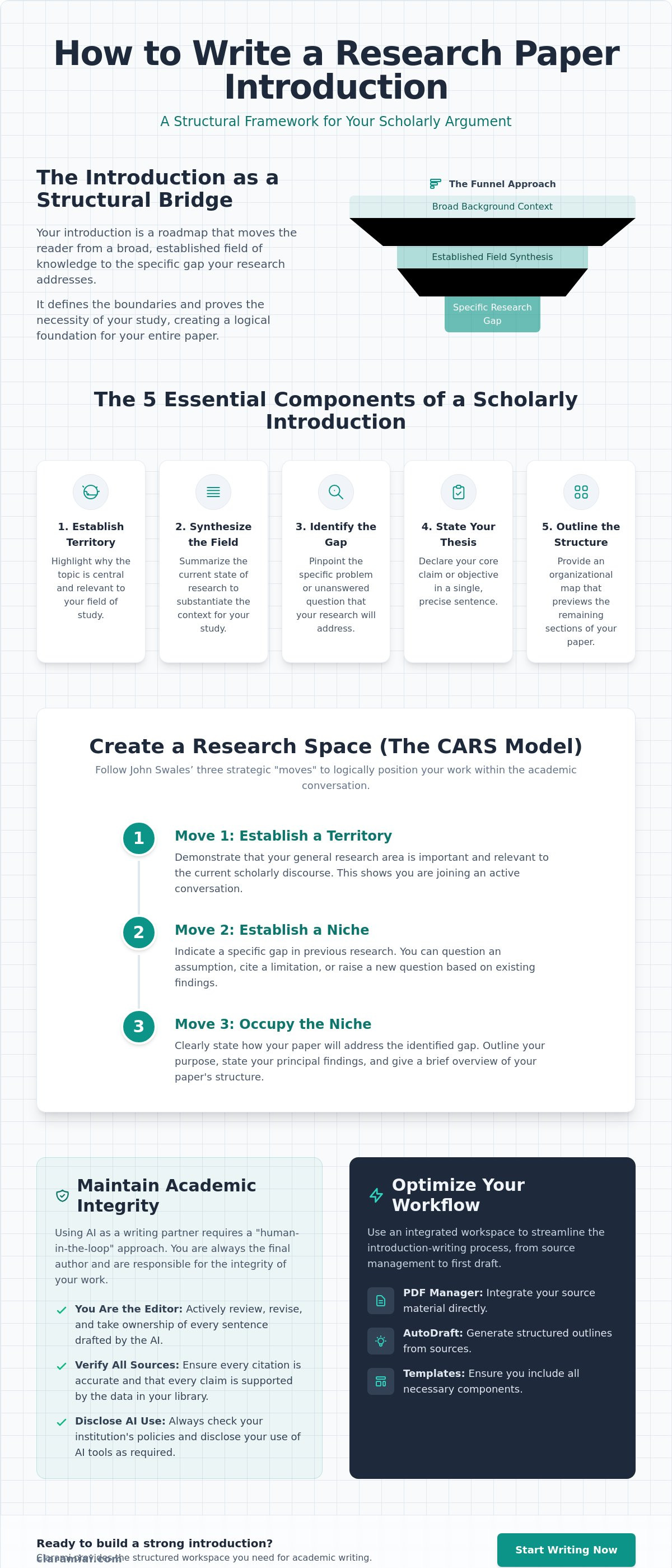
The introduction is the logical foundation of your scholarly argument. It functions as a roadmap. It defines boundaries. Your primary objective is to demonstrate that your research is necessary. Without a clear opening, your discussion section will likely lack coherence. Many students treat this as a creative exercise. It is actually a structural data-integration task. When you begin writing a research paper introduction, you are building the framework that supports your entire study.
Most academic disciplines follow the standard IMRAD structure, where the introduction sets the trajectory for the entire paper. It is not just a summary. It is a bridge. You are moving from what is already established to the specific gap your work addresses. This ensures your methodology and results have a clear context. A well-constructed introduction prevents structural issues in later sections. It anchors your argument. It provides a clear path for the reader to follow from your initial question to your final conclusion.
To better understand this concept, watch this helpful video:
### The difference between background and introductionBackground information provides general context. The introduction establishes a specific research trajectory. Don't write a mini-literature review in your opening paragraph. Instead, use the funnel approach. Start with the broad field. Narrow down to the specific problem. This prevents your reader from getting lost in irrelevant details. Within the Clarami workspace, you can use structured templates to ensure your background information remains concise and focused on the research gap. This methodical transition is essential for maintaining the reader's attention and establishing your authority as a researcher.
Academic integrity and the drafting process
The process of writing a research paper introduction requires a human-in-the-loop approach. You are responsible for every claim. Clarami helps you structure thoughts, but you are the final editor. Always disclose the use of AI tools in accordance with your institution’s policies. Check your specific school guidelines regarding AI-assisted drafting before beginning your work. Academic integrity is maintained when you remain the final editor of every sentence. Verification is your primary duty. You must ensure that every source cited is real and that every argument is supported by the data in your library. This disciplined approach ensures your work meets the high standards of professional scholarship.
The five essential components of a scholarly introduction
Writing a research paper introduction is a technical assembly of specific, high-utility parts. It is not a creative "hook" designed for entertainment. It is a structural necessity that requires five distinct elements to function correctly. You must first establish the research territory by highlighting why the topic is central to your field. This is followed by a synthesis of the current state of the field. You aren't just listing facts. You're substantiating the context for your study. Precision here prevents the reader from questioning the relevance of your work later in the document.
The University of Wisconsin–Madison emphasizes that drafting an engaging introduction involves more than just summarizing context; it requires a strategic promise of value. Once the territory is established, you must identify the "gap." This is the specific research problem or unanswered question that justifies your study's existence. Without a clearly defined gap, your research lacks a logical purpose. You then state your thesis or objectives clearly, followed by an organizational map that outlines the remaining sections of your paper. This sequence ensures structural integrity from the first page.
Creating a research space (The CARS Model)
John Swales’ CARS model remains the gold standard for academic introductions. It consists of three strategic "moves" that create a research space for your work. Move 1 involves establishing a territory by showing the topic is relevant and central to current scholarly discourse. Move 2 focuses on establishing a niche by indicating a specific gap or limitation in previous research. Finally, Move 3 involves occupying that niche by outlining exactly how your paper addresses the identified gap. Following this methodical progression ensures your introduction is grounded in existing evidence while clearly carving out a path for your new contributions.
Drafting a precise thesis statement
Your thesis statement is the anchor of your entire argument. It should be a single, declarative sentence that summarizes your core claim or finding. Avoid vague language or "filler" phrases. Use specific verbs that describe your methodology, such as "analyzes," "demonstrates," or "evaluates." The thesis must directly answer the research problem you identified in the previous section. It provides the reader with a clear destination. If you find yourself struggling to articulate this core claim, you can start your first draft in a structured workspace that helps you align your objectives with your supporting data.
The final component is the roadmap. This is a brief overview of how the paper is organized. It tells the reader what to expect in the methodology, results, and discussion sections. This transparency reduces cognitive load for the reader. It allows them to focus on your arguments rather than trying to guess the structure of your paper. By integrating these five components, you ensure that writing a research paper introduction becomes a repeatable, professional workflow rather than a source of anxiety.
Bridging the gap between background context and your research problem
The transition from what is known to what is unknown represents the most critical pivot in your paper. It's the moment you justify your study's existence. Many writers struggle here because they fail to connect their broad background to a specific research gap. You can use signal phrases like "However, few studies have addressed" or "While existing research focuses on X, there is a lack of data regarding Y." This demonstrates that you aren't just summarizing. You're engaging with the literature. When you are writing a research paper introduction, you must prioritize the connection between your sources and your unique claim.
According to a UCLA guide to writing research paper introductions, the goal is to lead the reader through a logical sequence that ends with your research question. You must maintain a professional and objective tone while critiquing existing work. Identify contradictions or limitations in previous studies. This isn't about dismissing others' work. It's about substantiating the need for your specific contribution. Precision in this phase prevents the reader from questioning the validity of your research problem later.
Connecting arguments to evidence in real time
The drafting process is often hindered by the friction of switching between browser tabs. You lose momentum when you have to dig through disorganized folders to find a single statistic. Keep your PDF library accessible while you draft. An integrated workspace like the Clarami workspace allows you to highlight relevant data and anchor your arguments in primary sources immediately. This ensures your summary of previous work is grounded in actual source material. It eliminates the risk of misrepresenting a researcher's findings because the evidence is always visible alongside your draft.
Avoiding the "generalization trap"
Vague claims weaken your authority. Don't make broad statements without specific citations to back them up. Focus on concrete data points that highlight why the current research is insufficient. If a previous study had a small sample size or an outdated methodology, state that clearly. Your goal is to write a single sentence that defines the problem your paper solves. This sentence acts as the final bridge before your thesis. It transforms a broad topic into a manageable research project. By focusing on these specific technical transitions, you ensure your introduction maintains structural integrity. You move beyond simple description. You enter the territory of critical analysis.
Drafting with precision: Maintaining integrity in the introduction phase
Precision is not an afterthought. It is a requirement of the drafting process. When you are writing a research paper introduction, you are making specific claims about the current state of knowledge. These claims must be substantiated. The human-in-the-loop model positions you as the final authority. AI can assist in structuring your thoughts. It can help bridge transitions. However, you are responsible for the accuracy of every sentence. This approach preserves your intellectual agency while utilizing technology to manage the cognitive load of composition.
Selection-level edits provide a methodical way to refine your work. Instead of regenerating an entire essay, you focus on specific paragraphs. This ensures your unique voice remains intact. You can use the In-App Editor to adjust a single sentence for clarity or impact. This granular control is essential for maintaining the structural integrity of your argument. It prevents the generic, flattened tone often associated with fully automated tools. You remain the primary architect of the narrative.
The risk of fabricated citations in AI drafting
Fabricated evidence is a primary concern in modern scholarship. General-purpose AI often invents DOIs or paper titles to fill structural gaps. These hallucinations are a direct threat to academic integrity. Source-grounded tools solve this by anchoring drafts in real, uploaded PDFs. Use the PDF Manager to organize your library before you begin. This ensures that every citation generated is traceable to a primary source. Always cross-reference your draft against your citation manager before finalizing the document. Verification is your most important task as a researcher.
Refining tone and clarity for scholarly audiences
Scholarly writing should be authoritative. It should be precise. It doesn't need to be overly complex. Use an academic writing tone checker online to ensure your scholarly voice remains consistent. Check for "tells" that suggest a draft was fully automated. These include repetitive sentence structures or a lack of specific data integration. A co-authored approach results in a more polished, professional output. It demonstrates a sophisticated engagement with the material. To begin building your source-grounded draft with full intellectual ownership, create your workspace account today.
Maintaining integrity while writing a research paper introduction requires constant vigilance. Factual claims must be checked against the source material. Academic integrity is not just about avoiding plagiarism. It is about the honest representation of data. By using tools that prioritize traceability, you reduce the risk of accidental misrepresentation. This disciplined workflow allows you to focus on the logical progression of your argument while the system manages the technical requirements of citation and structure.
Optimizing your introduction workflow within the Clarami workspace
Writing a research paper introduction is a technical task that requires a unified environment. You shouldn't be switching between a citation manager, a PDF reader, and a word processor. The process begins in the PDF Manager. Here, you organize your core evidence. This ensures every claim you make later is anchored in verified data. Once your library is set, use AutoDraft to create a structural outline. This tool analyzes your research gap and builds a framework based on academic standards. Using a dedicated AI writing tool for students that integrates research and drafting eliminates the friction of copy-pasting from external chat boxes.
Verification is the next logical step. You can't afford inaccuracies in your opening page. Use ClaimShield to verify claims instantly against your uploaded sources. This ensures your introduction is factually sound before you even finish the first draft. When you're ready to cite, the integrated Citation Generator builds perfectly formatted entries. It uses the real data from your PDFs. This prevents the hallucinated citations common in general-purpose AI tools. You maintain full control over the evidence used in your argument.
From research notes to first draft
Transitioning from notes to a narrative is often the most difficult part of the workflow. You can import your highlights directly into the editor. This keeps your evidence connected to your arguments. Use structured templates matched to academic rubrics to draft your CARS moves. These templates guide you through establishing territory and identifying the niche. If you hit a structural block, Clara provides source-grounded assistance. It doesn't write the paper for you. It suggests ways to connect your existing data points more effectively. You remain the final editor of every sentence. This human-in-the-loop approach ensures your intellectual ownership is never compromised.
Finalizing the draft for submission
The final phase involves polishing and exporting. Review your draft using the Tone Checker. It ensures you maintain a professional scholarly voice throughout the introduction. This tool identifies informal language or automated-sounding patterns. Once you're satisfied, export your work to DOCX or LaTeX. The system handles the complex formatting for APA or Chicago styles. Check the pricing page to see which plan fits your project needs. Whether you're an undergrad or a professional researcher, a systematic workflow ensures that writing a research paper introduction is a streamlined, accurate process.
Academic Integrity Disclaimer: Before submitting any work, please check your specific school or institutional policies regarding the use of AI assistants. Many universities require you to disclose the use of AI tools in your methodology or acknowledgments. Always ensure you are the final editor and responsible for the accuracy of all submitted content.
Building your scholarly foundation with precision
Mastering the process of writing a research paper introduction transforms a daunting task into a repeatable, professional workflow. You have learned to define the scope of your study and bridge the gap between existing literature and your unique research problem. By following the CARS model and maintaining a human-in-the-loop approach, you ensure every claim is substantiated and every transition is logical. Structural integrity is the result of methodical preparation and source-grounded drafting. This discipline prevents the common errors of generalization and citation inaccuracies.
Clarami provides the specialized tools to maintain this rigor without the stress of disorganized source material. You can utilize AutoDraft for structural outlines, ClaimShield for real-time verification, and the integrated Citation Generator for APA, MLA, or Chicago standards. This workspace keeps your evidence visible and your arguments anchored in primary sources. You remain the final editor of your scholarship. Your intellectual agency is the most valuable part of the composition process.
Start your next research paper in the Clarami workspace to establish a precise, verified foundation for your work. You have the framework and the tools. Now you can build your argument with calm assurance and complete academic integrity.
Frequently asked questions
How long should a research paper introduction be?
A research paper introduction should generally account for 10% to 15% of your total document length. For a 10-page assignment, this translates to approximately 1 to 1.5 pages. The specific length often varies based on the complexity of your topic and the breadth of background context required to justify your study. You must provide enough information to make the research problem understandable without overwhelming the reader with unnecessary detail or irrelevant historical data.
Can I use "I" in my research paper introduction?
The use of the first person depends entirely on your specific field of study and the requirements of your department. In the humanities, using "I" is frequently acceptable to state your position or define your research trajectory. Conversely, the sciences traditionally prefer the passive voice or third-person perspective to maintain an objective tone. You should always consult your department style guide or journal submission requirements before making a final decision on your writing style.
What is the difference between an abstract and an introduction?
An abstract is a concise summary of the entire paper, while the introduction is the first section that defines the problem and sets the stage for your argument. The abstract provides a quick overview of your methodology, results, and conclusions for readers who need an immediate summary. In contrast, writing a research paper introduction involves establishing a roadmap and research gap for the audience who intends to read the full study.
How do I find a "research gap" for my introduction?
You find a research gap by systematically reviewing existing literature to identify areas that are under-researched, contradictory, or outdated. A practical strategy involves examining the limitations or future research sections of recent scholarly papers. These sections explicitly state where further investigation is required. Identifying these gaps allows you to provide a clear justification for your own study. It ensures your work contributes new value to the field through a verified, evidence-based approach.
Is it okay to use AI to help write my introduction?
It is acceptable to use AI to assist with writing a research paper introduction as long as you adhere to your institution's academic integrity policies. You should treat AI as a structural assistant or drafting tool rather than a ghostwriter. You remain responsible for verifying every citation, editing the final prose, and ensuring the work reflects your intellectual contribution. Always check your university’s specific AI disclosure requirements before beginning your draft.
Related on Clarami
- Best AI writing tool for students (full guide) →
- AI academic integrity checklist →
- Clarami pricing: Free vs PRO vs Platinum →
- Editor vs ChatGPT for writing →
- Export DOCX, PDF, and hand-in checklist →
- How to outline a paper →
- Prompt to structured essay draft →
- Revise with AI on a selection →
- Sign up free →
- Clarami home →
- More guides on the Clarami blog →