Software for thematic analysis of literature: A guide to systematic synthesis
Find the best software for thematic analysis of literature. This guide offers a systematic workflow to code, synthesize, and verify research themes with inte...
Write with structure in Clarami AI
Editor-first AI drafting, citations, and two Workflows for student writing.
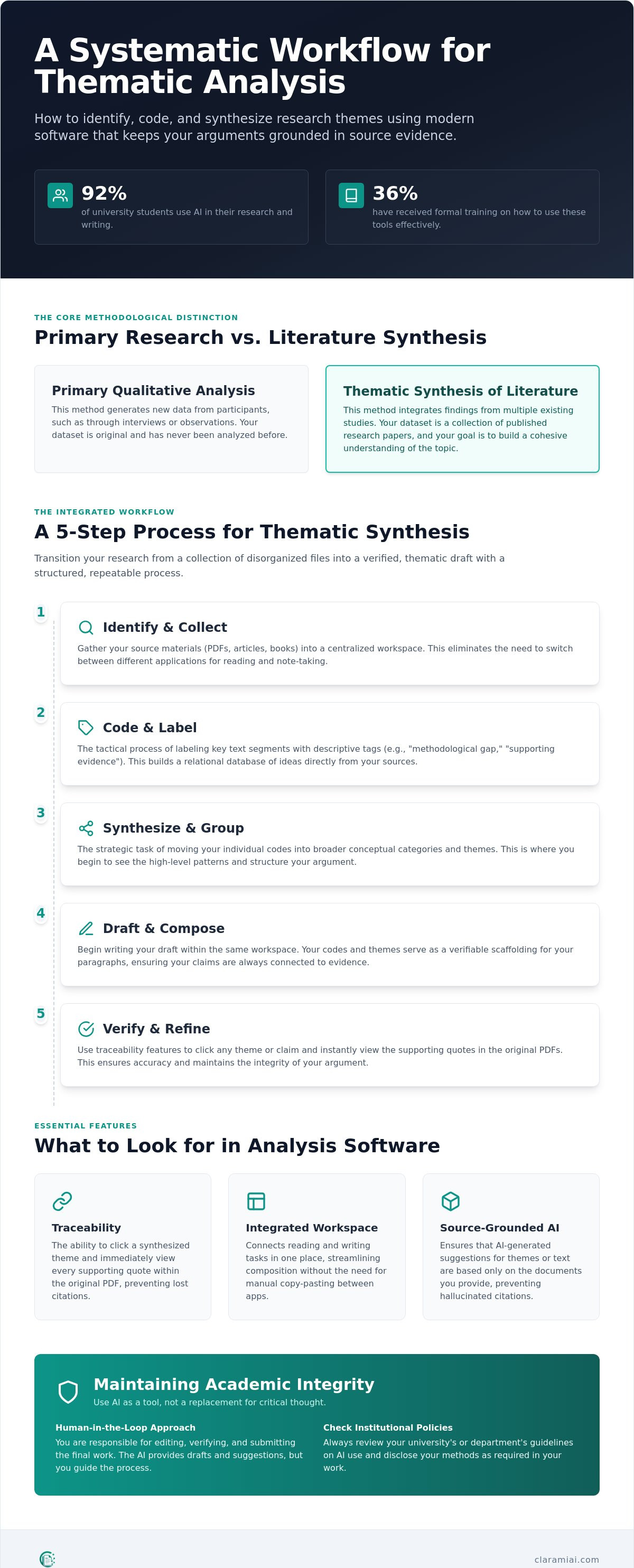
As of 2026, 92% of university students use AI in their research, yet only 36% have received formal training on how to use these tools effectively. While academic curricula catch up, platforms like IAB Academy are helping students bridge this gap by providing specialized education on using AI for data-intensive tasks like financial literacy and stock market fundamentals. When you are searching for the right software for thematic analysis of literature, you aren't just looking for a faster way to finish. You need a system that preserves the structural integrity of your arguments while managing the cognitive load of dozens of papers.
You likely know the stress of a disconnected workflow where reading a PDF feels entirely separate from writing your draft. It's easy to lose track of which paper supported which claim, especially when general AI tools often provide citations that don't exist. This guide explains how to identify, code, and synthesize research themes using modern software that keeps your arguments grounded in source evidence. You'll learn a systematic approach to literature synthesis that prioritizes verification and organizational cohesion.
Academic integrity notice: Always check your institutional policies regarding AI use and disclose the use of these tools in your methodology or acknowledgments as required.
Key Takeaways
- Distinguish between primary qualitative research and thematic synthesis to ensure your methodology remains rigorous and appropriate for your literature review.
- Evaluate the essential features required in software for thematic analysis of literature, specifically focusing on traceability and the ability to verify claims against original PDFs.
- Implement a structured five-step workflow that transitions your research from a collection of disorganized files into a verified, thematic draft.
- Maintain academic integrity by adopting a human-in-the-loop approach, using ClaimShield to prevent thematic drift and ensure your synthesis reflects the original author's intent.
- Streamline your composition process by using an integrated workspace that connects your reading and writing tasks without the need for manual data transfer.
Table of Contents
- What is thematic analysis of literature?
- Essential features for literature-based thematic analysis software
- Traditional CAQDAS vs. AI-integrated research workspaces
- A 5-step workflow for thematic synthesis of research papers
- Maintaining academic integrity while using AI for thematic analysis
What is thematic analysis of literature?
Thematic analysis is a foundational method for identifying, analyzing, and reporting patterns within a dataset. When you apply this method to literature, your dataset consists of existing research papers rather than primary interview transcripts. This distinction is essential for your methodology. While primary qualitative analysis generates new data from participants, literature-based thematic synthesis integrates findings from multiple studies to construct a cohesive understanding of a research area.
Many researchers treat literature reviews as a series of isolated summaries. This haphazard approach often leads to disconnected arguments and lost citations. Using dedicated software for thematic analysis of literature provides a systematic framework to organize your thoughts. It ensures your synthesis remains anchored in the source material, which is critical for the structural integrity of a dissertation or thesis.
To better understand how thematic analysis is applied in digital tools, watch this helpful guide:
Software for thematic analysis of literature functions as a reliable intellectual companion. It manages the logistical burden of sorting through hundreds of pages so you can focus on high-level interpretation. Instead of searching for a specific quote across multiple files, you can access all relevant evidence instantly. This immediate availability of supporting data reduces the cognitive load of multi-paper analysis and allows you to maintain momentum during the writing process.The difference between coding and synthesis
Coding is the tactical process of labeling text segments with descriptive tags. You might label a sentence as a "theoretical gap" or "sampling bias." Synthesis is the strategic task of moving these tags into broader conceptual categories. Within the Clarami workspace, this transition is seamless. You aren't just highlighting text; you're building a relational database of ideas. When you begin your draft, these codes serve as the scaffolding for your paragraphs, providing a verified foundation of source-grounded evidence.
When to use thematic analysis software for research
Manual tracking becomes a liability once your literature set exceeds twenty or thirty papers. Systematic reviews require a level of transparency and reproducibility that manual note-taking simply cannot sustain. If you're managing a high volume of sources, software reduces the cognitive load by centralizing your data and metadata. Collaborative projects also benefit from a shared environment. It ensures all contributors adhere to the same coding standards and can verify each other's interpretations in real-time without manual data transfer.
Essential features for literature-based thematic analysis software
Literature-based research requires a specialized feature set that differs from traditional qualitative field studies. You need tools that prioritize the extraction of methodology and the substantiation of claims over simple word frequency counts. Effective software for thematic analysis of literature must provide a direct, visible link between your synthesized themes and the primary sources within a unified workspace. This structural connection ensures your arguments remain grounded in evidence throughout the writing process.
Traceability is the hallmark of a rigorous review. When you categorize a concept like "methodological bias," the software should allow you to click that theme and immediately view every supporting quote within the original PDF. This prevents the common frustration of remembering a brilliant point but forgetting which paper contained it. A Practical, Step-by-Step Guide to thematic analysis highlights how this level of organization supports academic rigor.
Source-grounded AI acts as an intellectual companion by referencing only the verified documents in your library. Unlike general-purpose tools that often hallucinate citations, these models extract information exclusively from your primary sources. If you're ready to move beyond disconnected workflows, you can create a free account to see how an integrated workspace maintains the integrity of your data.
Verification and structural integrity
Claim verification is your primary defense against academic misinformation. A central PDF Manager is essential for maintaining a single source of truth. By anchoring every statement in a primary document, you ensure organizational cohesion. This systematic order allows you to verify the structural integrity of your arguments before you submit your work. It's a methodical approach that respects your intellectual agency while reducing the stress of disorganized source material.
Collaboration and suggest-mode
Sharing your progress with a supervisor requires a disciplined feedback loop. Clarami's suggest-mode allows co-authors to propose refinements to thematic definitions without altering your original analysis. This collaborative rhythm ensures your codebook remains precise and verified. Managing your software for thematic analysis of literature within a shared environment eliminates the need for disconnected emails or fragmented document versions. You can maintain a linear, focused workflow that leads to a polished, verified output.
Traditional CAQDAS vs. AI-integrated research workspaces
Traditional Computer-Assisted Qualitative Data Analysis Software (CAQDAS), such as NVivo 15 or MAXQDA 26.3, was originally built for the granular, manual coding of participant interviews. These platforms are excellent for small datasets where every line of human speech requires deep interpretive labor. However, when you apply these tools to a literature review, you often encounter a significant bottleneck. Manually coding fifty peer-reviewed articles can take weeks of professional labor. This creates an unnecessary delay in your synthesis process.
AI-integrated workspaces like Clarami focus on rapid synthesis and drafting for large literature libraries. They address the "silo problem" that plagues traditional research tools. In a siloed workflow, your analysis lives in one application while your draft lives in another. This separation forces you to jump between windows, breaking your concentration and increasing the risk of data loss. Modern software for thematic analysis of literature should function as a unified environment where your PDF library and your document editor exist side by side.
This demand for unified data environments is mirrored in specialized industrial sectors; for instance, the food processing and wholesale industry relies on Clæver Systems to integrate complex trade and production workflows into a single, specialized ERP platform.
Cost and accessibility also distinguish these two approaches. Student licenses for traditional software often start around $99 or $130 per year, while perpetual academic licenses can exceed $1,200. For independent scholars or students on a budget, these costs are a barrier to entry. An integrated research workspace provides a more accessible entry point, offering sophisticated tools without the steep learning curve or the high price tag of legacy platforms.
The end of the copy-paste workflow
Moving data between a coding tool and a word processor is a primary source of citation errors. When you copy a quote from a traditional analysis tool, you often lose the metadata associated with the author or page number. This leads to disorganized drafts and potential plagiarism risks. An integrated workspace eliminates this friction. By using a citation helper directly in your drafting window, you maintain a structural connection between the theme and its source. You don't need to leave your editor to verify a claim; the evidence is immediately available within your workspace. This organizational cohesion ensures your final output is accurate and verified.
Choosing the right tool for your project phase
Your choice of tool should depend on the specific requirements of your research phase. Manual coding remains the standard for deep, interpretive qualitative research where the researcher's subjective lens is the primary instrument of analysis. However, if you're conducting a systematic literature review or a scoping study, AI-assisted synthesis is significantly more efficient. You can use Clara to identify recurring concepts across multiple documents simultaneously, ensuring your arguments are grounded in the full breadth of your library. For more detail, read our guide on choosing an AI research assistant tool for systematic scholarly work.
Academic integrity notice: Always check your institutional policies regarding AI use and disclose the use of these tools in your methodology or acknowledgments as required.
A 5-step workflow for thematic synthesis of research papers
Systematic synthesis requires more than just reading. It demands a disciplined progression from raw data to verified narrative. When you use software for thematic analysis of literature, you replace intuition with a repeatable process. This workflow ensures that every theme you identify remains structurally connected to its source.
- Step 1: Centralize your library. Upload your research papers into the PDF Manager. Ensure your metadata is complete, as this forms the foundation for your automated citations.
- Step 2: Identify recurring concepts. Use Clara to scan your entire library simultaneously. Instead of reading sequentially, you can ask questions that cut across dozens of documents to surface patterns in methodology or findings.
- Step 3: Organize highlights. Move your identified patterns into a synthesis matrix. This thematic outline serves as the scaffolding for your eventual draft.
- Step 4: Generate a first draft. Use AutoDraft to convert your thematic notes into structured paragraphs. This tool provides a starting point, allowing you to focus on refining the argument rather than staring at a blank page.
- Step 5: Verify every claim. This is the most critical stage. Use ClaimShield to cross-reference your draft against the original PDFs. You must ensure that no thematic drift has occurred and that the author's intent remains intact.
By following these steps, you maintain a human-in-the-loop approach. The software provides the draft, but you remain the ultimate authority on the content. To begin building your own synthesis matrix, set up your research workspace today.
Organizing sources per project
Focus is the primary requirement for successful synthesis. Creating specific reference collections allows you to isolate papers relevant to a single chapter or research question. This prevents thematic overlap and keeps your analysis precise. For more guidance on managing large datasets, consult our guide to systematic literature review software 2026. Accurate metadata during this stage is not just a clerical task; it's the mechanism that ensures your citations are verified and error-free.
Refining themes with AI assistance
Clara acts as a methodical expert during the refinement phase. You can prompt the assistant to compare methodologies across five specific papers or extract patterns sentence-by-sentence. This level of precision is impossible with manual note-taking alone. If a thematic category feels too broad, use selection-level edits to rewrite specific paragraphs. This allows you to fine-tune the wording of your synthesis without losing the connection to the underlying data. Every edit you make is a meta-demonstration of your intellectual agency.
Academic integrity notice: Always check your institutional policies regarding AI use and disclose the use of these tools in your methodology or acknowledgments as required.
Maintaining academic integrity while using AI for thematic analysis
Academic integrity in the age of artificial intelligence requires a commitment to transparency and verification. When you utilize software for thematic analysis of literature, you remain the primary intellectual agent. AI tools function as sophisticated assistants that manage the structural load of your research, but they cannot replace your interpretive judgment. This human-in-the-loop requirement is essential. You must approve every thematic summary and verify that the synthesis aligns with the original data. You don't have to rely on general tools that treat data management as a secondary feature; instead, you can use a purpose-built workspace that respects your agency.
A significant risk in automated analysis is thematic drift, where a model might oversimplify or misinterpret an author's nuance. You can mitigate this risk by using ClaimShield to cross-reference your draft against your uploaded PDFs. This tool ensures your synthesis does not drift from the original intent of the source material. By maintaining a direct link between your claims and the evidence, you uphold the structural integrity of your scholarly work. This methodical approach alleviates the anxiety associated with potential inaccuracies in your final manuscript.
Transparency in your methodology is equally important. When writing your research paper, describe your use of software clearly. Detail how you used the tool for initial pattern identification and how you subsequently verified those patterns manually. Checking your specific institutional policies on AI usage is a non-negotiable step. As of 2026, many university policies have moved beyond blanket bans to more nuanced approaches that require disclosure and integration as a teaching tool.
The academic integrity disclaimer
Always remember that AI tools are research assistants, not authors. Major publishers like Elsevier and Springer Nature strictly prohibit listing AI as an author on research papers. You should disclose your use of software for thematic analysis of literature in your methodology or acknowledgments section. Manual verification remains your responsibility. You must check every citation to ensure it exists and is contextually relevant to your argument. Avoid relying on general AI tools that might hallucinate citations; instead, use tools that surface real sources from your own library.
Building a verified dissertation draft
Moving from disorganized research notes to a polished draft is a rigorous cognitive process. You can use the Clara AI Assistant to find specific methodology details or theoretical gaps within your existing library. This allows you to build a draft that reflects your unique scholarly voice while staying anchored in evidence. The final review should occur within the integrated editor, where you can check for tone, clarity, and citation accuracy. This methodical approach transforms the stress of composition into a steady, predictable workflow.
Academic integrity notice: Always check your institutional policies regarding AI use and disclose the use of these tools in your methodology or acknowledgments as required.
Mastering your systematic synthesis
Thematic synthesis is a rigorous intellectual process that requires both precision and organizational cohesion. By transitioning from manual, disconnected notes to a purpose-built workspace, you ensure that every argument remains anchored in source-grounded evidence. Effective software for thematic analysis of literature does more than just organize files; it bridges the gap between reading a PDF and writing a verified draft. This systematic order allows you to maintain your scholarly voice while leveraging the efficiency of modern research tools.
Your research journey should be defined by transparency and verification. With an integrated PDF manager and editor, you eliminate the risk of data loss and citation errors. You can rely on automated citation building for APA and Chicago styles, ensuring your bibliography is as accurate as your analysis. It's important to remember that you remain the ultimate authority in this workflow. By maintaining a human-in-the-loop approach, you produce work that is both efficient and ethically sound.
If you're ready to centralize your library and the substantiation of your claims, start your systematic research with Clarami today. You'll gain access to a source-grounded AI assistant designed to help you synthesize complex literature with calm assurance. Your next breakthrough is waiting within a more organized workspace.
Academic integrity notice: Always check your institutional policies regarding AI use and disclose the use of these tools in your methodology or acknowledgments as required.
Frequently Asked Questions
Is using software for thematic analysis considered cheating in a dissertation?
No, using software to organize and code your literature is a standard academic practice. Most universities encourage using specialized tools to ensure methodological rigor and organizational cohesion. However, you must remain the primary interpreter of the results and disclose the software in your methodology section. Always check your specific department guidelines to ensure compliance with local policies regarding AI and research assistants.
How does AI help in identifying themes across research papers?
AI helps by scanning multiple documents simultaneously to surface recurring concepts, linguistic patterns, and theoretical gaps. Instead of reading each paper in isolation, you can use these tools to extract methodology or findings across your entire library. This process provides a starting point for your synthesis. You then refine these patterns through manual coding and critical evaluation within a unified research workspace.
This type of pattern identification and automated processing is also being applied in commercial contexts. For example, Global AI Reps utilizes specialized digital representatives to automate lead generation and sales, demonstrating how AI can handle data-intensive workflows across different professional fields.
What is the best software for thematic analysis of literature in 2026?
The best software for thematic analysis of literature depends on your project's scale and your need for integrated drafting. Traditional CAQDAS tools like NVivo 15 or MAXQDA 26.3 are effective for granular manual coding of small datasets. For researchers who require a unified environment that connects reading and writing, AI-integrated workspaces like Clarami provide a more streamlined, source-grounded approach to synthesis and claim verification.
Can I use software to generate a literature review automatically?
You should not use software to generate an entire literature review automatically, as this violates most academic integrity policies. While AutoDraft provides initial thematic summaries, you're responsible for the final submission. Using an integrated editor allows you to refine these drafts paragraph by paragraph. This human-in-the-loop approach ensures the final argument remains your own and stays fully substantiated by real sources from your PDF library.
How do I ensure my thematic analysis is rigorous and transparent?
Rigor is maintained through traceability and the substantiation of every claim against primary sources. You should keep a detailed codebook and use software that allows you to click a theme to see its supporting evidence in the original PDF. Transparency is achieved by documenting your workflow, including how themes were identified and verified using your software for thematic analysis of literature. This systematic order ensures your arguments are grounded in source evidence.
What is the difference between thematic analysis and a systematic review?
Thematic analysis is a qualitative method used to identify patterns within data, while a systematic review is a broader research design following a strict protocol. You can use thematic analysis as the synthesis method within a systematic review. While a systematic review requires exhaustive searching and screening of papers, thematic analysis focuses on the interpretive process of categorizing findings and building a cohesive narrative.
Academic integrity notice: Always check your institutional policies regarding AI use and disclose the use of these tools in your methodology or acknowledgments as required.
Related on Clarami
- Best AI writing tool for students (full guide) →
- AI academic integrity checklist →
- Clarami pricing: Free vs PRO vs Platinum →
- Editor vs ChatGPT for writing →
- Export DOCX, PDF, and hand-in checklist →
- How to outline a paper →
- Prompt to structured essay draft →
- Revise with AI on a selection →
- Sign up free →
- Clarami home →
- More guides on the Clarami blog →