How to write a dissertation proposal: A systematic guide for researchers
Our guide on how to write a dissertation proposal provides a step-by-step process to transform your research notes into a well-structured, approvable plan.
Write with structure in Clarami AI
Editor-first AI drafting, citations, and two Workflows for student writing.
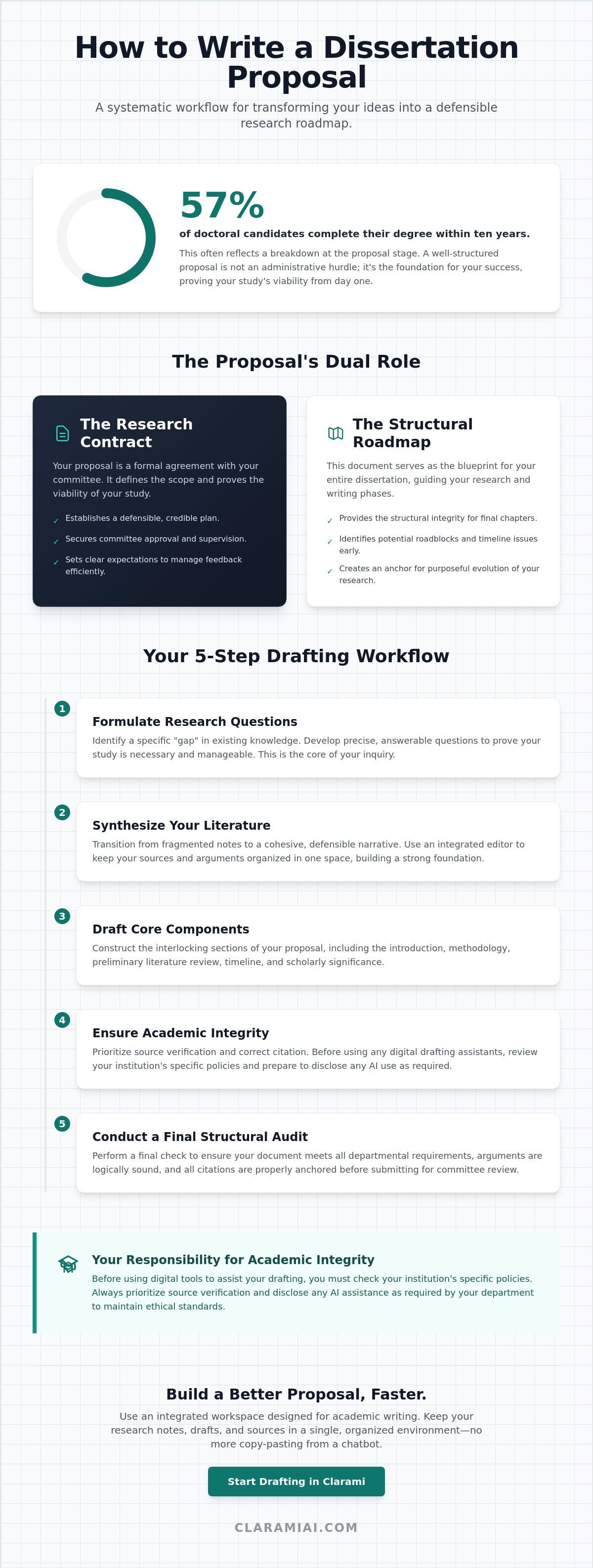
Approximately 57% of doctoral candidates complete their degree within ten years. This statistic often reflects a breakdown during the earliest stage of the process: the proposal. You might feel paralyzed by the scope of your literature review or anxious that a committee member will uncover a methodological flaw. It's common to struggle with disorganized research notes and source materials that don't yet feel like a cohesive argument. Learning how to write a dissertation proposal is about more than following a department checklist; it's about building a defensible contract between your vision and your committee's expectations.
This guide provides a systematic workflow to transform your initial ideas into a well-structured roadmap. You'll learn how to construct a proposal that secures approval and provides the structural integrity needed for your final chapters. We'll cover a step-by-step drafting process and a structural template that ensures your research questions are substantiable. Academic Integrity Disclaimer: Before using any digital tools to assist your drafting, check your institution's specific policies and disclose any AI assistance as required by your department.
Key Takeaways
- Establish the proposal as a formal research contract that proves the viability of your study and provides a structural roadmap for your committee.
- Master the systematic process of how to write a dissertation proposal by formulating precise, answerable research questions that address verified knowledge gaps.
- Develop a workflow for transitioning from fragmented literature review notes to a cohesive, defensible narrative within an integrated document editor.
- Maintain academic integrity by prioritizing source verification and following institutional disclosure policies for digital assistants.
- Conduct a final structural audit to ensure your document meets departmental requirements and contains properly anchored citations.
Table of Contents
- Understanding the purpose and scope of a dissertation proposal
- Core components of a successful research prospectus
- Transitioning from literature synthesis to a structured draft
- Ensuring academic integrity and source verification
- Finalizing the proposal for committee review
Understanding the purpose and scope of a dissertation proposal
A dissertation proposal is more than an administrative hurdle. It's a formal document that defines your research questions, your chosen methodology, and the scholarly significance of your work. By Understanding the Purpose of a Research Proposal, you establish the foundation for a defensible study. This document serves as a structural roadmap. It bridges the gap between your initial inquiry and the final, thousands-of-words-long dissertation. Mastering how to write a dissertation proposal requires you to view it as a blueprint for your future chapters rather than a simple summary of intent.
To better understand this concept, watch this helpful video:
Beyond being a snapshot of your study, the proposal is your primary tool for securing committee approval and a dedicated supervisor. It allows your department to verify that your project is viable, ethical, and within the scope of your program. While it sets your direction, it isn't a rigid contract. Research often evolves as you collect data or encounter new literature. Your proposal provides the anchor for that evolution, ensuring you don't drift too far from your core objectives as you begin the labor of drafting.Research is a dynamic process. As you engage with primary sources or preliminary data, your focus might shift. The proposal isn't a trap; it's a guide. It allows you to pivot with purpose rather than wandering aimlessly through your data set. This document ensures that every change you make later is grounded in your original logic.
The proposal as a research roadmap
A successful proposal identifies potential roadblocks before you invest years of labor. It establishes a clear timeline for your research and writing phases. By aligning your project goals with departmental requirements from the start, you avoid structural failures later. Using an integrated document editor helps you maintain this alignment by keeping your methodology and research notes in a single, organized space. This systematic approach ensures that you aren't just writing; you're building a verifiable path to completion.
Managing the student-committee relationship
You use the proposal to set clear expectations with your advisor. It's a professional document that builds your credibility as a researcher. Addressing committee feedback during this stage is far more efficient than making major revisions during the final defense. This professional credibility is essential when you request resources or access to specific archives. A committee that trusts your preparation is more likely to advocate for your project during departmental reviews. They see you as a peer who respects the structural rigors of the academy.
Academic Integrity Disclaimer: Always check your institution’s specific policy on AI use and disclose its application in your research process.
Core components of a successful research prospectus
A successful research prospectus is not a collection of isolated chapters. It's a unified argument. When you learn how to write a dissertation proposal, you're learning to synchronize your inquiry with your execution. You start by establishing the research problem. This isn't just a topic. It's a specific "gap" in existing knowledge that your work intends to fill. Your committee needs to see that your study is both necessary and manageable within the constraints of your program.
Scholarly research requires a disciplined framework. Following A Systematic Approach to Proposal Writing ensures that your prospectus meets the rigorous standards of your committee. This approach anchors your arguments in verified data and logical progression. It transforms a vague interest into a defensible claim. To achieve this, your proposal must contain several interlocking components:
- Research Questions and Objectives: Precise, answerable inquiries that dictate your data collection and analysis.
- Literature Review: A synthesis that demonstrates your command of the field and the theoretical framework you'll use.
- Methodology: A technical blueprint detailing your specific data collection and analysis techniques.
- Significance and Limitations: A clear explanation of why your study matters and a transparent look at its boundaries.
Crafting a precise research problem
Identifying a gap in the literature is the first step toward substantiating your research. You must move from a broad interest to a narrow, researchable problem statement. For example, a broad interest in "educational technology" is too wide for a dissertation. A specific problem statement regarding "synchronous feedback loops in ESL environments" provides a clear target. This precision ensures your problem statement leads logically to your research questions. It prevents you from collecting data that you cannot use.
Methodological rigor and feasibility
Your methodology section is the technical heart of your proposal. You need to choose between qualitative, quantitative, or mixed-methods approaches based on what your questions require. Justifying your choice is essential. You must also address the practical feasibility of your data collection plan. If your study requires 200 longitudinal interviews but you only have six months, your committee will flag it as unrealistic. Using a structured research workspace allows you to map these requirements early, ensuring your plan is as practical as it is rigorous.
Academic Integrity Disclaimer: Always check your institution’s specific policy on AI use and disclose its application in your research process.
Transitioning from literature synthesis to a structured draft
The gap between reading and writing is often filled with anxiety. You've collected hundreds of sources. You've highlighted thousands of lines across dozens of PDFs. Yet, the page remains blank. Learning how to write a dissertation proposal involves bridging this gap through a systematic organization of your evidence. A disorganized library leads to a disorganized draft. You must ensure that every claim you make is anchored in a primary source from the start. This prevents the "hallucinations" common in general-purpose tools and ensures your work remains defensible.
Success depends on choosing an ai research assistant tool that treats your sources as the foundation of the workspace. Unlike general-purpose platforms that rely on external, unverified data, a specialized scholarly tool focuses on the structural connection between your statement and your supporting evidence. This approach eliminates the need to copy-paste between disconnected windows, allowing you to maintain focus on the logical progression of your argument. It creates a calm, focused environment for synthesis.
Organizing research references and PDFs
A PDF Manager is essential for this workflow. You should categorize your sources by theme, methodology, or theoretical framework rather than just by author name. This allows you to extract key claims and build a synthesis matrix. A matrix helps you see where authors agree or where a "gap" in the literature actually exists. Maintaining a searchable database of evidence ensures that when you reach the drafting phase, your citations are already mapped to specific proposal sections. Data extraction. Claim verification. Logical anchoring.
Drafting with integrated research tools
Integrated editors offer a significant advantage over chat interfaces. When your editor is connected to your library, you can use Clara to locate specific evidence within your uploaded files without leaving the document. This "human-in-the-loop" process ensures you remain the primary architect of the work. Moving from a high-level outline to a granular first draft is the most technical part of how to write a dissertation proposal. By utilizing selection-level edits, you can refine individual paragraphs for tone and clarity while keeping your original research anchors intact.
Academic Integrity Disclaimer: Always check your institution’s specific policy on AI use and disclose its application in your research process.
Ensuring academic integrity and source verification
Academic Integrity Disclaimer: Always check your institution’s specific policy on AI use and disclose its application in your research process.
Maintaining integrity is the most critical aspect of the research process. You must ensure that your dissertation proposal is a true reflection of your own intellectual labor. General-purpose AI tools often provide plausible-sounding but entirely fabricated data. These hallucinations pose a significant risk to your academic standing. When you're focused on how to write a dissertation proposal, you can't afford the technical inaccuracies of unverified tools. You're the final authority on your document. Every claim must be traced back to its origin in the primary literature.
A "human-in-the-loop" framework ensures that you remain in control of the drafting process. In this model, you use digital assistants to organize and synthesize, but you perform the final verification. This disciplined approach is essential for understanding how to write a dissertation proposal that meets ethics-focused standards. It prevents the accidental inclusion of bias or misinformation. It shifts the focus from automated generation to systematic verification. Your goal is a polished, verified output that stands up to the closest scrutiny of your committee members.
Verifying claims against primary sources
Scholarly accuracy requires a rigorous audit of every citation. You should follow established techniques for how to verify ai citations to ensure your bibliography is sound. Using ClaimShield allows you to cross-reference your draft against your uploaded source library in real time. This tool highlights where a statement lacks a direct connection to your data. Always check DOIs and publication metadata manually before you finalize your submission. Verification is a non-negotiable step in the scholarly workflow.
Maintaining your scholarly voice
Your committee wants to see your intellectual agency, not a generic, automated tone. Avoid generating whole chapters at once. Instead, use selection-level edits to refine specific paragraphs for clarity and flow. This ensures your theoretical framework reflects your own unique perspective on the research problem. By focusing on small, granular improvements, you maintain the structural integrity of your argument. Your voice should be authoritative, precise, and anchored in the evidence you've collected throughout your literature review. Don't let the tool replace your own cognitive labor.
Ready to build a proposal that is both defensible and accurate? Create your research workspace today and start drafting with verified sources.
Finalizing the proposal for committee review
Finalizing your draft is a process of rigorous auditing. You must verify that your proposal satisfies every departmental requirement before you hit submit. Review your draft for clarity, precision, and an appropriate academic tone. This final stage of learning how to write a dissertation proposal ensures your document is ready for the scrutiny of a committee feedback session. You aren't just checking for typos. You're verifying the structural integrity of your entire research plan. Technical accuracy. Professional standards. Verified output.
Preparation for the proposal defense starts with a meticulous review of your logic. Ensure your research questions still align perfectly with your methodology. If you've pivoted during the drafting process, update your significance section to reflect those changes. A polished proposal builds the committee's confidence in your ability to execute the full study. It demonstrates that you've mastered the professional standards of your discipline. You're presenting yourself as a peer who respects the rigors of scholarly labor.
Automated citation and bibliography management
Technical accuracy in your bibliography is non-negotiable. You can use an integrated Citation Generator to format your references according to APA 7th Edition, MLA 9th Edition, or the Chicago Manual of Style 18th Edition. These tools ensure consistency between your in-text citations and your final reference list. Once you've verified every entry, you can export your proposal to DOCX or LaTeX for final submission. This systematic approach eliminates the risk of manual formatting errors that could undermine your credibility. Organizational cohesion. Traceable evidence.
Refining tone and clarity
Scholarly writing should be authoritative and direct. Use a Draft Tone Checker to identify and eliminate filler phrases that weaken your arguments. Focus on creating logical transitions between your methodology and your theoretical framework. Sharing your progress within a collaborative workspace allows for precise feedback from peers or advisors. This "human-in-the-loop" refinement ensures your intellectual agency remains the focus of the document. You're the architect of the argument; the tools simply help you polish the structure. Clear narratives lead to faster approvals.
Effective finalization is the last step in how to write a dissertation proposal that secures immediate committee support. By the time you reach the review session, your document should be a verified, defensible roadmap. You've transitioned from disorganized notes to a polished scholarly contribution. Now, you're ready to begin the actual research with a clear path forward.
Academic Integrity Disclaimer: Always check your institution’s specific policy on AI use and disclose its application in your research process.
Securing your research roadmap
Constructing a defensible prospectus is the first technical milestone of your doctoral journey. You've seen that mastering how to write a dissertation proposal requires more than a list of chapters. It demands a systematic transition from fragmented highlights to a unified, source-grounded argument. By prioritizing methodological rigor and ethical verification, you establish a roadmap that guides your research and builds committee trust from the start.
The labor of synthesis is easier when your workspace respects your intellectual agency. You can maintain structural integrity by utilizing an integrated editor that keeps your evidence immediately available. Use ClaimShield technology to verify the accuracy of your claims against your primary library in real time. With automated citation building for APA and Chicago, you can ensure your bibliography meets the highest professional standards without the stress of manual formatting.
Academic Integrity Disclaimer: Always check your institution’s specific policy on AI use and disclose its application in your research process.
Start your dissertation proposal in the Clarami workspace to transform your research notes into a polished, defensible draft. You've the expertise to conduct the study. Let the right environment support your progress.
Frequently asked questions
What is the typical length of a dissertation proposal?
A dissertation proposal typically ranges from 10 to 20 pages. This length varies significantly by academic discipline and specific departmental requirements. STEM proposals might be shorter and more focused on experimental design, while humanities proposals often require more extensive literature reviews. Always prioritize your department's handbook over general guidelines to ensure you meet technical expectations.
Can I change my research topic after the proposal is approved?
You can change your research topic after approval, but it usually requires formal notification or a new defense. Minor adjustments to the methodology or scope are common as data collection progresses. Significant shifts in the core research question often necessitate a revised proposal to ensure your committee still supports the project's viability and scholarly significance.
How do I choose a methodology for my proposal?
Your methodology depends entirely on the nature of your research questions and the type of data you need. Quantitative methods suit studies testing hypotheses with numerical data, while qualitative methods are better for exploring lived experiences. When you learn how to write a dissertation proposal, you'll see that justifying your choice based on your data collection plan is a critical step.
Should I use AI to write my dissertation proposal?
You should only use AI as a structured assistant for synthesis and organization, never for ghostwriting. Academic integrity requires you to be the primary author of every claim. Use digital assistants for selection-level edits or finding evidence within your library. Academic Integrity Disclaimer: Always check your institution’s specific policy on AI use and disclose its application in your research process.
What is the difference between a dissertation proposal and a prospectus?
Many institutions use the terms proposal and prospectus interchangeably. However, some departments define a prospectus as a shorter preliminary document used to find an advisor. The proposal is usually the more formal, detailed roadmap that requires committee approval before you can advance to candidacy. Understanding these nuances is part of learning how to write a dissertation proposal effectively.
How do I cite sources in a dissertation proposal?
Citing sources requires strict adherence to your department's preferred style, such as APA 7th Edition or Chicago 18th Edition. You should use a Citation Generator that integrates directly with your editor to maintain consistency. This prevents discrepancies between your in-text citations and your final reference list, ensuring your work meets the technical standards for academic verification and structural integrity.
Related on Clarami
- Best AI writing tool for students (full guide) →
- AI academic integrity checklist →
- Clarami pricing: Free vs PRO vs Platinum →
- Editor vs ChatGPT for writing →
- Export DOCX, PDF, and hand-in checklist →
- How to outline a paper →
- Prompt to structured essay draft →
- Revise with AI on a selection →
- Sign up free →
- Clarami home →
- More guides on the Clarami blog →