
How to make a thesis statement: A research-grounded approach
Discover a step-by-step process to make a thesis statement. Learn to build a defensible claim from your research and create a roadmap for your essay.
Write with structure in Clarami AI
Editor-first AI drafting, citations, and two Workflows for student writing.
What if your thesis statement wasn't just a sentence you wrote at the end of a long night, but a structural anchor that held your entire argument together? You likely know the frustration of staring at a mountain of research notes and wondering how to condense dozens of sources into one defensible claim. It's often difficult to narrow a broad topic into a specific argument without losing the nuance of your evidence. When you set out to make a thesis statement, you aren't just summarizing a topic. You're building a foundation for every paragraph that follows.
This article provides a methodical process to help you craft a clear, one-sentence condensation of your argument. You'll learn how to anchor your claims in primary sources, build a logical roadmap, and maintain structural integrity. By grounding your writing in verified data, you can move forward with the confidence that your assertions are substantiatable. Academic integrity is paramount. Always check your institution's specific policies regarding AI tools and ensure you disclose their use where required.
Key Takeaways
- Identify the three core elements of a defensible thesis: the claim, the evidence categories, and the significance of the argument.
- Follow a methodical, research-grounded process to make a thesis statement by distilling your research question into a single, focused assertion.
- Apply the "Opposing Viewpoint" test to verify that your argument is debatable and possesses structural integrity.
- Synthesize recurring themes from your PDF highlights to ensure your claim is anchored in verified evidence rather than general observations.
- Utilize a roadmap approach to signal the direction of your research and establish a logical thread for your body paragraphs.
Table of Contents
- Understanding the role of a thesis statement in academic research
- The anatomy of a defensible thesis statement
- A research-driven process to make a thesis statement
- Refining and testing your thesis for structural integrity
- Elevating your thesis with the Clarami research workspace
Understanding the role of a thesis statement in academic research
A thesis statement acts as the intellectual foundation of your entire paper. It's a one or two sentence summary that encapsulates your primary claim and the evidence you'll use to support it. When you investigate what is a thesis statement, you'll find it's essentially a roadmap for your reader. It signals the specific direction your research will take and ensures your audience knows exactly what you intend to prove. In scholarly writing, this statement must be more than a simple observation or a statement of fact. It needs to be a debatable assertion that requires substantiation through rigorous data and logical analysis.
Academic integrity is a core component of the writing process. If you use AI tools to help synthesize your research or generate drafts, you must disclose this use and follow the specific policies set by your institution. Responsible scholarship relies on transparency and the verification of all claims.
To better understand this concept, watch this helpful video:
### Why your essay needs a clear argumentA strong thesis prevents "scope creep" by defining the boundaries of your investigation. Without a specific claim, you might feel pressured to include every piece of data you found during your research phase. This often leads to disorganized drafts and diluted arguments. A clear argument limits the evidence you need to present to only what's necessary to prove your point. This creates a structural framework that dictates the logical order of your body paragraphs. By establishing a central claim early, you move away from merely descriptive writing and toward the analytical depth expected in professional and academic environments. It forces you to organize your thoughts into a cohesive narrative that supports a singular, verified conclusion.
The difference between a topic and a thesis
Broad topics like "urban planning" or "climate change" describe a general subject area. They lack the precision required for a rigorous research paper. When you prepare to make a thesis statement, you must transition from describing a subject to taking a definitive stand on it. A topic identifies what the paper is about; a thesis explains what you're arguing about that topic. For example, while "remote work" is a broad topic, a thesis would argue that "remote work policies in the tech sector improve employee retention by reducing burnout and increasing geographic flexibility." This shift ensures your argument is narrow and specific. It allows you to anchor your claims in primary sources rather than generalities. Knowing how to make a thesis statement effectively means understanding that your argument must be narrow enough to be proven within the constraints of your assignment.
The anatomy of a defensible thesis statement
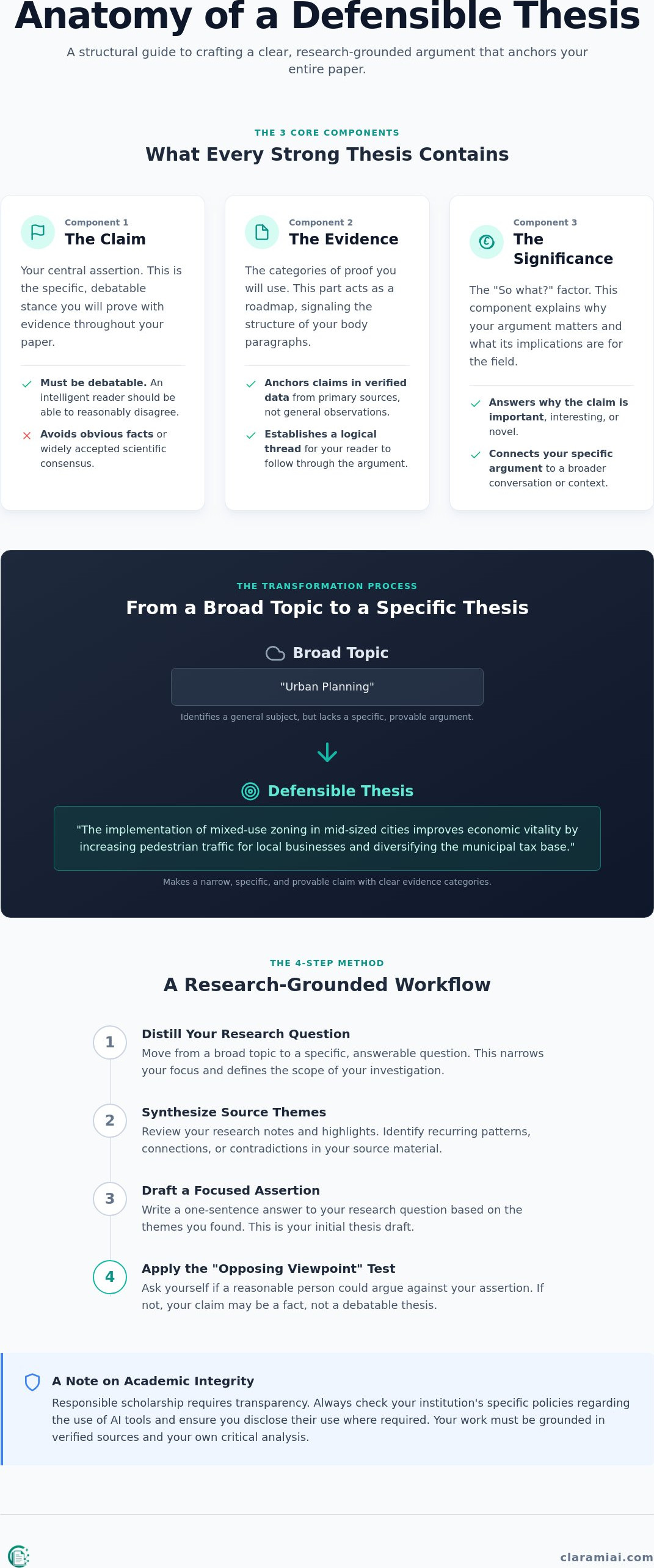
A defensible thesis statement is a structural necessity for any serious research paper. It isn't a mere summary. It's a precise synthesis of your argument's three core components: the claim, the evidence categories, and the "so what" factor. Precision matters. Specificity is the hallmark of professional writing. When you set out to make a thesis statement, you must replace vague qualifiers like "interesting" or "many" with precise academic terminology that reflects your specific field of study. Verification of these terms against your source material ensures the structural integrity of your argument.
This demand for precision is not unique to academia; in the healthcare sector, for example, an assistant téléphonique médical IA is often used to ensure that patient communications are managed with the same level of accuracy and professional care as a well-crafted thesis.
The claim: Taking a stand
Your claim is the central assertion of your work. It must be debatable. An intelligent reader should be able to reasonably disagree with your stance. Avoid stating obvious facts or reporting widely accepted scientific consensus as a thesis. Instead, ensure your claim is grounded in the methodology of your specific discipline. If you're struggling to move from a general topic to a specific argument, reviewing a guide on how to write a thesis statement can provide a structured framework for your initial draft. This helps you move from observation to analysis.
The evidence categories: Mapping the body paragraphs
The second component of your thesis outlines the primary data areas or theoretical frameworks you'll use. These categories act as a roadmap for your reader. They dictate the sub-headers in your final document. To maintain focus, you should limit these categories to two or three distinct themes. This constraint prevents your argument from becoming fragmented. It ensures that every paragraph remains tethered to your central claim. By mapping these categories early, you create a logical progression that guides the reader through your evidence. This systematic order allows you to organize your research workspace before you begin the drafting phase.
The significance: The 'so what' factor
The "so what" factor explains why your argument matters to the broader scholarly field. It connects your local analysis to a larger conversation. You must explain how your findings influence future research or policy decisions. Including a clear significance factor increases the citation potential of your work because it demonstrates the utility of your analysis to other researchers. It transforms a localized study into a contribution to the field. When you make a thesis statement that addresses this significance, you provide a clear reason for your audience to engage with your work.
Academic integrity requires you to be responsible for the final output. Always check your institution's policies regarding AI use and ensure you disclose its role in your drafting process. Responsible scholarship relies on the human researcher to verify all data points and finalize the argument's logic.
A research-driven process to make a thesis statement
Many students treat a thesis as a static sentence decided before the research begins. This approach often results in a claim that lacks depth or fails to account for the complexities of the source material. You should view the process as a chronological workflow: collection, synthesis, and verification. To make a thesis statement that effectively anchors your work, follow this five-step procedure:
- Distill the prompt: Turn your assignment or research prompt into a single, specific question.
- Review highlights: Examine your PDF Manager notes to identify recurring themes, patterns, or contradictions.
- Draft a working thesis: Create a preliminary answer to your research question based on your current evidence.
- Align with standards: Ensure the draft meets institutional requirements and matches your intended academic tone. You can use the Draft Tone Checker to verify that your language remains professional and objective.
- Revise continuously: Update the statement as you uncover new data points or conflicting evidence during the writing phase.
This iterative approach ensures that your final claim is not just an initial guess, but a verified conclusion based on the total body of your research. It prevents the frustration of trying to force your evidence to fit a claim that no longer represents the data.
Turning research questions into answers
Analysis begins with the right inquiry. Start by framing your topic with "How" or "Why" questions. These prompts encourage deep investigation rather than simple description. Your thesis statement is essentially the concise answer to that primary question. By using the integrated document editor, you can view your research question and your collected notes side-by-side. This proximity allows you to see the direct connection between your inquiry and the evidence available to answer it. It transforms the writing process from a struggle for words into a logical translation of data into a defensible claim.
Synthesizing evidence from multiple sources
A sophisticated thesis often emerges from the tension between different perspectives. Look for claims in your sources that conflict with one another or highlight a gap in current knowledge. Your argument can be the synthesis of these conflicting viewpoints. Avoid the temptation to cherry-pick data to fit a preconceived idea. Instead, let the evidence lead you to a conclusion. If your research reveals a recurring contradiction, your thesis should address how your analysis resolves that conflict. This grounded approach ensures your argument is defensible and rooted in the methodology of your discipline.
Academic integrity is a fundamental part of the research process. Always check your institution's specific policies regarding the use of AI tools. You must disclose AI use where required and remain responsible for the final accuracy and submission of your work.
Refining and testing your thesis for structural integrity
Structural integrity is the difference between a collection of notes and a professional academic argument. Once you make a thesis statement, you must subject it to rigorous testing to ensure it can withstand scholarly scrutiny. This phase moves beyond initial drafting into the verification of your logic. You're no longer asking what you want to say; you're asking if what you've said is defensible, specific, and grounded in your data. It's helpful to use the Draft Tone Checker during this stage to ensure your language remains objective and avoids the emotional bias that often creeps into early drafts.
The Opposing Viewpoint test is a fundamental check for any scholarly claim. Ask yourself if a reasonable, intelligent reader could argue the exact opposite of your statement. If no counter-argument exists, your thesis is likely a statement of fact rather than a debatable assertion. Additionally, you must check for "List-itis." This occurs when a thesis becomes a dry inventory of three unrelated points rather than a single, cohesive argument. Your evidence categories should be connected by a logical thread that supports your central claim, creating a unified narrative rather than a fragmented list. You can create a free research workspace to begin testing and refining your own arguments within a structured editor.
The 'So What' test
A professional thesis must demonstrate its own significance to the broader field. Ask yourself: "Would a specialist in this discipline find this argument useful?" If your claim feels self-evident or merely descriptive, it lacks the necessary analytical depth. You can refine this by connecting your specific argument to a documented gap in existing literature. This transformation ensures your work contributes to a larger scholarly conversation rather than simply repeating known information. When you make a thesis statement that passes the "So What" test, you provide your audience with a clear reason to engage with your research.
Verifying claims against sources
Responsible scholarship requires a "human-in-the-loop" approach to verification. You must manually check every assertion in your thesis to avoid the hallucination trap common in broad-market AI tools. Ensure that every claim is anchored in a real primary or secondary source found in your PDF Manager. Verification includes checking that your citations are correctly formatted in APA, MLA, or Chicago style. Most importantly, confirm that the evidence provided in your body paragraphs actually supports the specific claim made in your thesis. If the data shifts during the writing process, your thesis must be revised to maintain organizational cohesion.
Academic integrity is your responsibility as a researcher. Always check your institution's specific policies regarding the use of AI writing assistants. You must disclose the use of these tools where required and verify the accuracy of all final submissions yourself.
Elevating your thesis with the Clarami research workspace
The Clarami research workspace is designed to bridge the gap between your raw data and your final argument. When you make a thesis statement, the primary challenge is often the physical distance between your notes and your blank document. Clarami solves this by integrating your document editor with your PDF manager. This creates a seamless environment where evidence-to-thesis mapping is immediate and traceable. Precision is non-negotiable in scholarly labor. The workspace maintains the structural integrity of your paper by linking every assertion to a specific source in your library.
The Clara AI assistant functions as an intellectual companion during the synthesis phase. It helps you organize your highlights into a cohesive argument without replacing your own critical thinking. Once you make a thesis statement, AutoDraft allows you to build your first draft around that central claim. This ensures that every paragraph remains structurally aligned with your initial assertion. To maintain accuracy, ClaimShield provides a verification layer that keeps your writing grounded in the actual sources you've uploaded.
From disorganization to verified output
Maintaining a clear connection between your argument and your evidence is essential for rigorous composition. You can keep your primary sources and your evolving draft in a single research workspace to eliminate the friction of switching between multiple applications. This integration removes the need to copy-paste between a separate chat box and your final document. For those working with advisors, "suggest-mode" allows for collaborative refinement of your thesis. This structured workflow ensures that your output is polished and verified before submission.
Maintaining academic integrity with source-grounded AI
Responsible research requires a "human-in-the-loop" approach to composition. Unlike broad-market tools that prioritize creative flair over accuracy, Clarami focuses on the structural connection between a statement and its supporting data. It's vital to ensure your thesis is supported by verified AI citations to prevent the fabrication of evidence. Professional researchers value the traceability provided by an integrated editor because it allows for a clear audit trail of every claim. Organizational cohesion and transparency are the foundations of ethical writing.
Academic integrity is your responsibility. Always check your school's policies regarding AI use and disclose the role of these tools in your workflow. You're responsible for the final submission and the accuracy of your arguments.
<section class="faq-section">## Frequently Asked QuestionsWhat is a thesis statement?
A thesis statement is a one or two sentence summary of your paper's main argument. It acts as a roadmap for the reader and establishes a defensible claim that you will prove using evidence.
How long should a thesis statement be?
Most thesis statements are a single, concise sentence. In longer research papers or dissertations, they may extend to two sentences to account for complex evidence categories.
Can a thesis statement be a question?
No. A thesis statement is the answer to a research question. It must be a declarative assertion that takes a clear stand on a topic.
Where does the thesis statement go?
It is typically placed at the end of your introductory paragraph. This placement ensures the reader understands your argument before they encounter your body paragraphs.
</section>## Establishing structural integrity in your researchTransitioning from a broad topic to a defensible argument requires a disciplined, iterative approach. You've learned that a strong thesis isn't just a summary; it's a structural necessity that dictates the logic of your entire paper. By focusing on the claim, evidence categories, and the "so what" factor, you ensure your work contributes meaningfully to your field. When you make a thesis statement using this research-grounded method, you move from disorganized notes to a verified, authoritative output. This emphasis on organizational excellence is a standard shared by professional service providers like Allora Cleaning, whose specialized janitorial and post-construction work ensures that physical workspaces remain as clear and focused as a well-argued paper.
Professional writing demands traceability and accuracy. Clarami provides the tools necessary to maintain this standard, including integrated PDF management and citation building. Our ClaimShield technology offers a verification layer to ensure your assertions stay grounded in primary sources. This is why researchers at top universities utilize our workspace to manage the rigors of scholarly labor. Academic integrity is your responsibility. Always check your institution's specific policies regarding AI tools and disclose their use where required.
Start your research-grounded draft with Clarami for free and establish a clear roadmap for your next assignment. You have the methodology; now you have the workspace to execute it with confidence.
Frequently asked questions
Where does the thesis statement go in an essay?
The thesis statement usually appears at the end of the introductory paragraph. This strategic placement ensures the reader has the necessary context before encountering your central claim. It provides a logical bridge to the body paragraphs where you'll present your supporting data. When you make a thesis statement, positioning it here allows you to transition smoothly from general background information to your specific, evidence-grounded argument.
Can a thesis statement be two sentences?
Yes, a thesis can be two sentences for complex research papers or dissertations. While a single sentence is standard for shorter assignments, nuanced arguments often require more space to outline multiple evidence categories. Focus on organizational cohesion rather than a rigid sentence limit. This allows you to maintain structural integrity while ensuring that every part of your claim is clearly articulated for your audience.
How do I make a thesis statement if I haven't finished my research?
You should create a "working thesis" based on your preliminary findings to guide your remaining research. This draft acts as a temporary anchor that you refine as you uncover new data. To make a thesis statement effectively, you must be willing to revise your claim once your synthesis is complete. This prevents you from forcing evidence to fit an outdated or inaccurate assertion as you discover new sources.
Is it okay to use an AI generator for my thesis?
Using an AI tool is acceptable for drafting and synthesizing research if you follow your institution's specific guidelines. You must always disclose AI use and verify that every assertion is anchored in real data. Academic integrity requires you to maintain intellectual agency by finalizing the logic and checking for inaccuracies. You're responsible for the final submission and ensuring it meets all ethical standards.
What is the difference between a thesis and a hypothesis?
A hypothesis is a testable prediction made at the beginning of a study, whereas a thesis is a proven claim presented after your research is complete. The hypothesis explores what might happen; the thesis asserts what you've found based on verified evidence. It's the transition from inquiry to a defensible argument that you're prepared to support with specific data and logical analysis.
Related on Clarami
- Best AI writing tool for students (full guide) →
- AI academic integrity checklist →
- Clarami pricing: Free vs PRO vs Platinum →
- Editor vs ChatGPT for writing →
- Export DOCX, PDF, and hand-in checklist →
- How to outline a paper →
- Prompt to structured essay draft →
- Revise with AI on a selection →
- Sign up free →
- Clarami home →
- More guides on the Clarami blog →