
How to improve academic writing style and tone for scholarly success
Struggling with your academic writing tone? This guide offers a repeatable workflow to refine your style, eliminate bias, and present research with authority.
Write with structure in Clarami AI
Editor-first AI drafting, citations, and two Workflows for student writing.
What if the secret to sounding like an authority isn't finding more complex words, but removing the ones that cloud your evidence? You likely worry that your drafts sound too simple or unprofessional, making it difficult to maintain a consistent academic writing tone. This anxiety often leads to over-complicating sentences until the core argument is lost. You want to sound objective and authoritative without losing the impact of your research findings.
This article provides a clear path to mastering scholarly prose through specific linguistic shifts and structural habits. You'll learn how to transform conversational drafts into precise, evidence-based arguments using a repeatable editing workflow. We'll cover how to manage passive voice, eliminate personal bias, and use Clarami’s In-App Editor to refine your work. By following these steps, you can ensure your writing is both objective and persuasive. Always check your institution's specific policies regarding AI assistance and disclose your use of tools like Clarami where required to maintain academic integrity.
Key Takeaways
- Shift the focus from personal opinion to research-backed arguments by adopting a formal academic writing tone.
- Identify and replace informal language markers, such as colloquialisms and phrasal verbs, with precise scholarly equivalents.
- Implement a systematic four-step workflow to audit your drafts for emotive language and personal bias.
- Use Clarami’s In-App Editor to perform selection-level edits that refine your voice without sacrificing intellectual agency.
- Ensure compliance with institutional integrity standards by disclosing AI assistance and verifying claims against primary sources.
Table of Contents
- Understanding the purpose of academic writing tone
- Essential characteristics of a scholarly voice
- Transitioning from conversational to formal language
- A four-step workflow to refine your academic style
- Maintaining integrity and voice with Clarami
Understanding the purpose of academic writing tone
An effective academic writing tone isn't a mask for complexity. It's a functional tool for structural precision. By adopting a formal, objective, and precise style, you signal that your work belongs within a professional scholarly conversation. The goal isn't to sound smart, but to be clear. This shift in language moves the focus away from you as the writer and places it squarely on your research and evidence. Before proceeding, always check your institution's specific policies regarding AI assistance and disclose your use of tools like Clarami where required to maintain academic integrity.
Establishing authority in your field requires more than just good data. It requires a presentation that commands respect through its neutrality. When your tone is disciplined, your claims carry more weight. According to 2026 survey data, 28% of students now use AI tools specifically to improve their writing, showing a growing recognition that style impacts grades. While Academic writing conventions vary between the hard sciences and the humanities, the underlying requirement for evidence-based claims remains the same. Common differences include:
- Physical and Life Sciences: These fields often favor the passive voice to emphasize the experimental process over the individual researcher.
- Humanities and Social Sciences: These disciplines may allow for active voice and more interpretive language to highlight the strength of a specific argument.
To better understand the nuances of scholarly language, watch this helpful video:
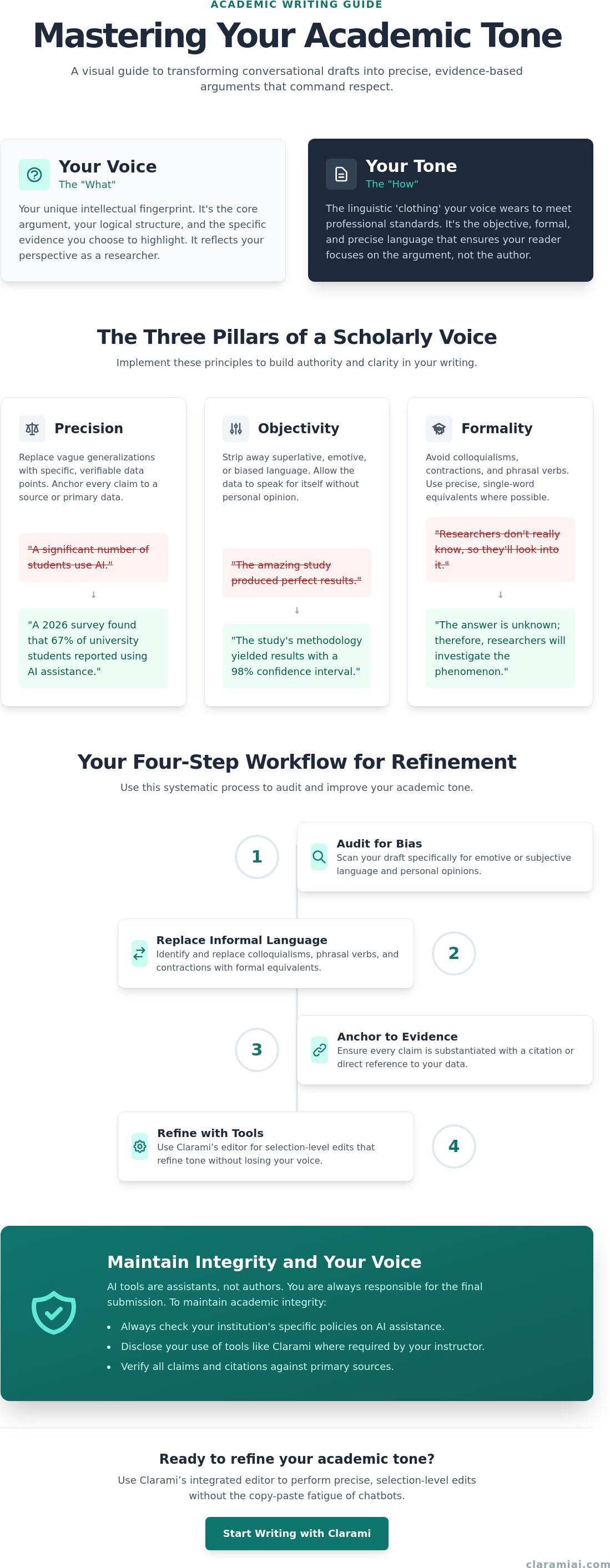
### The difference between tone and voiceYour scholarly voice is your unique intellectual fingerprint. It's the way you structure your logic and the specific arguments you choose to highlight. Think of tone as the linguistic clothing your voice wears to meet professional standards. If your voice is the "what" of your argument, tone is the "how." Maintaining a consistent tone helps your reader follow complex logic without distraction. You can use the Clarami In-App Editor to ensure your tone remains steady across every paragraph of your draft.
Why objectivity matters in research
Objectivity is a cornerstone of the scientific method. Using a neutral tone helps reduce personal bias, allowing the data to speak for itself. This isn't just about politeness. It's about the reproducibility of your findings. When you remove emotive adjectives or personal anecdotes, you create a transparent record of your methodology. Other researchers can then verify your claims without being influenced by your personal feelings. A disciplined tone ensures that your work stands up to the rigors of peer review and contributes meaningfully to the existing body of knowledge.
Essential characteristics of a scholarly voice
A scholarly voice is defined by its commitment to accuracy. It prioritizes data over decoration. Using a consistent academic writing tone ensures that your readers focus on your methodology rather than your personality. Precision is the first pillar of this style. Instead of using vague generalizations like "a significant number," use specific data points. For instance, a 2026 survey found that 67% of university students reported using AI assistance in their written assignments. This shift removes ambiguity and prevents the reader from questioning your definitions. Every claim you make must be anchored to a verifiable source or primary data point. This substantiation creates a foundation of trust between you and your audience.
Objectivity requires you to strip away superlative or emotive language. Words like "amazing," "terrible," or "perfect" have no place in a research paper because they reflect personal opinion rather than verified fact. The purpose of academic tone is to establish a neutral ground where the reader can evaluate the evidence fairly. By avoiding hyperbolic claims, you demonstrate a disciplined approach to your subject matter. Remember that while digital assistants can help you generate initial drafts, the responsibility for verifying the accuracy and ethical use of that content rests with you. Always check your school's specific policies on AI tools before submission.
Mastering the art of hedging
Hedging involves using cautious language to acknowledge the limits of your research findings. Scholars rarely claim absolute certainty because variables can change. Instead, they use verbs like "suggests," "indicates," or "may contribute to." Overstating a claim can damage your credibility if future research contradicts your results. For example, instead of writing "This study proves," try "The results suggest a correlation." This nuance shows you understand the complexities of your field and are not making baseless assumptions. If you find yourself struggling to strike this balance, you can create a free account to use Clarami's Draft Tone Checker for instant feedback on your language choices.
Effective signposting for logical flow
Signposting acts as a map for your reader. Major signposts appear in your introduction and conclusion to outline the paper's structure and overall aim. They tell the reader exactly what to expect. Minor signposts connect individual sentences and paragraphs. Using words like "conversely," "consequently," or "specifically" helps guide the reader through your logical progression. These transitions reduce cognitive load by making connections explicit. They clarify how one idea relates to the next. Without them, even the most brilliant logic can feel disjointed and difficult to follow. As the editor of your own work, you must ensure these markers are placed logically to maintain a professional flow.
Transitioning from conversational to formal language
Moving from a rough draft to a scholarly submission requires a shift in your linguistic register. You've got to strip away the conversational habits of daily speech to achieve a professional academic writing tone. This process begins by identifying informal markers that undermine your authority. While contractions like "don't" or "it's" are fine for a blog post, they've got no place in a formal research paper. Expand these to "do not" and "it is" to maintain professional standards. Always check your institution's specific policies regarding AI assistance and disclose your use of tools like Clarami where required to maintain academic integrity.
Removing "fluff" and filler words is the next step in refining your prose. Words like "basically," "actually," or "really" dilute the impact of your argument. They don't add value; they just take up space. You'll find that your logic becomes much clearer once you remove these verbal crutches. This isn't just about word count. It's about ensuring every sentence serves a specific purpose in your argument. If a word doesn't add evidence or clarity, it's likely filler. Precision is the goal.
The role of active and passive voice
Active voice provides clarity and directness by identifying the subject of the action immediately. It makes your sentences punchy. You should use it when you want to be transparent about who is performing an action. Passive voice is still appropriate when you need to emphasize the action or the object rather than the actor. For example, in a lab report, "The solution was heated" is often better than "I heated the solution." Modern academic style often prefers the active voice for transparency.
Replacing vague terms with precise vocabulary
Vague terms like "stuff" or "things" make your work feel unpolished. You can use Clara to find discipline-specific terminology that matches your research context. It's better to be specific than broad. However, be careful with a thesaurus. If you choose a synonym without understanding its technical nuance, you risk misrepresenting your data. Use the table below to identify common conversational words and their formal equivalents.
<table><thead><tr><th>Conversational Term</th><th>Academic Counterpart</th></tr></thead><tbody><tr><td>Look into</td><td>Investigate or examine</td></tr><tr><td>Get</td><td>Obtain or acquire</td></tr><tr><td>Go up</td><td>Increase or escalate</td></tr><tr><td>A lot of</td><td>Numerous or substantial</td></tr><tr><td>Bad</td><td>Deficient or detrimental</td></tr></tbody></table>The debate over using "I" in your work depends largely on your field. Historically, third-person was the only acceptable choice. Many modern style guides now allow for the first person when you're describing your own methodological choices or acknowledging your perspective. The key is balance. Use "I" for procedural transparency, but avoid it when stating facts or evidence-based conclusions. Striking this balance is essential for maintaining a consistent academic writing tone throughout your document.
A four-step workflow to refine your academic style
Refining your work is a systematic process. It requires moving from the initial generation of ideas to the rigorous verification of claims. A repeatable workflow ensures you maintain a consistent academic writing tone without getting stuck in the drafting phase. This methodical approach allows you to focus on logic first and linguistic precision second. Before you begin editing, check your school's specific policies on AI use and disclose your workflow where required to uphold academic integrity.
- Step 1: Draft for ideas first. Don't let formal rules stop your intellectual momentum. Focus on getting your arguments and data onto the page. You can refine the linguistic register once your structure is sound.
- Step 2: Audit for emotive language. Look for personal pronouns and subjective adjectives. Use selection-level edits to rewrite specific paragraphs that feel too conversational without altering the surrounding logic.
- Step 3: Strengthen your verbs. Replace generic verbs like "show" or "have" with "illustrate," "possess," or "exhibit." Replace vague nouns with technical terms to add structural integrity to your prose.
- Step 4: Verify every claim. Every statement must be anchored to a primary source or specific data point. If you can't cite it, you likely shouldn't state it as a fact.
Auditing your draft for emotive bias
Spotting value judgments in your own work is difficult. You might describe an outcome as "shocking" or "unfortunate" without realizing these are opinions. Scholarly writing requires you to rephrase these as objective observations. For example, instead of calling a policy "unfair," describe its specific disparate impacts on a population. This shift ensures the focus remains on the evidence rather than your personal feelings. You can use a tone checker to identify these inconsistencies automatically. This tool helps you maintain a neutral stance throughout your document.
Anchoring claims and verifying citations
The structural connection between your statement and your supporting data is the most important part of your paper. Your citations must match the formal tone of your prose. If your writing is precise but your citations are poorly formatted or irrelevant, your authority will suffer. Scholarly success relies on the traceability of your arguments. Every claim acts as a link in a chain of evidence. Style serves the substance of your research. It's the framework that allows your evidence to be verified by others. To start refining your drafts with professional precision, you can sign up for a Clarami workspace today.
Maintaining integrity and voice with Clarami
Clarami's In-App Editor eliminates the need to cycle between separate chat interfaces and word processors. This structural cohesion allows you to focus on maintaining a consistent academic writing tone without the distraction of copy-pasting text segments. You remain the primary architect of your argument. The workspace is designed to support your intellectual agency, providing tools that suggest refinements while leaving the final editorial decision in your hands. It's a methodical environment where the technology acts as a companion rather than a replacement for your critical thinking.
The "human-in-the-loop" approach is central to scholarly success. When you use AI to assist with a draft, you're not just generating text; you're synthesizing complex ideas. This requires a tool that respects the boundaries of academic integrity. By working within an integrated editor, you maintain a clear trail of your research and composition process. This transparency is vital for meeting the rigorous standards of peer review and institutional requirements.
Refining style sentence-by-sentence
You can use AutoDraft to generate formal alternatives for specific sentences or paragraphs. Unlike general-purpose tools that rewrite entire essays, Clarami focuses on selection-level edits. This means you can target a single, conversational paragraph and refine its linguistic register without losing your original logic. You've got the power to approve or reject every suggestion. This iterative process builds your confidence as an editor. It ensures that the final output reflects your authentic scholarly voice while adhering to professional standards.
Verification and claim checking
Formal tone is only effective if it's backed by verified evidence. The Clarami workspace keeps your research notes and primary sources immediately available alongside your draft. This ensures that every stylistic shift is anchored in data. Before you finish your work, use this final checklist to guarantee structural integrity:
- Verify that every claim has a corresponding citation in the correct style, such as APA 7th or MLA 9th.
- Audit the document for any remaining colloquialisms or phrasal verbs that might dilute your authority.
- Ensure that your signposting markers accurately reflect the logical flow of your argument.
- Check that your hedging language appropriately reflects the limitations of your data.
Once these steps are complete, you can export your document to DOCX or LaTeX for submission. This workflow ensures that your submission is polished, precise, and entirely your own.
Academic Integrity Disclaimer: You're responsible for the final content you submit. Always check your institution's specific policies regarding the use of AI writing assistants. You must disclose your use of tools like Clarami where required by school or journal guidelines.
Achieving long-term scholarly success through precise style
Mastering a professional academic writing tone is a career-long process of refinement. By moving away from conversational habits and adopting a methodical workflow, you ensure your research remains the focal point of your work. Precision, objectivity, and structural signposting are not just stylistic choices; they're the foundations of credible scholarship. You now have a repeatable framework for auditing your drafts and anchoring every claim to verifiable evidence.
Clarami supports this journey by providing an integrated document editor that keeps your research and prose in a single workspace. With source-grounded AI assistance and real-time citation management, you can focus on the cognitive work of synthesis while the platform helps you maintain formal standards. You remain the primary architect of your arguments, ensuring every submission meets the highest levels of integrity. Always check your institution's specific policies and disclose AI use where required to maintain academic honesty. Start refining your scholarly voice in the Clarami workspace today to produce work that is both authoritative and objective. Your unique intellectual perspective deserves a presentation that matches its depth.
Frequently Asked Questions
What is the difference between formal and informal tone in academic writing?
Formal tone uses objective, precise language and avoids personal bias or conversational habits. Informal tone often includes colloquialisms, contractions, and first-person anecdotes that can distract the reader from your research findings. In scholarship, a formal approach ensures the focus remains on the evidence rather than the writer's personality. This shift in language helps maintain professional standards across different disciplines.
Can I use 'I' in a research paper or dissertation?
You can use the first person in many modern research papers, particularly when describing your specific methodology or acknowledging your perspective. However, you should avoid using "I" when stating objective facts or drawing general conclusions from data. It's best to use the first person for procedural transparency while relying on the third person for evidence-based claims. Always check your department's specific style guide for local requirements.
How do I make my writing sound more professional without using big words?
You make your writing professional by choosing precise verbs and specific nouns rather than complex vocabulary. Replace generic verbs like "do" or "make" with "conduct" or "generate" to add structural integrity to your prose. Focus on the structural connection between your statements and your supporting data. Clarity and precision are more important for scholarly success than using a thesaurus to find obscure synonyms.
Is passive voice always bad in academic writing?
Passive voice is not always bad and is often preferred in scientific fields to emphasize the experiment over the researcher. For example, "The samples were analyzed" focuses on the process rather than the individual performing the action. You should use active voice for clarity in your introduction and conclusion. Balancing both styles allows you to maintain a professional flow while being transparent about your methodology.
How can I check if my writing tone is appropriate for my field?
You can check if your academic writing tone is appropriate by analyzing the top-cited journals in your specific discipline. Look for patterns in how established authors introduce arguments and handle evidence. Using a tool like Clarami’s Draft Tone Checker can also help you identify if your style aligns with scholarly expectations. This iterative feedback helps you refine your voice before you submit your work for peer review.
What are some common words to avoid in scholarly prose?
Avoid conversational fillers like "basically," "really," and "actually" in your scholarly prose. You should also eliminate vague qualifiers like "a lot" or "some" and replace them with specific data points or percentages. These words dilute the impact of your research and can make your arguments feel less authoritative. Removing these verbal crutches ensures that every sentence serves a specific purpose in your argument.
How can AI help me improve my writing style without violating integrity?
AI can help you improve your academic writing tone by suggesting formal alternatives to conversational paragraphs through selection-level edits. To maintain integrity, you must remain the primary architect of the argument and verify all AI-generated suggestions against your primary sources. Always disclose your use of tools like Clarami and check your school's specific policies regarding AI assistance. You're responsible for the final content you submit.
Related on Clarami
- Best AI writing tool for students (full guide) →
- AI academic integrity checklist →
- Clarami pricing: Free vs PRO vs Platinum →
- Editor vs ChatGPT for writing →
- Export DOCX, PDF, and hand-in checklist →
- How to outline a paper →
- Prompt to structured essay draft →
- Revise with AI on a selection →
- Sign up free →
- Clarami home →
- More guides on the Clarami blog →