Choosing the best ai tool for literature review: A methodical guide for 2026
Find the best AI tool for literature review. Our 2026 guide helps you avoid fake citations and manage sources to draft a verified, structured paper.
Write with structure in Clarami AI
Editor-first AI drafting, citations, and two Workflows for student writing.
The most significant risk to your research in 2026 isn't a lack of data, but a hallucinated citation that undermines your entire methodology. With 95% of students now using some form of artificial intelligence, the challenge has shifted from finding information to verifying it. You likely feel the friction of managing hundreds of PDFs while worrying about accidental plagiarism. It's frustrating to juggle multiple chat boxes and word processors just to synthesize a single chapter.
Finding the right ai tool for literature review requires looking beyond general-purpose chatbots. You need a system that anchors every claim in a primary source. This guide provides a methodical approach to selecting tools that synthesize research, manage sources, and draft reviews with high structural integrity. We'll explore how to move from a disorganized folder of research to a polished, verified draft using a human-in-the-loop workflow. Always check your university's specific policies and disclose your use of AI tools where required by academic integrity guidelines.
Key Takeaways
- Learn to distinguish between generative models and source-grounded systems to ensure your claims are always anchored in verifiable evidence.
- Evaluate the best ai tool for literature review based on its ability to substantiate claims through automated verification and precise source attribution.
- Streamline your research process by moving from source organization in a PDF Manager directly into a structured draft within an In-App Editor.
- Protect your academic integrity by adopting a human-in-the-loop approach where you use the Clara AI Assistant to synthesize data while maintaining final editorial control.
- Establish a clear workflow for extracting methodologies, key themes, and research gaps across your library to create a cohesive synthesis of existing research.
Table of Contents
- What is an ai tool for literature review?
- Essential features for systematic evidence synthesis
- A systematic workflow: From source organization to synthesis
- Maintaining academic integrity and verifying claims
- Why an integrated workspace outperforms chat-based generators
What is an ai tool for literature review?
An ai tool for literature review is a specialized software environment designed to help you locate, analyze, and synthesize scholarly material. Unlike general-purpose AI, these tools are built to handle the structural rigors of academic labor. They don't just provide answers; they facilitate a methodical process. This process includes extracting methodologies, identifying research gaps, and drafting summaries that maintain a physical connection between a claim and its evidence. Choosing the right ai tool for literature review is about more than speed. It's about ensuring your work remains grounded in verifiable data.
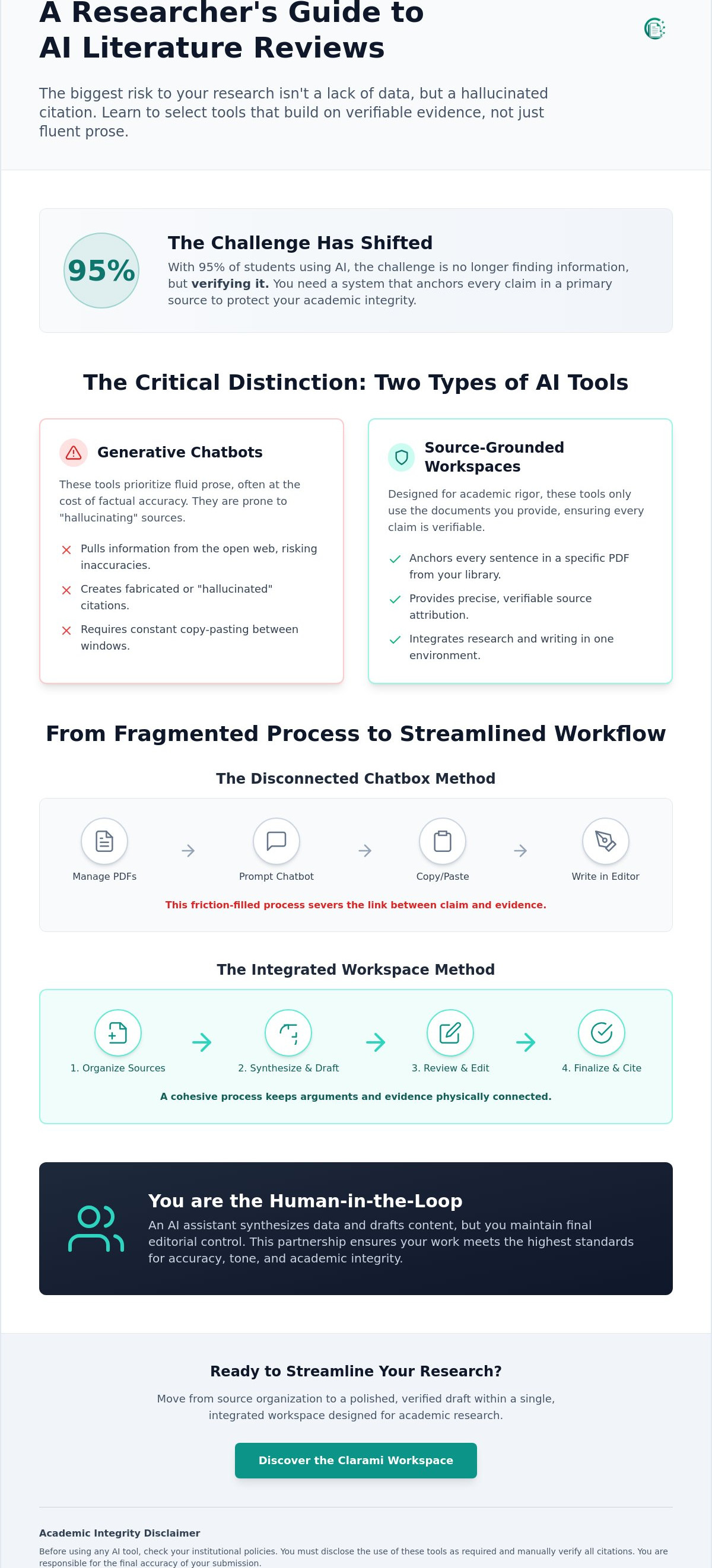
There is a critical distinction between generative and source-grounded technologies. Generative tools often prioritize fluid prose over factual accuracy, which can lead to the hallucination of citations. Source-grounded tools, however, anchor every sentence in a specific PDF from your library. This ensures that the draft remains a reflection of the existing literature rather than a creative invention. You maintain intellectual agency by acting as the human-in-the-loop, reviewing every draft the AI provides to ensure it meets your standards for accuracy and tone.
Academic Integrity Disclaimer: Before using any AI tool, check your institutional policies regarding AI-assisted writing. You must disclose the use of these tools in your methodology or acknowledgments and verify all citations manually. You are responsible for the final accuracy of your submission.
The evolution of research synthesis
Academic research has moved beyond the limitations of simple Boolean operators. Modern synthesis involves semantic understanding, where the software recognizes the context and intent of a study's findings. This is particularly vital for a systematic review, where rigorous data extraction and evidence-based summaries are required. Instead of generic responses, these tools map the relationship between different papers, highlighting where authors agree or where contradictions exist in the data. This chronological and logical flow creates a sense of momentum in your writing process.
Core components of a research workspace
A purpose-built centralized workspace replaces the friction of scattered browser tabs and disconnected chat boxes. It integrates several functional layers to support your workflow:
- PDF Manager: A dedicated system to organize, index, and search your primary sources.
- Drafting assistants: Tools like AutoDraft that recognize academic conventions and maintain a professional tone.
- Citation Generator: An engine that handles complex metadata to ensure your bibliography is accurate and formatted correctly.
These components work in unison to ensure structural integrity and traceability. When your arguments are anchored in primary sources within a single environment, the risk of technical inaccuracy decreases. This specialized approach treats data management and composition as a single, integrated task.
Essential features for systematic evidence synthesis
An effective ai tool for literature review must prioritize structural integrity over linguistic flair. It's not enough for a tool to generate text; it must do so within a controlled environment that minimizes the risk of error. Source-grounding is the technical requirement for AI to only use provided documents for drafting. This constraint prevents the system from pulling information from the open web, which is the primary cause of fabricated citations and hallucinations. By restricting the AI to your specific library, you ensure the output is a direct reflection of the evidence you've gathered.
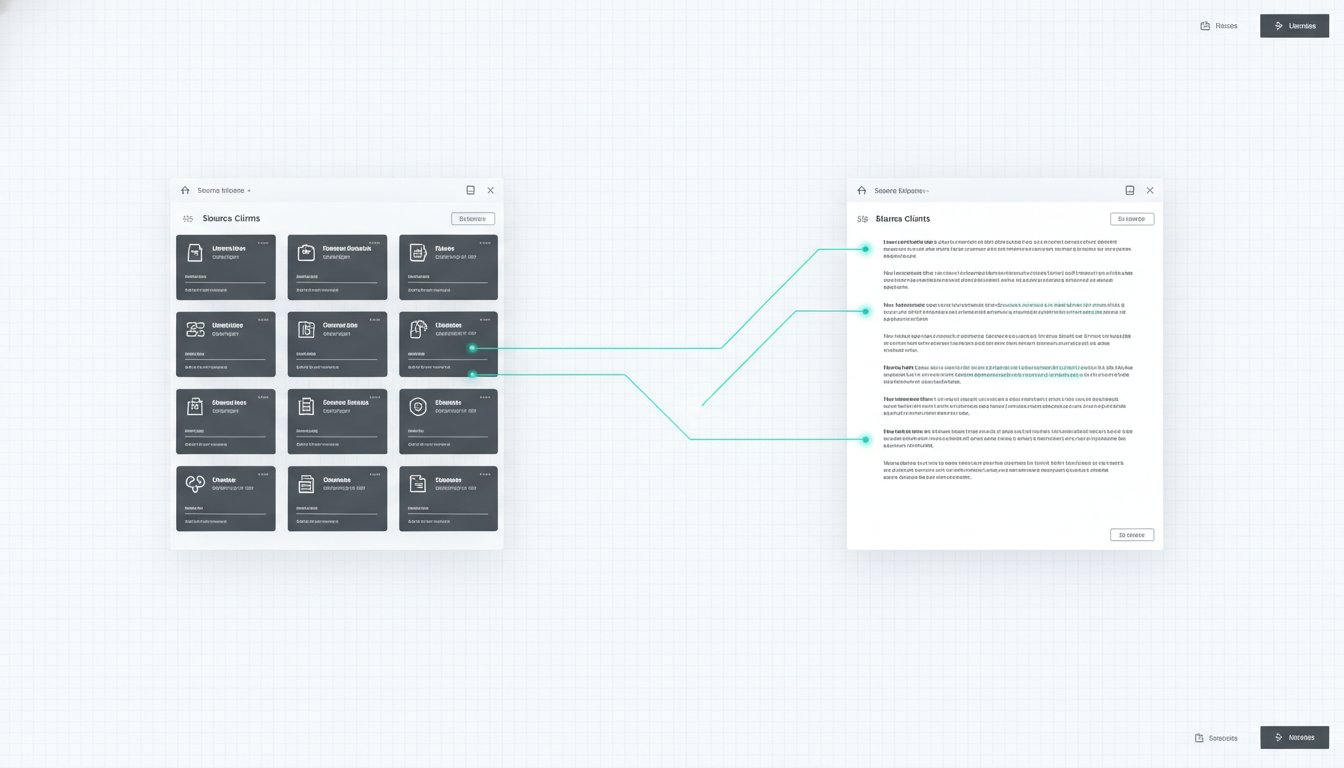
The "chat box" model often creates a significant cognitive burden. You're forced to copy-paste data between a browser and a separate word processor, which severs the physical link between the claim and the source. An integrated editor keeps your library and your draft in one digital environment. This cohesion is essential for maintaining focus during the synthesis of complex research. It allows you to move from reading to writing without the friction of switching tabs, keeping your arguments and evidence physically connected.
Source-grounded research assistance
Utilizing Clara allows you to maintain a high level of precision throughout the drafting process. This assistant doesn't just summarize broad concepts. It extracts granular data points such as sample sizes, p-values, and specific methodologies from your uploaded PDFs. Recent research into Artificial Intelligence in Literature Review Synthesis highlights how semantic search improves the discovery of relevant papers by mapping conceptual relationships. This goes beyond simple keyword matching, helping you identify vital studies that use different terminology but share the same research goals.
Automated citation and reference management
Citation management is a frequent point of failure for many scholars. Manual entry is a leading cause of formatting errors in dissertations and journal submissions, particularly when you need to toggle between APA, MLA, and Chicago styles. A professional ai tool for literature review should build these citations in real-time as you write. By linking every reference directly to the PDF source, you can perform instant verification. This traceability ensures that every statement in your draft is substantiated by a primary source you can revisit with a single click.
Professional submission requires flexibility in how you share your work. Your workspace should support multiple export formats, including LaTeX for technical papers and DOCX for standard academic documents. This ensures your final output is ready for peer review or grading without requiring a complete reformatting. To see how a grounded workspace can organize your research, you can create your free account and begin building your library today.
A systematic workflow: From source organization to synthesis
Moving from a collection of papers to a coherent argument is often where the research process stalls. The friction of switching between reference managers and word processors creates a "bridge" problem that few general tools solve. A methodical workflow using a specialized ai tool for literature review allows you to maintain momentum by keeping your evidence and your draft in the same environment. This chronological approach ensures that synthesis is an inevitable result of your organization rather than a separate, daunting task.
- Step 1: Upload and organize your library of PDFs within a centralized workspace.
- Step 2: Use AI to extract key themes and methodologies across multiple papers.
- Step 3: Create a synthesis matrix to identify gaps in current research.
- Step 4: Draft your review paragraph-by-paragraph to maintain control over the narrative.
- Step 5: Verify every claim against your uploaded sources before final export.
Scholarly institutions, such as the University of Iowa, have begun providing guidance on AI-Assisted Literature Reviews, emphasizing that these tools should support, not replace, the researcher's critical eye. By following a structured sequence, you ensure that every sentence in your draft is backed by the data you've already verified. This systematic method prevents the disorganized "copy-paste" habit common with chat-based interfaces.
Organizing your research library
Effective synthesis begins with precise organization. Within your PDF Manager, use a folder structure based on themes or methodology types rather than publication dates. Tagging individual papers with specific metadata ensures you don't encounter "missing author" errors during the final citation phase. Web clippers are useful for capturing research from digital databases, but you must verify that the metadata is complete before starting your analysis. This organizational cohesion is the foundation of traceability.
Drafting with AutoDraft and templates
Once your library is organized, use AutoDraft to generate initial section drafts. This isn't about creating an entire paper at once. Instead, focus on paragraph-level synthesis. Matching your draft to specific academic rubrics using structured templates ensures that you meet the requirements of your assignment or journal. This section-by-section approach allows you to maintain a consistent scholarly voice while ensuring each argument is anchored in your primary sources. It's a disciplined way to build a literature review that respects your intellectual agency.
Maintaining academic integrity and verifying claims
Academic integrity is the foundation of scholarly labor. The primary risk when selecting an ai tool for literature review is the tendency for general-purpose models to prioritize linguistic flow over factual accuracy. This often results in hallucinations, where the system invents citations that appear legitimate but don't exist in reality. To counter this, you must adopt a verification-first mindset. Tools like ClaimShield are designed specifically to fact-check AI output against your uploaded library, ensuring every statement is substantiated by real data.
Academic Integrity Disclaimer: Always check your university or department's specific AI policies before beginning your draft. It's your responsibility to disclose AI assistance and verify the accuracy of all citations and claims per institutional requirements.
Transparency in your methodology is essential for professional and graduate-level work. When you use an ai tool for literature review, you act as the final authority on the text. Before finalizing any section, perform a manual metadata check to ensure the structural integrity of your bibliography. Follow this verification checklist for every source in your draft:
- DOI Validation: Confirm the Digital Object Identifier (DOI) exists and links to the correct paper.
- Author Accuracy: Cross-reference the names in your citation with the original PDF metadata.
- Contextual Check: Ensure the cited page actually contains the specific data or argument you've attributed to it.
- Metadata Consistency: Verify that publication years and journal titles are formatted correctly without missing fields.
Identifying and fixing AI hallucinations
General-purpose LLMs make up citations because they lack a physical connection to your specific PDFs. They predict the next likely word in a sequence, which can result in a fake source that sounds plausible. Pass every draft through a traceability test. If you can't click the source and view the original text within your workspace, don't use the sentence. You should use the assistant to improve clarity or transition between complex ideas, but you must never allow it to define the underlying research meaning without direct evidence.
Collaboration and supervisor feedback
Writing a literature review is rarely a solitary task. Using suggest-mode within the In-App Editor allows you to share drafts with advisors or committee members for real-time feedback. This feature is particularly useful for managing conflicting comments from different readers. Instead of juggling multiple versions of a document, you can resolve suggestions directly in the workspace. For research groups requiring even more robust features, consult our guide on systematic literature review software 2026. To ensure your synthesis is grounded in real evidence, verify your citations and start drafting today.
Why an integrated workspace outperforms chat-based generators
Chat-based AI often forces you into a repetitive cycle of copying data from one window and pasting it into another. This workflow is fundamentally disorganized. An integrated ai tool for literature review eliminates this friction by housing your library and your manuscript in a single digital environment. When your arguments and evidence are physically connected, you reduce the cognitive load associated with context switching. This structural cohesion ensures that every claim is anchored in the primary data you've already verified.
Drafting directly alongside your sources significantly lowers the risk of accidental plagiarism. Rather than asking a chatbot to generate a whole section from memory, you perform selection-level edits. You can rewrite a single paragraph or refine a specific argument while viewing the original PDF in your PDF Manager. This human-in-the-loop approach keeps you in control of the narrative. It ensures the AI serves as a drafting assistant rather than a ghostwriter. You aren't just accepting a block of text; you are actively shaping the synthesis based on the evidence in front of you.
The 'no copy-paste' advantage
Preserving formatting and citation links is a major efficiency gain for any scholar. In a standard word processor, moving text from a chat interface often breaks metadata. It requires tedious manual re-formatting. An In-App Editor maintains these connections automatically. There is a psychological benefit to working in a calm, distraction-free research space. You don't have to worry about losing the link between a quote and its source. Researchers often save hours of labor by avoiding the administrative burden of manual data transfer. This steady rhythm allows for continuous progress through the collection, synthesis, and verification stages.
Finalizing your literature review for submission
Before you export your work, use the Draft Tone Checker to ensure the scholarly voice is consistent across all sections. This is particularly useful for maintaining a professional persona that values transparency and substantiation. Once you're satisfied with the draft, you can export your manuscript to LaTeX or DOCX. The Citation Generator ensures your bibliography is perfectly formatted according to APA, MLA, or Chicago standards. This transition from a rough draft to a polished, verified output is the final step in a systematic workflow.
Academic Integrity Disclaimer: Always check your university's specific policies regarding the use of AI in written assignments. You're responsible for disclosing AI assistance and verifying all citations before your final submission.
Ready to streamline your research? Explore Clarami's pricing and start your next project.
Standardizing your research workflow
Selecting a specialized ai tool for literature review is a commitment to academic rigor. You've seen how a methodical approach, from source organization to final verification, prevents the common pitfalls of disorganized research. By prioritizing source-grounded drafting over general-purpose generation, you ensure that every claim is anchored in verifiable evidence. This integrated process eliminates the friction of switching between tools, allowing you to maintain focus on your intellectual contributions.
A successful review depends on your ability to synthesize data while acting as the final authority on the text. With the Clara AI Assistant and ClaimShield verification technology, you can substantiate every argument within a single digital environment. This human-in-the-loop workflow protects your integrity while streamlining the transition from collection to a polished final draft. You now have the framework to move from a disorganized folder of PDFs to a submission-ready manuscript with calm assurance.
Ready to begin? Start your methodical literature review with Clarami and build a research foundation you can trust.
Frequently asked questions
Can an AI tool write my entire literature review for me?
No, an AI tool cannot replace the researcher's intellectual agency. While these systems provide structured drafts and extract methodologies, you remain the human-in-the-loop responsible for the final synthesis and submission. You must review every paragraph to ensure it aligns with your specific research goals and academic standards. The tool acts as a drafting companion, not a substitute for your critical analysis.
How do I ensure the citations generated by AI are real and accurate?
You should use a source-grounded ai tool for literature review that anchors text in specific, uploaded PDFs. Tools like ClaimShield allow you to verify every statement against the primary source metadata. Always perform a manual check of the DOI and author names before finalizing your bibliography to ensure total technical accuracy. This verification process is essential for maintaining the structural integrity of your research.
Is it considered cheating to use AI for a literature review?
Using an ai tool for literature review is generally permitted if you follow your institution's disclosure requirements and academic integrity policies. Most universities allow AI for brainstorming, organization, and drafting assistance. However, submitting AI-generated text as your own without editing or disclosure is a violation of scholarly standards. You must always check your specific school policy and disclose AI use where required.
What is the difference between a chat-based AI and an integrated research workspace?
Chat-based AI operates in a separate window and requires constant copy-pasting, which severs the link between your draft and your evidence. An integrated workspace keeps your PDF Manager, In-App Editor, and citations in one environment. This cohesion reduces the risk of hallucinations and ensures your arguments stay physically connected to your primary sources. It's a more disciplined approach to academic composition.
Can I use AI to find research gaps in my field?
Yes, you can use AI to extract themes and identify contradictions across a large library of papers. By analyzing methodologies and results from multiple sources, the tool helps you build a synthesis matrix. This systematic overview makes it easier for you to spot areas where existing research is insufficient or requires further substantiation. It's an efficient way to map the current state of your field.
Do these tools support APA, MLA, and Chicago citation styles?
Yes, specialized research tools include a Citation Generator that supports major academic styles, including APA, MLA, and Chicago. These systems pull metadata directly from your uploaded PDFs to ensure your references are formatted correctly. This automation helps you avoid the common formatting errors associated with manual entry in a standard word processor. It ensures your bibliography meets professional submission standards.
What happens if my university has a strict policy against AI-generated content?
You must prioritize your university's guidelines over any software feature. If AI generation is prohibited, you can still use the workspace for PDF management, manual citation building, and collaborative suggest-mode with advisors. These functional layers improve your organization and structural integrity without violating policies against automated text creation. Always act with transparency by disclosing how you've used the software.
Related on Clarami
- Best AI writing tool for students (full guide) →
- AI academic integrity checklist →
- Clarami pricing: Free vs PRO vs Platinum →
- Editor vs ChatGPT for writing →
- Export DOCX, PDF, and hand-in checklist →
- How to outline a paper →
- Prompt to structured essay draft →
- Revise with AI on a selection →
- Sign up free →
- Clarami home →
- More guides on the Clarami blog →