

Center vs Centre: How to Choose the Correct Spelling
Struggling with center vs centre in academic writing? This guide clarifies the rules for APA, MLA, and Chicago to help you maintain manuscript consistency.
Write with structure in Clarami AI
Editor-first AI drafting, citations, and two Workflows for student writing.
You submit your final manuscript after months of rigorous data collection, only to receive a peer-review rejection because of inconsistent spelling. The discrepancy often stems from the center vs centre debate, especially when you are citing sources from both sides of the Atlantic. These small errors signal a lack of technical precision to reviewers. You likely feel the anxiety of managing a long dissertation where regional variations collide, making it difficult to maintain a single linguistic standard throughout your work.
This article provides a clear understanding of regional spelling rules. You'll learn how to align your manuscript with specific standards without compromising the integrity of your original sources. Maintaining structural integrity across hundreds of pages requires a disciplined approach to vocabulary. We'll examine how major style guides like APA, MLA, and Chicago handle these variants and provide a reliable workflow for manuscript consistency. Before you begin, please check your institution's specific policies regarding AI assistance and disclose its use where required.
Key Takeaways
- Distinguish between American and British English standards to ensure your manuscript meets the specific requirements of your target journal or institution.
- Master the center vs centre spelling rules to maintain professional credibility and avoid peer-review rejection due to inconsistent language.
- Select a primary style guide early in your research process to anchor your linguistic choices and prevent unintentional "spelling drift" across long chapters.
- Use an integrated editor to manage regional variations throughout your document, helping you avoid the formatting errors common in fragmented writing workflows.
Table of Contents
- Regional standards for center and centre
- Usage in research and scientific contexts
- The consistency challenge in global research
- Practical steps for manuscript integrity
- Maintaining cohesion with the Clarami workspace
Regional standards for center and centre
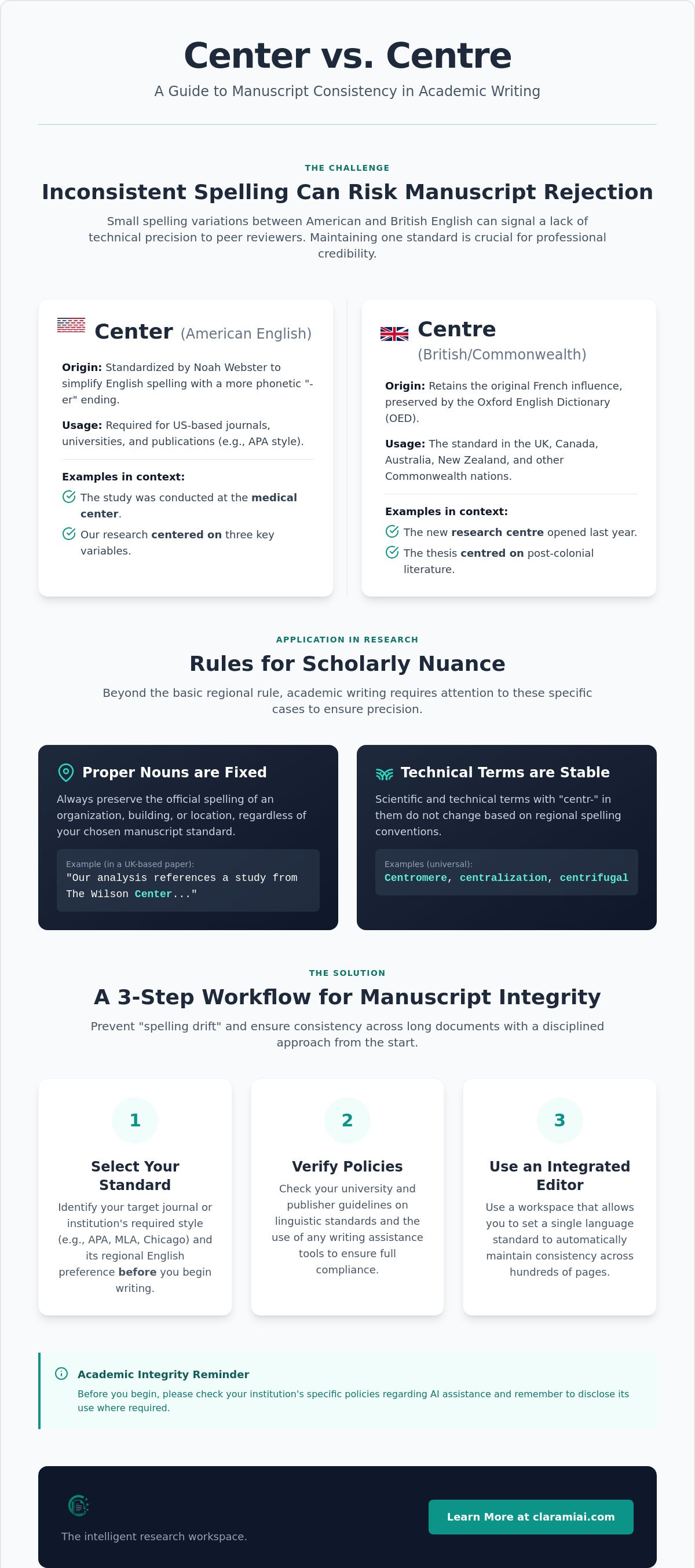
Before you begin drafting your manuscript, verify your specific university or journal policies regarding AI assistance and linguistic standards. Academic integrity requires you to disclose the use of AI tools where required. The choice between center vs centre is a matter of regional convention rather than semantic difference. Both terms function identically as nouns, verbs, and adjectives. They describe a middle point, a place of activity, or the act of focusing. While the meaning remains stable, the orthography shifts based on your target audience's geographic location.
Understanding American and British English spelling differences is vital for maintaining structural integrity in your dissertation. If you are submitting to a US-based publication, "center" is the required form. Conversely, "centre" is the standard for British and Commonwealth contexts. Inconsistent usage signals a lack of attention to detail to peer reviewers. It can disrupt the flow of your argument and create unnecessary friction for the reader.
To better understand this concept, watch this helpful video:
### The American English standardUS-based journals and institutions strictly adhere to the "center" spelling. This preference traces back to Noah Webster's 1828 dictionary. Webster sought to simplify English spelling by making it more phonetic. He removed the French-influenced "-re" ending in favor of "-er." In your scholarly work, you'll encounter this in phrases like "medical center" or "student center." Using this standard consistently across a 200-page document ensures your work appears polished and verified. It establishes a sense of professional discipline. When you use the center vs centre distinction correctly, you demonstrate an understanding of the regional expectations of your peers.
The British and Commonwealth standard
In the UK, Canada, Australia, and New Zealand, "centre" is the authoritative spelling. This version retains the original French influence; it's a tradition preserved by the Oxford English Dictionary. You'll use this variant when discussing an "urban centre" or a "research centre." Even within the Clarami workspace, you can configure your environment to respect these specific regional requirements. This prevents the "spelling drift" that often plagues long-form scholarly labor. Precise spelling acts as a proxy for technical precision. It anchors your arguments in a recognized linguistic framework, ensuring your methodology is presented with clarity and organizational cohesion.
Usage in research and scientific contexts
Technical precision extends beyond your data sets; it requires absolute consistency in your linguistic choices. The center vs centre distinction is particularly vital when your prose transitions from describing physical locations to abstract data points. In geometry or statistics, the mathematical center defines the point equidistant from all boundaries, and its spelling must align with the rest of your manuscript's regional choice. While you must choose one standard for your own prose, technical terminology often remains fixed. Terms like "centromere" in biology or "centralization" in political science do not change their internal "e" and "r" placement based on geography. These words maintain a stable structure across all English variants.
You will often encounter a conflict between physical locations and abstract concepts. For example, you might discuss a study conducted at The Wilson Center while analyzing the center of a specific theoretical argument. Scholarly integrity requires you to preserve the official name of a building or organization while applying your chosen regional standard to your own analysis. This methodical approach ensures your work remains anchored in primary sources. Always check your school's specific policies on AI usage and ensure you disclose any assistance where required.
Nouns vs. verbs in scholarly prose
Verbal forms present a significant challenge for researchers. If you are writing for a US-based journal, your methodology should describe how your study "centered on" a specific variable. In British or Commonwealth contexts, you would write that your research "centred on" the data. Precision is paramount. Avoid the common colloquialism "center around" in formal writing. A point is a singular location; therefore, your arguments should center on a specific claim rather than moving around it. Maintaining this chosen spelling in both physical and metaphorical contexts creates a sense of organizational cohesion throughout your dissertation. If you find these distinctions difficult to track, consider creating your Clarami account to access an environment designed for academic rigor.
Organizational names and proper nouns
Maintaining the structural integrity of your citations is an uncompromising rule. You must preserve the original spelling of an institution, such as The John Innes Centre, even if your entire paper follows American standards. Altering a proper noun to fit your regional preference is a technical inaccuracy. This rule applies to all references, footnotes, and bibliographies. When you manage your sources within the PDF Manager, ensure that the metadata reflects the source's original spelling. This practice ensures traceability and verification for your peer reviewers.
- Use "center" for generic references to facilities in US English (e.g., "The research center was well-equipped").
- Use "centre" for generic references in UK English.
- Always respect the specific, legal name of the entity you are citing.
This disciplined approach to proper nouns prevents the disorganized output that often leads to submission delays. ## The consistency challenge in global research
Long-form scholarly labor often spans months or years. During this time, you may inadvertently switch between regional standards as you move between different source materials. This spelling drift is a common risk in complex dissertations. Peer reviewers view inconsistent spelling as a proxy for your overall attention to detail. If you cannot manage the center vs centre distinction, they may question the precision of your data analysis. A manuscript that flip-flops between regional variants signals a disorganized workflow. It suggests that the author has not fully synthesized their diverse sources into a single, cohesive narrative.
When you incorporate direct evidence, you must preserve the original text exactly as it appears. If you cite a UK-based study that mentions a "community centre," do not change it to "center" to match your US-English manuscript. This maintains the structural integrity of the source. You are responsible for the accuracy of these transcriptions. If the regional spelling might confuse your audience, you can use the [sic] notation. However, this is usually reserved for actual errors rather than standard regional variants. Most researchers simply let the original spelling stand within the quotation marks to respect the source's origin.
Handling mixed-region citations
Citing organizations like "The Centre for Policy Research" requires a source-grounded approach. You must standardize your own synthesis while ensuring the proper noun remains untouched. Verifying these claims against your primary sources is a critical step in the collection, synthesis, and verification process. Using ClaimShield allows you to anchor your arguments in verified data while maintaining this delicate balance. Your workflow should involve a final pass specifically to check that your own prose hasn't adopted the spelling of your sources. You remain the human-in-the-loop, making the final decision on every linguistic choice.
Journal-specific linguistic requirements
Every publication has a specific linguistic mandate that you must follow. Before you finalize your draft, consult the "Instructions for Authors" section of your target journal. For instance, Nature generally prefers British standards. In contrast, Science mandates American English. The choice of center vs centre often depends on whether you are submitting to a journal based in London or New York. Adapting your draft tone and voice to match the target publication is a procedural requirement. This ensures your work fits seamlessly into the journal's existing corpus. Always check your specific school policies regarding AI assistance and disclose its use where required.
Practical steps for manuscript integrity
Achieving linguistic consistency requires more than intuition; it demands a structured workflow. You must select a primary style guide early in your research process to anchor your spelling choices. Whether you use APA, MLA, Chicago, or MHRA, your choice between center vs centre should be a deliberate, one-time decision that governs the entire manuscript. Once decided, verify that your document editor language is set to the correct regional variant. Standard spellcheckers are often insufficient for scholarly labor. They may recognize both spellings as technically correct if they aren't strictly locked to a specific region, leading to a disorganized output where both variants coexist invisibly. This creates a risk of technical inaccuracy that can undermine your authority as a researcher.
Using a global find-and-replace function often results in the accidental corruption of proper nouns and official institutional names, creating errors that are difficult to undo.
Style guide alignment
Your choice of style guide often dictates your regional spelling. APA and MLA default to American English, requiring "center" for all prose. Conversely, MHRA and Harvard (UK) expect "centre." Always consult your university's specific template for localized requirements. These templates often contain granular instructions that override general style guide rules. Before finalizing your work, please check your school's policies regarding AI assistance and disclose its use where required. This methodical alignment ensures your work meets the precise expectations of your discipline.
Systematic proofreading workflows
A project-specific glossary acts as a reliable intellectual companion throughout the writing process. It ensures that every instance of a technical term or regional variant is verified against a single standard. This is especially useful for ESL writers who may be managing sources from multiple geographic origins. You can use a tone checker to verify that your voice remains cohesive and professional. During your final pass, isolate specific elements of your paper. Check headings, captions, and references in separate stages to prevent your eyes from glossing over repeated terms. This systematic order is the best defense against peer-review rejection. To implement these workflows within a purpose-built academic environment, sign up for the Clarami workspace today.
Maintaining cohesion with the Clarami workspace
Most general-purpose tools treat the center vs centre choice as a post-writing correction task. This fragmented approach often leads to technical inaccuracies during the final stages of composition. Within the Clarami integrated editor, spelling consistency is treated as a foundational element of the drafting process. By working in a unified environment, you eliminate the need to copy-paste text from a separate chat interface. Copy-pasting often introduces the default spelling settings of the AI, which may conflict with your manuscript's regional standard. This creates a disorganized output that requires extensive manual correction.
You can use AutoDraft to generate initial sections that adhere to your pre-defined regional standard from the start. This methodical approach ensures that your bibliography and primary prose remain synchronized. While the workspace provides the structural framework, you remain the human-in-the-loop. You are responsible for the final editing and submission of your work. Before you begin, please check your specific university policies regarding AI assistance and disclose its use where required. This disciplined workflow ensures that your nuanced linguistic decisions are preserved throughout the writing cycle.
Integrated drafting and reference management
Keeping your sources and drafts connected is essential for maintaining the original context of a quote. When you manage your PDF collections within the workspace, you can easily track the geographic origin of every reference. This is particularly useful when you must preserve a British "centre" in a direct quotation while using American "center" in your own analysis. You can also leverage suggest-mode to invite advisor feedback on specific linguistic choices. This collaborative feature allows for a precise verification of your regional standards before you proceed to the final export.
Ensuring structural and linguistic integrity
The Clara AI Assistant helps you substantiate your arguments while maintaining a consistent scholarly voice. Instead of generating entire essays, you can use selection-level edits to refine specific paragraphs where "spelling drift" might have occurred. This surgical approach allows you to correct center vs centre inconsistencies without altering the surrounding verified data. Once your synthesis is complete, you can export your manuscript to DOCX or LaTeX with the assurance that your regional standards are applied uniformly across every heading, caption, and footnote. This systematic order is a meta-demonstration of professional discipline, ensuring your work is ready for the rigors of peer review.
Establishing linguistic precision in your research
Mastering the center vs centre distinction is a fundamental step toward professional credibility. You've seen that while the semantic meaning remains identical, regional conventions dictate the orthography of your prose. Maintaining this consistency across a long dissertation requires a disciplined workflow and a clear understanding of your target journal's requirements. Remember to preserve the original spelling of institutional names and primary source quotations even when they conflict with your manuscript's primary standard. This attention to detail signals a high level of technical precision to your peer reviewers.
A methodical approach to drafting ensures that your work isn't undermined by small linguistic errors. By utilizing source-grounded AI assistance with Clara and automated citation building for APA, Chicago, and more, you can focus on the structural integrity of your arguments. The integrated document editor allows you to synthesize complex data without the risks associated with fragmented writing tools. Always verify your institution's specific policies regarding AI assistance and disclose its use where required to ensure your work adheres to local academic integrity standards.
Start your next research project in the Clarami workspace to maintain absolute cohesion from your first draft to your final submission. Your dedication to detail will ensure your work meets the highest standards of academic excellence.
Frequently Asked Questions
Is it center or centre in Canada?
Canada standardizes on the "centre" spelling for general, government, and academic writing. While Canadian English often shares vocabulary with American English, it retains the British spelling for this specific term. If you're submitting your manuscript to a Canadian institution, you should use "centre" throughout your prose. Always verify the specific linguistic requirements of your target journal to ensure your work adheres to their regional standards.
Can I use both center and centre in the same research paper?
You shouldn't mix both spellings within your own prose as it indicates a lack of technical precision. Consistency is a primary requirement for any scholarly manuscript to avoid a disorganized output. The only exception is when you're quoting a source that uses a different regional standard than your own. Mixing center vs centre in your analysis will likely lead to peer-review rejection for poor attention to detail.
Does APA style require 'center' even for UK-based researchers?
APA style follows American English standards, which requires the use of "center" regardless of your geographic location. If you choose to use APA, you must adopt American spelling for your entire manuscript. Always verify your university's specific requirements before finalizing your work. Please check your school policies regarding AI assistance and disclose its use where required. This methodical alignment ensures your work meets the precise expectations of your discipline.
How do I quote a British source that uses 'centre' in my American paper?
Keep the original spelling of the source exactly as it appears within the quotation marks. Altering the spelling of a direct quote compromises the structural integrity of your evidence. You don't need to change "centre" to "center" in these instances. This practice ensures your work remains anchored in primary sources while you maintain your own manuscript standard in the surrounding text. It demonstrates an uncompromising commitment to accuracy.
Which spelling is preferred for international scientific journals?
The preference depends entirely on the journal's location and its specific "Instructions for Authors." For example, journals like Science prefer American English, while Nature generally follows British standards. Research the target publication's corpus to determine whether center vs centre is the expected variant. Selecting the correct regional standard early prevents the need for extensive selection-level edits later. This ensures your work fits seamlessly into the journal's existing corpus.
Is there a difference in meaning between 'centered on' and 'centered around'?
Academic writing prefers "centered on" because it implies a singular, precise focus. The phrase "centered around" is often considered a logical fallacy or a colloquialism because a center is a fixed point, not a circumference. Using "centered on" demonstrates a commitment to technical precision in your methodology. This choice helps substantiate your claims with the calm assurance expected in professional scholarly labor. It anchors your arguments in a recognized linguistic framework.
Related on Clarami
- Best AI writing tool for students (full guide) →
- AI academic integrity checklist →
- Clarami pricing: Free vs PRO vs Platinum →
- Editor vs ChatGPT for writing →
- Export DOCX, PDF, and hand-in checklist →
- How to outline a paper →
- Prompt to structured essay draft →
- Revise with AI on a selection →
- Sign up free →
- Clarami home →
- More guides on the Clarami blog →