Best software for PhD students 2026: A specialized toolkit for researchers
Find the best software for PhD students 2026. Streamline your research, manage citations, and draft your dissertation in one unified, source-grounded workspace.
Write with structure in Clarami AI
Editor-first AI drafting, citations, and two Workflows for student writing.
Best software for PhD students 2026: A specialized toolkit for researchers
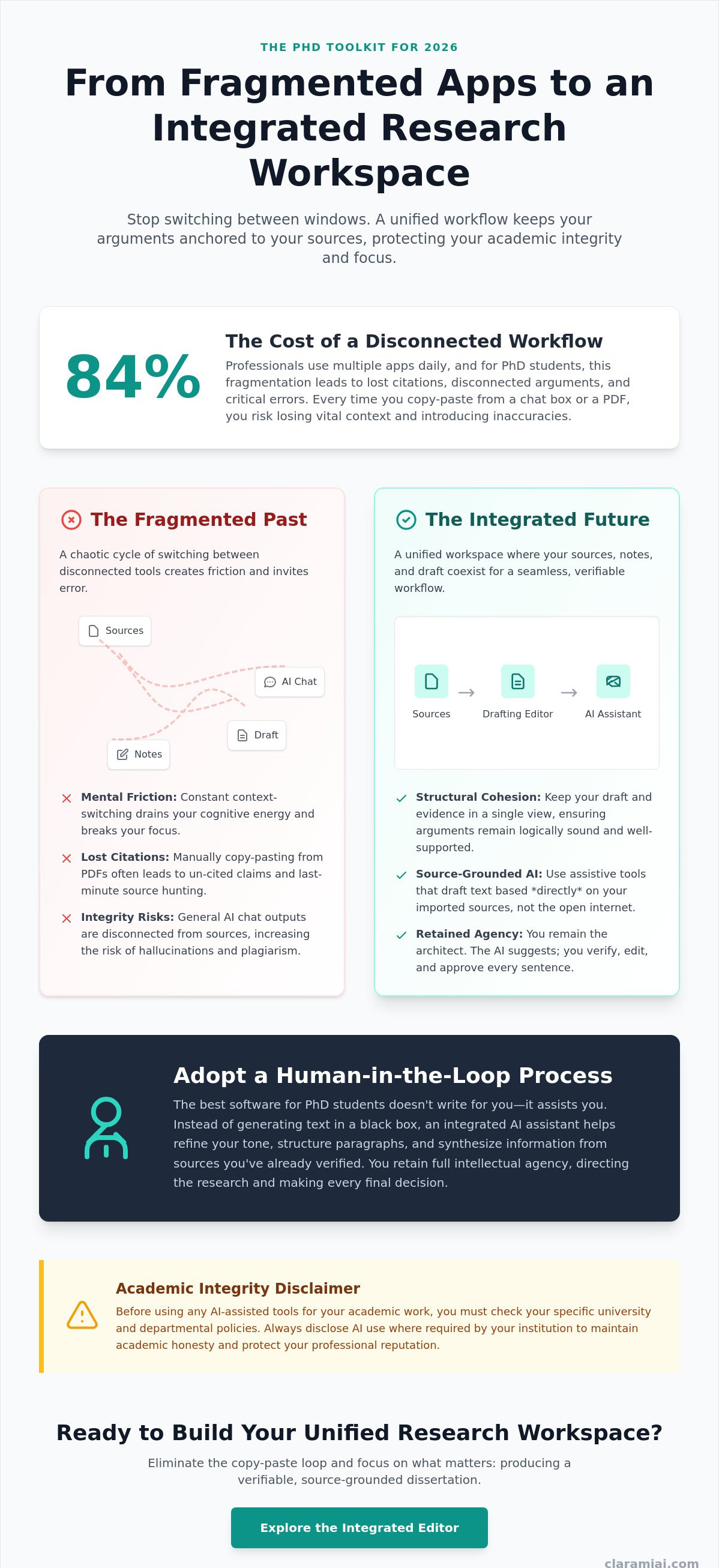
What if the primary obstacle to completing your dissertation isn't writer's block, but the structural gap between your research data and your draft? Recent data shows that 84% of professionals use multiple apps daily. For a PhD candidate, this fragmentation often leads to lost citations and disconnected arguments. Finding the best software for phd students 2026 is no longer about finding a faster way to type. It's about building a verified, source-grounded workflow that protects your intellectual agency.
You likely feel the pressure of managing committee feedback while trying to avoid the inaccuracies common in general AI tools. This guide identifies the essential toolkit for literature management and dissertation drafting, including how to select a specialized AI writing tool for students that integrates directly with your source material. We will examine how a unified workspace eliminates the need to copy-paste between windows; this ensures your draft remains anchored to verified data. Note: Always check your university's specific policies regarding AI assistance and disclose AI use where required by your institution.
Key Takeaways
- Distinguish between general productivity tools and specialized research environments that prioritize claim verification and source transparency.
- Evaluate the 2026 landscape of reference managers to identify the best software for phd students 2026 that integrates directly with your drafting workflow.
- Transition from fragmented chat interfaces toward integrated document editors to maintain structural integrity and eliminate the need for manual copy-pasting.
- Adopt a human-in-the-loop drafting process that uses specialized assistants to anchor your arguments in primary sources while you retain full intellectual agency.
Table of Contents
- The specialized PhD software landscape in 2026
- Literature discovery and reference management essentials
- Dissertation drafting: Integrated editors vs. chat interfaces
- Collaboration and feedback tools for committee reviews
- Building a unified research workspace with Clarami
The specialized PhD software landscape in 2026
The research environment in 2026 has shifted away from general productivity suites. You don't just need a word processor; you need a system that respects the complexity of a dissertation. Broad-market tools often fail to provide the traceability required for high-stakes academic work. Searching for the best software for phd students 2026 reveals a clear trend toward specialized, purpose-built platforms. Just as editorial teams use Editivo for professional content automation, researchers are adopting environments that prioritize structural integrity over generic automation.
Traditional reference management software serves as the backbone for organizing your bibliography, but the modern researcher requires more than a digital filing cabinet. You need a bridge between your library and your draft. The best software for phd students 2026 focuses on this connection, ensuring that your citations aren't just stored, but are active participants in your writing process. This shift marks the end of the "black box" era of AI, where outputs were generated without clear origins or verifiable data points.
To better understand how these tools fit into a modern research workflow, watch this helpful video:
### Academic integrity and the role of AI in 2026Integrity depends on your ability to verify every claim. Using AI to generate entire papers is a direct risk to your degree and your professional reputation. Most universities now utilize sophisticated detection methods that identify non-human structural patterns. Instead, you should look for assistive drafting tools that support a human-in-the-loop approach. This means you remain the primary architect of the work. You approve every paragraph; you verify every source. Assistive drafting helps you refine your academic tone without outsourcing your intellectual agency. Academic Integrity Disclaimer: Before using any AI-assisted tools, you must check your specific school policies and disclose AI use where required by your institution.
Why integrated workspaces are replacing disconnected apps
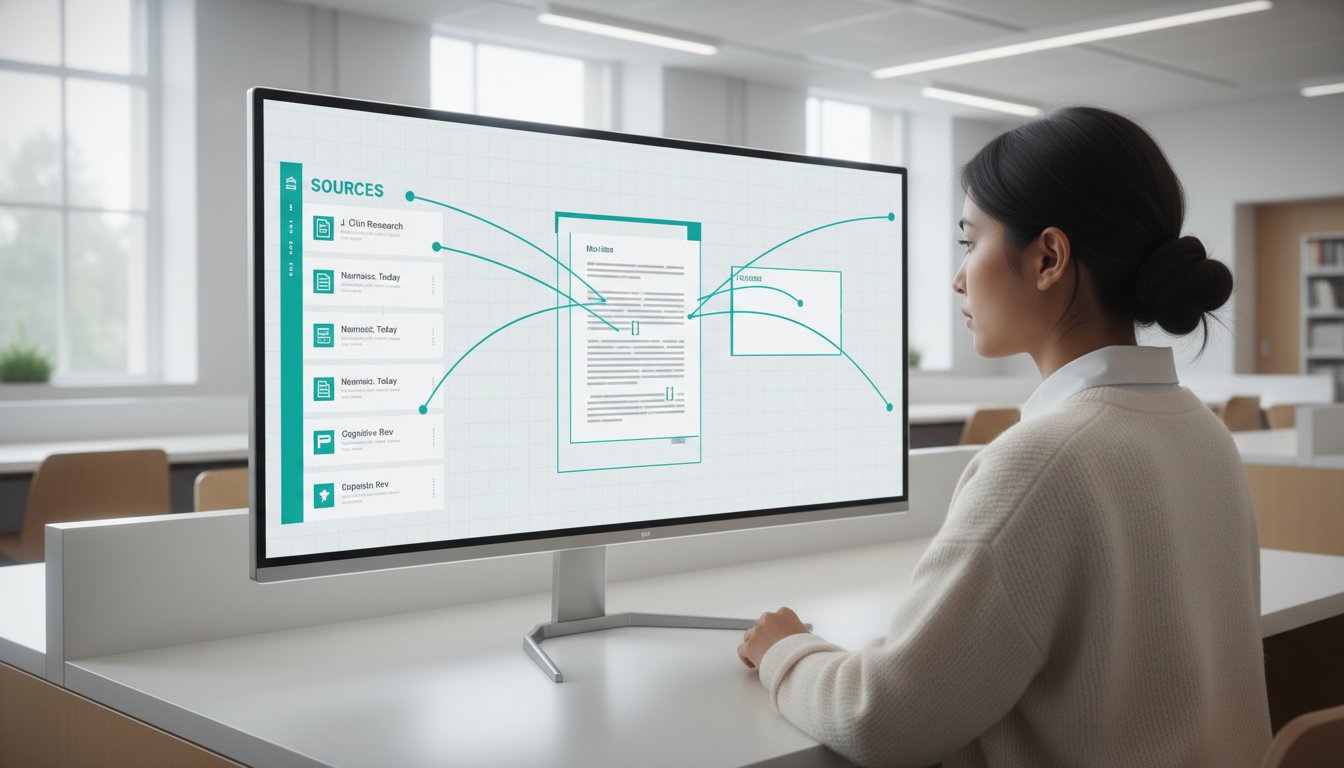
Switching between a PDF reader, a note-taking app, and a document editor creates mental friction. This fragmentation leads to lost insights and disconnected arguments. Every time you copy and paste a quote from a chat box into your draft, you risk losing the context of the original source. A unified research workspace allows you to keep your evidence and your draft in a single visual field. This structural cohesion ensures that your arguments remain anchored in primary data. Using the Clara AI Assistant within an integrated editor helps you focus on synthesis rather than manual formatting. It's a methodical way to build a dissertation that is both polished and verifiable.
Literature discovery and reference management essentials
Effective research begins with a robust infrastructure. You can't rely on basic keyword searches to identify the best software for phd students 2026. Classic tools like Zotero and Mendeley remain central to the academic workflow. Zotero, as an open-source option, provides 300 MB of free storage, with paid tiers ranging from $20 to $120 per year for those managing extensive PDF libraries. Mendeley continues to offer a structured environment for those within the Elsevier ecosystem. When you evaluate these tools, prioritize metadata extraction speed. A manager that fails to pull accurate DOIs or publication dates creates hours of manual correction work during the final stages of your dissertation.
This essential guide to academic research software highlights how specialized tools now handle qualitative and quantitative data alongside traditional citations. Cloud-based organization is no longer optional; it's a requirement for multi-device research. You need the ability to annotate a PDF on a tablet and have those notes immediately available in your primary document editor. Tracing your sources through a PDF Manager ensures that every claim you make is substantiated by the original text.
Discovery tools for identifying research gaps
Traditional keyword searches often miss relevant studies that use different terminology. Semantic search engines like Consensus use natural language processing to understand the intent behind your query. These tools help you build a theoretical framework by identifying consensus or conflict across hundreds of papers. Tracing citations forward and backward through a field of study allows you to map the evolution of a methodology. This systematic approach ensures you aren't duplicating existing work but are instead filling a verified research gap.
Reference management for large-scale projects
Organizing sources into a single, massive list is a recipe for confusion. You should categorize your library by project, chapter, or specific argument. Use web clippers to capture metadata directly from publisher databases like JSTOR or ScienceDirect. This ensures that your library stays organized from the start. Automated citation building in styles like APA 7, Chicago, or LaTeX is essential for maintaining accuracy across hundreds of pages. To maintain this level of organization throughout your drafting process, you can start your research workspace today and keep your library connected to your editor.
Dissertation drafting: Integrated editors vs. chat interfaces
Transitioning from literature discovery to the actual drafting of a dissertation is where many students experience significant organizational friction. While standalone chat interfaces are common, they often create a disconnected workflow that forces you to juggle multiple windows. The best software for phd students 2026 solves this by embedding assistive tools directly into the writing environment. This integration ensures that your draft remains connected to your research notes and bibliographic data at all times. Using an In-App Editor allows you to maintain focus without the constant interruption of switching between applications.
The drafting process requires a methodical progression from raw notes to structured prose. Tools like AutoDraft assist in this synthesis by helping you organize your initial thoughts into a coherent academic structure. This isn't about generating content from nothing; it's about refining the ideas you've already developed during your literature review. By keeping the drafting process within a unified workspace, you ensure that the logical thread of your argument remains intact across every chapter.
The pitfalls of copy-pasting from AI chat boxes
Relying on a separate chat box for writing assistance introduces unnecessary risks to your dissertation. When you move text from a chat window to your document, you often lose the underlying metadata and citation links. This fragmentation leads to formatting errors and, more critically, lost sources. A disconnected AI doesn't have the context of your entire 200-page document. It can't see how a paragraph in chapter four relates to your methodology in chapter one. In-app editors allow for structural audits where the software understands the broader context of your research, helping you maintain consistency in terminology and argument strength throughout the project.
Maintaining your voice with selection-level editing
Your scholarly voice is your most valuable asset as a researcher. Broad-market AI tools often produce generic, overly polished prose that sounds nothing like your own writing. The best software for phd students 2026 prioritizes selection-level edits, allowing you to highlight a specific sentence or paragraph for refinement. You can use a Draft Tone Checker to ensure your language remains objective and formal without losing your unique perspective. This sentence-by-sentence approval process is fundamental to a human-in-the-loop workflow. You remain the final editor, ensuring every word serves your specific research goals. Academic Integrity Disclaimer: You must check your university's specific policies regarding AI assistance and disclose its use according to your institution's requirements.
Collaboration and feedback tools for committee reviews
Managing the expectations of a dissertation committee is a logistical challenge that requires more than a simple file-sharing service. You need a system that tracks the evolution of your arguments while preserving the structural integrity of your data. The best software for phd students 2026 must facilitate this dialogue without introducing technical errors or losing track of which advisor requested which change. Many traditional word processors struggle with complex revisions, often leading to corrupted metadata or disconnected citations during the final review phases.
A unified research workspace prevents these issues by anchoring the bibliography to the document itself. This ensures that when an advisor suggests a structural change, the supporting evidence remains linked to the claim. Academic Integrity Disclaimer: You are responsible for reviewing all committee feedback and ensuring that final submissions adhere to your institution's specific standards for original work and AI disclosure.
Collaborative drafting workflows
Effective collaboration depends on precise version control to prevent data loss during heavy revisions. When you are coauthoring research papers or sharing your dissertation chapters, real-time updates eliminate the confusion of multiple file versions. Setting up "suggest mode" is a methodical way to handle advisor input. This feature allows committee members who do not use specialized software to contribute without overwriting your primary text. It gives you the intellectual agency to accept or reject changes on a sentence-by-sentence basis, ensuring you maintain the final authority over your scholarly voice.
Organizing feedback for systematic implementation
Receiving conflicting feedback from multiple committee members is a common pain point in the doctoral journey. You can mitigate this stress by managing feedback from your dissertation advisor through a centralized feedback matrix. Categorize comments by priority and chapter to create a logical path for revisions. This systematic approach ensures that you address every critique without losing focus on your core thesis. Maintaining citation consistency is critical when multiple authors or editors interact with your draft. The best software for phd students 2026 automates the re-formatting of these citations, allowing you to focus on the content of the feedback rather than manual bibliography updates.
To begin organizing your committee feedback within a unified research environment, create your Clarami account today and gain access to specialized academic templates.
Building a unified research workspace with Clarami
Clarami represents the methodical choice for researchers who value traceability and structural integrity. It provides a sophisticated environment where your intellectual agency remains central to the writing process. By using an integrated workspace, you connect your PDF library directly to the document editor. This structural cohesion addresses the fragmentation issues common in traditional research workflows. The Clara AI Assistant acts as a reliable intellectual companion, offering source-grounded drafting that respects the rigors of scholarly labor. It's a system designed by specialists for specialists.
Academic Integrity Disclaimer: You must verify your school's specific policies and disclose the use of AI-assisted drafting tools in accordance with your institution's guidelines.
Verification with ClaimShield and AutoDraft
ClaimShield performs a systematic audit of your document to ensure every argument is substantiated. It highlights claims that lack supporting evidence within your uploaded library, allowing you to anchor your arguments in primary sources. This feature is essential for maintaining the high standards of a doctoral dissertation. You can use AutoDraft to generate initial prose from your specific research notes, ensuring the logical thread of your work remains intact. The "no copy-paste" advantage of this system is clear. Drafting within the editor prevents the loss of citation metadata that typically occurs when moving text from standalone chat boxes. It's a precise way to manage the transition from raw data to polished output.
Pricing and access for the 2026 academic year
Selecting the best software for phd students 2026 requires a focus on long-term utility. Annual SaaS subscriptions offer a stable path for multi-year dissertation projects, providing predictable costs and continuous access to cloud-based organization. This model ensures you always have the latest verification tools at your disposal. Unlimited source-grounded assistance is a high-utility feature for doctoral candidates who need to maintain momentum during the final stages of their degree. You can view the full details on the Clarami pricing page to select the plan that matches your specific research timeline and budgetary requirements. This methodical approach to software selection helps you build a toolkit that supports your growth as a professional scholar.
Finalizing your dissertation with structural precision
Building a dissertation is a systematic process of substantiating claims and organizing complex data. You've seen how the shift toward unified research environments allows you to bridge the gap between your literature library and your final draft. By prioritizing traceability over simple automation, you ensure that your intellectual agency remains the driving force behind your work. Selecting the best software for phd students 2026 is a strategic decision to protect your academic integrity while streamlining the synthesis of primary sources.
Clarami provides the specialized infrastructure needed for this methodical labor. With ClaimShield verification technology, source-grounded AI drafting, and integrated PDF and citation management, you can maintain a rigorous connection between every statement and its supporting evidence. This workspace eliminates the friction of app-switching, allowing you to focus on the cognitive work of research. Academic Integrity Disclaimer: Always check your university's specific policies regarding AI assistance and disclose its use according to their standards.
Start your methodical research journey with Clarami today. Your path to a verified, polished dissertation begins with a workspace built for specialists.
Frequently asked questions
Is it ethical to use AI software during my PhD in 2026?
Yes, provided it is used for assistive drafting and verification rather than ghostwriting. When evaluating the best software for phd students 2026, institutional ethics remain the primary consideration. Most standards require a human-in-the-loop approach where you approve all outputs. Academic Integrity Disclaimer: Always check your specific school policies regarding AI use and disclosure requirements.
What is the best reference manager for a 100,000-word dissertation?
Zotero and EndNote are the most reliable for massive libraries due to their robust metadata handling. When searching for the best software for phd students 2026, look for tools that link these libraries directly to your editor. This avoids the manual re-entry of citations during the final editing stages and ensures your bibliography remains structurally sound.
How do I avoid fake citations when using AI writing tools?
Use source-grounded assistants that only interact with your verified PDF library. General-purpose chat bots often hallucinate data because they lack access to your specific research papers. Tools like ClaimShield audit your draft to ensure every statement is anchored in a real document you have uploaded. This systematic verification prevents the inclusion of non-existent sources in your work.
Can I use Clarami for both STEM and humanities research?
Yes, the platform includes structured templates tailored to both scientific methodologies and humanities-based critical analysis. STEM researchers benefit from systematic data extraction; humanities scholars use it for tracing thematic arguments across primary texts. The integrated editor supports selection-level edits for any disciplinary tone, allowing you to refine specific paragraphs without losing your unique perspective.
Does Clarami support LaTeX export for journal submissions?
Clarami allows you to synthesize and verify your research before moving it into specialized typesetting software like LaTeX. The workspace focuses on the drafting and verification phase of your project. This ensures your content is structurally sound and accurately cited before you apply final journal formatting. It acts as a methodical bridge between your raw notes and your final submission.
Guide maintained by Clarami AI. If you found this useful, consider sharing it with a classmate or research group.
Clarami AI is a All-in-one AI academic writing workspace for students and researchers. Draft, cite, and revise from outline to submission — in one editor, with traceable citations. Try free. Get started free
Related on Clarami
- Best AI writing tool for students (full guide) →
- AI academic integrity checklist →
- Clarami pricing: Free vs PRO vs Platinum →
- Editor vs ChatGPT for writing →
- Export DOCX, PDF, and hand-in checklist →
- How to outline a paper →
- Prompt to structured essay draft →
- Revise with AI on a selection →
- Sign up free →
- Clarami home →
- More guides on the Clarami blog →