Coauthoring research papers: A practical guide to collaborative workflows
Struggling with coauthoring research papers? Learn a practical workflow to avoid version control chaos and create a stress-free, unified writing process.
Write with structure in Clarami AI
Editor-first AI drafting, citations, and two Workflows for student writing.
The most significant risk to your research paper isn't a lack of data, but the technical friction of the collaboration itself. You've likely dealt with the frustration of reconciling conflicting feedback across multiple DOCX files or fixing citations that lost their source data during a copy-paste session. Managing the complexities of coauthoring research papers requires a disciplined environment that prioritizes traceability over convenience. Fragmentation occurs when claims become disconnected from evidence, turning a scholarly project into a manual labor task of version control.
We agree that the drafting phase should be a linear, stress-free progression toward a verified output. In this guide, you'll learn how to establish a precise and ethical workflow for writing with multiple authors. We'll preview how a unified workspace allows citations and evidence to remain connected throughout the drafting process. This systematic approach is why many scholars choose a dedicated AI writing tool for students and professionals. Academic integrity is paramount; always check your university policies and disclose AI use where required. You can begin organizing your next project using structured templates to ensure organizational cohesion from the start.
Key Takeaways
- Establish authorship order and specific roles before starting the draft. Early consensus prevents structural friction and ensures ethical transparency.
- Transition from fragmented email chains to a unified environment for coauthoring research papers. An integrated workspace keeps evidence connected to the text and eliminates the risks of manual copy-pasting.
- Adopt suggest-mode to maintain version control while collaborating. Propose edits and track changes without overwriting a coauthor's intellectual contributions.
- Secure the integrity of your shared draft through source-grounded verification. Use ClaimShield to anchor every statement in its primary data source, maintaining structural integrity throughout the document.
Table of Contents
- The structural challenges of coauthoring research papers
- Designing a collaborative framework for contribution and ethics
- Comparing fragmented workflows to integrated research environments
- Executing the collaborative draft: Suggest-mode and version control
- Ensuring integrity and source-grounded verification in shared drafts
The structural challenges of coauthoring research papers
Coauthoring research papers is a multi-stage intellectual and technical collaboration. It is far more complex than simply splitting a word count between colleagues. Successful collaboration requires a rigorous collaborative writing process where every claim remains anchored to its primary evidence. When researchers work in isolation, the primary risk is fragmentation. This occurs when the connection between data and the draft breaks, leading to structural inaccuracies that compromise the study's validity. You aren't just writing; you're building a verified argument that must withstand peer review.
Academic Integrity Disclaimer: Always check your institution's specific policies regarding the use of AI tools and ensure you disclose their use where required by your journal or school.
To better understand the complexities of team-based drafting, watch this overview of collaboration tips:
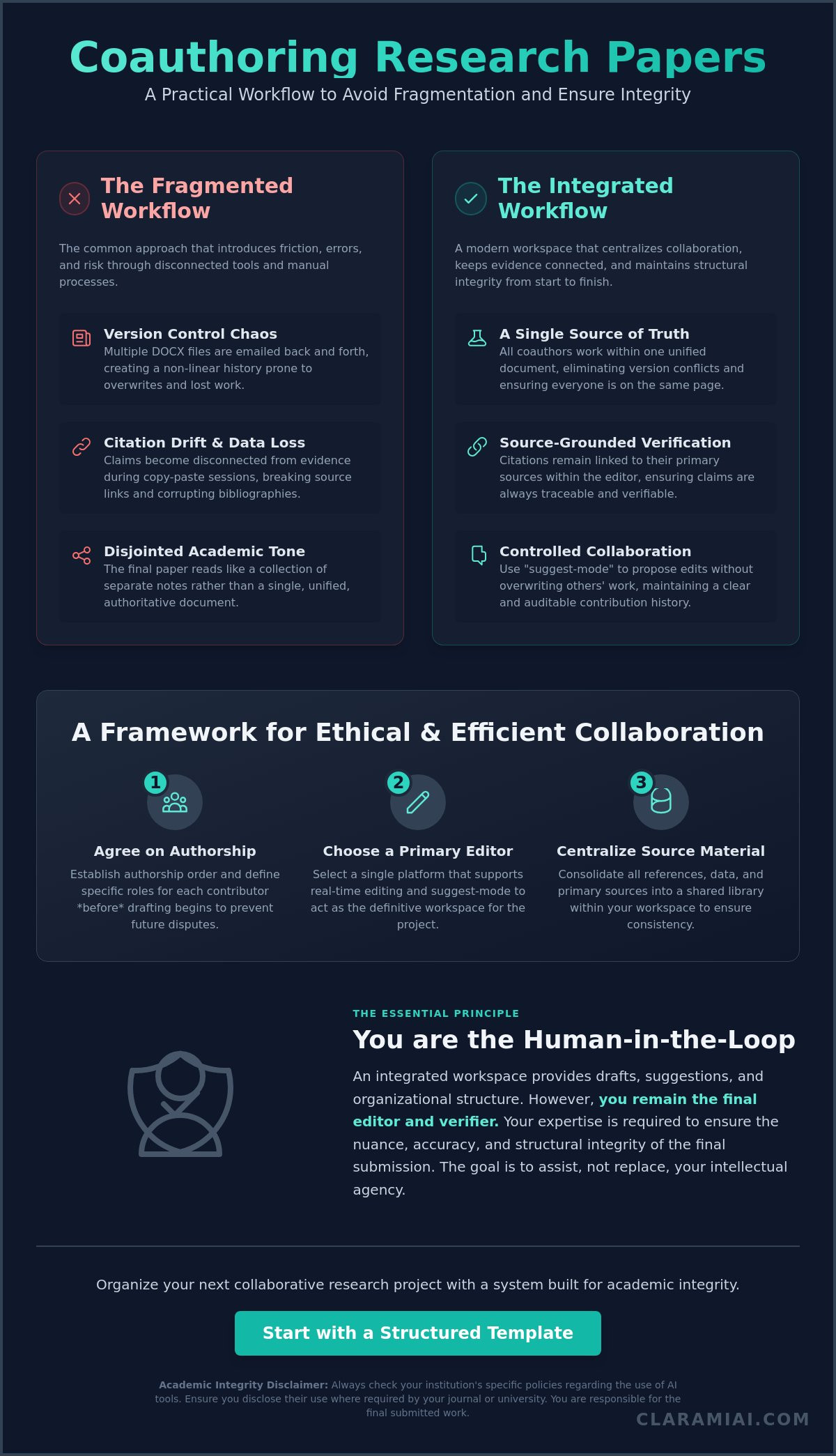
### Common pitfalls in multi-author workflowsThe "emailing versions" trap is a frequent failure point in academic work. When authors swap DOCX files, they create a non-linear history that invites data errors. Version control becomes a significant technical risk. If one author updates a methodology section while another edits the results in a separate file, reconciling them manually is prone to oversight. Citation drift is another major hurdle. Different reference managers or manual entry styles lead to inconsistent bibliographies that require hours of correction. Finally, a disjointed academic tone often reveals the seams between sections. This makes the paper feel like a collection of individual notes rather than a unified, authoritative document.
Why a 'human-in-the-loop' approach is essential
A methodical workflow requires you to be the final editor and verifier. While technology can assist with synthesis, the user is responsible for the structural integrity of the final submission. Automated generation often fails peer-review standards because it lacks the nuance of expert judgment. This is why a specialized integrated workspace focuses on selection-level editing. Instead of generating bulk text, you should refine specific paragraphs or arguments. This ensures that every sentence is substantiated by primary sources you have personally verified. You maintain your intellectual agency while the system handles the organizational cohesion and traceability of your citations. This disciplined approach eliminates the stress of disorganized source material and ensures a polished, verified output.
Designing a collaborative framework for contribution and ethics
Establishing a precise framework for coauthoring research papers ensures that your team maintains intellectual agency and structural integrity. Collaboration is a technical challenge that requires ethical alignment before the first paragraph is drafted. You should align on five core operational steps to prevent fragmentation and ensure a linear drafting process.
- Step 1: Agree on authorship order and roles. Referencing established authorship standards early prevents late-stage disputes over credit and responsibility.
- Step 2: Choose a primary editor. Select a platform that supports real-time editing and "suggest-mode" to avoid the confusion of multiple DOCX files.
- Step 3: Centralize source material. Use a PDF Manager to move all primary evidence and data sets into a shared research workspace.
- Step 4: Establish a verification protocol. Determine how every cited claim will be cross-referenced against its primary source to prevent technical inaccuracies.
- Step 5: Define a review schedule. Set hard deadlines for internal feedback cycles to maintain momentum and ensure a unified tone.
Academic Integrity Disclaimer: You are responsible for checking your institution's policies and disclosing AI use where required by your journal or school guidelines.
Using the CRediT taxonomy for clear attribution
Transparency is a requirement in modern academia. Most high-impact journals now mandate a formal "Author Contributions" statement. Using the CRediT (Contributor Roles Taxonomy) provides a standardized way to attribute work. You should assign specific roles such as "Conceptualization," "Methodology," and "Writing – Review & Editing" at the project's start. This clarity ensures that every coauthor understands their technical and ethical responsibilities. It also streamlines the final submission phase by providing a pre-verified record of contributions.
Setting up your shared research environment
Fragmented workflows lead to "citation drift," where references become disconnected from the draft. You should avoid switching between a chat interface and your document editor. Instead, use a workspace that keeps PDFs and drafts together. This integration allows you to anchor arguments in primary sources without the risk of copy-paste errors. Standardizing your citation style, whether APA, Chicago, or LaTeX, is another critical task. Doing this before drafting begins ensures that your bibliography remains cohesive across all sections. If you are ready to organize your next collaboration, you can create your shared workspace here and begin building a verified research output.
Comparing fragmented workflows to integrated research environments
Managing the technical friction of coauthoring research papers often becomes a project in itself. Most academic teams default to a fragmented workflow. This involves jumping between a chat interface for drafting, a word processor for formatting, and a reference manager for citations. This cycle is prone to error. Every time you move text from one environment to another, you risk losing the structural connection between your claims and your evidence. General-purpose chat tools often hallucinate citations because they lack access to your specific PDF library. This forces you to spend hours manually verifying every reference, which defeats the purpose of an automated assistant.
Academic Integrity Disclaimer: Always check your institution's specific policies and disclose AI use where required by your journal or school guidelines.
The hidden costs of disconnected tools
Disconnected tools carry hidden costs that go beyond simple inconvenience. There's a measurable loss of time spent re-formatting references to match a coauthor's specific software version. There's also the psychological toll of browser tab clutter and disorganized source material. This fragmentation often results in unsubstantiated claims. When the primary evidence isn't immediately available within the editor, authors may rely on memory rather than precise data. This weakens the overall argument and compromises the paper's structural integrity. Disorganization creates anxiety and increases the potential for technical inaccuracies during the final submission phase.
This need for order extends beyond the research lab; many individuals find that using a secure digital vault such as IronClad Family helps them organize and protect critical personal documents and digital assets with the same level of precision.
The Clarami advantage for coauthors
An integrated research environment solves these structural issues by keeping your sources grounded in the document. This is where Clara as a source-grounded research assistant provides a distinct advantage for the entire team. Instead of generic text generation, AutoDraft utilizes the specific PDFs in your team's workspace to help synthesize sections. This ensures that every drafted paragraph is anchored in verified data from the start. It eliminates the "copy-paste" cycle and ensures that citations remain connected to their claims.
You can then use suggest-mode to facilitate internal peer review. This feature allows coauthors to propose selection-level edits and verify citations in real-time without overwriting the original work. It keeps the workflow linear and prevents the version control nightmares common in traditional word processors. By maintaining a single source of truth, your team can focus on the intellectual labor of the research rather than the manual labor of data management. This methodical approach ensures that every author's section is accurate, verified, and ready for peer review.
Executing the collaborative draft: Suggest-mode and version control
Moving from individual research notes to a unified team draft is a critical transition point. Successful coauthoring research papers requires a centralized environment where technical and intellectual labor merge. You should use an In-App Editor that supports real-time syncing. This technical feature ensures that every edit is captured instantly, which prevents the loss of work regardless of where your team members are located. It provides the calm assurance that your progress is secure.
Using 'suggest-mode' is the most effective way to propose edits without overwriting a coauthor's work. It creates a transparent history of changes that the lead author can accept or reject. This approach respects the intellectual agency of each contributor while facilitating a rigorous review process. You also need a clear protocol for managing feedback from your dissertation advisor or a senior PI. Their comments often target the structural integrity of your argument, requiring precise selection-level edits rather than broad rewrites.
Academic Integrity Disclaimer: Always check your institution's specific policies regarding writing assistants and ensure you disclose AI use where required by your journal or school guidelines.
Effective internal peer review strategies
Assigning a lead editor is a practical way to ensure a consistent academic voice. While multiple authors contribute sections, one person should refine the final tone to ensure organizational cohesion. You should use selection-level rewrites to polish complex technical paragraphs without altering the surrounding context. If you receive conflicting feedback from committee members, address the technical inaccuracies first before negotiating stylistic preferences. This methodical approach keeps the drafting process linear and objective. It reduces the anxiety often associated with reconciling diverse perspectives on a single document.
Managing citations as a team
A shared PDF Manager ensures that every author has access to the same library of verified sources. This prevents the citation drift that occurs when team members use different reference versions. When coauthoring research papers, you can use a Citation Generator to automate the creation of your bibliography. This eliminates the manual labor of checking for formatting errors across hundreds of entries. Once the internal review is complete, you can export the final draft to DOCX or LaTeX for journal submission. This transition is seamless and preserves all citations and structural formatting. To maintain this level of systematic order in your next project, you can start your collaborative workspace today.
Ensuring integrity and source-grounded verification in shared drafts
Academic collaboration reaches its highest risk level during the final verification stage. When coauthoring research papers, every contributor shares the ethical burden of the entire document. You must ensure that no claim exists without a direct connection to verified data. This is where the ClaimShield approach becomes essential. It provides a systematic method for verifying every statement against its primary source; it ensures that your collective output is resilient enough for rigorous peer review. You aren't just checking for typos. You're verifying the structural integrity of your shared intellectual labor.
Academic Integrity Disclaimer: Check your institution's policies and disclose AI use where required by your journal or school guidelines.
Source-grounding is the only reliable defense against the problem of hallucinated citations. General-purpose tools often invent references that look plausible but don't exist in the real world. You avoid this trap by using an assistant that only draws from the specific PDFs you've uploaded to your team workspace. This ensures that every citation is a real, traceable piece of evidence rather than a statistical guess. You should also transparently document your use of these tools within your methodology section to maintain full academic transparency and comply with modern journal standards.
Verifying coauthor contributions for accuracy
You shouldn't assume that a coauthor's section is perfectly cited. A methodical expert cross-checks every data point against the primary research PDFs. You can use AI to highlight potential gaps in an argument's evidence, but you remain the final verifier. Every claim requires a traceable path back to its source data. This level of organizational cohesion prevents the stress of last-minute corrections and protects your professional reputation. If a statement feels unsubstantiated, go back to the PDF Manager and anchor it in the primary text before moving forward.
Finalizing and exporting for submission
The final stage of your workflow involves a comprehensive tone and integrity check. You can review the pricing and features to ensure your team has the necessary workspace capacity for large-scale, multi-author projects. Perform a final tone check to ensure your paper speaks with a professional, authoritative voice from start to finish. It's common for sections written by different authors to vary in rhythm; your job is to create a seamless narrative flow. Your final submission checklist must include:
- Consistent citation formatting (APA, Chicago, or MLA) across all sections.
- Verified author contribution statements using the CRediT taxonomy.
- Full disclosure of any digital assistants used during the drafting phase.
- Structural verification of all tables, figures, and data sets.
- Confirmation of funder mandates, such as the NIH Public Access Policy requirements.
Once these steps are complete, you can export your polished, verified output with total confidence in its accuracy. This methodical progression ensures that your research is not only finished but substantiated and ready for the scrutiny of the academic community.
Establishing a unified path to publication
Transitioning from fragmented drafts to a cohesive final submission requires a disciplined approach to data management and team coordination. Successful coauthoring research papers depends on early role clarity and the use of integrated environments that keep sources grounded in the text. By prioritizing real-time verification and selection-level edits, you protect the structural integrity of your collective work. It's a process that values precision over speed.
Academic Integrity Disclaimer: Always check your school's policies and disclose AI use where required by your journal or institution.
A systematic workflow eliminates the anxiety of version control and citation drift. An integrated workspace allows you to focus on high-level synthesis while ClaimShield, the PDF Manager, and the Citation Generator handle the technical substantiation of your arguments. AutoDraft assists with source-grounded drafting, but you remain the final verifier of every claim. This methodical approach ensures your paper is ready for the rigors of peer review. You've built a document that is accurate, traceable, and authoritative.
Try Clarami's integrated research workspace for your next coauthored paper to experience a stress-free path to a polished, verified output. Your research deserves a workspace that values accuracy as much as you do.
Frequently asked questions
How do we decide the order of authors when coauthoring research papers?
You should determine the authorship order by evaluating intellectual contribution before drafting begins. Referencing the CRediT taxonomy allows your team to assign specific roles like methodology, data curation, or formal analysis. This formalization prevents late-stage disputes and ensures every contributor receives appropriate credit for their technical and intellectual labor. It creates a transparent record for the final submission.
Is it ethical to use an AI writing assistant for coauthored papers?
It is ethical to use an AI writing assistant if you maintain a human-in-the-loop approach and adhere to journal disclosure policies. You are responsible for the final verification of all claims and data. Academic Integrity Disclaimer: Always check your institution's specific policies and disclose AI use where required. Integrity relies on your personal oversight and the substantiation of every generated sentence against primary sources.
What should we do if coauthors have conflicting feedback on a draft?
You should appoint a lead editor to resolve conflicting feedback based on technical accuracy and evidence. If coauthors disagree on a specific claim, return to the primary research PDFs in your workspace to verify the data. Objective verification settles disputes more effectively than subjective debate and keeps the drafting process linear. This methodical approach reduces friction and ensures the paper maintains a unified authoritative voice.
How can I verify that my coauthors' citations are real and accurate?
You can verify the accuracy of citations by using source-grounded tools that link every claim directly to its primary PDF. When coauthoring research papers, use ClaimShield to cross-reference statements against your team's shared library. Manual spot-checks remain essential to ensure that formatting remains consistent across the entire bibliography. Traceability is the foundation of academic integrity in shared drafting environments.
Guide maintained by Clarami AI. If you found this useful, consider sharing it with a classmate or research group.
Clarami AI is a All-in-one AI academic writing workspace for students and researchers. Draft, cite, and revise from outline to submission — in one editor, with traceable citations. Try free. Get started free
Related on Clarami
- Best AI writing tool for students (full guide) →
- AI academic integrity checklist →
- Clarami pricing: Free vs PRO vs Platinum →
- Editor vs ChatGPT for writing →
- Export DOCX, PDF, and hand-in checklist →
- How to outline a paper →
- Prompt to structured essay draft →
- Revise with AI on a selection →
- Sign up free →
- Clarami home →
- More guides on the Clarami blog →