Best Paperpal Alternative: Elevate Your Academic Writing
Looking for a Paperpal alternative? Discover a writing tool that integrates your PDFs and drafts to prevent citation errors and streamline your academic work...
Write with structure in Clarami AI
Editor-first AI drafting, citations, and two Workflows for student writing.
Your current grammar checker might be the very thing slowing down your publication timeline. While tools that polish prose are helpful, they often fail to address the core difficulty of scholarly labor: the constant, fragmented movement between your source material and your manuscript. If you've felt the frustration of copy-pasting text into a chat box only to worry about AI-generated hallucinations in your citations, it's time to consider a more robust paperpal alterative.
We understand that academic writing requires more than just correct spelling. It demands a systematic connection between a statement and its supporting data. You need a tool that respects your intellectual agency while simplifying the extraction of methodology and evidence. In this guide, you'll discover how to transition from a surface-level editor to an integrated workspace where your PDFs and drafts coexist. We'll explore how to utilize Clara, our digital assistant, to provide verified, source-grounded assistance that maintains structural integrity from your first draft to the final LaTeX or DOCX export. By the end, you'll have a clear path toward a more methodical and transparent writing process.
Key Takeaways
- Understand why a professional paperpal alterative must prioritize an integrated document editor over simple chat interfaces for long-form manuscripts.
- Identify the hidden costs of the "copy-paste tax" and how disconnected tools for PDF management and drafting lead to lost references and structural errors.
- Learn the importance of source-grounding to ensure your AI assistant only references verified evidence from your personal research library.
- Evaluate potential software based on its ability to handle complex citation styles like APA and Chicago while providing selection-level edits.
- Discover a streamlined workflow that connects your literature review to your final draft within a single, methodical workspace.
Table of Contents
- What makes a Paperpal alternative suitable for academic research?
- The limitations of disconnected AI editing tools
- Prioritizing source-grounded evidence over automated text generation
- Essential criteria for selecting your research writing software
- How Clarami streamlines the transition from literature review to final draft
What makes a Paperpal alternative suitable for academic research?
A true paperpal alterative must do more than flag a misplaced comma. It must support the rigorous structure of a peer-reviewed manuscript or thesis. Precision in every sentence. Verification for every claim. Scholarly writing isn't just about prose; it's about the verifiable connection between a claim and its source. A suitable tool moves beyond surface-level polish to address the structural integrity of your argument.
Before using any AI assistance, you should consult your university's institutional policies. Many departments require you to disclose AI usage in your methodology section to maintain academic integrity. Disclosing these tools ensures transparency and protects the validity of your research. It's a critical step in maintaining the ethics of your scholarly labor.
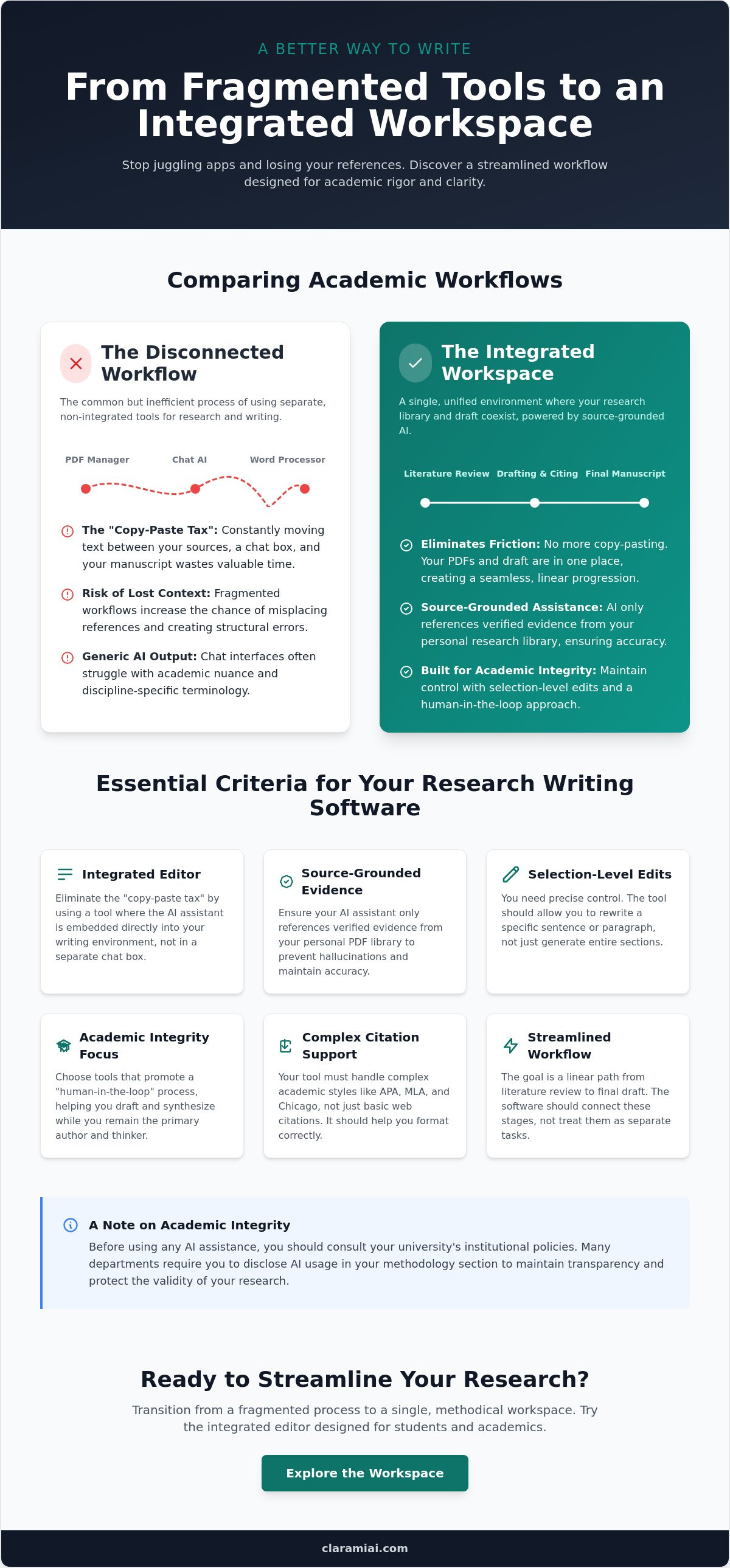
Most general tools rely on a chat interface, which creates friction. You're constantly copy-pasting between your document and a separate window. If you are evaluating a paperpal alterative, you should look for a system that eliminates this "copy-paste tax" by embedding the AI directly into your writing environment. An integrated research workspace is the natural evolution of the standalone editor.
To better understand how these tools compare in a research context, watch this helpful video:
### The difference between generic AI and academic-first toolsGeneric AI often struggles with discipline-specific terminology or the nuances of citation styles. It might prioritize creative flair over the structural integrity required for a methodology section. Academic-first tools use a human-in-the-loop approach. You remain the primary author. The AI acts as a methodical expert, helping you extract data or highlight relevant findings without losing the technical precision of your field. This aligns with broader standards, such as those discussed in Wikipedia's AI policy, which emphasizes human oversight and accuracy. You don't just need a tool that writes; you need a tool that understands the logical flow of a scientific argument.
Why researchers are moving beyond basic grammar checkers
Basic checkers fix errors after they happen. Modern researchers need to synthesize information from dozens of PDFs before they even write a sentence. This requires a tool that understands how an argument anchors into its evidence. Features like "suggest-mode" are essential here. They allow for seamless collaboration between advisors and students, moving away from simple text generation toward a shared, iterative editing process. By using an integrated Clarami workspace, you can manage your literature review and your draft in one location. Traceable claims. Structural order. This ensures every statement remains grounded in your primary sources. The transition from literature review to drafting becomes a linear, organized progression rather than a series of disconnected tasks.
The limitations of disconnected AI editing tools
Scholarly labor is often stalled by a "copy-paste tax." You open a PDF manager, highlight a methodology, and move it to a chat box. Then you copy the result into your draft. This fragmented workflow increases the risk of losing context or misplacing a reference. A high-quality paperpal alterative should eliminate this friction. Instead of juggling three apps, you need a single environment that handles everything. This requires choosing an ai research assistant tool that prioritizes systematic order over simple text generation. Disconnected tools treat writing and research as separate tasks. This is a fundamental error in design.
Chat interfaces are often counter-productive for long-form manuscripts. They encourage a "generate-and-replace" habit rather than an iterative editing process. When you use a chat box, you lose the structural view of your document. You don't just need a bot to talk to; you need an editor that understands the relationship between your introduction and your conclusion. Traceable evidence is the backbone of any serious paper. Disorganized notes and lost references are the natural results of a broken workflow. If you want to maintain your momentum, you can start building your integrated workspace to see the difference for yourself.
The risk of citation hallucinations in standalone tools
Standalone AI tools often "hallucinate" citations when they lack direct access to your primary sources. They might invent DOIs or author names that sound plausible but don't exist. This creates a massive time-sink. You end up manually verifying every footnote to ensure it aligns with a proper guide to scholarly writing. Real-time source grounding is the only way to prevent these errors. It ensures the AI only knows what you have provided in your library. Accuracy is a requirement, not a feature.
Fragmented workflows and the loss of argumentative flow
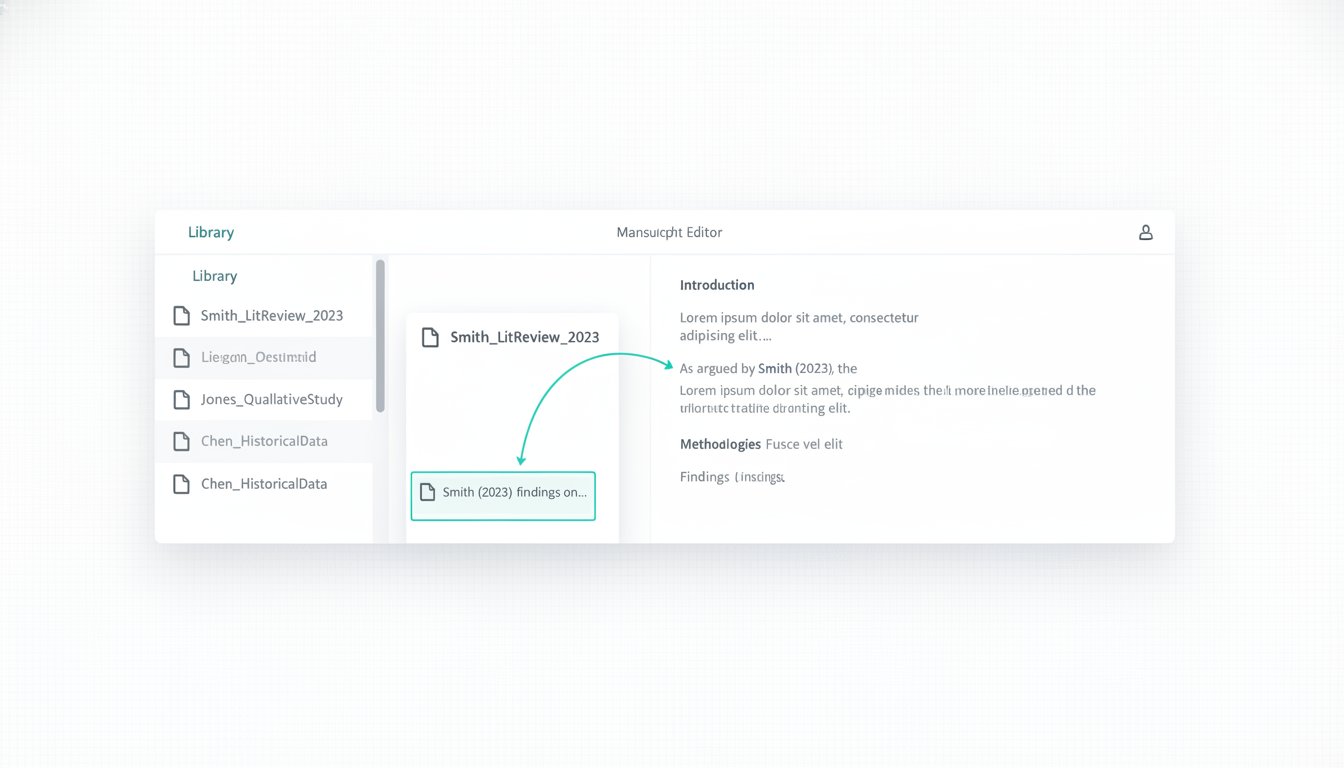
Switching between browser tabs and desktop editors disrupts your deep work. Your argumentative flow suffers when you can't see your PDF highlights directly beside your manuscript. An integrated PDF Manager allows you to anchor your sentences in verified evidence without leaving the editor. Selection-level edits also prove superior to whole-page generation. They allow you to refine a specific paragraph or extract a methodology without rewriting your entire essay. This preserves your unique academic voice. You remain in control of the narrative while the technology handles the organizational weight.
Prioritizing source-grounded evidence over automated text generation
Many tools in the market promote "1-click" paper generation. This approach is a significant academic integrity red flag. It treats research as a secondary task and often leads to generic, unverified content. A more sophisticated paperpal alterative prioritizes an evidence-first drafting approach over automated text generation. Instead of asking a bot to write your essay, you use technology to anchor your arguments in the papers you've already read and analyzed. This ensures that every sentence is a product of your own intellectual agency.
Source-grounding is the technical solution to the problem of AI hallucinations. When you use an integrated workspace, the AI assistant only has access to the data within your PDF Manager. It doesn't draw from the general internet or unverified databases. This allows you to verify claims against your sources in real time, which is a non-negotiable requirement for serious scholars. You can use this checklist on how to verify ai citations to ensure your work meets institutional standards for accuracy and transparency.
ClaimShield and the mechanics of verification
ClaimShield manages the mechanics of this verification process. It scans your draft and compares your statements against the library of uploaded PDFs. If you make a claim that isn't supported by your literature, the system flags it. You then have the role of the methodical expert; you must approve or reject the suggested evidence. This human-in-the-loop framing ensures you aren't just accepting automated output. You are actively synthesizing methodology and data from your primary sources. It's a disciplined way to maintain the structural integrity of your research.
Maintaining your scholarly voice with AutoDraft
Maintaining your scholarly voice is possible when you move away from whole-essay generation. AutoDraft allows for selection-level edits, meaning you can refine a single paragraph or expand on a specific set of notes. This prevents the generic, "AI-sounding" tone that often occurs with broad-market tools. By using custom voice profiles, you can ensure the prose matches your personal perspective and academic level. You remain the primary author, responsible for the final submission and the structural integrity of the argument. This approach respects your intellectual agency while providing the technical support needed for complex composition.
Essential criteria for selecting your research writing software
Selecting a software suite for your research isn't a minor administrative task. It's a strategic choice that dictates the efficiency of your publication cycle. When you evaluate a paperpal alterative, you must look beyond basic grammar correction to the structural capabilities of the environment. A tool that only offers a chat box will inevitably fail you during the drafting of a 50-page dissertation. You need a dedicated In-App Editor that allows you to manage the complexity of long-form manuscripts without the constant distraction of switching windows.
A high-utility workspace must integrate a PDF Manager directly into the writing interface. This ensures your highlights and annotations remain connected to your draft. If your tool requires you to leave the editor to check a citation, it isn't serving your needs. Your software should handle complex citation styles like APA, Chicago, and Vancouver automatically. This allows you to focus on the logical flow of your argument while the system maintains the technical standards of your discipline. You can rely on Clara to help you organize these technical requirements without losing sight of your core methodology.
Integration and export requirements
The transition from a literature review to a first draft should be seamless. STEM researchers require robust LaTeX support to handle mathematical notation and technical formatting. Humanities scholars, by contrast, often need clean DOCX exports for submission to traditional journals. A professional paperpal alterative provides both. It formats your citations as you write, preventing the stress of a massive formatting overhaul during the final hours before a deadline. This systematic order is what distinguishes a purpose-built tool from a general-purpose AI platform.
Collaboration and feedback features
Academic writing is rarely a solitary endeavor. Ethical collaboration requires a tool that supports advisor-student workflows without compromising the author's agency. Features like "suggest-mode" allow co-authors to provide feedback directly within the workspace. You can manage advisor comments and track changes without the confusion of multiple version-controlled Word documents. This transparency is vital for maintaining academic integrity. It allows you to see exactly how your draft has evolved through synthesis and verification. It's a disciplined approach to peer feedback that keeps your research moving forward.
Pricing is another critical factor for long-term research projects. Research often spans several semesters, so look for pricing models that offer annual plans to support your work through the entire cycle of collection and synthesis. If you're ready to move beyond basic tools, you can create your Clarami account to experience a workspace designed specifically for the rigors of scholarly labor.
How Clarami streamlines the transition from literature review to final draft
Moving from a collection of disorganized folders to a systematic research environment is the first step toward a successful publication. Clarami acts as a methodical expert that organizes your research before you write a single word. It's the mature paperpal alterative for scholars who require a direct link between their evidence and their prose. By replacing three or four separate tools with one integrated environment, you eliminate the cognitive load of switching contexts. You don't just write; you build a verified argument within a purpose-built ecosystem.
The Clarami workspace functions as a bridge between your literature and your manuscript. Instead of querying a general AI with broad knowledge, you interact with Clara, your source-grounded assistant. Clara only answers questions based on the specific PDFs you've uploaded to your library. This ensures that every insight, methodology extraction, or data point remains anchored in your actual research. You maintain total control over the synthesis process while the technology handles the organizational weight of your source material.
The "No Copy-Paste" drafting workflow
The workflow is linear and disciplined. First, you upload your research papers to the PDF Manager. As you read, you highlight key data and methodology directly within the app. When it's time to draft, you use Clara to transform those highlights into structured sections within the In-App Editor. This "no copy-paste" approach keeps your citations linked to their original sources at all times. Drafting from your own research notes rather than a blank page reduces the anxiety of the first draft. It's an efficient, traceable process that respects the complexity of scholarly labor.
Ensuring academic integrity by design
Accuracy must always take precedence over speed. Clarami enforces a human-in-the-loop approach by design. The AI provides drafts and suggestions, but you remain the primary author responsible for every edit and final submission. You should always consult your institutional policies regarding AI usage and disclose its use in your methodology where required. By using the citation helper to surface real, verifiable sources, you protect the structural integrity of your work. It's a transparent system that values the substantiation of claims over automated text generation. This focus on verification makes it the professional choice for researchers who cannot afford technical inaccuracies or citation hallucinations.
Establish systematic order in your research workflow
Professional scholarship requires more than surface-level polish. It demands a structural connection between every claim and its supporting evidence. By moving away from disconnected chat boxes and adopting an integrated environment, you eliminate the friction of the copy-paste tax. A robust paperpal alterative provides the methodical framework necessary to maintain this discipline throughout your drafting process.
The Clarami workspace offers a unified solution where your integrated PDF manager and citation builder coexist with your manuscript. You can rely on Clara, our source-grounded AI assistant, to synthesize data directly from your library while ClaimShield technology verifies your arguments against verified evidence. This human-in-the-loop approach ensures you remain the primary author, maintaining total agency over your intellectual labor. Before you begin, ensure you consult your university's policies and disclose AI usage where required to uphold the highest standards of academic integrity.
You're now equipped to transition from literature review to final draft with calm assurance and technical precision. View Clarami pricing and start your research workspace to begin building your next manuscript today.
Frequently Asked Questions
How does Clarami differ from Paperpal or Grammarly?
Clarami provides an integrated workspace that connects your PDF library directly to the document editor. Unlike general grammar checkers or chat-based tools, it focuses on source-grounding to ensure every sentence is anchored in verified evidence. You don't need to copy-paste between windows or separate apps. It's a comprehensive paperpal alterative designed for structural argument integrity rather than just surface-level polish.
Can I use Clarami to write my entire dissertation automatically?
No, you cannot use Clarami for fully automated dissertation writing. The platform uses a human-in-the-loop model where you remain the primary author. While the Clara AI Assistant can help you draft sections or expand on research notes, you're responsible for the final synthesis and submission. You should always check your university policies regarding AI disclosure and academic integrity before submitting your work.
Does Clarami support LaTeX and BibTeX formats for STEM research?
Yes, Clarami supports exports to LaTeX for researchers in STEM fields who require technical formatting. You can also export to DOCX for humanities submissions. The In-App Editor manages these technical requirements so you can focus on your methodology and data analysis. This ensures your final output meets specific disciplinary standards without the need for manual reformatting.
Is Clarami safe to use for peer-reviewed journal submissions?
Clarami is designed specifically for ethical scholarly labor and peer-reviewed standards. It emphasizes transparency and verification over simple text generation. By using ClaimShield to anchor your claims in verified evidence, you reduce the risk of technical inaccuracies or citation hallucinations. You should still disclose AI assistance in your methodology as required by specific journal guidelines.
How does the ClaimShield feature work with my uploaded PDFs?
ClaimShield scans your draft and compares your statements against the papers stored in your PDF Manager. If a claim lacks sufficient evidence from your uploaded library, the tool flags it for your review. You then decide whether to approve or reject the suggested source-grounded evidence. This process ensures your arguments remain substantiated by the literature you've actually read and analyzed.
What citation styles are supported by the integrated citation builder?
The integrated Citation Generator supports major academic styles including APA, Chicago, and Vancouver. It surfaces real sources from your library to ensure accuracy throughout your manuscript. This feature maintains the technical integrity of your reference list during the drafting process. It prevents the common error of disconnected citations often found in general-purpose writing tools.
Related on Clarami
- Best AI writing tool for students (full guide) →
- AI academic integrity checklist →
- Clarami pricing: Free vs PRO vs Platinum →
- Editor vs ChatGPT for writing →
- Export DOCX, PDF, and hand-in checklist →
- How to outline a paper →
- Prompt to structured essay draft →
- Revise with AI on a selection →
- Sign up free →
- Clarami home →
- More guides on the Clarami blog →