
Best ChatGPT Alternatives for Reliable Academic Writing
Looking for the best ChatGPT alternative for academic writing? Discover tools that use your PDFs to generate accurate citations and eliminate copy-pasting.
Write with structure in Clarami AI
Editor-first AI drafting, citations, and two Workflows for student writing.
What if the very tool meant to speed up your research is actually creating hours of extra verification work? You’ve likely felt the frustration of chasing down a citation that doesn't exist or spent your afternoon cleaning up prose that lacks academic rigor. Finding the best chatgpt alternative for academic writing means looking beyond a simple chat box and toward a source-grounded workspace. While general-purpose chatbots are impressive, they weren't built for the structural demands of a thesis or a peer-reviewed paper.
This article explains why professional scholarly writing requires an environment where your arguments are anchored in primary sources. You'll learn how to transition from a disorganized pile of PDFs to a verified, citation-ready manuscript while maintaining full intellectual agency. We will explore workflows that automate citation management in APA and Chicago styles and eliminate the tedious need to move text between separate windows. The focus remains on a human-in-the-loop approach where you lead the research and the technology supports the structure.
Academic integrity disclaimer: Please review your school's specific policies and disclose any AI use as required by your institution.
Key Takeaways
- Understand why general-purpose models often hallucinate citations and how a source-grounded workspace ensures every claim is backed by a verified DOI.
- Identify the best chatgpt alternative for academic writing by prioritizing tools with a built-in PDF Manager that anchors responses in your specific research material.
- Learn how to eliminate the copy-paste cycle by using an In-App Editor and AutoDraft features to compose directly within a single, integrated workspace.
- Adopt a human-in-the-loop writing model that prioritizes academic integrity and follows institution-specific disclosure policies for AI use.
- Follow a structured 5-step workflow to move from raw research to a polished manuscript using templates matched to professional academic rubrics.
Table of Contents
- Why general-purpose AI models fall short for scholarly work
- Identifying the core requirements of an academic writing alternative
- Beyond the chat box: The shift toward research-integrated workspaces
- Maintaining academic integrity while using AI assistants
- Transitioning your workflow to an integrated research environment
Why general-purpose AI models fall short for scholarly work
General-purpose AI models are built for broad accessibility, not narrow accuracy. Their primary function is to predict the next likely token in a sequence based on vast datasets. While this makes them excellent for creative brainstorming, it makes them unreliable for scholarly labor. In a peer-reviewed context, a claim without a verifiable source is a liability. This is why many researchers are searching for the best chatgpt alternative for academic writing; they need a system that prioritizes verification over creative flair.
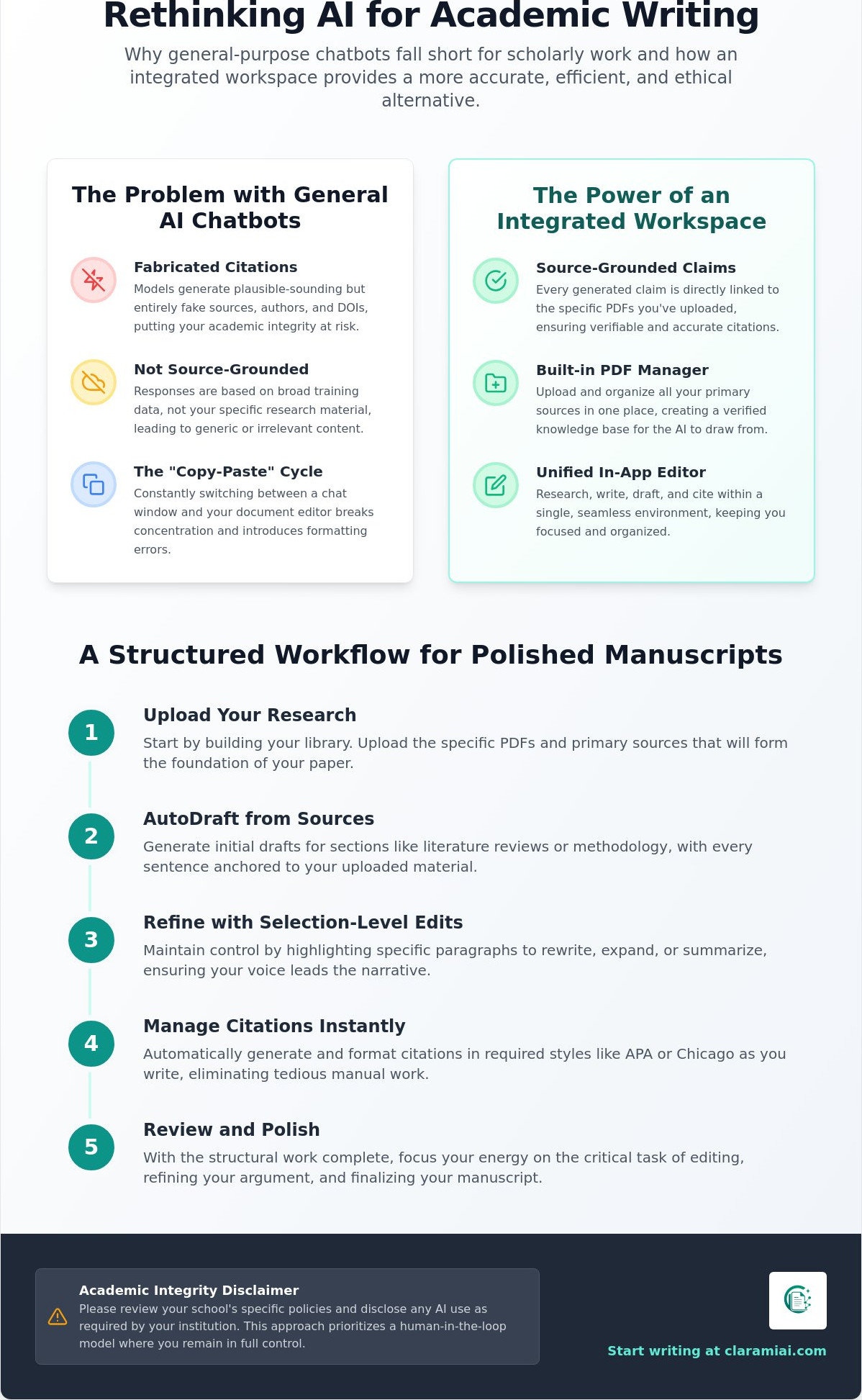
Large language models often struggle with the "hallucination problem," where the system generates plausible-sounding but entirely fabricated citations. This happens because general-purpose AI models do not "know" facts in the way a human does. They identify patterns in language. If you ask for a source on a specific niche topic, the AI may invent a convincing title, a realistic author name, and even a fake DOI. For a student or academic, using these fabricated sources can lead to severe consequences for academic integrity and professional reputation.
To better understand how specialized tools compare to general models, watch this helpful tutorial:
### The technical limit of chat-based citationThe core issue lies in how these models access information. Most general AI tools operate as a "closed loop," meaning they rely on their training data rather than a live, searchable database of academic journals. They cannot "see" the specific PDFs on your hard drive unless you manually upload them to a chat box every single time. Even then, the chat interface often lacks the structural integrity to maintain those connections throughout a long-form document. This leads to "plausible but fake" references that look correct at a glance but fail under scrutiny.
Friction in the copy-paste workflow
Writing a dissertation or a research paper is a non-linear process. It requires constant movement between reading, note-taking, and drafting. Using a standard chat interface introduces significant cognitive load. You find yourself constantly switching between browser tabs and your document editor, which breaks your concentration and leads to formatting errors. This fragmented workflow is more than a nuisance; it often results in lost context and disorganized data. A dedicated In-App Editor solves this by bringing your research and your manuscript into a single, unified environment. Transitioning away from a chat box is the first step toward finding the best chatgpt alternative for academic writing and building a more reliable workflow.
Identifying the core requirements of an academic writing alternative
Speed is a metric for social media posts, not scholarly manuscripts. When searching for the best chatgpt alternative for academic writing, you must prioritize accurate synthesis over fast generation. A professional tool doesn't just "write" for you. It helps you organize existing research into a coherent argument. This requires an environment where the AI is constrained by your specific data rather than its broad training set.
A built-in PDF Manager is a non-negotiable requirement for grounding. Without it, the AI relies on general data, which often results in the hallucination problems mentioned in the previous section. A dedicated manager allows you to upload your specific source material, ensuring the AI only references what you have actually read. You should also look for selection-level editing capabilities. Generating an entire essay in one click is a risk to your intellectual agency. Instead, you should be able to highlight a single paragraph to refine the methodology or clarify the data analysis. This keeps you in control of the narrative.
Effective scholarly work is about substantiating claims through a methodical process. If you are ready to move beyond the limitations of a chat box, you can create your research-integrated workspace today.
Source-grounded research assistance
Finding the best chatgpt alternative for academic writing involves choosing a tool that uses Retrieval-Augmented Generation, or RAG. Most general-purpose models guess the next word based on probability. RAG changes this by forcing the AI to retrieve information from a specific set of documents first. When you use Clara as your research companion, she scans your uploaded PDF library to find the exact data points needed for your argument. She doesn't pull from the open web or her own training data unless you explicitly allow it. This ensures that every citation is real, traceable, and relevant to your specific research question.
Structural integrity and formatting
Academic writing follows rigid structural rules that general chatbots often ignore. Whether you are using the IMRaD format or a specific humanities rubric, your workspace must provide the necessary structural scaffolding. You need native support for APA, MLA, and Chicago styles to manage citations automatically without manual entry. The ability to export your work in professional formats like LaTeX or DOCX is equally vital for the final submission process. You can explore these Clarami features to see how a structured workspace maintains the integrity of your draft from the initial outline to the final bibliography.
Beyond the chat box: The shift toward research-integrated workspaces
The traditional chat box is a legacy interface. It works well for general inquiries, but it fails the rigors of scholarly labor. When you use a general-purpose chat tool, you're operating in a vacuum. You must prompt the AI, wait for an output, and then manually bridge the gap to your document editor. This fragmented workflow is a primary source of mental fatigue for researchers. A research-integrated workspace represents the best chatgpt alternative for academic writing because it removes these artificial barriers.
Using an In-App Editor with AutoDraft features changes the fundamental rhythm of composition. Instead of a disconnected sidebar, your research material and your draft coexist in a single view. This allows for a level of structural integrity that general tools cannot match. You can see your PDF highlights while you write. You can verify a claim against a primary source without leaving the page. This cohesion ensures that your arguments are always anchored in verified data.
The "No Copy-Paste" advantage
The copy-paste cycle is more than a nuisance; it's a risk to academic integrity. Manually moving text between windows often leads to formatting errors or mismanaged citations. In a specialized writing environment, you can highlight a key passage in your source and instantly convert it into a cited draft. This direct link between source and manuscript prevents accidental plagiarism. Because the tool supports selection-level edits, you can refine individual paragraphs or sentences. You don't have to worry about the AI rewriting your entire essay and losing your voice. You remain the primary editor, ensuring the final output meets your specific standards.
Managing references per project
Scholarly success depends on methodical organization. A professional workspace allows you to manage references per project using dedicated folders for your PDFs. This keeps your research focused and prevents the cross-contamination of sources. Automated citation building then handles the complex requirements of APA, MLA, or Chicago styles. This saves hours of tedious labor during the final formatting stage. If you want to improve your organizational cohesion, you should explore the Clarami workspace. This environment also includes suggest-mode for collaboration. It allows advisors to provide direct feedback, creating a transparent path from a rough draft to a polished manuscript.
Maintaining academic integrity while using AI assistants
Always check your institution’s policies and disclose AI use as required by your specific school or department. Academic writing is a record of your personal intellectual labor. Using a "human-in-the-loop" model ensures that you remain the primary author and editor of every draft. While general tools focus on bypassing detection, the best chatgpt alternative for academic writing focuses on substantiating claims. You are responsible for the final manuscript, and your tools should reflect that accountability.
Specialized features like ClaimShield allow you to verify AI-drafted claims against primary evidence in your PDF library. Instead of accepting a block of text at face value, you should approve your draft sentence-by-sentence. This methodical approach ensures that every statement is accurate and supported by data. It transforms the AI from a creative ghostwriter into a disciplined research assistant. By maintaining this level of granular control, you protect the structural integrity of your research.
If you are ready to build a draft based on evidence rather than probability, you can start your verified manuscript today.
Verifying claims in real time
Verification is a structural process. When the AI suggests a fact, you should immediately cross-reference it with your uploaded source material. Check the specific page number and context within the PDF to ensure the synthesis is accurate. You can also use a tone checker to ensure your prose remains objective and professional. There's a clear ethical difference between generating an essay from scratch and drafting from verified sources. Drafting from sources respects the work of original researchers while using technology to organize your own synthesis of their findings.
Working with advisors and committees
Transparency is the foundation of scholarly trust. Be open with your supervisors about your workflow and the specific tools you use for synthesis and organization. Collaborative features allow you to share drafts with committee members for direct feedback, making the revision process more efficient. Academic integrity is the commitment to honesty even when using advanced tools. By maintaining control over every edit, you ensure that the final work is a true reflection of your intellectual growth and critical thinking.
Transitioning your workflow to an integrated research environment
Moving from a scattered collection of PDFs to a cohesive manuscript requires a systematic approach. A professional workspace acts as a reliable intellectual companion, guiding you through each stage of the composition process. This structural cohesion is what makes a purpose-built tool the best chatgpt alternative for academic writing. It's not about replacing your effort; it's about providing the momentum needed to reach a polished final draft. You remain the author, responsible for the final synthesis and ethical disclosure of your methods.
Academic integrity disclaimer: Please consult your university's guidelines and disclose AI assistance as mandated by your specific department or institution.
To move from raw research to a verified manuscript, follow this 5-step workflow:
- Centralize sources: Upload your reference library into the PDF Manager to ensure all AI responses are grounded in your specific data.
- Select a structure: Choose a template matched to your academic rubric, such as IMRaD or a standard literature review outline.
- Synthesize findings: Use the Clara AI assistant to extract methodology and key data points across multiple documents.
- Draft with precision: Utilize AutoDraft to turn your synthesized notes into structured paragraphs, maintaining a scholarly tone.
- Verify and export: Approve every claim sentence-by-sentence and export the final work to LaTeX or DOCX for submission.
Setting up your first research project
Success begins with organizational cohesion. When you start a new literature review, categorize your reference library into project-specific folders. This prevents the AI from pulling irrelevant data into your current argument. Before you begin drafting, set your required citation style, such as APA 7th Edition or Chicago. This allows the system to build your bibliography automatically as you work. Once your sources are organized, use AutoDraft to transform raw notes and highlights into structured paragraphs. This process ensures that your initial draft is already anchored in primary evidence, reducing the time spent on manual formatting later.
Refining and verifying the final draft
The final stage of scholarly labor is the most critical. You must perform a rigorous check of every claim and citation. Use the In-App Editor to polish your scholarly voice and ensure the prose meets the expectations of peer reviewers. This environment allows you to refine specific selections without losing the overall context of your research. If you're an ESL writer, this is the stage where you can clarify complex arguments while keeping the technical vocabulary precise. When you're ready to professionalize your research process, you can view pricing plans to find the right tools for your specific academic needs. This methodical transition ensures your work remains accurate, ethical, and ready for publication.
Establishing a methodical writing workflow
Scholarly writing is a process of substantiating claims through rigorous evidence. You've seen how general-purpose models often fail this standard by fabricating citations and breaking the structural integrity of your research. By moving toward a research-integrated workspace, you eliminate the friction of the copy-paste cycle and ground your drafting in verified data. Finding the best chatgpt alternative for academic writing requires a tool that respects your intellectual agency and prioritizes verification over creative generation.
Clarami provides the structural scaffolding needed for high-stakes research and dissertations. With ClaimShield verification technology and integrated reference management, you can maintain a human-in-the-loop workflow that prioritizes accuracy. The Red Dot-level interface design ensures a focused environment, allowing you to synthesize complex data without the distractions of a general chat box. Your research deserves a workspace built for the specific demands of the academy.
Always check your institution's specific policies and disclose AI use where required. You're ready to produce a verified, source-grounded manuscript that reflects your own critical thinking and scholarly labor. Start your next research project in the Clarami workspace to begin drafting with precision and calm assurance.
Frequently Asked Questions
Can I use AI for academic writing without violating integrity policies?
You can use AI tools ethically by maintaining a human-in-the-loop workflow and disclosing your use to your institution. Most universities allow AI for brainstorming, outlining, and refining prose, provided you remain the primary author. Always check your school's specific policies and disclose AI assistance as required. The best chatgpt alternative for academic writing focuses on helping you synthesize your own research rather than generating content from scratch.
How does a source-grounded assistant differ from ChatGPT?
A source-grounded assistant restricts its responses to the specific documents you provide in your PDF Manager. While ChatGPT relies on its general training data, a grounded tool like Clara scans your uploaded library to answer questions. This reduces the risk of hallucinations because the AI isn't guessing the next word. It's extracting methodology and data points directly from your primary evidence to ensure structural integrity.
Does Clarami provide real citations or just placeholders?
Clarami provides real citations that are anchored in your uploaded source material. The Citation Generator surfaces actual data from your PDF library rather than predicting what a citation might look like. Because the system is integrated with your workspace, you can verify each reference against the original document in real time. This eliminates the "black box" problem found in general-purpose chat interfaces.
Is it possible to export my work to LaTeX or Word from an AI editor?
Yes, you can export your verified drafts to professional formats like LaTeX or DOCX. The In-App Editor is designed to bridge the gap between an AI-assisted draft and a final manuscript ready for submission. This workflow ensures that your formatting remains consistent and your citations are correctly applied in APA, MLA, or Chicago styles before you send the document to your advisor or committee.
Can I use an AI assistant if English is my second language (ESL)?
AI assistants are highly effective for ESL writers who need to refine their scholarly voice. You can use the Draft Tone Checker to ensure your prose meets the rigorous standards of academic English without losing your original arguments. This helps you focus on the cognitive work of research while the technology assists with the structural nuances of the language. It's a supportive tool for achieving professional-level clarity in your writing.
How do I verify if a DOI provided by an AI tool is real?
You can verify a DOI by using ClaimShield to cross-reference the claim against your uploaded PDFs or by searching official databases like Crossref. Verification is a methodical requirement for any scholarly labor. If a tool suggests a citation, always click through to the source in your workspace to confirm the data exists. This sentence-by-sentence approval process is the only way to ensure your manuscript remains accurate and ethical.
Related on Clarami
- Best AI writing tool for students (full guide) →
- AI academic integrity checklist →
- Clarami pricing: Free vs PRO vs Platinum →
- Editor vs ChatGPT for writing →
- Export DOCX, PDF, and hand-in checklist →
- How to outline a paper →
- Prompt to structured essay draft →
- Revise with AI on a selection →
- Sign up free →
- Clarami home →
- More guides on the Clarami blog →