Best AI Tools for Writing to Streamline Your Workflow
Discover the best AI tools for writing that integrate research and drafting. Learn our framework for choosing tools that streamline your workflow and respect...
Write with structure in Clarami AI
Editor-first AI drafting, citations, and two Workflows for student writing.
Effective professional writing requires an integrated workspace where research evidence and drafting tools are structurally connected rather than separate. You've likely felt the specific anxiety of managing disorganized source material while trying to maintain academic ethics. It's difficult to stay focused when your evidence is trapped in a chat box and your draft is in another window. This guide provides a systematic framework for selecting AI tools for writing that prioritize source-grounding and structural integrity over generic text generation.
We will examine the shift from generative to grounded intelligence and explain why a fragmented copy-paste workflow hinders your productivity. You'll learn a four-point framework for evaluating tool integrity and a step-by-step procedure for moving from raw PDF highlights to a verified first draft. By the end of this guide, you'll understand how to build a unified research ecosystem that respects your intellectual agency and simplifies complex composition.
Academic Integrity Disclaimer: Before using these tools, you must check your school or department's specific policies. It's your responsibility to disclose AI use where required and ensure that your final submission adheres to all institutional standards.
Key Takeaways
- Distinguish between general-purpose chatbots and specialized AI tools for writing designed for the cognitive and structural demands of professional composition.
- Identify the context gap caused by fragmented workflows and learn how an integrated workspace bridges the divide between research sources and the final draft.
- Implement a four-point framework to evaluate tools based on traceability, verification, integration, and voice control to maintain academic integrity.
- Master a methodical procedure for converting PDF highlights and research notes into structured documents using templates aligned with academic rubrics.
- Transition to a human-in-the-loop workflow where you maintain intellectual agency over every claim, citation, and stylistic choice in your document.
Table of Contents
- Understanding the evolution of AI tools for writing
- Why the copy-paste workflow hinders professional productivity
- Evaluating tools for academic and professional integrity
- Transitioning from research notes to a structured first draft
- Building your research ecosystem with Clarami
Understanding the evolution of AI tools for writing
Professional composition requires more than a text generator. It demands a methodical approach to evidence. Today, AI tools for writing have moved beyond the simple chat-box interface. They've become integrated environments designed to support the cognitive labor of research, organization, and synthesis. These tools don't just generate sentences; they assist in the structural processes that turn raw data into a coherent argument.
Unlike general-purpose Large Language Models (LLMs) that rely on broad, unverified web data, specialized research workspaces utilize grounded intelligence. This architectural shift ensures that every output is anchored in the specific documents you provide. It's the difference between a generic summary and a substantiated claim. When you use Generative artificial intelligence that is grounded in your own library, the software acts as an intellectual companion rather than a black-box generator.
To better understand how these technologies have evolved to support professional workflows, watch this helpful overview:
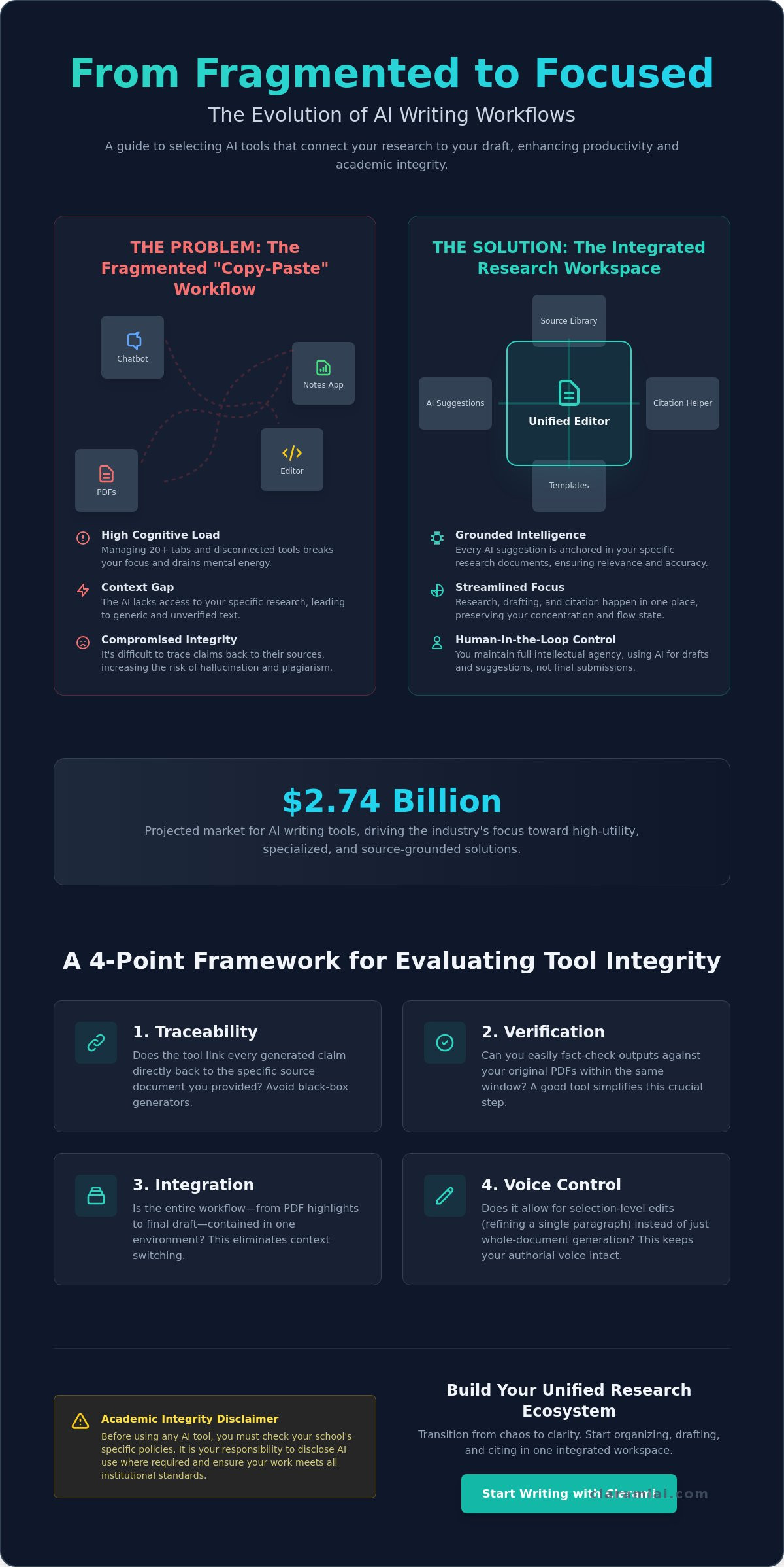
### The shift from generative to grounded intelligenceThe year 2026 marks a definitive end to the era of hallucination-heavy drafting. As the market for AI tools for writing reaches $2.74 billion, the focus has shifted toward high-utility, specialized solutions. Modern tools no longer guess at facts. They prioritize your specific PDF library, extracting methodology and data directly from the literature you upload. This transition also addresses critical privacy concerns. Your research material remains within your workspace, shielded from the public training sets used by consumer-grade applications.
Why your choice of tool impacts academic integrity
The tools you use dictate your level of transparency. General generators pose a significant risk because they lack source traceability. They provide answers without evidence. In contrast, purpose-built workspaces emphasize the human-in-the-loop philosophy. This means the software provides drafts, but you maintain final authority over every citation and claim.
Features that allow for selection-level edits are essential for this process. Instead of generating a whole paper, you might use the In-App Editor to refine a single paragraph or clarify a complex data point. This ensures the structural integrity of your work remains yours. It respects your intellectual agency while providing the momentum needed to overcome the blank page.
Academic Integrity Disclaimer: Before using any AI-assisted tools, you must review your school or department's specific policies. Ensure you disclose the use of AI in your methodology or bibliography as required by your institution.
Why the copy-paste workflow hinders professional productivity
Professional writing is an exercise in synthesis. Most AI tools for writing treat this process as a series of disconnected prompts and responses. This creates a context gap. Your research sources live in one tab while your editor lives in another. The result is a constant, exhausting cycle of copying and pasting. This fragmented workflow doesn't just slow you down; it compromises the structural integrity of your work.
The cognitive load of managing 20+ open browser tabs is substantial. Every time you switch windows to verify a data point, your focus breaks. Research on the impacts on writing skills suggests that when the connection between evidence and drafting is severed, critical thinking suffers. You become a curator of snippets rather than an architect of ideas. You aren't just losing time. You're losing the thread of your argument.
The hidden costs of disconnected tools
Time lost, mental fatigue, and systematic error. These are the real prices of a manual workflow. Manually re-entering citation metadata is a low-value task that invites inaccuracies. When you move text between a chat box and a document, you risk losing the link to the original source. This leads to misattribution or accidental plagiarism. The psychological friction of tab-switching prevents the flow state required for high-level scholarly labor. It's a process of constant interruption that turns a three-hour session into a six-hour ordeal.
Moving toward a unified research workspace
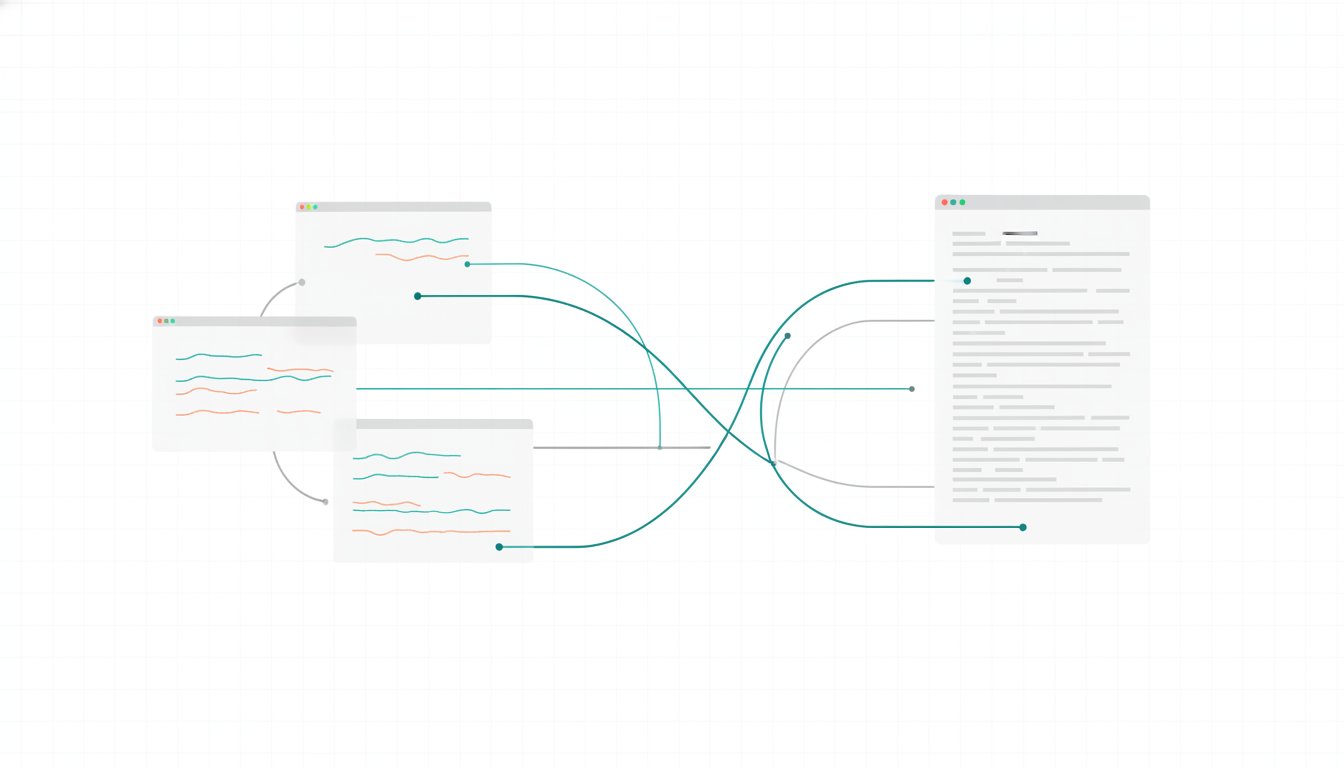
A modern research workspace eliminates the need for external chat interfaces. It anchors the drafting process within a single environment where your PDF library and your editor coexist. This allows for real-time reference management. When you use an integrated In-App Editor, the evidence is always visible. You aren't just generating text. You are substantiating claims as you write. Clara helps you maintain this connection by surfacing data from your library directly within the workspace.
Connecting your PDF Manager directly to your writing environment changes how you approach a first draft. It allows you to extract methodology and highlight relevant data without leaving the page. For a broader look at how these systems support your education, see our comprehensive guide on the best AI writing tool for students. For those seeking a more disciplined approach, choosing an AI research assistant tool for systematic scholarly work is the first step toward reclaiming your intellectual agency. You can start building your integrated workspace today to see how a unified environment simplifies complex composition.
Evaluating tools for academic and professional integrity
Selecting AI tools for writing requires a rigorous evaluation of their underlying architecture. In a professional or scholarly environment, a tool that cannot prove its claims is a liability. You need a methodical framework to distinguish between simple text generators and sophisticated research partners. This evaluation should focus on four pillars: traceability, verification, integration, and voice control. These criteria ensure that the software supports your intellectual agency rather than replacing it.
The most significant risk in modern composition is the "hallucinated" citation. General LLMs often invent plausible-sounding sources that don't exist. To maintain integrity, your workspace must surface real sources from your own library rather than generating "common knowledge" from a public dataset. Verification is not optional. It's the baseline for professional drafting. You must also consider the technical requirements of your field, such as support for LaTeX or DOCX export formats, to ensure your verified work transitions seamlessly to final submission.
The traceability test for AI outputs
Traceability is the ability to link a generated sentence back to a specific page in a primary source. When you test AI tools for writing, check if the software provides a direct reference you can click to verify. Real-time citation building is fundamentally more reliable than using post-drafting bibliography tools. It prevents the loss of metadata that occurs during manual transfers. Learning how to verify ai citations for academic and professional research is essential for anyone using these systems to substantiate complex arguments.
Verification and the ClaimShield approach
Verification goes beyond finding a source; it involves checking the accuracy of the claim itself. This is where a dedicated feature like ClaimShield becomes indispensable. It allows you to cross-reference your draft against a primary source database, ensuring that data points and methodologies haven't been distorted during the drafting process. Professional writers don't guess. They anchor their work in verified data.
Modern drafting also benefits from automated DOI verification. This process ensures that every digital object identifier in your bibliography is active and accurate. By automating these mechanical checks within the In-App Editor, you reduce the risk of clerical errors that can undermine the perceived quality of your research. This disciplined approach to verification transforms the AI from a mere generator into a reliable intellectual companion.
Academic Integrity Disclaimer: Always check your institutional policies regarding AI use. You're responsible for ensuring your work meets all ethical standards and for disclosing the use of AI tools in your research methodology where required.
Transitioning from research notes to a structured first draft
The transition from raw research to a cohesive draft is often the most significant bottleneck in the writing process. You've collected your data; now you must organize it. Effective AI tools for writing shouldn't just dump text onto a page. They should help you map your highlights to a logical structure. This starts with selecting a template that matches your specific academic rubric. Whether you're writing a literature review or a methodology section, the template provides the necessary scaffolding.
Instead of generating long blocks of text that often drift into generic filler, focus on selection-level editing. This involves refining specific arguments rather than asking the system to write entire chapters. You maintain control. You decide which evidence to include. Use a Draft Tone Checker to ensure your sentences remain objective and scholarly. This methodical approach prevents the context gap discussed earlier and ensures your unique perspective remains central to the work.
Structuring your argument with AutoDraft
AutoDraft allows you to synthesize evidence into a structured narrative without the friction of manual transcription. The process is instructional. You upload your PDF library, select your core claims, and the assistant suggests a logical flow based on those specific inputs. You don't just accept the output. You approve suggestions sentence by sentence in suggest-mode. This collaborative environment ensures that the AI acts as a drafting partner while you remain the primary author.
Overcoming blocks without sacrificing voice
When you hit a wall, use the Clara AI Assistant as a sounding board. If a theoretical argument feels incomplete, ask the assistant to help expand on a specific piece of evidence from your library. This isn't about letting the machine think for you. It's about using the Clarami workspace to bridge the gap between a disorganized note and a verified statement. You can create your free account to begin transforming your research highlights into a polished, structured draft today.
Academic Integrity Disclaimer: Before submitting any work, you must review your institution's AI policies. You are responsible for disclosing the use of AI assistance and ensuring that your final document reflects your own intellectual contributions and adheres to all ethical standards.
Building your research ecosystem with Clarami
Clarami represents a shift from general-purpose assistants to a specialized environment designed for the rigors of scholarly labor. Unlike general AI tools for writing that treat research as an external input, this workspace anchors every feature within a unified In-App Editor. This integration ensures that the connection between your evidence and your draft remains unbroken. The software acts as a reliable intellectual companion, providing the structural order necessary for complex professional composition.
The efficiency of the PDF Manager and Citation Generator working in tandem removes the mechanical burden of reference management. When these tools are connected, the risk of clerical error drops. AutoDraft facilitates the initial synthesis of your evidence, while ClaimShield provides a final layer of verification. This combination ensures that the structural integrity of your argument is maintained from the first highlight to the final export. You aren't just generating text; you're building a substantiated document.
The Clarami difference: Integrated editing
The "no copy-paste" workflow is a central differentiator. Traditional methods require you to move text between a chat interface and a word processor, losing metadata and focus along the way. In Clarami, your research library is immediately available within the writing pane. The Clara AI Assistant functions as a Methodical Expert, guiding you through the cognitive and structural processes of composition without treating your data as a secondary concern. This approach respects your intellectual agency and keeps your focus on the high-level synthesis of ideas.
Sustaining long-term research projects
Scholarly writing is rarely a single-session task. Whether you're managing a multi-year dissertation or a complex professional report, you need a stable research ecosystem. Subscription-based AI tools for writing provide continuous cloud access to your library and drafts, ensuring that your progress is never tethered to a single device. This continuity is essential for maintaining momentum during long-term projects. You can view Clarami subscription options and start your organized draft today to secure a workspace built for the long-term journey of professional research.
Academic Integrity Disclaimer: You must review your institution's specific AI policies before submitting any work. It's your responsibility to disclose AI assistance and ensure your final submission adheres to all ethical and academic standards required by your school or department.
Advancing your professional writing workflow
The standard for professional composition in 2026 has moved beyond simple text generation. Effective AI tools for writing must bridge the gap between research and drafting. You've learned how a unified environment eliminates the friction of the copy-paste workflow and protects the structural integrity of your arguments. By prioritizing grounded intelligence, you ensure that every claim is anchored in verifiable evidence rather than generic public data.
Clarami provides the specialized infrastructure needed for this methodical approach. With an integrated PDF manager and editor, you can maintain deep focus without switching tabs. Automated APA and Chicago citation building removes the mechanical burden of formatting, while ClaimShield verification technology acts as a safeguard for your academic reputation. You remain the primary architect of your work, utilizing these features to substantiate your unique perspective through a disciplined, human-in-the-loop process.
Academic Integrity Disclaimer: Always verify your institution's specific policies regarding AI use and disclose assistance as required. You're responsible for the final accuracy and ethical standing of your submission.
Ready to move beyond disconnected chat boxes? Start your next research project in the Clarami workspace and experience a more systematic way to write.
Frequently Asked Questions
How do AI writing tools for researchers differ from ChatGPT?
Specialized AI tools for researchers differ from general models by integrating the drafting process directly with your source library. While general models operate in a separate chat interface, a research-focused workspace uses an In-App Editor to keep your evidence and draft in one pane. This eliminates the context gap and the mechanical friction of copy-pasting. It allows the assistant to reference your specific data rather than general web knowledge.
Is it possible to use AI for writing while following APA or Chicago styles?
You can build citations in APA, Chicago, and other academic styles directly within your document using specialized AI workspaces. The Citation Generator surfaces metadata from your PDF library to create accurate bibliographies as you write. This prevents the clerical errors that often occur when manually transferring references from external generators. It ensures that your formatting remains consistent and your metadata stays connected to the relevant text.
What is source-grounded AI and why does it matter for writing?
Source-grounded AI refers to systems that generate responses based exclusively on the specific documents you provide. This is a critical feature for professional writing because it eliminates hallucinations where the AI invents plausible but false data. By anchoring the Clara AI Assistant to your PDF Manager, you ensure that every suggestion is based on verified data from your own research library rather than broad, unverified internet data.
How do I ensure my academic integrity when using an AI editor?
Maintaining academic integrity requires a human-in-the-loop approach where you remain the primary author and decision-maker. Use AI tools for writing to suggest structures or refine paragraphs, but always verify the final output against your original sources. Academic Integrity Disclaimer: You must check your institutional policies regarding AI use. You are responsible for disclosing AI assistance and ensuring your final submission adheres to all ethical and academic standards.
Can I export my drafts to LaTeX or Word from an AI workspace?
Professional AI workspaces support seamless export to standard formats including DOCX and LaTeX. This ensures that your verified draft can be moved into specialized typesetting software or word processors for final submission without losing its structural integrity. The goal is to provide a methodical path from the initial research phase to the final document. This allows you to meet the granular formatting requirements of journals and academic departments.
Related on Clarami
- Best AI writing tool for students (full guide) →
- AI academic integrity checklist →
- Clarami pricing: Free vs PRO vs Platinum →
- Editor vs ChatGPT for writing →
- Export DOCX, PDF, and hand-in checklist →
- How to outline a paper →
- Prompt to structured essay draft →
- Revise with AI on a selection →
- Sign up free →
- Clarami home →
- More guides on the Clarami blog →