
7 Best AI Summarizer Tools to Boost Your Productivity
Find the best AI summarizer tools for academic research. Learn to evaluate platforms for accuracy, traceability, and workflow integration to avoid bad citati...
Write with structure in Clarami AI
Editor-first AI drafting, citations, and two Workflows for student writing.
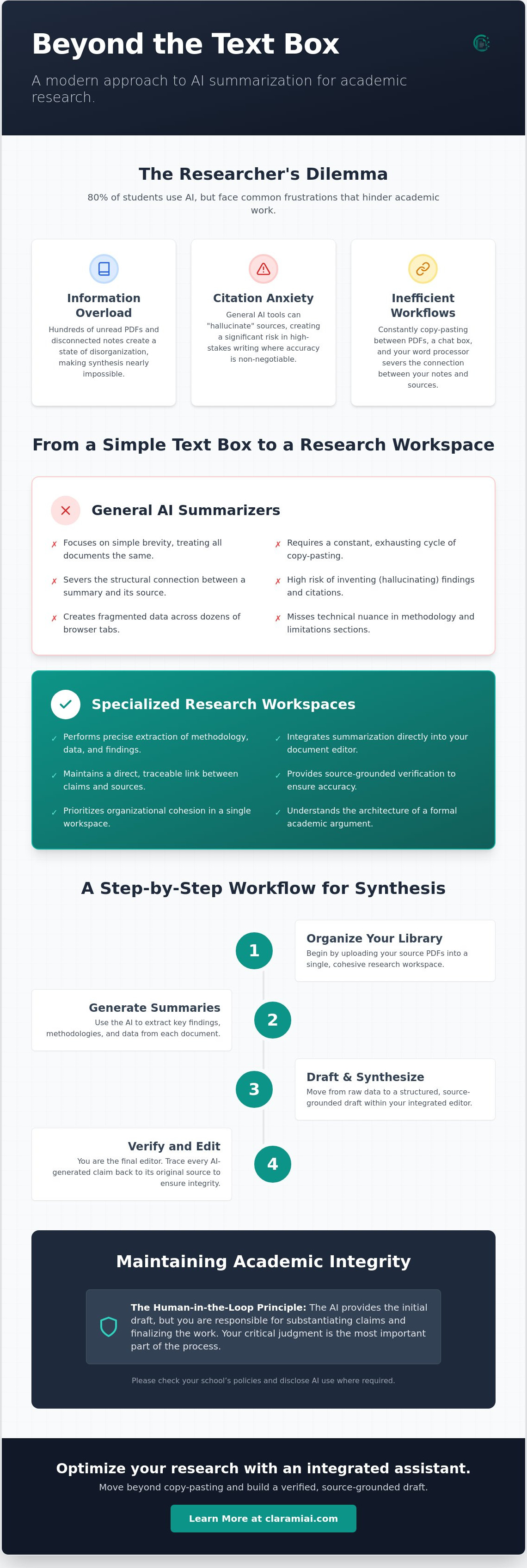
80% of university students now use generative AI tools to manage their research. While these technologies promise efficiency, you've likely experienced the frustration of information overload from hundreds of unread PDFs. Many general ai summarizer tools produce hallucinations in citations, which is a valid concern that keeps researchers tethered to manual note-taking. Information overload. Citation anxiety. Inefficient workflows. You shouldn't have to choose between speed and accuracy, nor should you have to constantly switch between a chat interface and your word processor.
We understand that a reliable summary must be a foundation for synthesis, not just a shortcut. This article explains how to evaluate these tools to ensure they support academic integrity and fit into a professional workflow. You'll learn how to find platforms that offer traceability, organizational cohesion, and clear links to original sources. Please check your school’s policies and disclose AI use where required. We'll preview seven specialized platforms that help you move from raw data to a verified draft without the usual technical friction.
Key Takeaways
- Move beyond simple text condensation by learning to use ai summarizer tools to extract specific methodology and salient findings from complex scholarly documents.
- Distinguish between extractive and abstractive synthesis to maintain the structural integrity of your research while identifying document architecture.
- Evaluate platforms based on their verification capabilities and how well they integrate into a professional research workspace rather than acting as a standalone chat box.
- Implement a linear workflow that begins with organizing your source library and ends with a verified, source-grounded draft.
- Maintain academic integrity by prioritizing traceability and ensuring you remain the final editor of every AI-supported synthesis.
Table of Contents
- Beyond the text box: why researchers need more than basic AI summarizers
- How modern AI summarization tools process complex scholarly data
- Evaluating the best AI summarizer tools for high-stakes writing
- A step-by-step workflow for synthesizing research summaries
- Optimizing your research with Clarami’s integrated assistant
Beyond the text box: why researchers need more than basic AI summarizers
In a rigorous research context, Automatic summarization is not merely about making a text shorter. It's the precise extraction of methodology, data points, and salient findings. Most general ai summarizer tools focus on brevity. They treat a complex dissertation the same way they treat a marketing blog post. For you, shortening a text isn't the primary goal. You need to understand the scholarly contribution. You need to know how the results were achieved, not just what the results were. This requires a tool that recognizes the architecture of a formal argument.
Traditional workflows often involve a constant, exhausting cycle of copy-pasting. You move text from a PDF to a chat box, then back to a document. This creates a state of initial disorganization. It severs the structural connection between the summary and its source. When you lose that anchor, your research loses its integrity. A summary without a direct link to its primary data is a liability, not an asset. You need a system that maintains the structural connection between your notes and your library.
To better understand how these tools are evolving to meet student needs, watch this helpful comparison:
### The limitations of general-purpose summary generatorsGeneral tools often miss the technical nuance required for professional labor. They might summarize a paper by focusing on the abstract while ignoring the specific methodology or limitations sections. This leads to a failure in distinguishing between a study's original findings and its historical literature review. Disconnected data in standalone web apps forces you to manage dozens of browser tabs. This fragmentation increases the cognitive load of synthesis. You need a specialized research workspace that prioritizes organizational cohesion over simple text condensation.
Avoiding the hallucination trap in academic literature
Generative models can invent findings when they lack a direct, enforced link to the primary source. This hallucination trap is a significant risk in high-stakes writing where accuracy is non-negotiable. Professional verification requires source-grounding. You must be able to trace every claim back to a specific page or paragraph. Please check your school’s policies and disclose AI use where required. Ultimately, you are the primary editor. The AI provides the initial draft, but you substantiate the claims. This human-in-the-loop approach ensures your work remains accurate, ethical, and grounded in evidence. Using ai summarizer tools should support your agency, not replace your critical judgment.
How modern AI summarization tools process complex scholarly data
Modern ai summarizer tools rely on Natural Language Processing (NLP) to map the architecture of a document. Instead of viewing a research paper as a simple sequence of words, the system identifies hierarchical structures like abstracts, methodology sections, and results. This structural awareness allows the tool to process complex scholarly data by recognizing the logical relationship between a claim and its supporting evidence. When you upload a multi-page PDF, the AI doesn't just read it; it parses the document's framework to understand how the argument is built.
There's a critical distinction between extractive summarization and abstractive synthesis. Extractive methods function like a high-precision highlighter, selecting the most statistically significant sentences directly from the source. Abstractive synthesis, however, generates new text to explain the underlying concepts in a more concise form. For professional research, a hybrid approach is often best. You need the accuracy of verbatim extraction combined with the clarity of a synthesized overview. This ensures that the technical nuance isn't lost during the condensation process.
Technical data extraction is where specialized tools outperform general assistants. They are trained to identify specific entities such as p-values, sample sizes, and experimental variables. As context windows have expanded in recent years, these tools can now maintain the thread of an argument across hundred-page documents without losing focus. This evolution prevents the fragmented output common in simpler models that can only process a few paragraphs at a time.
Extracting methodology and data over generic themes
Understanding the "how" of a study is often more vital for verification than knowing the "what." While a generic tool might summarize a study's conclusion, scholarly NLP isolates the experimental conditions and variables that led to that result. Scholarly NLP serves as a high-precision instrument for structural data extraction from peer-reviewed literature. By focusing on the methodology, you can evaluate the validity of the findings before you decide to anchor them in your own work. This level of detail is essential for maintaining the structural integrity of your arguments.
The role of source-grounding in maintaining original context
Source-grounding ensures that the AI only draws information from your uploaded document library. It acts as a digital barrier, preventing the model from pulling in external, unverified information that could lead to inaccuracies. This creates a closed-loop system where every synthesized point has immediate traceability to a specific page or paragraph. It's a methodical approach to accuracy that respects your intellectual agency. If you're ready to move beyond fragmented chat boxes and disconnected notes, you can start building a source-grounded library within an integrated editor. Always remember to check your school’s policies and disclose AI use where required to uphold academic integrity.
Evaluating the best AI summarizer tools for high-stakes writing
When you evaluate ai summarizer tools for professional or academic use, you aren't just looking for a way to shorten text. You're seeking a system that preserves the substantiation of claims. A systematic literature review of automated systems highlights that the true value lies in how a tool handles the transition from extraction to synthesis. If a tool treats your research as a disconnected snippet, it fails the basic requirements of a professional research workflow. Accuracy, integration, and verification capability are the three pillars of a high-utility solution.
There's a significant difference between a generic utility tool and a dedicated research workspace. A utility tool is often a standalone chat box that lacks context. A research workspace, however, integrates your source library directly into your document editor. This organizational cohesion ensures that your summaries aren't just isolated notes, but active components of your drafting process. Please check your school’s policies and disclose AI use where required. Maintaining academic integrity requires you to be the final editor of every draft the system provides.
Ethical frameworks also matter when selecting a provider. You should choose tools that prioritize source-grounding and transparency over creative flair. The goal isn't to replace your critical reading, but to facilitate a more systematic order in how you process information. When citation management is built into the summarization process, you reduce the risk of technical inaccuracies and the stress of disorganized source material.
Verification features: the difference between summary and substantiation
Many consumer-grade tools offer summaries that sound plausible but lack evidence. Substantiation requires a direct, traceable path between the summary and the original source text. You should prioritize tools that provide anchored links back to the specific page or paragraph of your PDF. This structural connection allows you to verify methodology and data points without manually searching through hundreds of pages. To master this process, you can learn how to verify ai citations to ensure your final draft is beyond reproach. Verification is the antidote to the hallucination trap.
Integration vs. isolation in the research workspace
A standalone summary is often a dead end. If you have to copy-paste your findings from a chat box into a word processor, you're introducing friction and the potential for error. Your summaries should exist in the same environment as your active draft. This proximity ensures that your source material is immediately available as you write. Exploring the Clarami workspace demonstrates how an integrated editor eliminates the need for switching between disconnected apps. When your summarizer, citation manager, and editor exist in one cohesive ecosystem, your productivity increases through structural order rather than sheer speed. Features like suggest-mode further enhance this by allowing for precise, selection-level edits in collaborative projects.
A step-by-step workflow for synthesizing research summaries
Synthesis is a linear narrative. It begins with collection and ends with verification. To move from a state of initial disorganization to a polished output, you must follow a structured path. Before you engage with any ai summarizer tools, organize your source library within a central PDF Manager. Scattered files are a primary source of researcher anxiety. Centralizing your documents provides the calm assurance that every salient point is indexed and ready for analysis.
Once your library is prepared, use the AI to generate initial summaries. Focus these queries specifically on methodology, sample sizes, and results rather than generic themes. You don't need a vague overview; you need the technical data that substantiates a claim. After the AI provides these initial drafts, your role as the human-in-the-loop begins. Review each summary for technical accuracy. Refine the language to ensure it aligns with your scholarly voice. This step ensures that the AI functions as a reliable intellectual companion rather than a replacement for your own critical judgment.
Incorporating these verified snippets into a structured literature review requires a methodical approach to data organization. Use your summaries to build a synthesis matrix. This table allows you to compare experimental conditions and variables across multiple studies simultaneously. Finally, perform a final verification of all claims. Anchor every argument in a primary source to ensure the structural integrity of your draft. If you're ready to transition from disorganized notes to a verified draft, you can start your research workflow within a professional editor today.
From PDF highlights to structured literature reviews
Identifying patterns across dozens of sources is the most rigorous part of professional labor. Using specialized ai summarizer tools helps you build an evidence table that highlights contradictions or consensus in the field. This process moves you beyond simple text shortening. It allows you to visualize the document architecture of your entire library at once. By maintaining this high-utility workflow, you ensure that your final literature review is both comprehensive and precisely cited.
Maintaining academic integrity while using AI assistance
You are the author of record. While AI provides the building blocks, you are responsible for the final submission. It's essential to maintain your intellectual agency throughout the drafting process. Always verify school-specific AI policies and disclose usage as required. Please check your school’s policies and disclose AI use where required. Drafting with a focus on verification means using AI as a cognitive companion to highlight relevant data rather than an automated tool to bypass the rigors of composition. This commitment to transparency is what distinguishes professional research from automated output.
Optimizing your research with Clarami’s integrated assistant
Clarami distinguishes itself from general ai summarizer tools by embedding the technology within a dedicated In-App Editor. This integration eliminates the friction of copy-pasting text between disconnected browser tabs and word processors. Instead of treating summarization as a final endpoint, the workspace treats it as a foundation for synthesis. You maintain a state of systematic order by keeping your source library, your notes, and your active draft in one cohesive environment. This structural connection ensures that your intellectual agency remains at the center of the research process.
The Clara AI Assistant functions as a source-grounded research companion. Unlike general-purpose models that pull data from the open web, Clara operates strictly within the documents you provide in your PDF Manager. This approach minimizes the risk of technical inaccuracies and ensures that every suggestion is anchored in primary evidence. When you need to move from summarized points to a polished first draft, AutoDraft provides a structured starting point based on your verified notes. You remain the author of record, responsible for the final editing and submission of the work.
Research integrity is further supported by ClaimShield, which provides real-time verification of your statements. It checks your draft against your uploaded PDFs to ensure that your arguments remain faithful to the original data. To complete the professional workflow, the Citation Generator builds automated citations in APA, Chicago, and other scholarly styles. This ensures that your formatting meets rigorous academic standards without the stress of manual entry. By using a specialized ai writing tool for students, you prioritize accuracy and traceability over automated shortcuts.
How Clara grounds arguments in your specific source library
Clara allows you to ask specific questions of your documents without leaving your editor. You can request the extraction of methodology from a specific paper or ask for a comparison of data points across an entire project collection. This high-utility interaction helps you identify salient findings quickly while maintaining a human-in-the-loop framing. If you're still deciding on the right platform, you can learn more about choosing an ai research assistant for systematic scholarly work. Clara’s goal is to alleviate the anxiety of disorganized source material through precise, grounded feedback.
Verifying claims with ClaimShield before final submission
ClaimShield acts as a final safeguard for your research integrity. It performs a chronological check of your draft, highlighting statements that require further substantiation from your source library. This ensures that every argument is anchored in primary evidence before you finish your project. Please check your school’s policies and disclose AI use where required. If you're ready to start building a verified research library, you can view our pricing plans to find the right fit for your research needs. Professional labor requires professional tools that value transparency and verification.
Frequently Asked Questions
How do ai summarizer tools support academic integrity?
Specialized tools support integrity by providing direct links back to original sources. This traceability allows you to verify every claim. Always disclose AI usage and check your institution's specific policies before submission.
What is the difference between extractive and abstractive summarization?
Extractive summarization pulls key sentences directly from the text, acting like a high-precision highlighter. Abstractive synthesis generates new text to explain concepts. A hybrid approach is often best for maintaining technical nuance.
Can I use these tools for professional research?
Yes. Many researchers use these tools to manage information overload from hundreds of PDFs. The key is to use platforms that prioritize source-grounding and provide immediate traceability to primary data.
Moving from information overload to verifiable synthesis
Effective use of ai summarizer tools requires a transition from simple text condensation to methodical data extraction. You've learned that a reliable summary must maintain a structural connection to its primary source to ensure research integrity. By prioritizing traceability and organizational cohesion, you can manage hundreds of PDFs without losing the technical nuance of the original methodology. This systematic approach transforms raw information into a foundation for original scholarly work.
Please check your school’s policies and disclose AI use where required. Academic integrity relies on your role as the final editor and author of record. Clarami supports this human-in-the-loop approach by providing a professional environment where your library and draft exist in one workspace. This eliminates the friction of copy-pasting and keeps your focus on the quality of your synthesis rather than the management of browser tabs.
You can join Clarami to build source-grounded research drafts today. With an integrated PDF Manager, ClaimShield verification technology, and a built-in Citation Generator for APA and Chicago styles, you have the tools to move from raw data to a verified output with calm assurance. Your research deserves a system that respects your intellectual agency and supports your path to academic success.
Frequently Asked Questions
Can I use an AI summarizer to shorten my college essay?
You can use ai summarizer tools to identify wordy phrases or redundant arguments in your own drafts. This helps you refine your writing and improve the clarity of your work. However, you must remain the final editor and author of every sentence you submit. Please check your school’s policies and disclose AI use where required to ensure you meet all academic integrity standards.
Is it ethical to use AI for summarizing research papers?
It's ethical to use these tools as a cognitive aid for synthesizing large volumes of information. The goal is to facilitate comprehension, not to replace the critical reading of primary sources. You maintain your intellectual agency by using the AI to highlight methodology and results while you perform the final analysis. Ethical use requires transparency and a commitment to verifying all automated output.
How do I know if an AI summary is accurate?
Accuracy is confirmed through a methodical check of the summary against the original document. You should cross-reference every salient point with the specific page or paragraph in the primary PDF. Using a source-grounded assistant ensures that the AI only uses your uploaded library as its knowledge base, which significantly reduces the risk of technical inaccuracies or hallucinations.
What is the difference between extractive and abstractive summarization?
Extractive summarization functions like a high-precision highlighter by selecting the most important sentences directly from the source. Abstractive summarization generates new text to synthesize the underlying concepts. For professional research, a hybrid approach is often most effective. This allows you to maintain the structural integrity of the methodology while gaining a clear overview of the scholarly contribution.
Do AI summarizers work with foreign language documents?
Many modern platforms utilize multilingual NLP models to process documents in various languages. This allows you to upload a foreign language PDF and receive a synthesized summary in US English. You should always review the output to ensure that technical nuances and specialized terminology have been translated correctly before you incorporate the data into your draft.
Can I cite an AI-generated summary in my thesis?
You should not cite the AI summary as a source in your thesis. Instead, you must cite the original research paper that the AI summarized. The summary serves as a guide to help you find relevant evidence within your library. Once you've located the data, use a citation generator to anchor the primary source in your bibliography using APA, Chicago, or your required style.
Related on Clarami
- Best AI writing tool for students (full guide) →
- AI academic integrity checklist →
- Clarami pricing: Free vs PRO vs Platinum →
- Editor vs ChatGPT for writing →
- Export DOCX, PDF, and hand-in checklist →
- How to outline a paper →
- Prompt to structured essay draft →
- Revise with AI on a selection →
- Sign up free →
- Clarami home →
- More guides on the Clarami blog →