
Top AI Tools for Research: Boost Your Workflow Today
Find reliable AI tools for research to organize sources and prevent hallucinations. Improve your academic workflow while maintaining total intellectual agency.
Write with structure in Clarami AI
Editor-first AI drafting, citations, and two Workflows for student writing.
The most significant challenge in modern scholarship isn't finding data, but verifying the intelligence that synthesizes it. You likely recognize the anxiety of managing extensive source material while fearing the technical inaccuracies or fake citations common in general chatbots. The constant cycle of copy-pasting between separate windows often leads to a disconnected draft and a loss of your own scholarly voice.
We agree that the rigors of professional labor require absolute precision. You can learn to integrate AI tools for research into your process to streamline your literature review while maintaining total intellectual agency. This article provides a methodical path for selecting tools that focus on structural integrity and the substantiation of claims. We will examine how to move from a disorganized collection of data to a verified output where every statement connects to a real source. Note that you should always consult your school's academic integrity policies and disclose any AI use as required by your specific institution.
Key Takeaways
- Understand why moving from fragmented chat interfaces to an integrated workspace reduces cognitive burden and improves organizational cohesion.
- Identify the most reliable AI tools for research to assist with literature discovery, methodology extraction, and source verification.
- Learn how source-grounded intelligence prevents hallucinations by restricting the AI to information found within your verified documents.
- Establish a structured workflow that moves from PDF metadata extraction to evidence-based drafting without leaving your editor.
- Protect your academic integrity by using a human-in-the-loop approach that treats AI as a drafting assistant rather than a primary author.
Table of Contents
- Beyond the chat interface: The shift toward integrated research workspaces
- Essential categories of AI research tools for 2026
- Overcoming hallucinations through source-grounded intelligence
- Building a systematic research-to-writing workflow
- Maintaining academic integrity with human-in-the-loop drafting
Beyond the chat interface: The shift toward integrated research workspaces
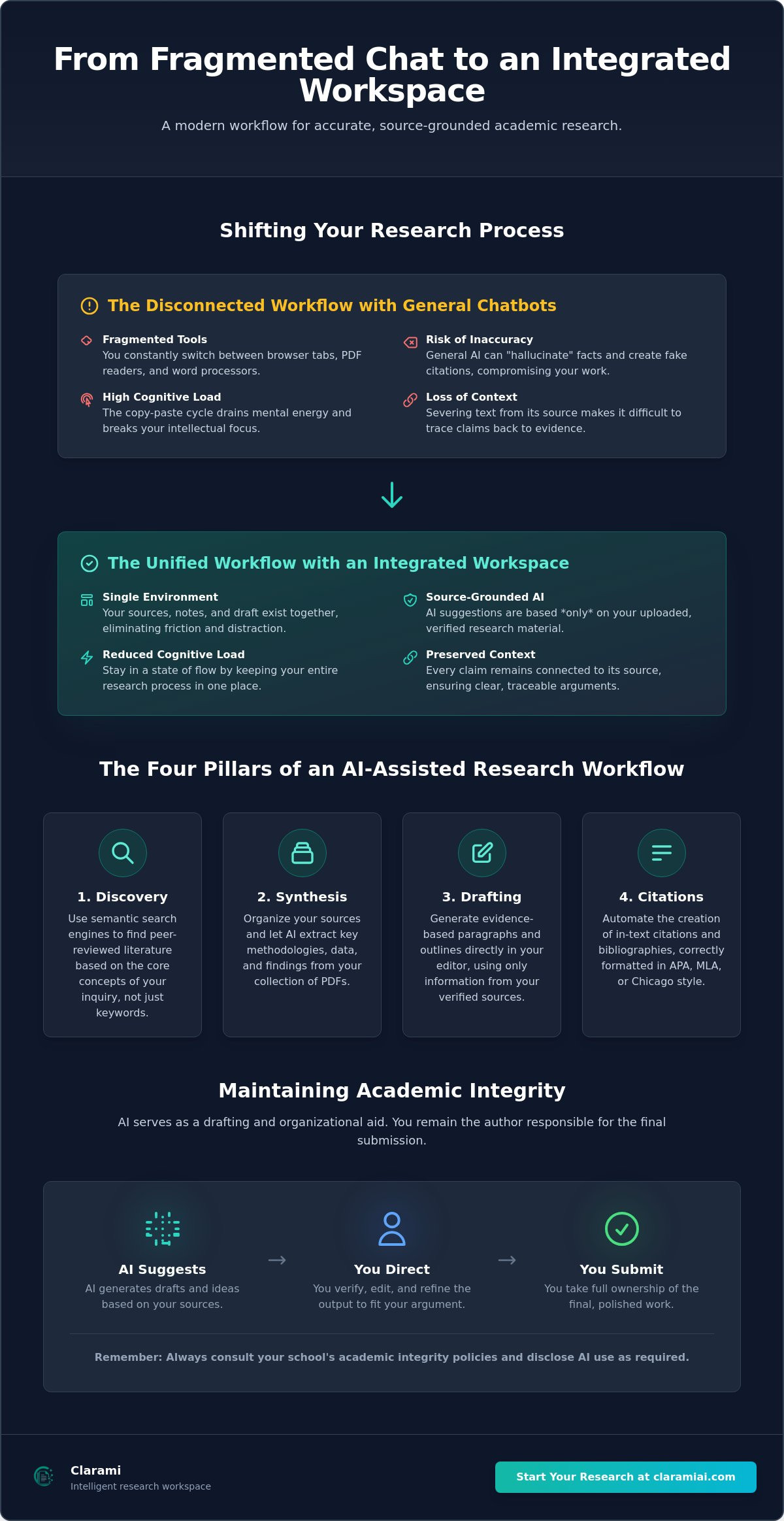
Many researchers begin their journey with general-purpose chatbots. This is often where the trouble starts. While these tools grasp the foundational concepts of artificial intelligence, they aren't designed for the rigors of scholarly inquiry. They treat every prompt as a standalone creative task. For a researcher, this creates a significant cognitive burden. You must constantly toggle between discovery engines, PDF readers, and word processors. This fragmentation leads to errors. It leads to stress. Most importantly, it leads to a loss of intellectual cohesion.
True efficiency comes from using AI tools for research that exist within a single, unified environment. An integrated research workspace eliminates the friction of the chat box. It places your source material directly alongside your drafting area. This isn't just about convenience. It's about structural integrity. When your evidence and your editor share the same space, the risk of misattribution drops. You can maintain a clear focus on your argument without the distraction of managing dozens of browser tabs.
Academic Integrity Disclaimer: You must verify all AI-assisted output and follow your institution's specific disclosure policies. AI serves as a drafting and organizational aid, but you remain the sole author responsible for the final submission.
The risk of fragmented research data
Context is the first casualty of the copy-paste method. When you move a paragraph from a chat window to a document, you sever the link to the evidence. You lose the "live" connection to the primary source. This makes it difficult to maintain a clear path between a claim and its proof. A specialized workspace keeps your data anchored. It ensures that every citation is traceable. You don't have to guess where a piece of evidence came from. It's right there, integrated into your workflow. This systematic order is essential for complex projects like literature reviews or dissertations.
Why specialized tools outperform general LLMs
General LLMs are built for conversation and broad utility. Scholarly writing is different. It requires precision. It requires specific metadata extraction from complex PDFs. General AI often lacks the ability to handle citation standards like APA or MLA correctly. It prioritizes fluency over factuality. Purpose-built AI tools for research are different. They focus on verification. They extract methodology and data points with a level of discipline that general models cannot match. These tools value accuracy over creative flair, ensuring your work meets professional standards.
Essential categories of AI research tools for 2026
Selecting the right software requires a clear understanding of functional categories. You need a stack that supports the entire lifecycle of a project, from the initial query to the final citation. Using specialized AI tools for research ensures that each stage of your workflow remains grounded in evidence. The National Institute of Standards and Technology emphasizes the development of trustworthy AI systems to manage the risks associated with automated data processing. By choosing tools designed for specific scholarly tasks, you maintain the structural integrity of your work.
- Discovery: Semantic engines that find peer-reviewed literature based on intent.
- Synthesis: Systems that extract methodology and results from PDF collections.
- Drafting: Editors that suggest text based only on your uploaded sources.
- Citations: Generators that automate formatting in APA, MLA, or Chicago styles.
Literature discovery and mapping
Literature discovery has evolved beyond simple keyword matching. Modern engines use semantic search to understand the conceptual relationships between papers. As of 2026, platforms like Semantic Scholar index over 200 million publications, allowing you to surface relevant citations that traditional databases might overlook. These AI tools for research often include visualization features. You can map out citation networks to identify research gaps or find the most influential studies in your field. This prevents you from missing foundational data while building your literature review.
Synthesis and PDF organization
PDF organization is the foundation of a systematic review. A dedicated PDF Manager allows you to automate the extraction of metadata and key findings from large document sets. Instead of reading every page to find a specific methodology, you can use synthesis tools to highlight relevant data points across dozens of files. This process ensures traceability. You always know which claim belongs to which source. Organizing your reference material this way reduces the anxiety of losing track of your evidence during the drafting phase.
Drafting with integrity
Drafting with integrity means keeping the human in the loop at every stage. You should use AutoDraft to generate initial sections based on your synthesized notes, but the final voice must be yours. Focus on selection-level edits. This means rewriting specific paragraphs or refining arguments rather than generating whole essays. This approach preserves your scholarly voice and ensures that you remain the primary author. To ensure your project starts with the correct structure, you can create a workspace account and select a template matched to your specific academic rubric.
Disclaimer: Always check your institution's academic integrity policies regarding AI use. You are responsible for disclosing the use of these tools and verifying the accuracy of all generated citations and claims.
Overcoming hallucinations through source-grounded intelligence
The most pervasive risk in using AI tools for research is the hallucination. General-purpose models often fabricate data points or invent citations to satisfy a prompt. Source-grounded intelligence solves this problem by restricting the AI to a closed dataset. This means the system only generates text based on the documents you provide. It's a fundamental shift from creative generation to evidence-based synthesis. By using Retrieval-Augmented Generation (RAG), the software retrieves specific excerpts from your library to inform every sentence it produces. This ensures your draft remains tethered to verified facts.
Verification is not an afterthought. It's a structural requirement. Tools like ClaimShield provide a layer of security by cross-referencing every generated statement against your uploaded PDFs. If a draft makes a claim, the system must point to the exact source. This eliminates the frustration of chasing fake DOIs or mismatched citations. You can maintain total confidence in the substantiation of your arguments. This systematic approach ensures that your work remains anchored in reality rather than algorithmic probability. Accuracy becomes a built-in feature of your workflow.
Academic Integrity Disclaimer: You must always verify the accuracy of citations and follow your school's AI disclosure policies. The user is responsible for all submitted content.
The science of verification
Real-time claim checking transforms the writing process. Instead of manual cross-referencing at the end of a project, you can verify as you go. Effective AI tools for research allow you to click a citation and see the exact page and paragraph in the primary source. This reduces the risk of misinformation in both professional and academic drafts. It's about organizational cohesion. You aren't just writing; you're building a verified knowledge base within your integrated editor. This level of transparency is essential for maintaining the high standards required in scholarly labor.
Anchoring arguments in evidence
A disciplined workflow requires anchoring every sentence in primary data. You should verify a claim before moving to the next paragraph. This prevents the accumulation of errors that can derail a complex argument. Building a document this way ensures that every statement is substantiated. Human-in-the-loop verification is a non-negotiable standard for researchers. You must act as the final arbiter of truth. The AI provides the draft, but your intellectual agency ensures the final output is accurate, ethical, and precise. This methodical expert approach values transparency over creative flair.
- Upload your primary sources to a secure PDF Manager.
- Use RAG-enabled drafting to ensure text is grounded in your library.
- Utilize ClaimShield to highlight and verify every citation.
- Perform selection-level edits to refine the scholarly voice.
Building a systematic research-to-writing workflow
Transitioning from source discovery to a finished manuscript requires more than just software. It requires a repeatable, systematic workflow. Without a clear roadmap, the use of AI tools for research can become disorganized, leading to fragmented drafts and missed evidence. A linear progression ensures that every document in your library contributes directly to the final output. You move from initial collection to a polished draft through a series of logical, step-by-step actions.
- Step 1: Consolidate sources and extract metadata using a PDF Manager.
- Step 2: Identify core themes and methodology through automated synthesis.
- Step 3: Generate a structured draft using AutoDraft and selection-level edits.
- Step 4: Automate style formatting with an integrated Citation Generator.
- Step 5: Verify claims and adjust tone for scholarly precision.
From PDF library to synthesis matrix
Efficiency begins with organization. Consolidate your source material into a specialized PDF Manager to extract metadata automatically. This creates a synthesis matrix, allowing you to view sources in a structured comparison format. By identifying the thread of evidence across multiple papers, you can construct a comprehensive literature review. This bird's-eye view ensures no relevant data point is omitted during the transition to writing.
The drafting phase: AutoDraft and suggest-mode
Once evidence is synthesized, move into the drafting phase. Use AutoDraft to generate initial sections within an editor that matches your academic rubric. This eliminates the friction of copy-pasting from external chat boxes. Refine paragraphs using selection-level edits to maintain your scholarly voice. For collaborative projects, use suggest-mode to maintain a clear record of changes and ensure the final verification phase is seamless.
Finalize your work by utilizing a Citation Generator to automate APA, MLA, or Chicago style formatting. The final step involves a Draft Tone Checker to ensure professional precision and a final pass with ClaimShield to verify every statement. This methodical progression guarantees a polished, evidence-based result.
Academic Integrity Disclaimer: You must check your institutional policies and disclose the use of AI as required. The researcher remains responsible for the accuracy and originality of the final submission.
To implement this systematic approach in your next project, start building your research workspace today.
Maintaining academic integrity with human-in-the-loop drafting
Academic integrity is the cornerstone of scholarly labor. When you integrate AI tools for research into your workflow, you must maintain a clear ethical distinction between assistance and ghostwriting. AI-assisted drafting involves using software to organize evidence and generate initial phrasing based on your own synthesis. Ghostwriting is the outsourcing of your intellectual agency. You remain the ultimate authority over your work. This means you're responsible for every claim, citation, and conclusion in your final submission. Technology should act as a reliable intellectual companion, not a substitute for your critical thinking.
Verification is a continuous process that doesn't end until the final period is placed. Most universities now require explicit disclosure of AI use in student work. Journals often have specific guidelines for acknowledging these tools within the methodology or acknowledgments sections. Transparency protects your reputation and ensures your methodology is reproducible. By following a human-in-the-loop approach, you ensure that every statement is substantiated and every source is real. You don't want to risk your academic standing on an unverified algorithmic output.
Academic Integrity Disclaimer: Always check your school's specific policies regarding generative AI. You are required to disclose your use of AI tools and verify the accuracy of all output before submission.
Refining the scholarly voice
A Draft Tone Checker is essential for maintaining professional precision. AI-generated text can sometimes feel repetitive or overly formal. You can use these tools to identify and fix phrases that lack the nuance of a human expert. This process improves clarity and flow without compromising technical accuracy. You should tailor your draft to meet the specific requirements of your target journal or academic persona. Selection-level edits allow you to refine individual paragraphs. This ensures they reflect your unique scholarly voice and adhere to the rigorous standards of your discipline.
The future of the intelligent research assistant
The environment of academic writing is shifting toward deeper integration. Software like Clara acts as a methodical companion throughout the research lifecycle. This eliminates the need for fragmented, "copy-paste" workflows that often lead to data loss or citation errors. Within the Clarami workspace, your source material and editor exist in a single environment. This meta-demonstration of order allows you to focus on high-level synthesis while the system manages the structural details.
Before you submit your work, follow this final checklist:
- Cross-reference every citation against the primary PDF source in your library.
- Verify that all DOIs are active, accurate, and correctly formatted.
- Adjust the tone to match the specific expectations of your academic discipline.
- Disclose AI assistance according to your institution's or journal's policy.
- Perform a final pass to ensure your own voice remains the primary driver of the argument.
Mastering the systematic research workflow
Transitioning from fragmented chat boxes to a unified workspace is the most effective way to protect your scholarly integrity. You now have the roadmap to use source-grounded intelligence to eliminate hallucinations by anchoring every claim in primary data. By maintaining a human-in-the-loop approach, you ensure your intellectual agency remains the primary driver of your academic work. This methodical progression from collection to verification replaces anxiety with calm assurance.
Effective AI tools for research must provide more than just text generation; they must offer organizational cohesion and traceability. You can implement a workflow that moves from PDF synthesis to a verified first draft without the friction of manual data management. Using a platform with an integrated citation generator and ClaimShield technology ensures that every sentence is substantiated. Many researchers find that this structured approach reduces research time by up to 50%. Always verify output against primary sources and follow your institution's specific disclosure policies.
Start your verified research workflow with Clarami today and experience a more disciplined way to write.
Frequently asked questions
How does source-grounded AI differ from a standard chatbot?
Source-grounded AI tools for research restrict their knowledge to the documents you upload. Unlike general chatbots that draw from a broad and often unverified internet dataset, these systems use Retrieval-Augmented Generation to ensure every sentence is tethered to your specific library. This eliminates the risk of fabricated data points and ensures your draft remains focused on verified evidence.
Can I use these tools to format my bibliography in APA or Chicago style?
You can use an integrated Citation Generator to automate formatting for major academic styles, including APA, MLA, and Chicago. Because the software extracts metadata directly from your PDF library, it reduces the manual labor of building a reference list. You should still perform a final pass to verify that specific details like edition numbers or DOIs are accurate before submitting your work.
What is the most effective way to maintain my scholarly voice while drafting?
The best approach is to utilize selection-level edits rather than generating whole essays at once. By rewriting specific paragraphs or sentences using AI assistance, you keep the human in the loop and ensure the final voice is yours. Using a Draft Tone Checker also helps you identify and refine any phrases that don't meet the professional precision required by journals or universities.
Is it necessary to disclose the use of AI tools for research to my institution?
You should always consult your school's specific academic integrity policies regarding generative AI. Most institutions and journals now require clear disclosure of any tools used during the research or drafting process. Transparency protects your scholarly reputation and ensures your methodology remains ethical and reproducible.
Academic Integrity Disclaimer: You must check your school's policies and disclose AI use where required. The user is responsible for editing and verifying all content before final submission.
Related on Clarami
- Best AI writing tool for students (full guide) →
- AI academic integrity checklist →
- Clarami pricing: Free vs PRO vs Platinum →
- Editor vs ChatGPT for writing →
- Export DOCX, PDF, and hand-in checklist →
- How to outline a paper →
- Prompt to structured essay draft →
- Revise with AI on a selection →
- Sign up free →
- Clarami home →
- More guides on the Clarami blog →